Tag Archives: publishing

Thoughts on Publishing – The Excerpt at the Front of a Print Book

I’m in the process of creating a paperback edition of Magic’s Stealing. I’ve got most of the formatting complete, save for a couple blank pages, and I’m currently focusing on adding an excerpt at beginning of print book. The idea is that as soon as a potential reader opens the book, the first thing they see is a teaser that makes them want to read more (and encourages them to be patient if that scene takes time to reach).

Keep in mind, when a reader is browsing a book store or examining a book at an author’s table, they will likely look at the cover, then at the back cover blurb, then at the excerpt on the first page of the book. The goal is to draw them in more and more until they choose to buy the book.

This is how I ended up buying The Girl with the Iron Touch by Kady Cross (and ultimately loving it) at a Barnes and Noble. I’ve seen other books do the same. Adding the excerpt provides a teaser so that the reader knows what to expect.

(You might see another form of this on a hardcover book, but the excerpt may be on the back cover, usually something of action or intrigue, with the blurb inside the cover flaps).

Let’s take a look at Magic’s Stealing and see how this compares.

Back Cover Blurb:

For centuries, ribbons of magic have provided the kingdom of Cirena with light, healing, and protection. Then, in a span of minutes, those ribbons fly from their masters, stolen, save for the magic of a few chosen mages. One of these mages is Toranih, a young noblewoman who would rather have a sword in her hand than use her powers to heal or throw fireballs. As a result, her magic skills are lacking. But with former mages dying from magic withdrawal, and the looming threat of an army of shadows who are impervious to mortal weapons, she must either embrace the responsibilities of a mage or watch her home perish.

Whatever excerpt I choose, the excerpt should enhance the understanding of the content inside the book.

These were the two excerpts I’m considering:

First Excerpt

Toranih cast a glance toward the distant mountain and shivered. The closer they came, the more her unease grew. It wasn’t her usual dislike of magic. As close as they were now, the magic inside the forge glowed like a star. Yet the whole place was shrouded with a thick fog, a veil that kept the magic hidden from the distance.

She frowned.

She could almost see thin filaments weaving through the fog, like the shadows of strings from a poorly played puppet theatre. The filaments lashed out in different directions, disappearing as they touched bright, sunlit sky. She tilted her head and squinted, but the strings vanished altogether.

She shivered and returned to picking at the soft innards of her roll.

There was something different about that magic. Wild. Unsteady. Like a foal that hadn’t been broken, and might never be. The magic was curious, like a dark storm cloud spewing cracks of thunder and lightning when the rest of the land was gold.

Toranih shivered.

All this magic was bound to cause strange visions.

So why was she drawn to follow?

In this excerpt, we get a glimpse at shadow magic, a sense of eeriness, and a taste of the writing style. There is a also a question at the end, which would hopefully draw a reader’s attention. However, this scene doesn’t jibe with the back cover blurb. We have a mountain forge, shadowy, string-like magic, strange visions, and some kind of call to follow that magic. While the scene should be intriguing in itself, it doesn’t mesh well with the blurb.

Second Excerpt

Toranih could actually see faint ribbons in the distance, rising from their masters. The ribbons streamed into the sky, a dazzling array of colors, then fled east, away from the city in a glaring river.

She looked at the bowl again and blinked her eyes to clear the spots. She had to know what was going on. The liquid had gone milky-white, but if she could see what was happening . . .

She ran her fingers along the strings at the top of the water. One here, one there. The tips of her fingers tingled as lavender wisps flooded the bowl. The image swirled, faint. The mountain forge reappeared. The man held his sword fixed between both hands, raised to the sky. His feet were spread strong under his shoulders. Ribbons streamed to his sword from across the kingdom. The sword glowed bright and brighter, and as the screams outside died into a disjointed murmur, the sword faded and the image darkened.

The water was clear now, devoid of life.

Everyone’s magic had fled into the stranger’s sword.

First, this excerpt shows the ribbons mentioned in the blurb. Second, we see Toranih using magic (which conflicts with her dislike of magic, but the blurb does say she must embrace the responsibilities of being a mage). Third, we see a bit about the antagonist. Fourth, we see the event that the blurb mentions, and the end of the excerpt sets the problem up further.

Ultimately, I’m thinking the second excerpt is a lot stronger as a potential hook, especially when paired with the back cover blurb.

I hope you find this post helpful. 🙂 Have you considered adding an excerpt to the front of your book?

Leave a comment

Filed under Business Ventures, Writing

Thoughts on Publishing – Starting a Publishing Imprint

A couple days ago I was talking with an author friend, and they asked about the process of how my husband and I started Infinitas Publishing. I typed up a response, then realized that other people might also find this information useful. So here it is… the basics of how my husband and I started a business.

IMPORTANT: I am not a lawyer nor am I certified in taxes, so please do not take this as legal advice. These are just my experiences thus far, and are meant to be useful in figuring out what steps you may need to take.

Also note that this process varies depending on your location and the kind of business you want to start. This particular post is tailored to my experiences starting a publishing imprint in Missouri, in the United States of America. (Business law varies from state to state).

Choosing a Name

First off, my husband and I chose the name of our business. We chose Infinitas Publishing. We did a Google and Bing search, since the results are different, to see if there was anything too similar to the name already.

We found a few similar names, but we decided that our specific product (speculative fiction and games) and branding was different enough that the two companies wouldn’t easily be confused.

Once we found that we were in the clear for general terms, we did a trademark search. Since trademark law tends to be a pain and I still don’t feel like I have a good grasp on it, I figured we’d be best off avoiding anything too close to something that already existed.

As a side note, if the trademarks can’t easily be mistaken for each other, and they involve unrelated products, they should be free for use. (For example, if two trademark names were similar, but one related to a brand of vacuums and the other to a doggy day care. Completely different uses, so the companies can have similar trademarks.)

As an example, at one point Isaac and I called Battle Decks “Beastie Wars”… only to discover that “Beast Wars” was already in use by Transformers. Since both products involve entertainment and games, we decided to steer clear of the name. Not only that, but renaming the game Battle Decks gives us more versatility in future game expansions… never mind that there’s a PowerPoint slide competition of the same name. The game and event shouldn’t be easily be mistaken, however, so that shouldn’t cause any mix-ups.

To look up a trademark, I used the Basic Search Database (Under TESS, click “Search Trademark Database”), and told it to search “all” words.

Fictitious Name Registration / DBA
After we chose the name, we registered for a fictitious name / Doing Business As (DBA) license. For Missouri, this cost $7.00 and lasts for five years (which reminds me that I’ll need to renew my SBibb’s Photographic Illustration DBA soon). This allows you to legally use the business name instead of your own.

Determine the Business Type
You also need to decide what kind of business you’re starting. There are four major structures, including Corporations, but a Sole-proprietorship, Partnership, and Limited Liability Corporation (LLC) are the ones you’re most likely to run into at this stage.

Nolo has some great information in regards to business practices.

An LLC has the benefit of protecting your personal assets in the event of a lawsuit, but it does have a higher start-up cost. There are also certain tax benefits, and the salary structure is different but I’m not as familiar with this business structure, so I can’t say what those benefits are off the top of my head. If you are if you are publishing multiple authors or publishing materials that could result in a lawsuit, you may want to go the route of an LLC.

EDIT: Check out Raistlin212’s comments below for a better explanation of the benefits of the LLC business structure.

A sole-proprietorship is by far the easiest business to start, as all money coming into the business flows directly to you. Technically, once you have the DBA and EIN, you have the basics you need to start the business online. (This is the structure I use for SBibb’s Photographic Illustration).

A partnership is like a sole-proprietorship, except you have multiple people involved and there’s an extra form you need to fill out for income taxes (Form 1065 and the resulting K-1, which I’m not looking forward to figuring out next year, but I know a couple people I can ask for assistance). This is the structure my husband and I chose for Infinitas Publishing.

Employer Identification Number (EIN)
Once you have the DBA, you can apply for an EIN (Employer Identification Number) through the IRS (so many acronyms, I know). This number is handy because it identifies your business on tax forms. The EIN is registered on the federal level. You apply online and you get the number immediately upon completing the form. Doesn’t cost anything either, and you have a different number for each business (Infinitas Publishing has a different EIN than SBibb’s Photographic Illustration).

If you have any questions about filling out the form, your local bank may be able to help. I had a bit of trouble trying to call the IRS help line (I felt like I was playing a Choose Your Own Adventure game, phone style), but the people at the bank were able to answer my questions in regards to start dates and such.

If you are doing freelance work, having this number is nice because it gives you a number to give contractors for the Form 1099-Misc without having to give them your social security number.

Business Bank Account
It is usually recommended that you have a separate banking account for your business to keep your income and expenses organized. This may especially be helpful if you’re ever asked to produce records for tax purposes.

Check with your bank to see what they require to start an account. I went to US Bank, since I was familiar with them and they had a basic package that suited our needs and wouldn’t cost us money to use. This was important since we didn’t expect a high inflow of money to start with. For a partnership, our local branch required a General Partnership Agreement (an LLC needed an Operating Agreement). They also needed the EIN, and I think they needed proof of the registered DBA. It took a couple weeks for this to show up in their system, so be sure to plan ample time between getting everything registered and actually starting the business.

If you need assistance with the General Partnership Agreement or Operating Agreement, there are several sites online that offer free templates. Once you find a suitable template, you can tweak it to fit your needs.

If nothing else, this agreement acts as a guide to each partner’s responsibilities in the case of misunderstandings or if anything gets rough. Now, if you want to be sure that everything is legally correct, you may want to hire a lawyer to look over your forms.

Since Infinitas Publishing is between my husband and I, we didn’t do this, though we did make sure that we understood everything in our agreement and that it suited our needs.

For SBibb’s Photographic Illustration, I don’t use a separate bank account. Due to the nature of my work, I have very few expenses that I apply to that business. However, I do keep a ledger of all income, and it is still advisable to have a separate account, even if you’re a sole-proprietor.

Online Payments
Once the business bank account was set up, I created a business Paypal account and input the new information into my Kindle, Createspace, Smashwords, and The Game Crafter settings. Now when we receive royalty payments or purchase proofs, they’ll be linked to the business, rather than our personal accounts.

Smashwords Publisher Account
Smashwords has a “publisher” account option, which I upgraded to so that my works would show up as published by Infinitas Publishing. Then I created “ghost” author accounts for my Stephanie Flint and Stephanie Bibb names, and I’ll add Isaac’s name once we start publishing our co-authored works.

Sales Tax
Our next step will be to fill out the Missouri Sales Tax form. During the time that we only had ebooks, we didn’t need to worry about sales tax, but once we get print books made, which we plan to offer to bookstores and try selling at a local holiday market, we’ll need to collect Missouri sales tax.

As a side note, I’m not sure about what differences we’ll see when I get to selling wholesale (to bookstores) versus retail (holiday market). I’m still researching this, so I’m a bit sketchy on this. However, when emailing the Missouri Department of Revenue, I’ve been able to get some very helpful information on what forms we’ll need to fill out (Form 2643 and 53-1), along with details about the form.

Give yourself a bit of time to get through it all, but definitely ask if you have questions.

Important: Check with whichever state(s) you’re doing business in, because the requirements vary.

Final Notes
Of course, all of this information is for if you plan to self-publish rather than seek representation through a trade publisher. Be sure to research both sides thoroughly, as there are pros and cons to each.

Granted, this doesn’t even cover creating a logo, a website, buying ISBNs, approaching book stores, and everything else I’ve forgotten at this point. But hopefully it will give you a starting point, and maybe I’ll talk about the “branding” and marketing side of things at a later date.

Also, If you’re curious to read more about the business side of publishing, take a look at Kristine Kathryn Rusch’s “Freelancer’s Survival Guide.”

I picked up a copy through a StoryBundle offer, and while I’m still in the process, it has been immensely helpful in considering what steps to take to start the business. Plus, some of the articles are on her website for free, so you can read through whichever ones you need. 🙂

I hope you find this post useful. Do you have any tips for starting a publishing business?

***

By the way, Carissa Taylor was awesome and agreed to host a give-away of one free, ebook copy of Magic’s Stealing, so if you’re interested in winning a copy, head over to her blog.

She also has some really useful information on Twitter pitching and a list of literary agencies that accept YA science fiction and fantasy, so be sure to check those out as well. 😀

10 Comments

Filed under Business Ventures, Writing

Thoughts on Publishing – Infinitas Publishing Status Report and First Chapter of Magic’s Stealing

Where does the time go? My day job started up again a couple days ago, and I’m currently readjusting my schedule to be able to be productive and not spend all my time daydreaming about what happened in the role-play campaign that my husband and I just finished this week. (A main character got a bittersweet ending… not the ending he was hoping for (he’s a fourthwaller), but an ending that left him reasonably happy and with his mind intact).

Anyway, while I’m readjusting my after-work patterns,  I thought I’d do a quick status report on the projects of Infinitas Publishing

When Isaac and I started up our business this summer, we created a rough schedule of when we would like to release our books and games. It’s something we created for our own personal use, which gives us an extra push to actually publish things, rather than getting into an endless loop of editing. It’s also a good measure for us to use in terms of how much time we have until we complete a project, even if we don’t release the prospective dates to the public. This should give us a little more wiggle room for when our planning inevitably goes astray.

For Magic’s Stealing, I’m about a month behind on my goal (Shh… don’t tell anyone), but I’m in the final phase. I’ve already got it formatted as ebook, except for the table of contents (easy to do, but needs to be different between Kindle and Smashwords editions), and I’m working on the final proofread for typos on printed paper. Once that’s done, I’ll put it up for pre-order and reveal the cover. Look for that coming soon… which I also need to update on the main website. A few months after that I am hoping to make the paperback edition available.

For Battle Decks: Trials of Blood and Steel, we’re on par. We’ve already ordered the initial proof copy (which I posted about a while back), got feedback, and made edits. I’ve updated the box title to Trials of Blood and Steel instead of Multiverse: 1953, based on further feedback, along with updated the rules (still needs to be proofread) and fixed the cards for consistency (cards now say +2 ATK instead of +2 attack, etc). Once we have the rules proofed, we plan to order a second copy of the game to make sure all of our edits are input correctly. We also need to recreate the trial edition of the game with rules specific to the trial (that way we don’t confuse players with irrelevant rules, such as how to choose heroes for each faction). Based on our current schedule, we should be able to release Battle Decks as planned.

For The Multiverse Chronicles: Trials of Blood and Steel, we should still be on par, but we’ll see as we get closer to our planned release date.  Isaac is currently working on the rough draft of episode 19 of the 24 expected episodes, though some of those we’ve planned to split, so we may be a bit further ahead (and there may be more than 24 episodes). I’ve gotten ten of those episodes edited and semi-polished, ready for us to do the full read-through and see how everything meshes together. I’ve got partial edits done on episode 11. However, once those are complete we will need to send out the episodes to beta readers to look for errors, and then polish the first few episodes to release online. We also need to prepare the blog site where we’ll be publishing the story. The first four episodes need to be ready to go before we release Battle Decks.

Beyond those projects, which are up for release by the end of this year, I also have plans for The Shadow War, (book two in The Wishing Blade series).The first draft is partially written (but requires changes), and I’ve been plotting the rest of the story and making sure it will flow easily into book three. The upside of my day job is that I have plenty of time to plot while I do greenscreen work on photos.

Once I have a definite date for these projects, I’ll make them public.

In the meantime, please enjoy the first chapter of my upcoming YA fantasy novella, Magic’s Stealing. 🙂

Magic’s Stealing


The Wishing Blade - Section Break - Magic Swirl ONE The Wishing Blade - Section Break - Magic Swirl

Darkness flooded Toranih Covonilayno’s sleeping chamber as she mentally extinguished her magic crystal’s light. She tossed the crystal onto her dresser and hurried to her bed. The silk covers rustled as she slipped underneath, where she felt for the leather hilt of the knife under her pillow.


The last few nights had brought strange creaking noises from the attic, soft footsteps and the brushing of rough wool on the edges of the wooden floorboard above. She listened now, waiting to see if the footsteps returned.


They did not.


Instead, wind whistled through a tiny crack in her bedroom windowsill. She peeked over the covers. A shadow passed by the heavy curtains and she clasped the smooth fabric between her fingers.


Ridiculous.


She kicked off the covers, knife in hand, and hopped out of bed. She waited, just in case the shadow returned. Then she walked to her dresser, picked up the crystal, and carefully raised the light again.


The dresser was pristine, with only an oil lamp sitting in the dustless corner. A small oak chest at the foot of her bed remained locked with steel. Heavy brocade curtains obscured the window.


No sign of intruders.


So why couldn’t she shake the feeling that someone had been watching her?


She dimmed the crystal’s light until the room was cast in an eerie twilight, but the only magic present was her own. The crystal’s faint light revealed thin, lime green ribbons of magic floating around her, while glowing turquoise ribbons darted in and out of the crystal.


Her older sister, Siklana, had created the artifact for Toranih when she was little. Few could see magic without a crystal. Whenever a mage used their ribbons to do… well… anything, she couldn’t see the cause.


And what she couldn’t see, she couldn’t fight.


Toranih sighed. She was seventeen now, and she wasn’t afraid of magic. She just didn’t like it. There was a difference.


Something tapped the glass. Toranih shrieked, fumbling with the crystal. She clutched it to her chest and spun toward the window. A cluster of ribbons danced around a small form on the other side.


Well, are you coming? Daernan’s telepathic voice flitted through her mind, amused.


Of all the times for him to show up unannounced—


She dropped the crystal on her dresser, sheathed the knife, then flung open the curtains. “Don’t scare me like that!”


A small, brown, ostensibly cute owl peered at her with bright yellow eyes and giant black pupils. Daernan, judging by the white ring of feathers crowning his left eye.


The owl shrugged and puffed out his plumage like a feather duster. Not my fault you’re so jumpy.


Toranih crossed her arms. Though dim in the moonlight, the crystal’s twilight revealed various blue and yellow and pink ribbons swirling thick through Daernan’s owlish body.


Coming? The pink ribbons carried Daernan’s thoughts to Toranih’s mind, and she fought the urge to swipe them away.


Toranih knelt beside the window so that she was eye-level with the owl. He tilted his head and blinked. She snorted. “I’ve been expressly forbidden from attending the festival,” she said in the most high-and-mighty voice she could muster. “So, no. I’m not coming.”


Not that she minded missing the event. Too much magic and too many people teasing her about when she and Daernan would make their courtship a formal engagement.


She turned from the window, lit her oil lamp, and then mentally killed the crystal’s light.


The ribbons vanished.


Let me guess. Your father wasn’t happy that you challenged Lady Ikara to a duel, then respectfully threatened that she ought to let her fiancé fight for her, lest you knock her off her high horse onto her—he mentally coughed for effect—her lazy ass?


Toranih shrugged. “She insulted you. Good excuse not to go.”


The owl sighed, best an owl could, before tapping the window with his beak. Can I at least come in?


She obliged him with a flip of the latch. Then she plopped onto her bed. The owl swooped inside, changing as he went. By the time he landed, the owl had morphed into a young man with shoulder-length brown hair. A patch of white hair ran through his bangs above his left eye.


Daernan stood from his crouch and shook himself like a dog that had just run through a pond. He looked as he usually did, no more dressed for the festival than any other day. Only a simple cotton tunic and loose fitting breeches, along with a leather belt that Toranih had helped to etch and dye. That belt had been an experiment, to say the least. Daernan proved much better at drawing the various creatures than she had. An owl, a shaggy dog, a horse… his favorite changes.


He tossed her a green velvet satchel. “I know you don’t like this holiday, but that’s for you.”


She scowled, dangling the satchel by its cords. “Really?”


If Daernan had brought her spicy cocoa flowers, like last year, she would swear to Shol that she’d make him pay the next time he tried to duel with her.


Daernan shrugged and leaned against the dresser, perilously close to her oil lamp. “Don’t worry, it’s not flowers or ribbons, or anything silly that you wouldn’t like.”


“I didn’t get you anything,” she said. Well, technically she had, but she’d planned to give him the owl-shaped ginger cookies she’d bought for him tomorrow, when the gift wasn’t linked to Aifa’s Night.


“In that case, you could make it up to me by coming to the parade.” He smiled hopefully.


Toranih raised an eyebrow. She dug into the satchel and paused when her fingers touched cool metal ridges. She withdrew a brooch made of sterling silver. The metal had been crafted into a raven that held a wreath of flowers in its talons. Small and not particularly gaudy, the piece would look nice pinned on the pouch she normally wore on long horseback rides.


Daernan rubbed the back of his neck self-consciously. “I might have lied about the flowers. I hope you don’t mind.”


“It’s…” She let out a breath and smiled. “I like it. Thanks.”


He grinned. “I commissioned the crafter whose goods you keep eyeing.”


“I do not!” Toranih had done her best not to let anyone catch her eyeing the metalsmith’s jewelry… just his weapons. They might think she’d gone soft.


“Sure you don’t.” Daernan chuckled, then glanced around the room. “Redecorated?”


“The room was cluttered. I cleaned it.”


“You? Clean something?” Daernan raised an eyebrow. “Who are you and what have you done with Toranih?”


She scowled. “There were too many things someone could hide behind.”


His smile faltered. “You still think someone’s watching you?”


“I heard noises last night. I checked the attic, but nothing was up there. I even used the crystal to look for magic.” She kicked her feet against the bed and sighed. “I know I don’t have enemies, but someone’s been in here.”


“Lady Ikara, maybe? She isn’t exactly friendly towards you.”


“Oh, please. She could run my ear off but I don’t think she could tell the difference between a dagger and a dirk.”


“She doesn’t have to know the difference to stab you,” Daernan pointed out.


Toranih punched his shoulder.


“Ow! I’m just saying!”


She snorted. He wasn’t helping. Lady Ikara wasn’t the kind to go snooping around the manor, and Toranih’s father, Lord Covonilayno, had relatively few enemies. Though he was officially a viscount who oversaw the day-to-day proceedings of Viyna, he was also tasked with guarding the kingdom’s armory, so most nobles chose to stay on his good side.


Daernan sighed. “The parade is starting soon. If you really don’t want to be seen, we can go as owls. There’ll be dancing…”


“Which we can’t enjoy since we’ll be owls.”


“Free food…”


“As owls? Do you want mice? Besides, you get free food anyway. Everyone likes you.”


“They like you, too,” Daernan protested.


“They bow and curtsy to me.”


“Unless you challenge them to a duel.”


“There is that.” Toranih grinned and eyed the raven brooch. Lady Ikara could sniff the air all she liked, but she wouldn’t keep calling Daernan a street mutt. Besides, he did have claim to noble lineage, even if his father wasn’t around to prove it. His mother permitted the commoners to tend to their estate in return for access to a small cottage inside the city. No one paid attention to the fact that she had married into nobility.


Seemed that was how she liked her life.


“And we’ll get to watch all the mag—entertainment.” Daernan closed his mouth quickly.


Toranih rolled her eyes. “Magical entertainment, right. Know what? You go. Report to me in the morning about all the beautiful light showers and flashy streamers, and don’t forget to tell me how the gracious Aifa blessed the newlyweds. If you get back here before sunrise, you might even beat Siklana to the story.”


Her sister always did like magic. She cast enough for the two of them.


Daernan groaned and tugged Toranih’s arm. “Come on—it’s no fun if I go by myself. And everyone’s expecting us, even if we are owls. You should come.” He beamed, giving her his kingdom-class puppy-dog eyes.


She swallowed uncomfortably. “This is a bad idea.”


“Please? It’ll be fun. I promise.”


Toranih sighed. Sometimes she wondered if he had ribbons of the persuasive nature, though she’d never caught him. Wasn’t likely, anyway. That kind of magic was rare.


She rose from her bed and set the raven brooch beside her prized lamp. Then she raised her crystal’s light until it was just right for seeing magic. After she extinguished the oil lamp, she focused on her royal blue ribbons and stretched her arms, her palms open to the ceiling. Tickles rolled through her fingers, then her hands, then her body. Blue ribbons swirled around her, merging into a thick smoke that rushed to her toes. She shrunk. Her bones mended into the form of an owl. Her magic glowed bright, twisting and fading with a heartbeat of its own.


 Ready? Daernan asked, already perched on the windowsill.


Toranih killed the crystal’s light and hopped toward the window with her leathery feet.


She preferred raven form— though it wasn’t much better—but at least now she could see.


Daernan hooted. Let’s hurry—the show should be starting! He dropped off the windowsill, his wings outstretched, and caught the air with a quick swoop.


Toranih cringed. What would happen if she hadn’t made the change properly? What if she didn’t actually fly?


The ground teetered beneath her, perilously far from the ledge. She spread her wings, prayed to Shol she wouldn’t crash, and dropped into the night.

* The Wishing Blade - Section Break - Magic Swirl *


A cloaked figure knelt beside a sprawling sycamore near the young woman’s sleeping chamber, her eyes trained on the two owls.


Finally, they were gone. She climbed the tree, bark catching on the tips of her leather boots, then slipped inside the open window. The room was dark, save for moonlight, but it was just enough for her to see that the young woman had rearranged the furniture since the night before.


No night table or pile of books, and her usual set of sparring knives didn’t hang from the wall. Probably locked in the chest at the foot of her bed, or buried under the mattress.


She didn’t bother to check, though, instead stopping beside the dresser and stroking her fingers across the light crystal. It responded eagerly, and turquoise ribbons flared to life.


She quickly extinguished the crystal and peered into the distance, waiting to see if her own sight revealed the magical ribbons that would signal the two’s return to investigate.


The night remained empty.


The only magic she saw was her own. The rest of the family was at the parade.


But there was something new in the room. Ashen moonlight shone through the oil lamp at the edge of the dresser. Skewed light reflected onto a metal brooch—a brooch with a raven and a wreath of flowers.


The intruder held her breath, reaching her fingers toward the jewel piece, then quickly withdrew. She couldn’t leave any trace that she’d come. That meant leaving objects where they’d been found.


She left the sleeping chamber for the hallway. Bronze wall sconces flickered with pale, turquoise light across elaborate tapestries. The crystals cast shadows along the crimson throw rugs, each one embroidered with curling gold patterns.


She paused, recalling the two owls flying into the night.


Always strange to see the young woman, but stranger still to see Daernan alive.


She wrapped her cloak tight around her shoulders, then traveled the familiar stairs downward, downward, and deeper—under the manor and into the kingdom’s dwindling armory.

Stay tuned for cover reveal and release date! 😀

3 Comments

Filed under Business Ventures, Personal Work, Writing

Thoughts on Publishing – Author Photos

As I get closer to releasing Magic’s Stealing, I’ve been thinking about the little details that still need to be decided before publishing. What do I want to put on the copyright page? Where should I put the acknowledgements? Do I want the blurb after the title page inside the ebook edition? Should I have an author photo?

Let’s focus on the author photo, because that’s the one that’s been puzzling me.

SBibb - OldAuthorPhoto

Really Old Artsy Author Photo

My first author photo (artist photo, really, since I started by using it on DeviantArt) is quirky. I’m in costume and I’m holding a shiny, reflective ball that I bought at a renaissance faire. This particular photo is really small, I’m not sure where the original picture is, and it was probably taken during my early college years or during my late high school years.

Then there is my current author photo, which I use on Twitter and in various places. This was taken by my husband during college (edited by me), and still went for artsy . Black and white, a little mysterious. I’m fond of this photo. Problem is that I’ve heard from several people that it doesn’t look like me. (Striped lighting and no glasses… I guess I’m not too surprised).

SBibb - Current Author Photo

Current Black and White Author Photo

But I’ve been using this fairly consistently, so I wasn’t sure if I should change it. On the other hand, if the photo doesn’t look like me, and I ever do a local book signing… I can see a benefit to having a picture that looks more familiar.

For example, when I went to ConQuest this year, I could very easily recognize Brandon Sanderson and George R.R. Martin because their photos look like them, or at least how they present themselves publicly. I pulled out a few books on my bookshelf, and about half of them have author photos. It was interesting to find one of Brandon Sanderson’s earlier books that I bought, which has an early photo of him, and to compare it to later books, which have a more recent photo. So obviously, authors change which photo they use over a period of time.

Another thing to consider, author pictures often represent the author’s primary genre. For non-fiction, a more business-oriented photo lends credibility. For hard science fiction (I’m thinking of a few older authors here), the author might be sitting in a library setting, usually black and white. (Though the lack of color may have been due to printing limitations). For fantasy, authors might get dressed up in relevant costume. Middle grade authors often use more colorful photos, or illustrated pictures of themselves.

SBibb - Steampunk Author Photo

Steampunk Cosplay Snapshot

The question is, how do we want to be perceived? Should our author photos be a straightforward, contemporary photo? Or should we go for the fun costume pictures (as long as they still look like us)?

Do we really want to be recognizable? Should we even have a photo? A person with a pen name might not. Perhaps they have a hat that hides their face, yet makes them distinguishable (like Authoress, from a blog I follow).

We might not necessarily need an author photo, but there are cases where having one could prove useful. For one, an author can unite their Twitter, Goodreads, and Facebook accounts with a single photo as their avatar. (Though they might use a relevant symbol, instead). Or an author might include a photo when guest blogging, or at conventions.

There are benefits to having a photo on hand, which brings me back to deciding on an author photo.

I did a little bit of reading on the subject, and one thing that stood out in the reading was a distinction between a professional head-shot versus a snapshot. Both of which can be a good photo, but a professional photograph will give the feeling that your book is professionally written. And having a picture that represents the genre (a more somber image for mystery and crime, versus a friendlier image for romance) can affect how a reader perceives a book.

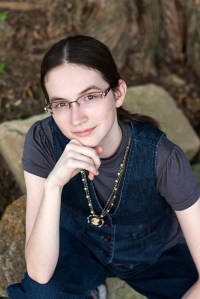
Anyway, Isaac and I went out on Thursday evening, found a nature-y spot that still had some sunlight, and took a few pictures. I dressed up for them (semi-modern, semi steampunk), and Isaac had the camera. I have a degree in photography and he’s had a few classes, so I felt comfortable that we could get a reasonably professional photo on our own. Then we sorted through the pictures in Adobe Bridge and selected the best five. I did a few retouches to improve lighting, and we posted them to Facebook to see which ones our friends liked best.

These are the resulting favorites (in no particular order):

SBibb - New Author Photo Options

Author Photo Option 1

SBibb - New Author Photo Options

Author Photo Option 2

SBibb - New Author Photo Options

Author Photo Option 3

SBibb - New Author Photo Options

Author Photo Option 4

One of these has a few more friend votes than the others, but I’m curious to see which one you guys like best before I make my final decision. Once I decide on one of these photos, I’ll need to decide on how much editing to do to them, and whether or not to keep them in color, desaturate them, or go with black and white. Granted, the print edition will be in black and white, but I could use color on the web or in ebooks.

I hope you enjoyed this post. Which photo do you feel is the strongest, and have you chosen an author photo?


Further Reading About Choosing An Author Photo:

http://maryrobinettekowal.com/journal/debut-author-lessons-the-author-photo/

http://www.thedailybeast.com/articles/2013/12/10/a-picture-says-it-all-or-does-it-judging-an-author-by-their-photo.html

https://www.standoutbooks.com/author-photo-tips/

http://www.huffingtonpost.com/heather-hummel/the-relevance-of-a-profes_b_4498575.html

https://www.graywolfpress.org/blogs/and-against-author-photos-part-one

22 Comments

Filed under Business Ventures, Writing

Thoughts on Writing – What does a Serial Episode need?

While waiting for the final round of beta comments on Magic’s Stealing (there are a lot of waiting phases… which is why it is really helpful to have another project on hand), I’ve been working on editing The Multiverse Chronicles.

As I’ve said before, The Multiverse Chronicles is a set of short stories written by my husband, which I then revise and edit. Our current goal is to have twenty-four episodes in the first season, which will be released weekly over a period of six months.

There are a few specific challenges associated with this project. While all the episodes must fit together as a whole (and I’m not sure I’d recommend reading them out of order), they each need to stand alone on some level.

The reason is this: Not everyone who might stumble upon the Multiverse blog will read them from the very beginning, and readers who do start from the beginning may miss a week. While each episode stands alone, Isaac and I must decide how much information to remind a reader of in each episode (since we don’t want to remind them that Alia is the bodyguard of Prince Alfons every episode–that would get monotonous very quickly if they’re reading the full season all at once).

So what do I want us to achieve in our upcoming serial blog series?

Each episode needs to be compelling. There needs to be:

  • A strong sense of character, and relationships between characters.
  • Both humor and serious notes… usually involving some bit of quirkiness.
  • A strong sense of world-building.
  • Conflict and/or tension.
  • A reasonable beginning, middle, and end.
  • Something that propels this episode into the next.

With these core elements, I believe each episode has the potential to draw a reader back the next week, or, if they aren’t interested in serial fiction, maybe get them intrigued by the complete volume of season one (which needs to be complete in itself while opening up questions of interest for season two).

Isaac and I intend to have the entire first season written  (at least a rough draft), as well as the first four episodes polished, before releasing the first episode. This way we have a month’s worth of episodes ready to release without worrying about what happens if we run into a snag while polishing a later episode. Of course, I’m hoping we will have the majority of the season polished beforehand, but we’ll see. I’ve also got to continue writing the rough draft of the second book in The Wishing Blade series.

Will this work? Can we successfully imbue each episode with these elements? Will readers enjoy The Multiverse Chronicles?

Hard to say until we start releasing episodes, but if I think that if we keep the above ideas in mind, I’ll have a decent guide to work from as I edit each episode.

I hope you enjoyed this post. Do you have any serial stories that you’ve enjoyed? Are there certain traits of serial fiction that you like or dislike?


Further Reading About Writing Serial Fiction:

http://tuesdayserial.com/?p=2032

http://riptidepublishing.com/faq/all-about-serial-fiction

http://thewritepractice.com/serial-novels/

http://blog.karenwoodward.org/2013/04/how-to-write-episodic-serialized-fiction.html

http://ezinearticles.com/?How-To-Write-Serial-Fiction—The-Four-Keys&id=6243275

http://www.justinmclachlan.com/1948/5-tips-writing-serial-fiction/

http://writerunboxed.com/2014/02/24/serial-fiction/

http://blog.janicehardy.com/2013/04/what-downton-abbey-can-teach-us-about.html

5 Comments

Filed under Business Ventures, Writing

Thoughts on Writing – The Magic of Writing

When I was in high school, my language class read a short story about a man who spent his life on the river. When he first started sailing as a boy, the river was magical. The eddies and sand banks… he didn’t understand them, but they called his attention and made him want to know more. As he grew older, he learned to understand the river. To know what caused the eddies and where the dangerous currents hid, and as he learned, the river lost its magic.

I can’t remember if the story ended with him seeing the magic of the river again in his old age or not, but the story stuck with me (even if the name of that story and the author did not). (Edit from comments: The story is “Two Ways of Seeing A River” by Mark Twain).

Writing (like any profession), has the same problem.

When I was younger, reading was magical. It still is, but when I was younger I could pick up most any book on a topic I liked and there was a good chance I would enjoy it, going through book upon book without a problem. However, as I became more fascinated with the art of actually writing these stories, I began to dissect them. I wanted to know how they worked. Why they worked.

Piece by piece, I figured them out. I read books on writing, blogs on writing. I joined internet forums dedicated to writing. Slowly, I puzzled out what worked and what didn’t, and why.

At first, those pieces were difficult to see. I knew a certain story worked for me, but others didn’t. It was difficult to see why. The first time I remember truly understanding an aspect of why a story worked was when I read Darth Bane: Path of Destruction by Drew Karpyshyn, and then Mistborn by Brandon Sanderson. I suddenly understood how to get in close to a character in third person and write from their point of view. I even wrote an alternate ending Star Wars fanfic based on this principle, and I’m still a teensy bit proud of it for that… even if it’s not my best work.

Later, when I read The Raven Boys by Maggie Stiefvater, a single line about the halo of mist around a streetlamp stood out to me, and when I read Rebekkah Ford’s Beyond the Eyes series and could actually smell the wet, autumn leaves in the forest, I began to see how zooming in on specific details could bring a story to life. I sought out more stories like these, stories which really brought out some aspect of writing to help me finally understand.

While working on Glitch (a Distant Horizon story with elements of horror), if I read a scene in a book that made me shiver, I reread that scene until I understood why. The example here is The Devouring by Simon Holt, in which one of the Devours has a deliciously creepy one-on-one conversation with the main character. Christine, by Steven King, helped me see the use of repetition of key, creepy phrases or scenes (the dream sequences). Pure by Julianna Baggott revealed the use of discordant imagery, beautifully described but terrifying in their own right.

Then there were books that taught me the value of relationships in stories. The Host, by Stephenie Meyer had me crying during a certain scene with the grandfather figure. It’s a rambunctiously wordy novel, but it’s good. The Girl with the Iron Touch has one of my favorite romances in a book, and I’m not really a romance reader. It revealed how to draw tension between the characters, and did a wonderful job distinguishing between sexual and romantic attraction, and utilizing both.

There are so many books that have been an influence on my writing, and they have all helped me to understand how a story works.

But recently, I’ve had a much harder time picking up a book and simply enjoying it. I used to spend hours in a book store poring over books and trying to decide which one to buy with my limited gift cards. Now? I go into a book store, hoping to find something, and often come out empty-handed and disappointed.

There’s a few possible reasons. One: I don’t have nearly as much free time for reading. I don’t feel as inclined to spend time reading a book unless it has something to do with what I’m currently writing. Two: (Something my husband pointed out) The topics I’m interested in might not be what the publishers are putting out right now.

For example, there was a period of time before The Hunger Games by Suzanne Collins came out where I couldn’t find anything I wanted to read. This was the first time that happened and it was really, really discouraging. Then I found The Hunger Games in hardcover, and the concept intrigued me. I wanted to read it, but since I was limited on Barnes and Noble gift cards, and paperbacks were more sensible in terms of getting the most for my money, I didn’t pick it up.

Around a year later, I bought the paperback and loved it. I happily picked up the next two from the library. Later, I found a copy of Delirium by Lauren Oliver at Barnes and Noble, and while it didn’t seem like my thing (heavy romance), the premise intrigued me and the writing intrigued me, and I was hooked. I took a chance on the hardback and was glad I did.

Those kinds of finds are my favorites. The ones where you pick up a book at a bookstore and don’t want to put it down. But ever since I’ve put an emphasis on learning the writing craft, it’s been harder to find those books. I glance at a back cover blurb, and in what feels like just a couple seconds, without fully knowing what it’s about, I’ll put it back on the shelf. Books don’t catch my attention like they used to. Or maybe the book gets my attention and I slow down. I try reading the inside, but the writing style jars me and I just can’t convince myself that I’ll have enough patience to read through the whole book. The feeling is disappointing, especially given that the premise for that particular book sounded interesting and the characters were having a good conversation. The writing style just didn’t work for me. And the problem seemed to have been specifically within that book, because when I went and looked at Dust Lands: Raging Star by Moira Young, that book caught my attention. And the Dust Lands trilogy has a really interesting writing style. But the style of that series is so different that it didn’t push me away.

Problem Three: When I’m at a book store, I’m looking for something that I wouldn’t normally find. Something I don’t think the library currently has or could easily get. Which means that books that are popular and that I would love to read tend to get set aside. Now, if I really like them and I got a copy from the library, I might purchase my own copy later.

I admire the voracious readers who go through book after book and love them. Sometimes I feel like the man from the story who loved the river so much that he did everything he could to understand it, only to lose the magic because he understands it.

But at the same time, I don’t. Because some books still hook me from the start, drag me in unsuspecting, and take me for the whole wild ride.

I’m hoping the books I recently bought will do that… especially since I kept going back and forth in the YA section debating, “Do I risk buying that in hardback?”

“You know what? Yes, I think I do.”

I hope you enjoyed this post. 🙂 Do you ever have a hard time finding a book you want to read?

4 Comments

Filed under Writing

Thoughts On Writing – The Revision Process

I recently finished the major revisions on Magic’s Stealing, and though I’m still in the process of making a few tweaks (trying to give the end just a bit more ‘oomph’ and trying to make sure that the antagonist has a clear motive while maintaining her mysterious persona) I thought I’d spend today’s blog post talking about my revision process.

First off, the difference between editing and revising. Honestly, I confuse the two and tend to use the terms interchangeably. But for the purpose of this post, I wanted to make sure I was talking about the right thing. So I did a quick web search, and this is what I found:

Editing is when you focus on a manuscript’s grammatical conventions. You’re looking for typos, words that like to get flip-flopped (my offenders were rein/reign and lose/loose), and grammatical issues. The story looks better when you edit.

Revising is when you focus on the big picture. You’re checking that the reader understands what you mean, that the story is clear, and the plot makes sense. The story sounds better when you revise.

Sometimes the two might clash, depending on whether you’re going for how something sounds, or how something looks. I’m fairly certain I drove one of my beta readers up the wall for my tendency to have ‘ , then ‘ in the middle of a sentence. For example: The owl sighed, best an owl could, then tapped the window with his beak. To be grammatically correct, the sentence should read: The owl sighed, best an owl could, and then tapped the window with his beak.

To be fair, I was doing this quite a bit, and I did go through and fix a number of those issues. However, as I was revising, I chose to keep certain instances because I liked how the sentence sounded, especially when compared to other sentences in the paragraph.

Here’s a breakdown of my revision process:

Step 1: Write rough draft. I don’t usually do much editing/revising at this stage. I just want to see the story completed.

Step 2: Examine rough draft. Tighten the writing, cut/add scenes as needed, now that I know how the story flows, and look for loose ends. Mostly revision.

Step 3: Polish the draft. Repeat Step 2 as necessary until I can’t find anything left to polish. I both edit and revise at this point. In some cases, this only takes one or two passes. In others… many, many more. (I really don’t want to think about how many times I’ve read through Distant Horizon. I feel like it’s fairly polished now, but it took several years to figure out this whole writing thing).

Step 4: Send polished draft to beta readers. Step away from manuscript and work on something else while waiting for a response.

Step 5: Ask beta readers questions. Once I have responses from my beta readers, I look through their comments and ask them questions to clarify anything I don’t understand. If one beta reader brings up a question that I think I should ask others, I send them those questions. For Magic’s Stealing, I did this in regards to what age they saw the characters as, as well as the readers’ theories regarding the antagonist. By doing this, I got a broader understanding of problems in the manuscript.

Step 6: Examine beta comments as a whole. Since it has been a while since I last looked at the manuscript, I read through all the comments to jog my memory.

Step 7: Apply critique to one chunk of the manuscript at a time. I examine what all the beta readers said about a particular section (in case there were conflicting opinions), and then applied the appropriate changes as necessary.

Step 8: Read the manuscript aloud. Once a couple sections were completed, I read the revised sections aloud, looking for any areas where I tripped over myself. Since I’m hoping to eventually do an audio edition of Magic’s Stealing, this is especially important. But even if you don’t plan to do an audiobook, reading aloud can help you catch errors or plot holes you wouldn’t catch if you are simply scanning the page. Plus, it’s kind of fun. (My Speech and Debate background likes to kick in here).

Step 9: Make any final adjustments that you know need to be made. For example, I know that the ending of Magic’s Stealing needs a little bit more ‘oomph,’ possibly in the form of one final confrontation with the antagonist. So I’ve been re-examining the rest of the manuscript to see if there are any loose strings there that I can use in that confrontation.

Step 10: Divide story into chapters. If you haven’t done this already, now’s the time to do it. Unfortunately, this is the part I don’t really like. Do I stick with a specific word count? Do I end at a really dramatic scene and have some really long or really short chapters? Should I cut before or after the antagonist view point? Eh… I much prefer revising.

Step 11: Read the full manuscript. If the story is truly polished, you’re only going to be making small changes or adjusting a word here or there. Nit-picking. If you see a major plot hole or flaw, you may want to go back and do further revisions. Each story is different. Like I said earlier, Distant Horizon went through a lot of revisions, and now when I look at it, I mostly nit-pick.

Step 12: Set the manuscript aside. Hand it over to any remaining proof-readers/beta readers. Read through it again after it’s been out of your thoughts for a little while. If readers say you’re good to go, proceed to the next step.

Step 13: Proceed with querying for trade publication or with self-publishing, depending on your goals. For Magic’s Stealing, I’ll be self-publishing, and I intend to print out the manuscript so I can look through it for typos. For Distant Horizon, I’ll intend to hire an editor before self-publishing, since it has been through so many changes that I’m bound to be missing something. The story is also considerably longer than Magic’s Stealing, and has a lot more room for plot holes (Distant Horizon is almost 100,000 words vs Magic’s Stealing’s 31,000 words).

There you have it: my revision process.

I hope you found this post useful. Have you had any revision techniques you found to be particularly helpful? 🙂

Want to share this post on twitter?

Thoughts On Writing – The Revision Process: http://bit.ly/1VcaEAl via @SBibbPhoto

Click to Tweet!

Leave a comment

Filed under Writing

Behind the Scenes – Blood Loss

A cover for Melange Books. For this cover, we wanted to have the dark color scheme while keeping the cover light enough that the colors wouldn’t go to black in the print version. So I created the basic scene first, then played with multiple color options once those basics were in place. For the castle’s glow, I masked out all the windows, then tinkered with the lighting on layers below the castle layer. Once I had the light source, I added ‘soft light’ and ‘overlay’ layers over the castle layer. I typically use dark blue/purple for shadows, and yellow for highlights.

The proof version was fairly blurry, due to using comp images. Comp images are handy when you’re trying to see if the idea will work or not. When I created the near-final, I smoothed out the blending and adjusted how strong the gaussian blur was on the background layers, thus making it considerably sharper. Once you have the full-sized stock images, it becomes much easier to smooth out edges and see how sharp it will really go.

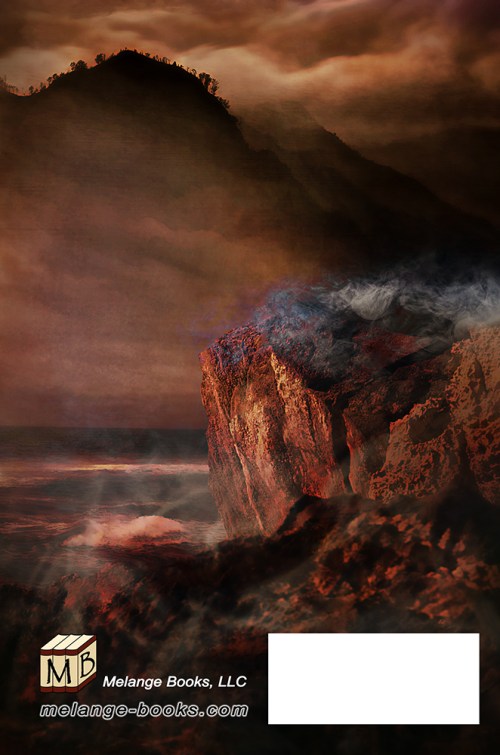
For the back cover, I stepped back several layers, removed the man and castle, adjusted my retouch layers, then flipped the merged image horizontally. This is the result:

SBibb - Blood Loss - Book Cover

SBibb - Blood Loss -  Back of Book Cover

Stock images from Dreamstime:

http://www.dreamstime.com/royalty-free-stock-photo-jagged-rocks-edge-cliff-desert-image29674305

http://www.dreamstime.com/stock-photo-edge-cliff-turquoise-ocean-image47133437

http://www.dreamstime.com/stock-image-morning-fog-mountains-image22074991

http://www.dreamstime.com/stock-photography-fog-lake-image37546892

http://www.dreamstime.com/stock-photo-ruins-tintern-abbey-former-cistercian-church-th-wales-banks-river-wye-close-to-english-border-image44804119

http://www.dreamstime.com/stock-photo-beautiful-dark-woman-black-robe-sword-fantasy-legend-image48884659

http://www.dreamstime.com/royalty-free-stock-image-smoke-background-image27490166

http://www.dreamstime.com/stock-photos-floating-smoke-black-background-image36147493

http://www.dreamstime.com/royalty-free-stock-photos-hooded-man-image9241498

2 Comments

Filed under Book Covers, Client Work, Photo Illustration

Thoughts On Writing – Foreshadowing

I was talking to one of my beta-readers the other day and they got me thinking about foreshadowing. Foreshadowing is important to having a satisfying ending, especially if the reader doesn’t see that ending coming. Without foreshadowing, readers may feel confused and lost. That’s okay if that’s the effect you’re going for, but be warned, sharp turns, like on a really rough, old, wooden roller coaster (I’ll take the smooth metal ones, thank you), can leave a reader nauseated if they aren’t prepared.

For example, I once critiqued a short story which started out sounding like a pleasant memoir. Kind of happy-go-lucky scenes, but the story rambled. It lacked direction. A couple plot points seemed out of place with the tone of the rest of the story, but they still felt… normal. Then, out of nowhere, there was a rather graphic scene that scarred the character (and the unsuspecting reader). In all fairness, I don’t mind stories that have some graphic violence, but in this particular story, that scene came out of the blue. It wasn’t satisfying. Had the foreshadowing been stronger, I think the scene could have worked perfectly, but the author wasn’t inclined to make changes to the manuscript that would allow such foreshadowing to take place. Their story, their say, but that incident did get me to start thinking about how important foreshadowing is to a story’s plot.

Some foreshadowing happens intentionally. You leave clues for the reader to create an expectation about what’s to come. This can occur within a short scene, across a book, or across a series. You might see this in the form of a prophecy. An example of this can be seen in Lord of the Rings movie, when the leader of the ringwraiths tells Eowyn (who is concealed by her armor), “No man can kill me,” and she replies, “I am no man,” then proceeds to defeat him. Prophecies are ripe with foreshadowing, and my favorites are the ones that seem clear but have double-meanings. The Sight, by David Clement-Davies, also uses prophecy to foreshadow events, and then twists the prophecy’s meaning to have a different ending than expected. With foreshadowing, those twists are exciting, rather than confusing. Take a look at any Twilight Zone episode. These shows often take unexpected turns, but those endings were cleverly foreshadowed so that the viewer has an ‘ah-ha!’ moment. Suddenly all the puzzle pieces fall into place and the viewer understands.

Something Wicked This Way Comes by Ray Bradbury also has several examples of foreshadowing. The story revolves around two twelve-year-old boys who discover a dark secret about the carnival that has come to their town. Throughout the book, the tone is dark, sinister, foreboding. Before the carnival arrives, we know a storm is coming because a lightning-rod salesman announces the coming of a storm and proceeds to gift the boys with a lightning-rod that has been adorned with various ancient, mystical symbols. But when the storm arrives, it’s not a lightning storm, as predicted, but the mysterious carnival with a dark, illustrated man and his tricks. The lightning-rod’s ancient symbols hint at the coming dark magic, and even (as the story later reveals) that the magic is ancient. Later in the story (Warning, spoilers ahead!), Will’s father (who has been foreshadowing the sinister purpose of the circus through his unease and concern) discovers that his laughter hurts the dust witch (who is absolutely creepy in her own right). Faced with the chance to confront her during a so-called ‘bullet trick,’ he carves a crescent moon into the bullet before firing. The crescent moon isn’t a moon, however, it’s a smile, and it kills her. (As a side note, the end of this book had me daydreaming an entertaining My Little Pony crossover where Pinkie Pie must face off with the Illustrated Pony…)

Foreshadowing allowed the ending to make sense, and for the reader to anticipate how the main characters would defeat the evil carnival. Readers keep reading in hopes of seeing if their theories prove true.

In a sense, foreshadowing is a shadow cast by the future. It can be a pale shadow, a single line or reference that hints at what’s to come. Or it can be a heavy shadow, a constant application of tone and mood and imagery. Characters may have suspicions (incorrect or not) about the future, which you can use to foreshadow events and to create lovely twists when the reader least expects them. Foreshadowing creates questions that entice a reader to keep turning pages. If you have a genre shift in your book, foreshadowing may be immensely important to keeping readers on board. Foreshadowing is a way to help readers suspend disbelief. Same with characters. If they’re going to need an obscure skill later to save the day, showing this early on, even in passing, allows the reader to believe in the character when the time comes.

Another kind of foreshadowing is the kind you don’t mean to add. Sometimes you write subtle hints into the story that you read later, which point at the outcome even though you didn’t realize you wrote them. There’s a line in Distant Horizon that stopped me cold after I’d written the rough draft of Glitch, a sequel in which one of the main characters dies rather horribly to save their friends. I remembered writing the line, but I hadn’t realized the potential impact it would have and how true it was. Granted, the line only has impact if you read Distant Horizon after Glitch, but it does provide a little bit of set-up for the character in question.

I also use foreshadowing heavily in The Little One, a prequel novel for the Distant Horizon series. Little One is a childlike spirit who has a number of chilling visions which eventually come to pass in one way or another. In several of the scenes (as they currently stand, since I still need to do edits), she references a rising sun. The rising sun is a reference to a symbol in the later stories, but, aside from being an Easter egg for readers, these scenes are meant to add to the story’s mood. The scenes start off lighter and become progressively darker. I’ve truncated a few scenes and edited them to make sense out of context:

First scene where the sun is referenced as foreshadowing…


One morning, Knight had gotten up early to use the restroom and found Little One staring out the window in her make-shift bedroom. Tiny rays of pink sunlight flickered across her face through the trees.


“It’s pretty,” she said absently.


He wandered around the foot of the bed and squeezed in beside her. The air conditioner tickled his feet from the floorboards, and early light twinkled across his eyes. He blinked. He hadn’t really watched the rising sun lately. Most the time he was sleeping. Or if he was headed to work, he was planning out his day. Not watching the sun slowly grow and ascend.


“It’s changing,” Little One said.


He glanced at her. “Yeah. It’s because of the earth’s spin and–”


“Not that. It’s different.”


He tried to tell if there was anything different from this sunrise than all the other sunrises he’d ever seen, but it looked the same as any other sunrise.


Little One shook her head. “It’s different. Just a little. Small. But it’s different.”


Knight twisted his lips. The kid seemed attuned to the subtle variances an adult couldn’t see, and he didn’t want to think about what those variances might be if she had insight for a power.


Later…


Knight sat down the drawings. There were images from Little One’s dreams, but there were other drawings, too. Swirling night skies and rising suns. And each time, Little One drew the sun just a little bit darker.


Later…


Hawk looked one more time at the drawing scribbled on his wall. On the far side, scribbled between the happy images of trees and squirrels, was a rising red sun, with five rays extending from it like spokes, but each cut off halfway through their usual extension.


Later… (One of Little One’s visions)


The poster was blurred to Little One. She paused, taking a second look. She couldn’t see it well, save for the red, rising sun of her usual vision. Then reality shifted. The normal colors downgraded, passing through a dark veil. The sun twisted and darkened, shrinking on itself until only five tiny rays remained, red as fresh-drawn blood. The buildings loomed and darkened, and the crowds thinned… as if a film had been placed over them, and the people raced and ran as flames consumed the new night, warping the street until the colors ran together and bled into one dull, monotonous grey.


Later… (near the end of the story, after a major battle scene)


Behind the city, like a crimson cog, the storm sun rose, its light sending spoke-like rays through the dark thunderheads, and basking the city in a bloody glow.

Note… that’s from the rough draft. I still need to go through and do edits.

There’s a lot of foreshadowing in The Little One for the entire Distant Horizon series. The Little One is a prequel, and the character has ‘insight,’ a power which lets her know more than she should, so it’s to be expected. Those scenes were a lot of fun to play with, and I wonder how different readers will read the various scenes…. especially depending on whether they read The Little One first or the other stories first.

Alternatively, let’s look at Magic’ Stealing. The antagonist has a lot of room for foreshadowing, but beta-readers have pointed out that the references seem odd and pulled them out from the story. There’s a reason those references seem odd, but I want the story to read smoothly, and as much as I don’t want to cut the references, I’m planning to do so (leaving the less obvious ones). Foreshadowing should serve the story, and in this case, beta-readers confirmed that I needed to try a lighter method.

I hope you enjoyed this post and found it helpful. What are your thoughts on foreshadowing? Have you read anything where the foreshadow did or didn’t work well? 🙂

4 Comments

Filed under Personal Work, Writing

Thoughts on Publishing – A Blurb for Magic’s Stealing

As I get closer to publishing Magic’s Stealing, I’ve been compiling the various elements meant to catch a reader’s attention. While a lot of emphasis is placed on the book cover (and I’ve realized the current version I’m considering may be better suited to the third book, so I’m debating what I might use instead for the first), after the cover, a reader inevitably sees the blurb. The blurb should show what the book is about and entice a reader to either buy the book, or at least take a look inside.

However, as a writer, we’re so close to our stories that it’s hard to see what will draw the reader’s attention. I’ve posted my current idea for a blurb on Absolute Write (which is a very useful source of information for authors), and I’ve come up with two slightly different versions. The question is… which works better? Short and snappy? Or more details about the world?

In order to get a little more insight on the subject, I read through a few articles that discussed what makes a good blurb (see the links below if you’re interested), and came up with a list of elements to consider:

  • A sense of the main character(s). Who and what kind of character are they? (For Magic’s Stealing: Toranih is a young noblewoman who would rather have a sword in her hand than use magic to heal or throw fireballs.)
  • Just enough detail to show the type of story and what makes this book different. (For Magic’s Stealing: there’s a kingdom, magical ribbons, mages, shadows who are impervious to mortal weapons… and this is where I start to wonder if I need to hone in on the description)
  • What the main conflict/plot will be. (For Magic’s Stealing: Almost all magic is stolen from the kingdom, leaving two young mages–one of whom doesn’t like magic–to protect their home.)
  • A question that entices the reader, or leaves them wanting more. (For Magic’s Stealing: Will Toranih successfully adopt the responsibilities of a mage so she can fight the shadows? Or will she fail and cause her home to perish?)
  • Offer a taste of the writing style. (Maybe I can include a tiny clip at the beginning of the description. You know, those story bites usually seen in italics?)

These are the current versions of the blurbs that I’m considering for Magic’s Stealing.

Short Version:

Toranih would rather have a sword in her hand than use her powers to heal or throw fireballs, and as a result, her magic skills are lacking. But when the kingdom’s magic is stolen, she’s one of the few whose powers remain. With former mages dying from magic withdrawal, and the looming threat of an army of shadows who are impervious to mortal weapons, she must either adopt her neglected responsibilities as a mage or watch her home perish.

Long Version:

For centuries, ribbons of magic have provided the kingdom of Cirena with light, healing, and protection. Then, in a span of minutes, those ribbons fly from their masters, stolen, save for the ribbons of two young mages. One of these mages is Toranih, a noblewoman who never liked magic to begin with. The other mage is her best friend, Daernan, a gifted shapechanger who uses his magical sight to track the vanishing ribbons. Toranih would rather have a sword in her hand than use her powers to heal or throw fireballs, and as a result, her skills are lacking. But with former mages dying from magic withdrawal, and the looming threat of an army of shadows who are impervious to mortal weapons, she must either adopt the responsibilities of a mage or watch their home perish.

So my question to you is this: Which blurb, if either, holds your attention, and do they entice you to ‘look inside?’ Why? Or if you neither holds your attention, why not?

I’m concerned that the shorter one may read too fast, but that the longer one may loose readers with unnecessary information. One solution I’m considering is that Smashwords offers both a short and long description for retailers, and as such, I could use both descriptions in their respective sections. Anyone who wanted more information could click to read the longer description. In the meantime, if whichever description I choose for Amazon doesn’t seem to be working, I can try switching it out for the other and see which one works better.

I hope you enjoyed the post. Are there any blurbs that worked well for you? Anything you’ve found that didn’t?

A few articles I found particularly helpful while researching the subject:

http://romanceuniversity.org/2011/11/23/5-top-tips-for-writing-a-compelling-book-blurb-by-amy-wilkins/

http://kristenpham.com/2014/01/14/how-to-write-a-great-ya-fantasy-or-sci-fi-book-blurb/

http://www.thecreativepenn.com/2010/11/16/how-to-write-back-blurb-for-your-book/

http://www.lightmessages.com/lm/index.php/blog/writing/229-how-to-write-a-book-cover-blurb

6 Comments

Filed under Business Ventures, Personal Work, Writing