Tag Archives: SBibb

Sneak Peek – Battle Decks

If you’ve been reading my blog lately, you may know that my husband, Isaac, and I are starting a publishing company for our stories and games. Well, I’ve talked a lot about the stories, but today I’m going to give you a peek into one of our games-in-progress: Battle Decks.

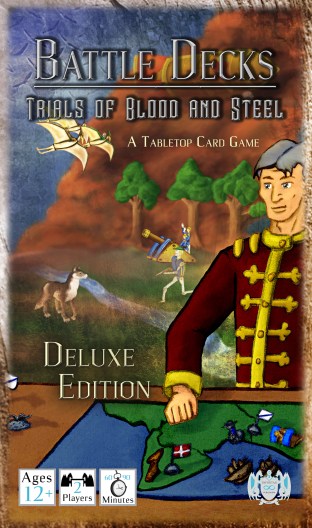
I’m not going to give a whole lot of detail on the game just yet, but I will say this: it’s a fantasy pseudo-steampunk table-top card game, where there are two battling factions and your goal is to take out the opponent’s hero cards. We’re considering the catch-phrase of “Dragons, dinosaurs, and dirigibles, oh my!”SBibb - Battle Decks Sneek Peek

Anyway, at this point in time, we have the basic mechanics of the game, stand-in cards, and we’ve played it on and off between ourselves over the past couple years. Currently, we’re in the process of creating the art for the actual cards. For the typical card, Isaac creates the base image with pencil on sketchbook paper. Then I go in and add the details, smoothing out the line art in the process. We then scan the page onto the computer. I retouch the pencil art in Photoshop CS6. Isaac does the basic coloring. Then I do the final touch-ups to the coloring and shade the image. That completes the basic art, up to the point we add them to their actual cards.

We’ve already ordered one proof of the first few cards, and there are tweaks to be made for readability. But it’s coming along, slowly but surely. There might be a set of stories planned around this game, too…

Your sneak peek is one character from each faction. 🙂

SBibb - Battle Decks Sneek Peek

Leave a comment

Filed under Business Ventures, Photo Illustration

The Infinitas Publishing Site is now Live!

I’m happy to announce that Isaac and I now have our Infinitas Publishing site live. 😀

http://infinitaspublishing.com

Took most of yesterday (including a couple photoshoots) and a few hours here and there to get it up and running, but after finally figuring out how to get the domain properly mapped, it’s now up. You can read about the behind the scenes process on our first blog (written by Isaac): http://infinitaspublishing.com/blogs/post/Behind-the-Website/

A few parts of the site aren’t quite working yet (the upper banner doesn’t want to resize for mobile devices), but I’ve sent an email to the web host to see if they can help.

Also, we have a new twitter account where we’ll be making announcements in regards to the books and games we’re publishing: https://twitter.com/InfinitasPub

Not much up at the moment, but it’s a start. We hope you enjoy it, and we have more plans for it as we continue to move forward. 🙂

Leave a comment

Filed under Business Ventures, Personal Work

Thoughts on Publishing – Pricing the Novella

Today, let’s talk business: What are you willing to pay for a novella?

When I went to ConQuest, I knew full well that I planned to fork over twenty bucks for a hardback copy of a book that contained two of Brandon Sanderson’s novellas. Sure, they’re available for purchase in ebook format for considerably cheaper, but having the hardback is nice, and I’m a fan of his work. (A note here: I’m the kind of person who likes having a hard copy, be it paperback or hardback. I’ll happily read non-fiction pertaining to publishing on my Kindle, but I have a difficult time reading fiction.) Anyway, I got the book signed at the convention, and I’ve read one of the stories (Perfect State) thus far. Even though I haven’t read the second one yet, spending that twenty dollars was worth every penny.

But not everyone is going to feel that way, and not for every book.

From the business perspective, I’ve got to figure out what readers are willing to pay for each book. Do I want to come up with a single, standard price range, or price them individually, according to length, genre, and various other factors? I don’t have the advantage of hiring a super-awesome illustrator for the cover art, or a top-of-the-line editor to make sure there aren’t typos. Not to start with, anyway (though I’ll sure do my best to find as many typos and errors as I can before I hit ‘publish’). Can I  make sure that the stories are the best they can be? Can I make sure that they are worth a reader’s hard-earned money?

I’ve determined that The Wishing Blade will be a series of (probably three) novellas. I’ve got the first one written, and it’s going through the process of being beta-read. Now the question I’m pondering is this: What should I price this novella, once I’ve completed edits and created the cover art?

On one hand, it’s a novella, so it’s not as long as a novel. I’m not sure how much money readers will be willing to spend, especially for an unknown author. While I do have several free pieces of flash fiction available on Smashwords, the style of writing varies, so it is unclear how many readers who download the freebies will be interested in the paid stories. I can’t price the stories as high as someone who already has a fan base. On the other hand, I’m trying to start a business. Which means that I actually need to be making money. The joy of self-publishing is that I get to wear two hats. I’m the creator, the author, and I’m also the business woman. So… provided that the stories are of a decent quality: engaging, not many typos, decent formatting, and good cover art, what should a novella be priced at?

I’m mostly going to look at Kindle’s (non-Select) pricing strategy, but I intend to sell on Smashwords as well:

99 cents: Not necessarily a bad spot for a short story, and many authors offer their novels at 99 cents as a way to promote their other works. However, the 99 cent price range only offers 35% royalties (I think it’s closer to 50-60% royalties on Smashwords, given that my “Ashes” short story, priced 99 cents, earned 56 cents after a Smashwords 10 cent cut and 33 cents transaction fee). The downside of this range is that people may pick up a 99 cent book on a whim, then forget about it because of the “it’s only a dollar” mentality.

$1.99: Long considered “the dead zone” in ebook pricing. I read a Smashwords report showing a trend of $2.99 vastly outperforming $1.99, and 99 cents doing just a bit better than the $1.99 range. Also keep in mind that Kindle only offers 35% royalties here. Not a lot of incentive to try this range, though I’ve seen trade publishers discount higher priced books to $1.99 on Book Bub. However, without actually testing this price range, it’s hard to say how well it performs for a specific story.

$2.99: Seems a bit high for a novella, with so many novels selling for $2.99, but is it? (See below list of example novella prices). At 2.99, Kindle authors get 70% royalties.  That’s around $2.00, versus 70 cents from pricing at $1.99, or 35 cents from pricing at 99 cents. And technically, if you hope to sell your novel at $4.99 or $6.99, that’s not too bad.

Now, one catch here is that I’m currently looking at the US dollar pricing. I haven’t even started to look at the UK or other territories. I’ll have to decide whether to try the retailer’s automatic price comparisons, or take a look at what’s selling in those stores and price it directly. This could be a bit difficult, though, given that the Amazon sites for other territories doesn’t show much what price they’re selling at. (Feel free to chime in with your thoughts on pricing, regardless of what currency you buy books with).

Here’s a few examples of novella length ebook prices in USD, from both independent and trade published authors (Note: I haven’t read all of these, I just did some research):

  • Perfect State by Brandon Sanderson sells for $2.99. I think it classifies as a novella. “Mitosis,” a short story from his Reckoners series, sells for $1.99.
  • Fairest by Marissa Meyer sells for $9.99 (46,600 words per Renaissance Learning)
  • The Invasion (an Animorphs book) by K.A. Applegate  sells for $5.99  (33,000 words per Renaissance Learning). Novella length, though meant for a younger audience.
  • Out of the Storm by Jody Hedlung is offered for free on Amazon. (The description suggests this is an introduction to her Beacons of Hope series).
  • Icefall by David Wood sells for $2.99 (approximately 30,000 words per article about the novella, and per Smashwords).
  • Elixer by Jennifer L. Armentrout sells for 99 cents (part of The Covenant Series).
  • Peacemaker by Lindsay Buroker sells for $2.99 (40,000 words, per her blog post).
  • Better World by Autumn Kalquist sells for $2.99. (A prequel novella to a novel series).

By the way, Renaissance Learning is great for finding the word count of books, especially middle grade and young adult. http://www.arbookfind.com/default.aspx

One of the textbooks I was reading recently, which focused on small business management (never mind that it’s from the earlier 90s), talked about the perception of value when marketing a product. There were two factors considered: quality and price.

A note on the chart below: an unknown indie author does not mean low quality, simply untested. Unfortunately, many people still perceive self-published books to be of low quality, whether they are or not.

High quality and high price: Serves clientele with expensive tastes. (Think of a Big 5 publisher selling an ebook for 13.99 from a big-name author).

Low quality and high price: No one buys the product, because the perception of value around it is muddled. (Think of an unknown author selling their ebook at $13.99).

Low quality and low price: “Cheap.” Not highly valued, but considered a decent price. (Think of how 99 cent indie novels are often perceived).

High quality and low price: “A good deal.” (Think of a Big 5 publisher running a $1.99 ad in Book Bub for a regularly $9.99 ebook).

So, at this point, I’m thinking of making Magic’s Stealing available for $2.99. It’s currently sitting at 30,000 words.

I hope you enjoyed this post. 🙂 What are your thoughts and experiences in the matter?

If you’re interested in further reading on the subject, these are a few of the articles I read while doing my research:

Leave a comment

Filed under Business Ventures, Writing

Behind the Scenes – Hide and Seek

A cover for Melange Books. For this one, the publisher wanted a cover that conveyed the romance of the two novellas in this book, as well as the suspense and western themes. So we stuck with a silhouette, darker (but still romantic) colors, and softer imagery. For the back cover, I simply used part of the desert landscape imagery I hadn’t used from the front, then applied a similar treatment.

This is the result:

SBibb - Hide and Seek - Book Cover

SBibb - Hide and Seek - Back Cover

Stock images from Dreamstime:

http://www.dreamstime.com/royalty-free-stock-images-black-tailed-jackrabbit-sniffing-southern-california-image38700799
http://www.dreamstime.com/royalty-free-stock-image-coyote-image7507496
http://www.dreamstime.com/stock-photos-arizona-desert-image9382933
http://www.dreamstime.com/royalty-free-stock-image-cowboy-couple-her-try-to-leave-silhouette-image36627786

Leave a comment

Filed under Book Covers, Client Work, Photo Illustration

Thoughts on Writing – Consistency of Style

With Magic’s Stealing out to beta readers, I’m trying to avoid working on that story line until I get the collected thoughts of the readers. That way I can evaluate all the comments and figure out how best to apply them. In the meantime, I’ve switched gears. I’m working on Isaac’s and my Distant Horizon story line. The first book is written and mostly polished, so I’m working on plot consistency in the second book. To do that, I’m rereading the first book to refresh my memory on what changes were made. (Seriously… my notes suggest I’ve read the first book twenty times. Granted, some of those rounds only involved skimming for minor edits, but some of those included major overhauls, and needless to say, I’m starting to get a little tired of rereading it.)

During my read-through, I realized that there’s a shift in the writing style from the first few chapters to the later chapters. There’s less description, more every-day action, and the slow set-up of things starting to go wrong for the protagonist. Events are happening, but I’m worried that they aren’t as enticing as they could be. Now, one possibility is that I’ve read through these first few chapters so many times that it’s all kind of a gray blur. I know the plot too well, but the story may be fine as-is. The other possibility is that there’s a definite shift in writing style that needs to be corrected, or risk turning away readers who might otherwise be interested in the story.

When the story first starts, its sounds very much dystopian:

The first time I flushed adominogen, the oblong capsule tumbled from my hand and bounced off the bathroom sink, once, twice, then fell into the toilet with a finalizing plop.

Gone.

I waited all day for someone to ask why I didn’t report accidently losing my pill. But no one did, and I didn’t have any of the hallucinations that I might have had for not taking adominogen. Instead, the world around me felt so much more alive. My attention improved, not that it was bad to begin with, and I could think clearer. Be more efficient.

After that, I stopped taking the pill. I graduated high school and moved into my first year of college, no sign of theophrenia. But when our hall advisor announced that the annual Health Scan would take place in two days, I panicked.

I needed three things to graduate: excellent grades, as many efficiency points as possible, and to pass the scan. It wasn’t often that someone failed, but it did happen. One of my friends in high school had a sister who failed. Galina. She took the scan at the clinic downtown, and Special Forces escorted her away, all while assuring her everything would be fine.

I didn’t want to end up like her, so right after the announcement yesterday, I took the pill. It was like throwing a clear, plastic tarp over my world. I couldn’t concentrate, but I couldn’t go to the doctor for the symptoms.

Not taking the pill was an international offense.

And a little bit later, still in the same style:

After the incident with Lady Black, I had this constant, nagging feeling that someone stood right behind me, watching me. Stalking me. If this was the plague, then I could only guess this was the onset of paranoia, the delusion that I was somehow important enough to warrant special attention.

Or I maybe I was just paranoid; the Health Scan was less than twenty-four hours away.

My bedroom door rattled and I looked up from my biology book. Faint, golden light traced my desk, highlighting the leaves of my plant and trailing along the edge of my bookcase.

The doorknob rattled again, followed by a new, chinking sound of metal.

I scooted from my chair, then sidled against the wall before checking the door’s peephole.

No one was out there.

Maybe the air pressure was playing with the hinges.

I opened the door and stuck my head into the hall. A couple students passed by, but they’d been too far back to affect the door.

But, as the story progresses (leaving act one into act two), the style shifts, bringing on more description:

Pops led us into a dark, narrow hall, a far cry from the neatly glowing dorm corridors. What might’ve gleamed with bronze reflections was now a dull, dented bit of metal. Yellow lights ran the length of the ceiling in small round inlets, casting a weird, brownish glow over the area. One of the lights was burnt out, and another was completely missing, the socket bare.

We headed up the second flight of stairs. The elevator we passed had a piece of yellowed paper with a DO NOT USE warning taped across it.

“We’ve been running on minimal repairs,” Pops explained. “We have decent funding, but we haven’t had a chance to resupply, and Crush only has so much time to work. He usually monitors the computers for signs of enemy activity.” Pops stopped at a plain, bronze door at the top flight of steps. “This is Jim’s office. My room is across the hall.”

Inside, a dusty world globe sat on the corner of an ornate, wood desk, obscured by various file folders and papers. Books were piled high, their spines haphazardly stacked like a puzzle game. An ancient, faded rug lay beneath the desk, so worn that its vibrant, geometric shapes and numbers were barely distinguishable. Bookshelves surrounded us from floor to ceiling, organized and decorated with models of antique stealth planes and trinkets. A giant, arched window graced the far wall, overlooking the night sky, and two red, plush chairs sat opposite the desk, where a reading lamp blanketed the room in a warm glow.

Later, part of an action sequence:

I followed Lance, since he was closest, and we huddled in the leaves, taking shelter from the fight. A local rushed the monster, and the beasts grabbed him by the throat and yanked him from the ground. Bones snapped and his screams fell short.

“We’ve got to help,” Lance said.

I wasn’t sure if it was his heart or mine pounding double-time in my ears.

No wonder Inese gave me her gun.

Behind us, there was no sign of Jack or Matoska, and I couldn’t hear anything more than a mingled mass of screams and shouts. Ahead, more beasties darted through the field, half-loping, half-running. One was lanky and pale, what little clothing it wore hooked over its bony waist. Crusted blood and clods of dirt plastered its skin. A feline eye stared my direction, while the other was swollen shut.

Other beasts were bulky and heavily muscled, swinging swords or metal clubs, bashing in the locals’ skulls if they got too close. A large glob of water hovered around a beast that stood straighter, more human than the others. The creature lunged at a man and water splashed onto the electric spear. Static traversed the metal shaft. Both man and beast crashed to the ground as electricity coursed over the beastie’s water-slick skin.

In the long run, I see a potential benefit of keeping the story the way it is because, as the style shifts, it suggests that the main character, Jenna, opens her eyes and really starts to see the world as it is, not how it’s portrayed by the sheltered Community. The story goes from being light on description to heavy on description, and the writing style includes thicker paragraphs. In addition, at least in the examples I’ve posted, the character goes from reflecting on the world around her (distant), to becoming heavily involved, a participant. Which might not be a bad thing. I won’t know until I have it available for readers to read.

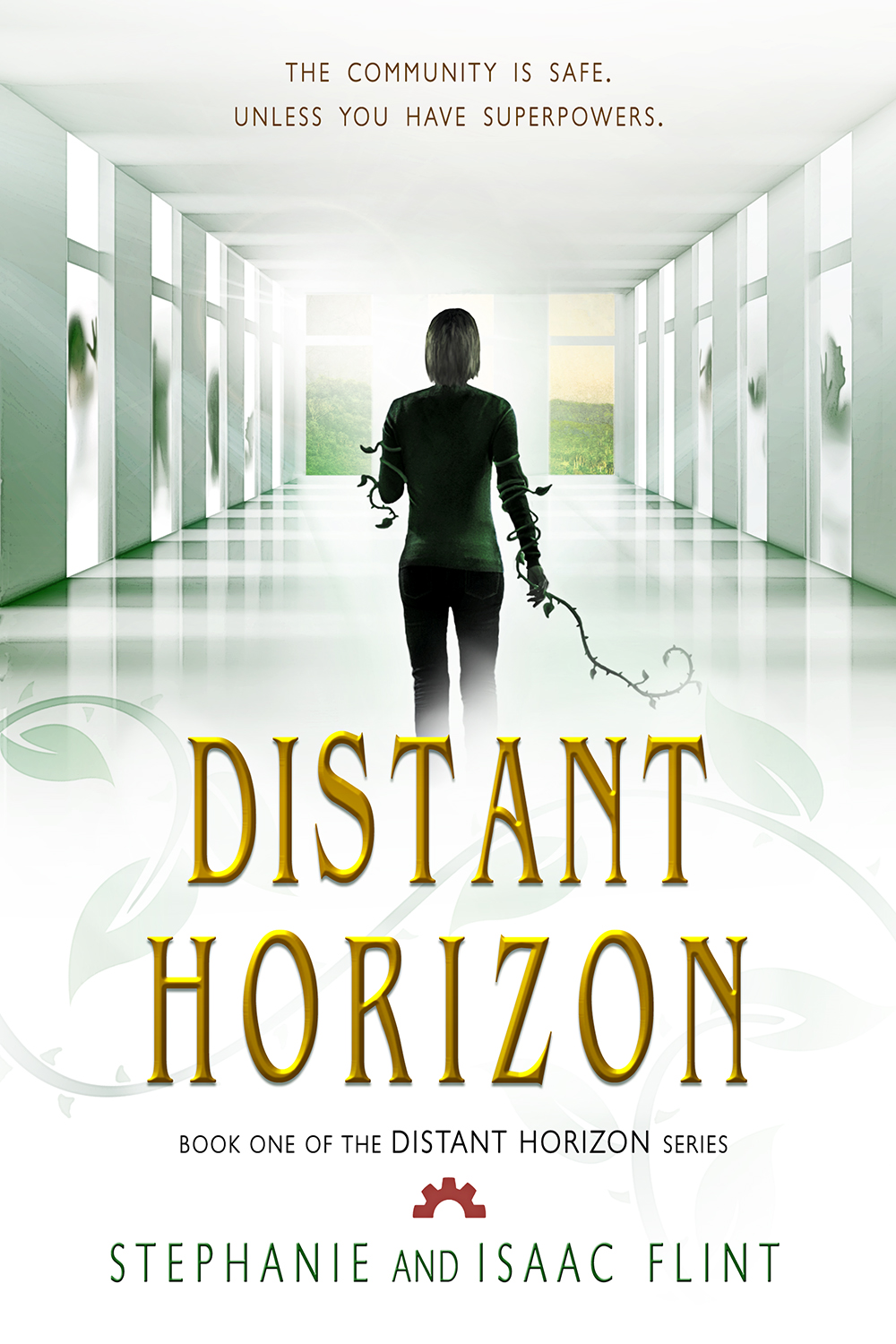
I hope you enjoyed this post (and the sneak peek at Distant Horizon), and I’d love to hear your thoughts. Have you experienced any issues with keeping the style and tone of a story consistent? Have you read any books where the style shifted subtly, or even dramatically?

Leave a comment

Filed under Personal Work, Writing

Thoughts on Publishing – A Novel or Three Novellas?

In general, I write novels. Then I trim said novels because their early drafts are excessively long. However, I’ve recently become fascinated with the concept of serial novelization. You release the novel in several parts, with the idea that readers know they aren’t getting a complete work at one time and that the next installment will come in a timely manner. I toyed with the idea of doing this for my current manuscript, The Wishing Blade, with each installment between 10,000 to 15,000 words. But as I started the rewriting stage, I realized that each section didn’t feel complete. The sections left on a cliffhanger, and weren’t really satisfying.

The other serialized option I’d studied was to write a complete short story (or novella), and make sure it had a full beginning, middle, and end, even if it was part of a larger work. At the moment, I’m thinking that might actually work well for The Wishing Blade. Each installment would be around 30,000 words, maybe more, with an expected three installments. I could release the story sooner, while still producing a reasonable quality work. Each story would be complete in itself, so there would hopefully be fewer unhappy readers who aren’t satisfied with the ending. With each installment, the reader should feel the series has made progress. Think about the show Avatar: The Last Airbender. (I think Legend of Korra and Fullmetal Alchemist where this way in their first seasons, too, but it’s been long enough since I’ve watched them that I don’t remember). For the most part, each episode (or set of episodes) felt complete, even though there was a larger story arc in progress. Granted… I’m still in the second season of Avatar, so that might change.


So here’s how it would work.

1. I separate The Wishing Blade into three novellas. They’re tentatively called Magic’s Stealing, The Shadow War, and The Immortal Realm. (What do you think of the names? Good? Bad? Neutral?)

2. I then figure out the story arc for each individual novella. This is crucial, because while reading them in order would be preferable, I also want readers to be able to pick up book three, enjoy it, then go back to book one. I personally have a habit of grabbing whichever book interests me… even if it’s in the middle of the series.

So the novellas would look something like this:

  1. Magic’s Stealing: Focus on the loss of ribbon magic in Cirena. Main character who hates magic is suddenly one of the few who can still use magic, and she’s trying to figure out what happened to the magic and where she fits into the whole scheme.
  2. The Shadow War: Main characters get separated. One works from within the shadows to foil the trickster god’s plot to kill the gods and get magic for himself. The other seeks out glass-stone, a material which has been proven to kill shadows and not be susceptible to shadow magic, then seeks to protect and warn others in the mortal realm. (For those of you who read my post on creating fantasy languages, this is where word magic shows itself).
  3. The Immortal Realm: Character in shadow realm escapes into ‘immortal realm’ and seeks out artifact (from book one) which could wipe out shadows for good. Other character defends Cirena’s capitol city from the shadows’ massive onslaught. They’ll either succeed in their separate goals, which serves to aid the other, or they’ll fail and the shadows will take over the kingdom.

3. Edit book one and make shiny. Send to beta readers for feedback. Work on a different story in the meantime (either finish the rough draft for The Wishing Blade: The Shadow War, or work on long-overdue edits to book two in my husband’s and my Distant Horizon universe). Once beta readers return comments, I’ll review said comments, make edits as necessary, then set book one aside for a while. Work on The Shadow War in the meantime.

4. Polish book one. Do what editing I can, maybe get an additional beta reader to proofread for errors.

5. Begin publishing process. Upload to Kindle and Smashwords, and consider other markets (I’m currently considering Drive Thru Fiction and Draft2Digital, but I haven’t had experience with either). For now, The Wishing Blade will be in ebook format only. I hope that once I have all three books out, I’ll be able to earn enough from them to purchase a block of ISBNs. Then I’ll need to decide if I want to make a collected print edition with all three books, or make a separate edition for each story. (If you’re looking for a length comparison, I’ve been looking at the old Animorphs series. Wrong genre and age group, but the word count is about right.)

6. Continue process with book two. I’m hoping to release each book around two months apart, though I may change my mind on that once I get further into this process.


Granted, there’s a lot more going on in the background (my husband and I setting up a partnership to publish this, and we’re picking up the DBA, EIN, and trying to figure out tax forms, etc…) but this is what I’ve got going on in the front end. Hopefully you found this post to be interesting, and I’d love to hear what your thoughts are regarding this process. 🙂

6 Comments

Filed under Business Ventures, Personal Work, Writing

Behind the Scenes – City of Warrensburg Mural

Today I’m deviating from my usual book cover behind the scenes to go behind the scenes of a large mural project I finished last year, doing work for one of my professors from college.

This project lasted approximately 18 months (April 2013 through October 2014). Dr. Bonsall directed the project, and the majority of the photos are hers. Other contributing photographers include: Robert Breshears, Andrew Mather, Bryan Tebbenkamp, Lowell Toole and Tricia Mannering, and special thanks goes to: Denton Humphrey, Lisa Irle, Brett Penrose, Courtney Stephens, Lisa Schmidt, Paula Hertwig Hopkins, UCM Photographic Services and Johnson County Historical Society.  The canvas was printed by Jerry Schmidt, and I did the computer artistry of blending all the images together. The mural currently resides in the Warrensburg, MO city hall.

Dr. Bonsall was one of my professors from my Bachelor of Science photography degree, and during her class, I was starting to do a lot of work focusing on digital manipulation of photographs. While I was still in college, she had commissioned me to do a couple smaller works where I blended various images into a single poster for her, and then after I graduated, she got a hold of me again and asked if I might be interested in this job. My job consisted of taking the photographs she provided, along with the sketches, and placing the photographs in a pleasing combination, then seamlessly blending them together.

The mural consisted of eight panels in four sections, with two panels per section placed side by side on canvas. Each section detailed a different area of focus: Whiteman Airforce Base, the University of Central Missouri, the town of Warrensburg, and the Union Pacific and Amtrak train station. The goal was to have each panel flow into the next panel, even though the categories were different.

For an example of scale:

Stephanie Flint and Dr. Bonsall in front of the Warrensburg Mural

(Myself on the left, Dr. Bonsall on the right, in front of the completed mural).

These are each of the four main panels:

SBibb - Bonsall Warrensburg City Hall Mural

SBibb - Bonsall Warrensburg City Hall Mural

SBibb - Bonsall Warrensburg City Hall Mural

SBibb - Bonsall Warrensburg City Hall Mural


2 Comments

Filed under Client Work, Photo Illustration

Thoughts on Writing – To Time Travel or not to Time Travel

In my current manuscript, The Wishing Blade, I’ve been streamlining the original story while striving to maintain the overall tone. I started the original draft in 2003, and I set it aside for several years before pulling it out again this year to revise it into a workable manuscript. While some plot points have been easy to keep or discard, there’s one point I’ve been going back and forth on… whether or not to keep the time travel incident in the novel or whether to remove it all together.

Now you get to have a first hand look at my thinking process regarding revisions… all while I try to work this out for myself.

First, let’s look at reasons to remove this incident:

1. Potential Confusion: I have a tendency to confuse people once I start talking about time and dimensional travel in my stories, and I’ve seen agents list ‘no time travel’ in what queries they accept. (However, the last point is negated since I intend to self-publish this particular story. And technically, while some agents might not want time travel, others might. So this bullet revolves entirely on whether or not the incident is confusing to readers and pulls them out of the story.)

2. Potential Loss of Tension: One of the main characters must ‘die’ if the time travel incident remains. The other character goes back in time with the aid of the gods, and they prevent the death of the other character. There are complications that arise once the character returns to the present, but those complications are minimal. Worse, by showing readers that there’s an object that does allow time travel in this particular universe, any future sequences threatening the main characters’ lives is moot, because readers may then wonder why the characters don’t just go back in time and fix it?

3. Unnecessary Plot Point: At this point, the time travel device only allows time travel once in the story. It does do other things, but I could pretty easily remove the time travel incident and chalk up its bizarre powers to other magic.

Possible solutions:

1. Streamline the sequence: Make sure what happens is clear to readers (or is as clear to the readers as it is to the main characters…).

2. Consequences: To avoid loss of tension, I could make sure there are consequences to going back in time. (In this case, I need to make sure those consequences are clear to both character and reader). Also, I could make the complications that arise from time travel a little more immediate. This was actually the case in the original draft, but was removed when I didn’t find a reasonable place to reinsert the point. (And this is a good example of where having fresh eyes to look at a manuscript can be useful, because you might remove an important tidbit without noticing the resulting effects).

3. Increase Relevance: Similar to the point about consequences, if I can better tie in the time travel incident to the main plot, along with making the incident crucial with what’s to follow (along with the irony of the incident regarding the antagonist), the incident shouldn’t feel out of place. Linking the antagonist further into this scene could also improve the overall story.

Besides the reasons I might remove the incident, I’m also considering reasons to keep the incident:

1. Character Development and Increased Tension: We get to see the antagonist step forward to protect one of the main characters– and get a hint as to why, and what she’s willing to do if that character dies (and remains dead). The goal? Tension rises as the character she’s trying to protect risks their life time and time again, because if the antagonist loses said character, all bets are off in regards to what she’s willing to do to achieve her larger goal, and what she isn’t.

2. Magical World Building: We have an explanation of why the ‘time travel device’ reacts a certain way to the bad guys later. Cause and effect comes into play, and the world gets a little more exploration. And we get to see more of the various character relationships.

3. Time Travel Is Cool: I like time travel and dimensional world travel. I know, that’s not a good excuse. But really… we’ll get to see the effects of time travel first-hand in the story. We don’t just hear about it from a side character.

4. Paradoxes! Or so the characters think…: The incident sets up tension between the antagonist and protagonist, because the protagonist knows who the antagonist is but doesn’t know how they got there…

This is a case where beta readers will come in handy. They’ll help decide if the time travel plot point should be removed altogether (requiring a light restructuring of the plot), or whether the plot point works. For now, (thanks in part to having a friend enthralled by the backstory of the antagonist), I’m going to keep the incident.

So… onward to editing, and I hope you enjoyed this post. Let me know what you think, and please let me know if there’s any topics you’d like me to cover. 🙂

2 Comments

Filed under Personal Work, Writing

Thoughts on Writing – Creating Fantasy Languages

One of the topics I’ve been thinking about recently is creating fantasy languages. Reason being, I’m creating a language for use in my YA fantasy manuscript, The Wishing Blade. Now, in the original draft (and even across several drafts for different books in that world), I only had a handful of made-up words sprinkled into the story to give it flavor. This time, however, the use of the language system suddenly had a reason to shine– I actually intended to show ‘word magic,’ one of the magic systems in my Cirena stories coming from the Cantingen Islands. Suffice it to say, creating a language has been fun, if not a bit difficult.

When I attended ConQuest, one of the panels I attended was about creating alien languages. Some of the topics in the panel included: deciding how in-depth you wanted the language to be– do you want to have a word here and there, or will there be full sentences in this language? How does it look? How does it sound to the ear? Might it have odd sounds (like clicks) that you might not normally read? Do you base your new language off of a current language, and if so, how do you change the language to fit the needs of your story? For example, does a word or phrase mean something now that it doesn’t mean in the future where your story takes place?

All of this is food for thought and can be applied to a fantasy language of your creation. For example, I like the idea that language changes over time. We can portray this in our stories. An example of this in The Wishing Blade is the name of a town, Shuhritan Fritarando. Which no one says because it’s ridiculously long. Most characters, unless they happen to be upper class or a particular linguist (I’m debating on my word mage correcting my main characters about the city’s name), are simply going to call the town Shu Frit. It gets even more fun, because the full name isn’t entirely exact. Shuhritan is an ancient Cantingen word for ‘male royalty’ or ‘king.’ Fritarando translates to ‘small male kin.’ Which could mean nephew, cousin, son, etc., but in this instance refers to ‘son.’ Shu Frit becomes ‘Little King’ in the terms of cultural history, even though neither word actually means that. It’s a colloquialism, informal and a pain to translate, but a natural part of how languages evolve.

Of course, this whole explanation may never show up in the story itself (and probably shouldn’t), but it shows how you can play with language to create cultural history in your novel. It’s a way to add flavor.

However, not everyone in my story is going to use such colloquialisms. In the example I gave, the characters are referring to a language that’s outdated. Outside of naming conventions, the language is only used by word mages. Due to the nature of word magic, these mages need to make sure that what they say is exact– or risk the consequences of having a fireball light them on fire instead of their opponent. Pronounciation is key. Which is why, when I went to place all the words and phrases I had thus far into an Excel spreadsheet, I realized that I needed to change one of my words. I had qui meaning ‘as,’ quis meaning ‘good health,’ and ki being an emphasized word that connects an unusual modifying word to what it is modifying. And they were all pronounced like the English ‘key.’

That could get dangerous for a word mage who is trying to say something about ‘good health’ and instead has his word translated to ‘as.’ (As what? Something deadly?)

So I changed qui to li and did a word search in my manuscript to make the changes. Small details, but hopefully fun for anyone who pays attention to the language in the novel. Eventually I want to make symbols that represent each phonetic pronunciation. (Oh, IPA (international phonetic alphabet)… so fun in high school theater).

If you decide to create a language for your story, I highly recommend writing down the words in a spreadsheet and keeping track of your rules. I recently updated my word document of notes into an Excel Spreadsheet. When I did, I saw several potential problems that I went ahead and fixed. Primarily verb conjugations. (Spanish… French… these classes are starting to be rather helpful, even if I never did become a proficient reader of either language). The Cantingen language is supposed to be precise. Repetitive, even. And I really didn’t want to mess with irregular verbs. So I adjusted each verb that I ran across. As long as you know the ending for “I did something” versus “you did something” or “he did something,” you’ll be able to tell who or what the verb refers to. None of this irregular verb mess we commonly deal with in English. In addition, a single add-on to the word will signify if something is past or future.

Is this a simplification?

Oh yeah. Definitely. But I’m not trying to be Tolkien (though I did try to learn Sindarin Elvish several years ago. Didn’t get far, but I got a few words of Enya’s “May It Be” translated into Sindarin beyond what was already translated). My goal is to add flavor to the story, and keep the language consistent.

And maybe try writing a song in pure ancient Cantingen. That would be fun, though that’ll be after I get more words and verbs ironed out. There’s plenty more that can be said about creating languages, but I’ll leave that for a later post. Let me know what you think, and I hope you enjoyed my ramblings. 🙂

21 Comments

Filed under Personal Work, Writing