Category Archives: Writing

Cover Reveal for a Fellow Author – Born of Treasure!

Today I’m hosting a cover reveal for Jordan Elizabeth, one of my author friends. Just to clarify, I didn’t create this cover (Amalia Chitulescu did, you can see more of her work here: http://www.redbubble.com/people/amyamalia ). I think it looks stunning. 🙂 And now for the reveal…

BORN OF TREASURE

Born of Treasure - Cover
Clark used to be a miner, until he drank from a vial he swore was absinthe but was actually an invention to give him the ability to raise the dead. Now Clark seeks to fulfill his father’s wishes to keep inventions away from Senator Horan and his beloved Amethyst is along for the ride. Deceit, drama, romance, the insidious underbellies of gangs…How can she not be involved?

Clark can’t hide behind the Treasure name forever and the army still wants him for his secret abilities. If Captain Greenwood can’t snare Clark, then he’ll use the Treasures as collateral. Saving his father’s inventions will just have to wait, especially now that the Treasures have been kicked off their ranch and driven into exile. Clark knows how to survive on the run, but that’s not the fate the Treasures deserve. He can surrender to the army or fight for his freedom, but Amethyst has other plans for fixing their troubles.

She’s come across another one of the vials that gave Clark his abilities, and it looks mighty tasty.

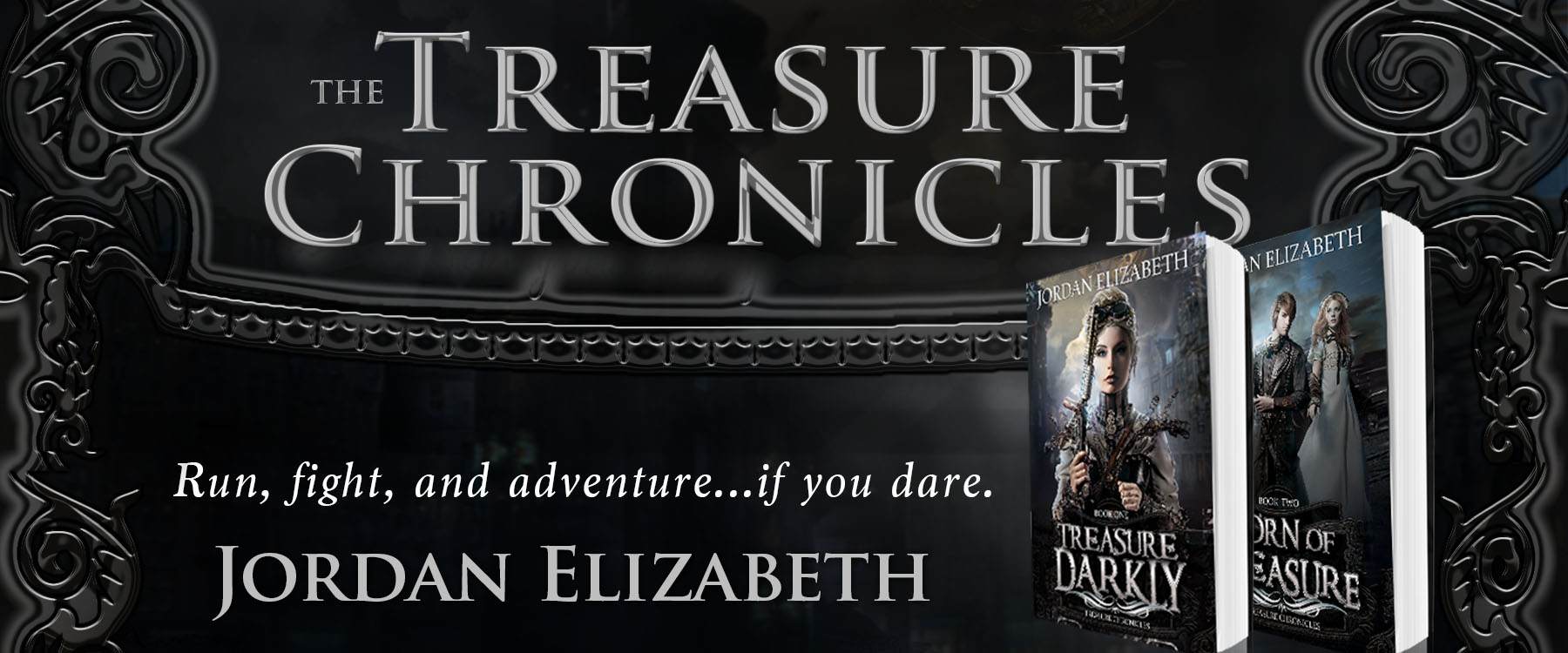
Born of Treasure Banner

BORN OF TREASURE, Book 2 of the Treasure Chronicles

This young adult fantasy turns the Wild West into a steampunk adventure. It will be released September 12, 2015, but in the meantime, enjoy the stunning cover, a contest, and an excerpt!

Enjoy the following excerpt…

Clark eased the door open enough to peer into the closet. Scratch that, make it a ballroom. Faded curtains with moth-chewed holes were fastened to the walls to display a stage. Forgotten props leaned against the back, a mixture of painted shrubbery and constructed balconies, as though the musty room couldn’t decide what it wanted to be.

This would be fun. He’d never come across a rundown, exotic hideout in the desert. Clark tucked his lock-picking kit into his jacket pocket and nudged the door shut behind him. His breath sounded too loud in the still room, but no ghosts appeared to haunt the memories. Dust motes floated in the sunbeams coming through the windows near the ceiling. One window, of stained glass, sent a distorted image of the late king onto the hardwood floor. He pictured the theater where he’d grown up back in Tangled Wire, a space in the corner of the saloon where alcohol hadn’t puckered the floorboards too much. Sometimes, the saloon owner had made his mother dance with the younger Tarnished Silvers.

“Mum would’ve shone on this stage,” Clark whispered. She could’ve worn her favorite green dress, to go along with the emerald shade of the curtains.

Tables covered what remained of the room, littered with piles of gears and cogs. Broken clocks glared at him through their cracked faces.

“Check near the stage.” The spirit of Clark’s father appeared beside him. Perfect, the ballroom needed a ghost. Black holes peered out instead of eyes, matching the space in his chest where a bullet had stolen his life. At last, a ghost to match the dismal space.

“Your inventions show up in the weirdest places.” Clark stepped over a heap of clock keys, but one crunched beneath the heel of his riding boot.

“Senator Horan never got this one, and he’s looked. Trust me, he’s looked. See, it was stolen right from my jacket! Never trust a girl wearing too much lip paint. She’ll slip her hand in your pocket and you’ll never see your watch or billfold again.”

This had to be the point where a son grew tired of his father’s rambling and zoned out. He’d seen it enough on ranches, especially when the father wanted the son to follow in reluctant footsteps. “Senator Horan wanted to buy the pocket watch right after I finished it.” Eric waved his hands. “Nope, I told him. You’re too late. A pretty Tarnished Silver made off with it. He didn’t believe me, swore I was lying. He tried to pay me another small fortune in land.”

Clark grinned. He could listen to his father, Eric, all day and never grow weary of his words. His mother must’ve felt like that, getting lost in Eric’s passion.

Clark lifted the corner of a striped sheet thrown over a table, revealing glass plates for clock faces. “Don’t worry, your time travel device is safe.”

Eric floated closer. “I told you, son. It’s not time travel.”

“Right,” Clark teased, drawing out the word. At least if the pocket watch had to have been stolen, it hadn’t been tossed down a privy with other garbage. A clock collector—obsessed fellow, more likely—turned out to be a great alternative. “If I was going to collect something, I would definitely keep it in an old railroad station.” Not that he’d ever had the luxury of collecting anything. If he managed to own a second pair of shoes, he felt like a king.

“It’s a magnificent workspace,” his father said. “Pity I didn’t think of using an old ballroom. Perfect light from every angle, lots of room to spread-out.”

Clark studied the table closest to the stage. Pocket watches of various sizes ranged from thumbnail small to fist-size large, most dented. A polishing cloth had been thrown over a triangular-shaped one.

“This was the first train station in Hedlund,” Eric rambled. “All they had here was a mission and a few shacks. The mountains were just starting to be mined and the king was encouraging farmers to come out here to the land. They wanted this station to be the hubbub of life. A great encouragement to the weaklings back east.”

“Like you?” Clark lifted an oval pocket watch with diamonds on the front. The spaces of missing stones reminded him of a face scarred by the pox.

“As the rest of Hedlund built up and the main cities extended to the ocean, this little town became quite little. It’s still a stop on the main railroad, but people don’t want to stay for dancing or a show. Did I tell you I wanted to be a professor?”

The other gang members might not laugh if they knew Clark’s father was loaded—lots of the wealthy slept around with Tarnished Silvers—but they’d have a good roar over Brass Glass Clark having a professor for an old man. Univeristy brats hid behind books in shadowed libraries. They didn’t run around the desert with steamcycles and pistols.

They didn’t get shot by mercenaries hired by a senator, either.

Clark spotted a pocket watch with the Grisham family crest on the front: a swan with a key hanging from its beak. “Got it.” A tiny diamond winked from the swan’s eye.
Author - Jordan ElizabethJordan Elizabeth, formally Jordan Elizabeth Mierek, is the author of ESCAPE FROM WITCHWOOD HOLLOW and a contributor to GEARS OF BRASS, both available from Curiosity Quills Press. GEARS OF BRASS includes a short story featuring Amethyst Treasure, one of the main characters in the Treasure Chronicles. Check out Jordan’s website for contests and book signings. Jordan is represented by Belcastro Agency and President of the Utica Writers Club.

Don’t miss any of the Treasure Chronicles. Book 1, TREASURE DARKLY, is on sale for 99 cents this week only!

Mark BORN OF TREASURE to read on GoodReads and check out the Facebook Release Party.

Don’t miss your chance to win a heart-and-key necklace with matching earrings worthy of Amethyst Treasure. Click here to enter the Rafflecopter Giveaway.

Leave a comment

Filed under Writing

Thoughts on Writing – The Omniscient POV

For most of the stories I’ve written, I prefer a deep point of view. I like being right next to the character, getting their thoughts and feelings as they see it. Most of the time I choose either first person (Distant Horizon and Glitch), or close third (Magic’s Stealing and The Little One). While I might swap point of view characters between scenes, those scenes stay distinctly in one person’s head.

And then I started working on The Multiverse Chronicles.

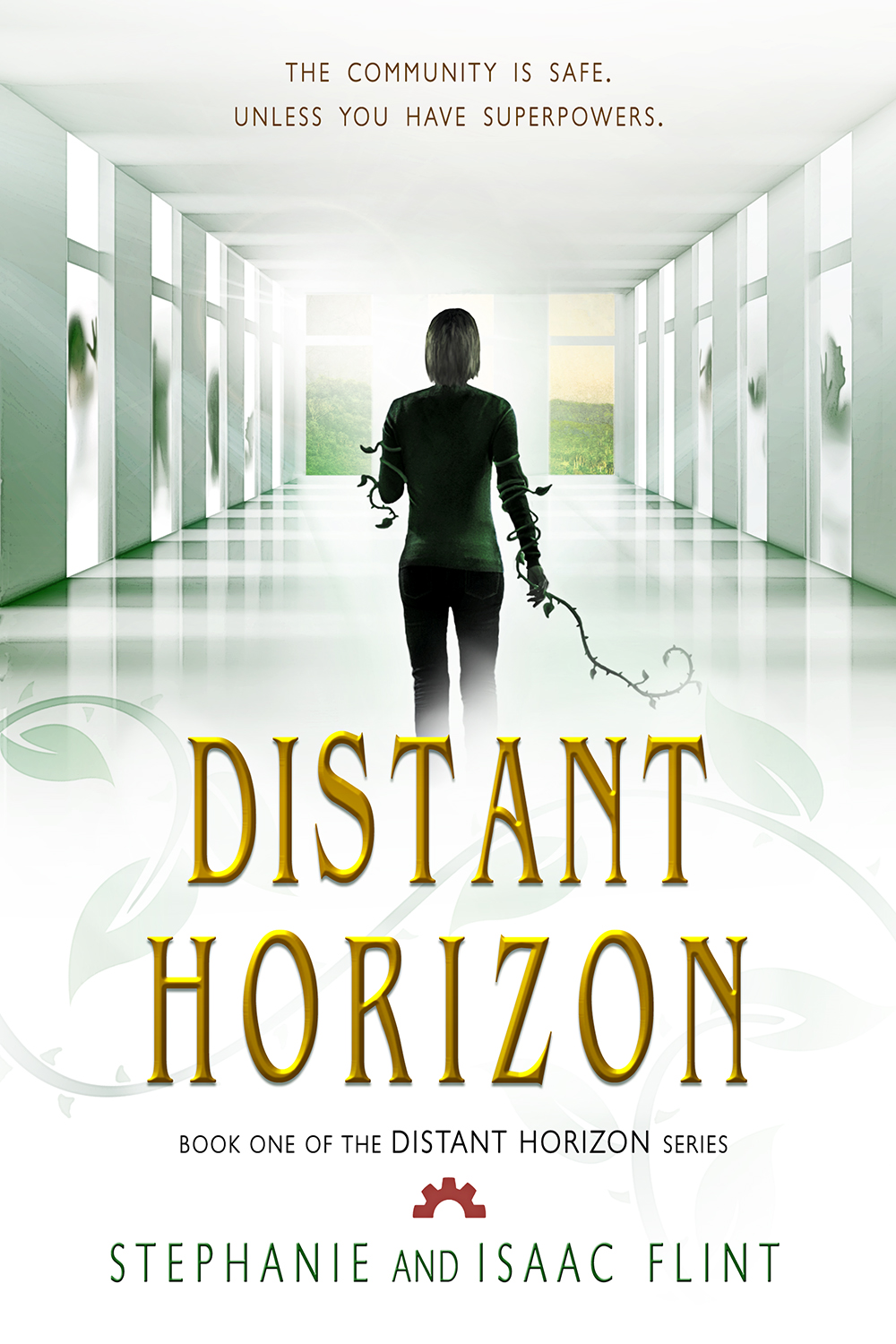
The Multiverse Chronicles is pseudo-steampunk fantasy that consists of a series of short episodes (each around 1,000 to 2,000 words long) that will posted weekly on a blog dedicated to the series. My husband, Isaac, writes the rough draft, which I edit.

At first, editing an omniscient point of view drove me nuts. I wanted one person to follow, and I wanted to stay with that person. (This despite toying with the omniscient POV in The Little One, where one of the characters is a fourthwalling telepath). All of those rules about not head-hopping? They kept poking me while I tried to edit. But once I finished editing the first episode, I tentatively took it to the writing group we attend. To my surprise, they didn’t have a problem with the point of view.

Okay, cool. So I just need to keep up whatever we did with the first episode, right?

I started work on the next episode. I initially wrote with the expectation that I was writing from the bodyguard’s point of view, but then I realized she wouldn’t see the scene in the way we’d written it. In this particular episode, the bodyguard is grudgingly attending a ball in which the man she loves is about to be formally engaged to a snobby princess who looks down at her.

But what I’d embellished focused on the splendor of the ball… not the dark side of the festivities.

Let’s take a look at the current (rough) intro for this episode:

The grand hall of Britannia’s castle was adorned with ornate, stained-glass lanterns. Their yellow arc lights depicted the glorious reign of the Dragon Dynasty across the cream-colored wallpaper. Flickering images of gold and crimson dragons danced among pink-tinted clouds at sunrise. Further down the grand hall, these lanterns revealed the proud history of Britannia. The first Dragon Queen sent her dragons to battle an unkempt hoard of miscreants, and later, she stood with her proud chin high as she morphed into the form of a glistening dragon, uniting her subjects into an unshakable empire for the past two-and-a-half centuries.


Beneath the lanterns, diplomats from across the continent mingled, tipping crystal goblets at each other with brilliant smiles as they eagerly awaited the announcement from the current Dragon Queen, Queen Catherine V.

Not exactly the reaction I’d expect from a scorned bodyguard.

However, it did match the mood of the queen, who is pleased with the arrangement of her daughter to the prince.

Suddenly, it made sense. I needed to write part of this scene from the perspective of the queen. Because we’re writing this in omniscient, I could bring in her point of view, even in the same scene, allowing us to see the contrast between the two characters and sense the rising tension.

For example, compare the queen’s thoughts about the bodyguard with the bodyguard’s thoughts about the royalty:

The queen had to admit that the prince was bit relaxed, slacking on the formalities she’d worked so hard to instill into her daughter. But he would come around, just as her Ramón had.


Her telepaths had assured her that the prince was faithful, even if his doting bodyguard was something of a slob. She rapped her fingers on the armrest’s dragon head, exhaled in time with the methodical orchestra, and returned her attention to the guests.

Now, for the bodyguard:

“Indeed, this has been a marvelous party, fit for the First Queen, and now, for my daughter.” The queen cast a loving gaze to Princess Cassandra, who beamed with pride.


As if she was ever anything but prideful.


Alia kept her face blank, but her cheeks burned at the thought of that snooty, high-horsed princess being anywhere near Alfons.


Not that there was anything she could do about it.


“Over these past months,” the queen continued, “I have been thrilled with the courtliness of Prince Alfons, crown prince of the house of Egilhard, who has treated my daughter with the utmost respect that can be expected from a man of his station.”


Because anyone who isn’t raised like some prude isn’t expected to be respectful, right? Alia clenched and unclenched her fists, but Alfons was too busy fawning over his princess to notice the queen’s slight.

Neither queen nor bodyguard like each other. Since we’re in an omniscient point of view, we get to see inside the heads of both characters.

The question I pondered, then, was how to make sure the transition was smooth. The danger of omniscience is head-hopping, a disorienting feeling of being thrown from one person’s point of view to another.

In order to avoid that problem, I decided to make sure that whenever a transition occurs, that transition must be clear. Our focus subtly shifts to the new character with a few cues, such as naming the character and quickly getting into their thoughts with a thought that is clearly not the thought of the former character.

As I considered the topic, I realized we could model this concept after movies and TV shows. Different camera shots let us see what different characters are up to, even in the same scene. (Off the top of my head, I’m thinking of Agents of SHIELD and Once Upon A Time). Without leaving the scene, the camera subtly pans to a character with an ulterior motive. We see their reaction, whether it be a malicious smile or a sad lowering of the eyes. We don’t hop heads, but we do switch point of view.

Let’s take a look at the current draft of The Multiverse Chronicles, in which the point of view switches from the queen to the bodyguard.

The queen’s telepaths had assured her that the prince was faithful, even if his doting bodyguard was something of a slob. She rapped her fingers on the armrest’s dragon head, exhaled in time with the methodical orchestra, and returned her attention to the guests.


Amongst the rigid guards and the pristine diplomats, amongst the proper dukes and the swirling, bejeweled duchesses who danced at their side, stood a lone, blue-uniformed soldier.


Alia Behringer, the prince’s favorite bodyguard. She was tall, especially among this crowd, with wheat blond hair and a lean, muscled body.


Alia cast a furtive glance toward the Dragon Queen, caught her glower, and looked away. She remained stoic as the redcoats, but unlike her counterparts, her blue-eyed gaze returned to the prince.


He was her charge, and she would defend him with her life.


She avoided the queen’s heavy gaze and gave her attention to the prince. Months ago he would have been joking at her side, not perched on miss high-and-mighty’s ‘graceful, endearing, and oh-so-lovely’ arm.

This scene could still use some tightening in terms of point of view, but we can see the switch from the queen to the bodyguard. The queen focuses on the bodyguard, we get a bit of information about her, and then we start seeing her thoughts, things she would know but the queen wouldn’t. Calling the guards redcoats, for example, or noting that she would defend the prince with her life, or how she calls the princess ‘high-and-mighty.’

The queen would not think in these terms.

The Multiverse Chronicles is still very much a work in progress. But the beginnings of the omniscient point of view is there, slowly unraveling itself and making itself useful.

I’ve tried taking cues from other books that feature an omniscient point of view (Ray Bradbury’s Something Wicked This Way Comes, for example) but I’ll admit, I haven’t read many stories with an omniscient POV that I remember, though I know I’ve read them.

I hope you enjoyed this post. Have you had much experience in reading or writing omniscient points of view? 🙂

Further reading I found on the subject:

http://io9.com/5924661/how-to-write-an-omniscient-narrator-if-youre-not-actually-omniscient-yourself (A really nice explanation of omniscient narration, and how to make it work)

http://www.scribophile.com/academy/using-third-person-omniscient-pov (Explains the difference between subjective and objective narrators, and potential pitfalls with an omniscient point of view)

4 Comments

Filed under Writing

Thoughts on Writing – Character Motivation

Today I’m talking about  how a character’s backstory influences their actions.

In the first draft of Magic’s Stealing, I never really explained why the main character, Toranih, didn’t like magic. She simply didn’t. But stories generally read better if the author knows why a character behaves a certain way, even if they never explain this directly to the reader. So, in order to add credibility to Toranih’s character, I began to explore her motives.

From Dictionary.com (a really useful resource when double-checking that a word means what you think it means), motives are “something that causes a person to act in a certain way, do a certain thing, etc.”

To see why Toranih acts so paranoid/distrustful of magic, while being so interested in learning how to effectively wield a sword, let’s take a look at her world. Toranih is the youngest daughter of the Lord of the Armory, so she has plenty of access to swords and the people who can teach her. In regards to magic, the kingdom has a high number of ribbon mages, so magic is common. However, the ability to see magic is not. Neither Toranih, nor her older sister, Siklana, can see ribbon magic, though her best friend can.

In the original draft of Magic’s Stealing, Toranih did not like magic because she felt like it was all tricks and illusions. (A side note: the trouble with using the term ‘illusion’ with magic is that if you actually have magic doing something, the illusion of something happening is no longer an illusion. I’ve been slowly weeding this word from the story). So my first idea for why Toranih didn’t like magic was that maybe a bad event scared her in the past. She gets her first glimpse of magic at a parade when she was little, and it overwhelms her. Thus, she’s been wary ever since.

However, my husband pointed out that a parade with a lot of colorful, fluttering ribbons is likely to be awe-inspiring to a four-year-old, not terrifying. While I still feel that everyone has different reactions, so what some kids like, others are terrified of (for example… clowns), I started looking elsewhere for answers. Toranih doesn’t like magic, and to the extent that she is paranoid in earlier drafts, there seems like there might be a bit more to her paranoia. So I cut the bit about the parade (keeping the event, but not having it terrify her), and considered Toranih’s distrust of their mythology. There are already several references in the current draft which lends itself to this theory.

For example, after an event involving Toranih being magically called to do a task she wouldn’t otherwise do:

Old fables flitted to the edge of her mind, haunting melodies of immortals and creatures whose very power was that of magic’s lure, the power to call and demand, to whisper in a person’s ear and convince them, without fail, to do their bidding.

In something of a flashback, Toranih’s sister tells her about life and death magic:

Once, long ago, when Siklana showed Toranih how to use her crystal, she’d convinced a couple of the servants to come stand in front of them. One had magic, the other did not. And she’d pointed to the one with magic and all the ribbons, and explained what ribbon magic was and how it worked.


Then Siklana pointed to the other servant, and said that even though he wasn’t a mage, he still had magic. Everyone had magic, but it was difficult to see because it was closer related to string magic, but couldn’t Toranih see it? There were two thin strings running through his body, each entwined and almost impossible to spot.


Siklana had adjusted the crystal to make them more visible. “That’s the only string magic visible to a ribbon mages,” she’d said. “One strand is life, and the other is death. Everyone has them. If you don’t, then you’re dead. That’s how the gods made us,” Siklana had continued, much to Toranih’s dismay. “But only the really powerful gods can manipulate those strings, so there’s nothing to be scared of.”


That memory had stuck with Toranih ever since.

In a conversation with Aifa, the Matchmaker goddess:

Aifa rolled her eyes. “Such a harsh tongue, tut-tut. Dear, I’m the goddess of relationships, not all-powerful. But if you don’t mind your manners, you’ll find yourself mute.”


Toranih swallowed hard. She had heard tales of citizens who’d crossed the gods in older times. Citizens who found their love lives broken or their ability to communicate… impossible.

Toranih has plenty of reason to be uneasy about magic and the gods’ use of magic. However, we can take this a step further. We know that Toranih is very interested in swordsmanship, and wants to be a guardsman except that her father doesn’t think that position befits her station. This is especially problematic when her sister, Siklana, reveals intentions to marry into a different estate, thus leaving Toranih as the sole heir.

Her father handed one of the servants his empty plate and rested back in his chair. “Understanding self-defense is important, but you’re taking these studies a bit far. There are more important subjects for a young lady to—”


“Siklana is much more adept at those studies,” Toranih interrupted. Her scone crumbled and she swept the crumbs into a napkin before he could get onto her about that, too. “Let’s be honest. When inheritance time comes around, she’ll inherit the estate. She’ll master magic at the academy, and she’ll be the one to win the hearts of the city and lead them in her wise, older age.”


Siklana ducked her head behind her bangs. Her dark brown eyes shown through. She was smaller in stature than her younger sister, especially since she lacked the muscle that came from Toranih’s years of swordplay. “What if I marry into a different house?”


Toranih turned sharply. Her sister… marry? Of course she would, she had always been interested in the attention of suitors, but Toranih hadn’t thought she would try to climb the social ladder through marriage.


If she married into a higher class, she would leave behind the Covonilayno estate. “I’d be the heir,” Toranih whispered, stunned.


Her father nodded. “The rights would fall to you. As is custom.”


Toranih glared at her sister. “How long have you been planning this?”


“I’ve been thinking about it for a year,” she admitted coyly. “I’ve already passed the academy’s first year exams, and I’m well into my second year. Our inheritance is decent, but there are a few worthy suitors who could help me further my education once I finish in Cirena City. With a decent suitor’s allowance, I could travel to the Islands. I’ll make sure that’s part of the contract. I might even learn word magic.”


Toranih swallowed hard. While having at least some degree of ribbon magic was common, word magic was practiced by very few. Anyone could learn it, so long as they knew how to pronounce the spell.


But say just one syllable wrong, and any number of horrors awaited the practitioner. Setting ones’ self on fire, opening a portal in the middle of a crowded city and killing anyone in its path, trying to heal someone and killing them instead… and a particularly powerful spell could bind a target to do the mage’s will.


Toranih shivered. Unlike ribbon magic, word magic was invisible. No crystal could reveal words the way it could reveal ribbons.

My husband pointed out that maybe Toranih doesn’t like magic because, unlike her sister (and most every other mage in the kingdom), she never really became adept with magic.

As a young child, Toranih saw her sister and Daernan surpass her with flying colors while she struggled to control ribbons for even basic tasks. At the same time, young noblewomen were taught basic self-defense, which is where she excelled. She threw herself into the study of swords and knives, hoping to become a weapons master. In the meantime, she became more and more resentful of magic. She eventually understood the basics (which we see her using in Magic’s Stealing), but she never quite comes to terms with the fact that she’s been left behind by the mages.

The result?

She can’t easily control magic, so she doesn’t trust it, and (as the current blurb says) she would rather have a sword in her hand than use her powers to heal and throw fireballs.

And now we have the reason that Toranih doesn’t like magic. We can see why she might, at times, lash out or vehemently deny anything to do with being a mage.

But she lives in a world so saturated with magic that she can’t ignore it, and so she still uses the magical light crystal her sister gave her. She still changes into an owl when Daernan convinces her to go to the parade. She still tries to save people who are dying when their magic is stolen. But she has a flaw, and because of that flaw she doesn’t always use her powers when she should, and her unwillingness to try could cost her the people she loves.

Now I’ve just got to make sure that is apparent within the story, even if I never come outright and say this is why she acts the way she does.

I hope you enjoyed this post. 🙂

Have you found any books where character motivations were well-done, or where they were lacking?

2 Comments

Filed under Writing

Thoughts on Writing – Developing a Magic System

I’m in the process of polishing Magic’s Stealing, and a beta reader pointed out a plot hole regarding one of my magic systems. Since my mind is now stuck on working through that problem, today I’m going to go into the process of developing magic systems.

In Magic’s Stealing there are three types of magic: ribbon magic, string magic, and word magic. The problem system is ribbon magic, which is the most common. It’s the magic that gets stolen, leaving the two main characters as the only mages.

As it stands in the current version of the story, ribbon mages either have all-magic—which allows a user to do most any common type of ribbon magic that they train for—and there is specific magic—in which the user is only good with one specific power.

Depending on their specialty, the colors of their ribbons vary. For example, a fire mage has yellow ribbons, while a light mage has turquoise ribbons. The problem is that once we get into all-magic, where there is no official specialty, the color system breaks down.

For example:

Toranih: Green ribbons. All-magic. She’s not particularly good with magic, though her specialty is telekinesis. She is also seen shape-changing and using her powers to heal wounds.

Daernan: Blue ribbons. All-magic. Specialty of shape-changing. Also seen casting fireballs and healing wounds.

Siklana: Turquoise ribbons. Specific magic. Specialty of light manipulation. Enchants light crystals for others to be able to see magic.

Shevanlagiy: Green ribbons. All-magic. She is seen creating portals, using telekinesis, and there is a mention of her enchanting a light crystal.

Cafrash: Yellow ribbons. Specific magic. Specialty of fire manipulation. (He’s a blacksmith).

We don’t see many different ribbon colors in the first book because the main character, Toranih, can’t see magic without a light crystal, and magic is stolen shortly thereafter. However, a beta reader pointed out that from the way I describe the ribbons in the book, the color of the ribbons seem to be based on the magic user, rather than on the type of magic. (Note that Toranih and Daernan can do the same things, but Daernan’s magic is blue, while Toranih’s magic is green.)

So I took a second look at how I explained ribbon magic. The only truly consistent piece of information was in regards to the strength of magic, and even that is not directly stated. (Ribbons are influenced by how often magic is used. Thin ribbons reveal magic that has been neglected. Thick ribbons show well-practiced magic. Like a muscle, the more practice a mage has, the stronger their ribbons will be). The other consistent deal with ribbon magic is the use of a certain color pertaining to a certain mage.

Since I want consistency in the system, especially as the series continues to evolve, I brainstormed a few ideas that might make the system stronger.

It didn’t immediately come together. The brainstorming process is messy, and you can see that from the ideas I have here:

Importance in the shade of magic: Inherent at birth. The more vibrant the color of magic, the more likely a mage has all-magic, or can do more with his ribbons. The paler the magic, the more specific their magic is, limiting them to what can be done.

Importance in the color of magic: Inherent at birth. Technically, similar colors should be similar powers. We also run into the problem that if the shade of magic says that the paler the magic, the more limited the mage, then we shouldn’t be able to tell what kind of magic a limited mage has. Their magic would be white.

So…

I wondered if I could flop these around.

The deeper the shade of magic, the more specific the power. This would be consistent with immortal magic, a type of ribbon magic which is described in the book as being “silver with black edges.” Their magic tends to be a little more all-encompassing (even though they each have their specialties). When Toranih and Daernan are granted a tiny bit of an immortal’s power, their ribbons take on an iridescent sheen. Which would make sense if the more all-encompassing their power, the more silvery-white it became.

Granted, that still doesn’t help me look at magic in terms of a visible light spectrum based on their current ribbon colors. But, if you take all the colors of the rainbow and put them together in the form of light, the light is white… which fits the idea of all-magic being paler in color (though brighter in luminescence).

That in mind, mortal mages would probably still have a visible color of magic because they don’t have nearly the kind of power that an immortal has.

Let’s look at the specialties in terms of a rainbow spectrum… with the addition of turquoise.

Red – (Not mentioned in this story)

Orange – (Not mentioned in this story)

Yellow – Fire

Green – Telekinesis

Turquoise – Light manipulation

Blue – Shapeshifting

Indigo – (Not mentioned in this story)

Violet – Portals?

Now, if specialties that are related are close together on the spectrum, then light manipulation should be more of a lime green or yellow-green than turquoise, and thus be closer to fire. If I go with the idea that each type of ribbon magic has a different color, unrelated, then those could remain the same.

But I still wasn’t really happy with this. I liked the idea of light manipulation being turquoise and fire being yellow, sticking straight to a rainbow spectrum is limiting, and besides that, this system still doesn’t help me with all-magic users.

I talked about this conundrum with my husband, Isaac, and the resulting discussion gave me the idea that maybe mages shouldn’t have one single color of magic. Instead, their ribbons could vary with multiple colors, depending on what kind of magic they have the potential to use. In this case, Daernan’s primary ribbon color would be blue, because he’s a gifted shapeshifter, but he would also have several thick yellow ribbons for fire, along with a few green ribbons for telekinesis and whatever other color I assign to the magic he practices. As he’s not particularly skilled with something like portals, but he’s capable, he might have a couple thin violet ribbons that no one really notices because they get lost among his blue ribbons.

Let’s take a quick look at a before-and-after of scene involving magic. This is how the section reads before I make changes:

The owl shrugged and puffed out its plumage like a feather duster. Not my fault you’re so jumpy.

Toranih crossed her arms. Though faint in the moonlight, the crystal’s twilight revealed blue ribbons swirling thick through Daernan’s owlish body.

Coming? The blue ribbons carried Daernan’s thoughts to Toranih’s mind, and she fought the urge to swipe them away.

However, if I make the changes I’m considering, the scene might read something like this:

The owl shrugged and puffed out its plumage like a feather duster. Not my fault you’re so jumpy.

Toranih crossed her arms. Though faint in the moonlight, the crystal’s twilight revealed various blue and yellow and pink ribbons swirling thick through Daernan’s owlish body.

Coming? The pink ribbons carried Daernan’s thoughts to Toranih’s mind, and she fought the urge to swipe them away.

Granted, I haven’t decided that pink is telepathy, but it’s an idea. This early in the story, readers should be able to immediately understand that different ribbons do different things. Before this segment we see Siklana’s turquoise ribbons of light magic, and after this segment we see Toranih using her own scrawny blue ribbons to transform into an owl.

If I go this route, I’ll need to make a chart of which colors represent which specialty, and I’ll have to be careful in editing to make sure the use of ribbon magic remains clear and consistent. But this last change might enhance the world, as well as fix a plot hole.

The system is still in development, but I hope this post gives you a bit of insight into how such a system can be developed. 🙂

2 Comments

Filed under Writing

Thoughts on Writing – The Magic of Writing

When I was in high school, my language class read a short story about a man who spent his life on the river. When he first started sailing as a boy, the river was magical. The eddies and sand banks… he didn’t understand them, but they called his attention and made him want to know more. As he grew older, he learned to understand the river. To know what caused the eddies and where the dangerous currents hid, and as he learned, the river lost its magic.

I can’t remember if the story ended with him seeing the magic of the river again in his old age or not, but the story stuck with me (even if the name of that story and the author did not). (Edit from comments: The story is “Two Ways of Seeing A River” by Mark Twain).

Writing (like any profession), has the same problem.

When I was younger, reading was magical. It still is, but when I was younger I could pick up most any book on a topic I liked and there was a good chance I would enjoy it, going through book upon book without a problem. However, as I became more fascinated with the art of actually writing these stories, I began to dissect them. I wanted to know how they worked. Why they worked.

Piece by piece, I figured them out. I read books on writing, blogs on writing. I joined internet forums dedicated to writing. Slowly, I puzzled out what worked and what didn’t, and why.

At first, those pieces were difficult to see. I knew a certain story worked for me, but others didn’t. It was difficult to see why. The first time I remember truly understanding an aspect of why a story worked was when I read Darth Bane: Path of Destruction by Drew Karpyshyn, and then Mistborn by Brandon Sanderson. I suddenly understood how to get in close to a character in third person and write from their point of view. I even wrote an alternate ending Star Wars fanfic based on this principle, and I’m still a teensy bit proud of it for that… even if it’s not my best work.

Later, when I read The Raven Boys by Maggie Stiefvater, a single line about the halo of mist around a streetlamp stood out to me, and when I read Rebekkah Ford’s Beyond the Eyes series and could actually smell the wet, autumn leaves in the forest, I began to see how zooming in on specific details could bring a story to life. I sought out more stories like these, stories which really brought out some aspect of writing to help me finally understand.

While working on Glitch (a Distant Horizon story with elements of horror), if I read a scene in a book that made me shiver, I reread that scene until I understood why. The example here is The Devouring by Simon Holt, in which one of the Devours has a deliciously creepy one-on-one conversation with the main character. Christine, by Steven King, helped me see the use of repetition of key, creepy phrases or scenes (the dream sequences). Pure by Julianna Baggott revealed the use of discordant imagery, beautifully described but terrifying in their own right.

Then there were books that taught me the value of relationships in stories. The Host, by Stephenie Meyer had me crying during a certain scene with the grandfather figure. It’s a rambunctiously wordy novel, but it’s good. The Girl with the Iron Touch has one of my favorite romances in a book, and I’m not really a romance reader. It revealed how to draw tension between the characters, and did a wonderful job distinguishing between sexual and romantic attraction, and utilizing both.

There are so many books that have been an influence on my writing, and they have all helped me to understand how a story works.

But recently, I’ve had a much harder time picking up a book and simply enjoying it. I used to spend hours in a book store poring over books and trying to decide which one to buy with my limited gift cards. Now? I go into a book store, hoping to find something, and often come out empty-handed and disappointed.

There’s a few possible reasons. One: I don’t have nearly as much free time for reading. I don’t feel as inclined to spend time reading a book unless it has something to do with what I’m currently writing. Two: (Something my husband pointed out) The topics I’m interested in might not be what the publishers are putting out right now.

For example, there was a period of time before The Hunger Games by Suzanne Collins came out where I couldn’t find anything I wanted to read. This was the first time that happened and it was really, really discouraging. Then I found The Hunger Games in hardcover, and the concept intrigued me. I wanted to read it, but since I was limited on Barnes and Noble gift cards, and paperbacks were more sensible in terms of getting the most for my money, I didn’t pick it up.

Around a year later, I bought the paperback and loved it. I happily picked up the next two from the library. Later, I found a copy of Delirium by Lauren Oliver at Barnes and Noble, and while it didn’t seem like my thing (heavy romance), the premise intrigued me and the writing intrigued me, and I was hooked. I took a chance on the hardback and was glad I did.

Those kinds of finds are my favorites. The ones where you pick up a book at a bookstore and don’t want to put it down. But ever since I’ve put an emphasis on learning the writing craft, it’s been harder to find those books. I glance at a back cover blurb, and in what feels like just a couple seconds, without fully knowing what it’s about, I’ll put it back on the shelf. Books don’t catch my attention like they used to. Or maybe the book gets my attention and I slow down. I try reading the inside, but the writing style jars me and I just can’t convince myself that I’ll have enough patience to read through the whole book. The feeling is disappointing, especially given that the premise for that particular book sounded interesting and the characters were having a good conversation. The writing style just didn’t work for me. And the problem seemed to have been specifically within that book, because when I went and looked at Dust Lands: Raging Star by Moira Young, that book caught my attention. And the Dust Lands trilogy has a really interesting writing style. But the style of that series is so different that it didn’t push me away.

Problem Three: When I’m at a book store, I’m looking for something that I wouldn’t normally find. Something I don’t think the library currently has or could easily get. Which means that books that are popular and that I would love to read tend to get set aside. Now, if I really like them and I got a copy from the library, I might purchase my own copy later.

I admire the voracious readers who go through book after book and love them. Sometimes I feel like the man from the story who loved the river so much that he did everything he could to understand it, only to lose the magic because he understands it.

But at the same time, I don’t. Because some books still hook me from the start, drag me in unsuspecting, and take me for the whole wild ride.

I’m hoping the books I recently bought will do that… especially since I kept going back and forth in the YA section debating, “Do I risk buying that in hardback?”

“You know what? Yes, I think I do.”

I hope you enjoyed this post. 🙂 Do you ever have a hard time finding a book you want to read?

4 Comments

Filed under Writing

Thoughts On Writing – The Revision Process

I recently finished the major revisions on Magic’s Stealing, and though I’m still in the process of making a few tweaks (trying to give the end just a bit more ‘oomph’ and trying to make sure that the antagonist has a clear motive while maintaining her mysterious persona) I thought I’d spend today’s blog post talking about my revision process.

First off, the difference between editing and revising. Honestly, I confuse the two and tend to use the terms interchangeably. But for the purpose of this post, I wanted to make sure I was talking about the right thing. So I did a quick web search, and this is what I found:

Editing is when you focus on a manuscript’s grammatical conventions. You’re looking for typos, words that like to get flip-flopped (my offenders were rein/reign and lose/loose), and grammatical issues. The story looks better when you edit.

Revising is when you focus on the big picture. You’re checking that the reader understands what you mean, that the story is clear, and the plot makes sense. The story sounds better when you revise.

Sometimes the two might clash, depending on whether you’re going for how something sounds, or how something looks. I’m fairly certain I drove one of my beta readers up the wall for my tendency to have ‘ , then ‘ in the middle of a sentence. For example: The owl sighed, best an owl could, then tapped the window with his beak. To be grammatically correct, the sentence should read: The owl sighed, best an owl could, and then tapped the window with his beak.

To be fair, I was doing this quite a bit, and I did go through and fix a number of those issues. However, as I was revising, I chose to keep certain instances because I liked how the sentence sounded, especially when compared to other sentences in the paragraph.

Here’s a breakdown of my revision process:

Step 1: Write rough draft. I don’t usually do much editing/revising at this stage. I just want to see the story completed.

Step 2: Examine rough draft. Tighten the writing, cut/add scenes as needed, now that I know how the story flows, and look for loose ends. Mostly revision.

Step 3: Polish the draft. Repeat Step 2 as necessary until I can’t find anything left to polish. I both edit and revise at this point. In some cases, this only takes one or two passes. In others… many, many more. (I really don’t want to think about how many times I’ve read through Distant Horizon. I feel like it’s fairly polished now, but it took several years to figure out this whole writing thing).

Step 4: Send polished draft to beta readers. Step away from manuscript and work on something else while waiting for a response.

Step 5: Ask beta readers questions. Once I have responses from my beta readers, I look through their comments and ask them questions to clarify anything I don’t understand. If one beta reader brings up a question that I think I should ask others, I send them those questions. For Magic’s Stealing, I did this in regards to what age they saw the characters as, as well as the readers’ theories regarding the antagonist. By doing this, I got a broader understanding of problems in the manuscript.

Step 6: Examine beta comments as a whole. Since it has been a while since I last looked at the manuscript, I read through all the comments to jog my memory.

Step 7: Apply critique to one chunk of the manuscript at a time. I examine what all the beta readers said about a particular section (in case there were conflicting opinions), and then applied the appropriate changes as necessary.

Step 8: Read the manuscript aloud. Once a couple sections were completed, I read the revised sections aloud, looking for any areas where I tripped over myself. Since I’m hoping to eventually do an audio edition of Magic’s Stealing, this is especially important. But even if you don’t plan to do an audiobook, reading aloud can help you catch errors or plot holes you wouldn’t catch if you are simply scanning the page. Plus, it’s kind of fun. (My Speech and Debate background likes to kick in here).

Step 9: Make any final adjustments that you know need to be made. For example, I know that the ending of Magic’s Stealing needs a little bit more ‘oomph,’ possibly in the form of one final confrontation with the antagonist. So I’ve been re-examining the rest of the manuscript to see if there are any loose strings there that I can use in that confrontation.

Step 10: Divide story into chapters. If you haven’t done this already, now’s the time to do it. Unfortunately, this is the part I don’t really like. Do I stick with a specific word count? Do I end at a really dramatic scene and have some really long or really short chapters? Should I cut before or after the antagonist view point? Eh… I much prefer revising.

Step 11: Read the full manuscript. If the story is truly polished, you’re only going to be making small changes or adjusting a word here or there. Nit-picking. If you see a major plot hole or flaw, you may want to go back and do further revisions. Each story is different. Like I said earlier, Distant Horizon went through a lot of revisions, and now when I look at it, I mostly nit-pick.

Step 12: Set the manuscript aside. Hand it over to any remaining proof-readers/beta readers. Read through it again after it’s been out of your thoughts for a little while. If readers say you’re good to go, proceed to the next step.

Step 13: Proceed with querying for trade publication or with self-publishing, depending on your goals. For Magic’s Stealing, I’ll be self-publishing, and I intend to print out the manuscript so I can look through it for typos. For Distant Horizon, I’ll intend to hire an editor before self-publishing, since it has been through so many changes that I’m bound to be missing something. The story is also considerably longer than Magic’s Stealing, and has a lot more room for plot holes (Distant Horizon is almost 100,000 words vs Magic’s Stealing’s 31,000 words).

There you have it: my revision process.

I hope you found this post useful. Have you had any revision techniques you found to be particularly helpful? 🙂

Want to share this post on twitter?

Thoughts On Writing – The Revision Process: http://bit.ly/1VcaEAl via @SBibbPhoto

Click to Tweet!

Leave a comment

Filed under Writing

Thoughts on Writing – Humor in Dark Places

After recently watching the full series of Avatar: The Last Airbender, and getting started watching season two of Agents of SHIELD, my husband and I noticed the stark contrast in the style of storytelling. The Last Airbender has a lot of lighthearted humor, with a few dark moments interspersed throughout the series. The first episode in season two of SHIELD is mostly dark with very, very little humor. As such, my husband and I began thinking about the roll that humor can play in the dark moments of  a story.

Let’s examine the two shows closer.

Agents of SHIELD: While the first episode didn’t have quite so many cheesy dramatic pauses that the first season did (one of our qualms with the show), it seemed very gritty and dark. There’s a lot of bad things going on for the characters, so the dark events make sense. Character with brain trauma? Okay. Taking away the one happy point about his character and the entire episode in a big reveal at the end of the episode? Not so okay. The plot twist was actually pretty nice– I didn’t see it coming and it was foreshadowed without being obvious. Good.

But here’s the kicker. During the entire episode, there were a few lines of witty banter, but not much in the way of humor. And without that humor, we didn’t really feel like we had any breathing room. My husband pointed that part out, which reminded me of a blog post by Chuck Wendig about Game of Thrones. Anyway, there was all sorts of awesome stuff happening on screen, all sorts of juicy tidbits that I want to see play out in SHIELD, but if the rest of the season lacks points for breathing, I’m not sure if I’ll really be interested in returning to watch further episodes.

When we watched the next episode, that episode played out much better for us. Despite the heavy matter linked to that previous episode, we had breathing room. Moments of humor, things going right for the good guys, if not completely right, and the character with brain trauma found someone who may be able to help them. The problems are still there, but there were little moments of humor that kept the episode floating, even with the dark moments.

By episode three, I was hooked again. Though I don’t remember many particularly humorous moments (there was one involving a twist on what the viewer expects, due to the information withheld), there were a few, and the action and information was paced well enough to allow for breathing room while still thoroughly holding my attention.

Avatar: The Last Airbender: My husband suggested that part of the problem with the first episode of SHIELD seeming so dark is that we could have used a transition series. We just finished watching Avatar: The Last Airbender. It’s an absolutely amazing series, in which I could easily gush about the characters… (Uncle Iroh is my favorite character, and Toph is so cool…). *Ahem.* (WARNING: There are a few spoilers for The Last Airbender in the rest of this paragraph.) The Last Airbender an anime that, while it has it’s dark, sucker-punch moments (the crazy sister, Azula and when she has her breakdown; Uncle Iroh when he’s in the prison cell and pretending to be a desperate old man (this guy is anything but desperate, so when you first see him groveling, it hurts), also uses a lot of light-hearted humor to break the tension and offer breathing room. Sokka is pretty good at this. He’s the humor guy with some really bad humor, but he helps ground the other characters.

Which brings me to my next point. Stories which are dark can (and probably should) have moments of humor. The main character might not be laughing, but as the reader, we can. There’s many ways to do this. There might be witty banter, a miscommunication, a character reaction that is just too classic that we have to laugh. Or an unexpected reaction. These scenes shouldn’t take a reader out of the story, but they should allow a reader time to breathe.

Continuing with The Last Airbender theme, whenever there was a goofy, over-the-top humorous episode, I automatically assumed that the next episode would probably be dark. There was a case where they had a set of short episodes in one, in which I was trying not to get teary-eyed on the one about Uncle Iroh because he was going about his day all happy and perky, and then it reveals what the day means to him and it was so sad… But in the previous short ‘episode,’ we saw Sokka having a Haiku rhyme competition in which he was trying to impress a bunch of girls. The mix of light and dark moments made for a stronger show, and those moments tied into all of a viewer’s emotions, allowing us to ride a wave without pounding us needlessly against a bunch of really blunt rocks.

Part of this is pacing, knowing when a reader might need time to sit back and take everything in. A story doesn’t have to be entirely pulse-pounding action. Carefully placed moments of humor, or moments of sadness in a comedy (it works both ways, a comedy can have some really heart-rending moments), don’t have to distract from the story. These alternate emotions enhance the story by giving meaning to the other emotion. You can’t have the high without the low, and you can’t have the low without the high. I can’t remember what book series it was (Maybe Pendragon, by D.J. MacHale?), but one of the characters (the villain, I think) said that the most terrible defeat comes after what you think is your greatest victory.

Having both light and dark moments makes the moment when a character succeeds or fails against all odds that much more meaningful.

There was a one-on-one role-play campaign my husband ran in which the team my character was on had suffered some major losses, and one of the characters I cared about had just been captured. Of course we were going to try and rescue the guy. I went into that campaign thinking that at least one of the main team members was going to die, especially since it was the last episode of the story. We’d already had some near misses, and we had recently lost another character who wasn’t the main character, but still very likable. Yet, against all odds, we took the rescue mission by storm, and not only achieved our goal, but far exceeded it… we won. Were we still in hiding? Yeah. But none of the main characters died, and we dealt a major blow to the baddies (at least for the guy who had been a pain-in-the-rear the entire time). It felt like we had saved the world. I actually went and played The World is Saved song afterward.) The feeling was amazing.

But that feeling wouldn’t have been quite so amazing without all the dark moments and the near misses that came before. There were serious moments, but there were also some very humorous moments as well. I look forward to writing those episodes once my current projects are complete. It’s going to be a while, but I have notes! *If I can read the notes. My handwriting while trying to play a character in a campaign is atrocious. There’s scribbles and arrows and half-written sentences everywhere.*

While working on The Little One, a prequel novel to the Distant Horizon series, I had a lot of fun playing with the dark and light moments. The story revolves around a very powerful but childlike spirit who possessed the body of girl who recently died. It’s in a world with powers, but Little One’s powers are beyond normal, and no one is quite sure what to make of her. The scene below is an excerpt from when Knight first encounters Little One, right after she takes the host body for her own and still isn’t quite all there.

The scream had come from the hole, but it didn’t belong to the girl. It was the man’s… a primitive, terrified scream that sent a flock of birds fleeing into the clouded sky. Then everything was silent. Deathly silent, save for the distant cries of the police force who was trying to catch up.

Knight swallowed hard, preparing himself for anything, then raced through the portal.

He was immediately blind. The cave was darker than the night above, and his flashlight and the portal’s glow did little to illuminate the place. He scuttled behind the portal and dropped to a crouch, willing his eyes to adjust quickly.

To his surprise, the sliver of light coming from the hole above him was brighter than he expected. It cast a soft line across the body of a man stretched across the ground. Just beyond him was a little girl, no more than five. She sat on a mound of rocks, swinging her legs.

She looked at Knight.

He looked back.

She didn’t blink.

He did.

He jumped, half expecting her to reappear right next to him, then chided himself when he realized she hadn’t moved from her perch. Late night television getting on his nerves, no doubt. He was wide-awake, on the last vestige of a caffeine high, and he’d been overextending his powers beyond any reasonable hope of a decent morning.

He had every excuse to be jumpy.

But still… shouldn’t a child blink? They couldn’t all be expert stare artists.

Knight shook his head of the notion, determined to keep his wits until he could crash in a hotel room, then slowly stood. “I’m here to help. What happened?”

If this sequence reads the way I intended, there should be a lot of tension. Knight, who’s been running on very minimal sleep and just had a run in with ‘ghosts’ in a previous sequence isn’t sure what’s going on, and there’s a dead body of the man who murdered the girl’s family nearby. Then there’s this little girl sitting on a pile of rocks who isn’t acting quite… normal. But there’s also humor, based on his interaction with the girl and based on his expectations.

I hope you enjoyed this post and found it useful. 🙂

Another good post I found on humor: 7 Tips for Adding Humor by Rhoda Baxter

Want to share this post on twitter?

Thoughts on Writing – Humor in Dark Places: https://sbibb.wordpress.com/2015/07/13/thoughts-on-writing-humor-in-dark-places/ via @sbibbphoto

Click to Tweet!

Leave a comment

Filed under Writing

Thoughts on Writing – How Studying Movie Scenes Can Help With Writing Book Scenes

I’ve been thinking about how movies pace their scenes and use various shots to draw a viewer in. This started after watching an episode of Film Theorists (they’re a Youtube Channel): https://www.youtube.com/watch?v=eyVlnPLaC7s which talked about where some of the common elements of movies got their beginnings.

We can learn a lot about writing scenes in a book by studying the methods used in film. I’m mostly going to take a look at three primary shots used in movies and TV shows: the wide shot, the medium shot, and the close-up. There are several others, though, which can also be incorporated.

For today’s examples, I’m mostly going to be talking about dinosaurs. I recently made some edits to the Multiverse Chronicles story my husband and I are working on (Dragons and dinosaurs and dirigibles, oh my!) And since we watched Jurassic World a week or two ago, that movie is still on my mind. Enjoyable movie, though the deaths didn’t quite hit it right for us.

And I kept wanting to call Owen, ‘Starlord of the Dinosaurs…’

*Ahem.* I digress. Here’s the three primary types of shots we see in movies, as well as my version of shots from Jurassic World (No spoilers, don’t worry).

Wide Shot / Long Shot: When a movie or TV show moves to a new area, they often pan over a larger scene. We get the setting details as to where the movie is taking place. (For example: A plane glides over the ocean and approaches a dense jungle island. (wide shot) Dark green, bushy trees rush underneath the plane (could be a medium shot) and in the distance, a tall pyramid breaks through the foliage, surrounded by a bustling theme park. (wide shot))

Medium shot: After the setting has been established, the movie closes in a bit more on the setting. Not too much, but enough to show who or what the particular scene is about. (For example: (Not related to previous example) Inside a posh, two-story home (a wide-shot), a mother hurries to collect her son from his room (medium shot). The room is a mess of toys, and it’s filled with posters of dinosaurs (medium moving on close-up shot). A curly haired boy sits by his desk with a View-Master in hand. (medium shot))

Close-up: Alternative to a wide shot, you might start with a close-up, then pull back to slowly reveal the surroundings, especially if mystery and tension can be built. (For example: Small cracks form on an alabaster egg. A tiny claw breaks through. It peels back the shell. A slitted, reptillian eye peers out. (All of these were close-ups. As the shot moves out of close-up to a medium shot , we see this:)Behind the dinosaur egg, several scientists wander past the white table, clipboards in hand. (medium shot) They walk around the pristine laboratory, unobservant to the tiny dinosaur. (medium-going-on-wide))

Let’s take a look at the (rough) intro for the Multiverse Chronicles story my husband and I are writing.

Four pterosaurs glided over the cliff-lined coast of Britannia in fingertip formation. Their tawny green backs glistened in the spotty sunlight that filtered through the clouds. The lead drake dipped its wings, following the mental call of its master, and landed on an outcrop of rock just offshore. The other three pterosaurs dropped through the warm, misty air and perched behind it.

As the scene starts, we see the pterosaurs gliding over a cliff-lined coast. A wide shot, to give us a feel of placement. Then we see a medium shot following the appearance of the pterosaurs with their tawny green backs, and finally, a close-up as the lead drake dips its wings. Consider how your mind visualized the image as you read the scene. Does how you visualized the scene follow this kind of sequence?

If you know how a scene looks in terms of the various shots, you can draw a reader’s focus to a particular detail and make it seem more important than before. If a detail is only mentioned in passing, it won’t stand out as much as if you spend a lot of time describing it.

An example from the manuscript of book two of our Distant Horizon series (No dinosaurs here, sorry).

Snow dusted the Community’s long, paved roads, swirling past two-story buildings and pelting my bare face. I wished I’d brought a heavier coat. Lance, my best friend and current partner in crime, tucked his hands under his armpits and grumbled about the wind. Though everything we wore was grey or white, same as the heavy parkas and thick hoods of the people hurrying to work, we had only the lighter jackets we’d left the Community with.

My grandfather, on the other hand, was bundled in a knee-length jacket and scarf, with fitted gloves. He kept his back straight and chin high. A passing security guard only tipped his hat and said, “The Community is safe.”

Pops inclined his head, lips twisted in a smile. “It is our duty,” he replied.

I shuddered and pulled my arms closer, careful not to squish the vines underneath my jacket. Everything I used to believe about the Community… half of it was a well-formed lie even high-ranking officials believed.

We stopped in front of a diner, where blue efficiency lights illuminated the snow outside the window and gave the gray world a little bit of color. “Ready, Jenna?” Pops asked, laying his hands across the top of his cane. His breath came out in short puffs.

Might as well be; we were here.

A blast of warm air whooshed past me, along with the smell of coffee, toast, and freshly scrambled eggs. The diner hadn’t changed much. Same pale colors, swept floors and mended chairs. Pops chose a seat at a round table next to the door, uncomfortably close to the security guards at the table beside us.

The first sentence gives us a feel for the world and setting. It’s snowing outside and cold, and we’ve got a vision of a town with two-story buildings and paved roads. A wide shot. Later, it describes the grandfather as being ‘bundled in a knee-length jacket and scarf, with fitted gloves.’ A medium shot. We see the grandfather and get a feel for his character. Then, ‘He kept his back straight and chin high.’ A close-up, conveying a special detail about him. Later, the characters stop in front of the diner, ‘where blue efficiency lights illuminated the snow outside the window and gave the gray world a little bit of color.’ Personally, I think this straddles the line between medium shot and wide shot, since it shows where the characters are without giving us the full scope of where we’re at. But when we get to ‘A blast of warm air whooshed past me, along with the smell of coffee, toast, and freshly scrambled eggs,’ I’d consider this a close-up, because we’re focusing on particular details. When Pops chooses a seat at a round table, and then we see the security guards at the table next to them, it’s two medium shots side-by-side (or one medium shot that pans across the scene).

That’s my interpretation of the different shots, but I’m not an expert, by any means. These are just my observations. There are several other types of shots and angles that movies employ, and I found several good examples at this site here, if you’re curious: http://www.serif.com/appresources/mlx5/Tutorials/en-us/tutorials/basics_shottypes.htm

By keeping these various shots in mind, you can choose how and when to add emphasis in your own scenes.

Other things to consider is where the focus is placed in a movie. Often, based on depth of field, our eye and attention will follow exactly what the director wants us to watch, even if there’s action happening in the background. A sharper focus on the main character of the scene, while the other characters are blurry, leads our eye to the sharper character. In a story, this happens when a writer gives us more detail about what one character is doing, while maybe only mentioning that another character is there.

This happens in the example, when I mention the people hurrying to work. They’re present in the scene, but they’re not the main focus, so I only briefly allude to them before moving on to the next ‘shot,’ the description of the grandfather. You don’t have as good of a view of them.

If you mention something in your story, the reader ‘sees’ it. Pay attention to this, especially in deep points of view. If you’re writing really close to the main character, and they don’t see something, the reader shouldn’t, either. Now, if you present clues that the character dismisses, but the readers can piece together, that’s a bit different. It links back to my earlier post I wrote about foreshadowing.

Another trick you can employ from movies is evoking the sense of slow-motion. This happens by paying attention to several particular details in a sequential action. One of my favorite examples of this is in Brandon Sanderson’s Steelheart. I don’t want to spoil the scene itself, so I’m not going to give all the details, but during the scene a gun is fired, and due to his description of each of the little details (the trigger being pulled, the hammer striking, the movement of the bullet), it felt like the scene was moving in slow motion, much like a movie sequence.

There’s a lot you can do with description to create pacing and enhance the world, and by choosing which details to focus on, you can employ cinematic effects in your writing.

Knowing how to employ these shots might also prove useful when creating book trailers.

I hope you enjoyed this post, and let me know what you think. 🙂

Want to share this post on twitter?

Thoughts on Writing – How Studying Movie Scenes Can Help With Writing Book Scenes: http://bit.ly/1V0vGBL via @sbibbphoto

Click to Tweet!

4 Comments

Filed under Writing

Thoughts on Writing: Author Interview at Cathleen Townsend’s Blog

Just a head’s up if anyone’s interested, Cathleen Townsend interviewed me at her blog today: http://cathleentownsend.com/2015/07/07/interview-with-stephanie-bibb/

Check it out, and if you like that one, she has a few other author interviews on her blog, as well. Enjoy. 🙂

Leave a comment

Filed under Writing

Thoughts about Publishing – Fireworks and Photoshoots

IP---Fireworks

A photograph from our fireworks photo shoot for the book trailer. The ‘scrying bowl’ from Magic’s Stealing.

Over the weekend, my husband and I visited my family for the Fourth of July. Among the things we did… per usual tradition… was to purchase fireworks. In previous years, we’ve typically picked up an assortment of fountains, smoke balls, and sparklers, then headed across town (or recently) up the hill in the evening to watch the fireworks from the city display. Over the years, the people around town have been picking up the big fireworks, so this year we watched them from the front yard. (And I made chocolate chip cookies during the lull… yum!) Anyway, we didn’t find any smoke balls for sale, but we did pick up a couple smoke canisters. The goal? To use the one day we had available to shoot off fireworks in a city area to get potential footage for the book trailer.

IP---Fireworks1

The setup for the 3D camera, ‘scrying bowl,’ and smoke canister.

While we don’t know for certain we’ll use the footage, the shoot was a lot of fun… and very smoky. Me, Isaac, and my dad headed up the hill, scoped out a decent spot for us to lay the bowl and the canister (we brought a couple bottles of water in case the canister didn’t fire properly), along with the 3D camera (it has video capabilities) and the DSLR. I set up the tripod for the 3D camera and kept it low to the ground, then once that was set up, Isaac lit the canister. I shot several still images with the DSLR for potential book cover usage, while Dad kept an eye on what the wind was doing with the smoke. Afterwards, we watered the area around the canisters and set them aside to cool. Dad went back the next day to throw them away.

IP---Fireworks

A still shot from the book trailer video shoot for Magic’s Stealing.

IP---Fireworks

Me having fun with Isaac’s Ultrasaber.

Later that night, I remembered a few photoshoots I’ve done previously using smoke balls and an FX lightsaber (I’m a Star Wars fan). I suggested that we should get a couple more smoke canisters (like Isaac suggested in the first place) and use Isaac’s new Ultrasaber to make long exposure shots. We each got one canister, and we took turns running around in the smoke, trying not to breathe it, to get the various effects. We also shot off a fountain, continued watching the surrounding fireworks show from the neighbors, and played with the sparklers and long exposures to see if we could get any ribbon-like effects for the Magic’s Stealing book cover. We had a lot of fun, and my parents joined in on playing with the sparklers. (We usually take turns lighting the sparklers and twirling them around). And I got poppers. So much fun…you throw them on the ground and they make light and noise… *Happy sigh.* Like my grandma said, “we had a party!”

IP - Fireworks

Isaac got creative with his sparklers and made various video game characters…

The next day we taped a bunch of streamers left over from party streamers ‘fireworks’ to a fan, then took both video and long exposure shots. We got a lot of abstract images, which are great for creating magical effects for the book cover.

IP---Fireworks

Long exposure of streamers for book cover art.


All in all, Isaac and I enjoyed combining our work with play. I hope you enjoyed this post, and I hope you had an enjoyable weekend, regardless of whether or not you celebrate the Fourth. 🙂


Leave a comment

Filed under Book Covers, Business Ventures, Photo Illustration, Writing