Category Archives: Writing

Thoughts On Writing – The Revision Process

I recently finished the major revisions on Magic’s Stealing, and though I’m still in the process of making a few tweaks (trying to give the end just a bit more ‘oomph’ and trying to make sure that the antagonist has a clear motive while maintaining her mysterious persona) I thought I’d spend today’s blog post talking about my revision process.

First off, the difference between editing and revising. Honestly, I confuse the two and tend to use the terms interchangeably. But for the purpose of this post, I wanted to make sure I was talking about the right thing. So I did a quick web search, and this is what I found:

Editing is when you focus on a manuscript’s grammatical conventions. You’re looking for typos, words that like to get flip-flopped (my offenders were rein/reign and lose/loose), and grammatical issues. The story looks better when you edit.

Revising is when you focus on the big picture. You’re checking that the reader understands what you mean, that the story is clear, and the plot makes sense. The story sounds better when you revise.

Sometimes the two might clash, depending on whether you’re going for how something sounds, or how something looks. I’m fairly certain I drove one of my beta readers up the wall for my tendency to have ‘ , then ‘ in the middle of a sentence. For example: The owl sighed, best an owl could, then tapped the window with his beak. To be grammatically correct, the sentence should read: The owl sighed, best an owl could, and then tapped the window with his beak.

To be fair, I was doing this quite a bit, and I did go through and fix a number of those issues. However, as I was revising, I chose to keep certain instances because I liked how the sentence sounded, especially when compared to other sentences in the paragraph.

Here’s a breakdown of my revision process:

Step 1: Write rough draft. I don’t usually do much editing/revising at this stage. I just want to see the story completed.

Step 2: Examine rough draft. Tighten the writing, cut/add scenes as needed, now that I know how the story flows, and look for loose ends. Mostly revision.

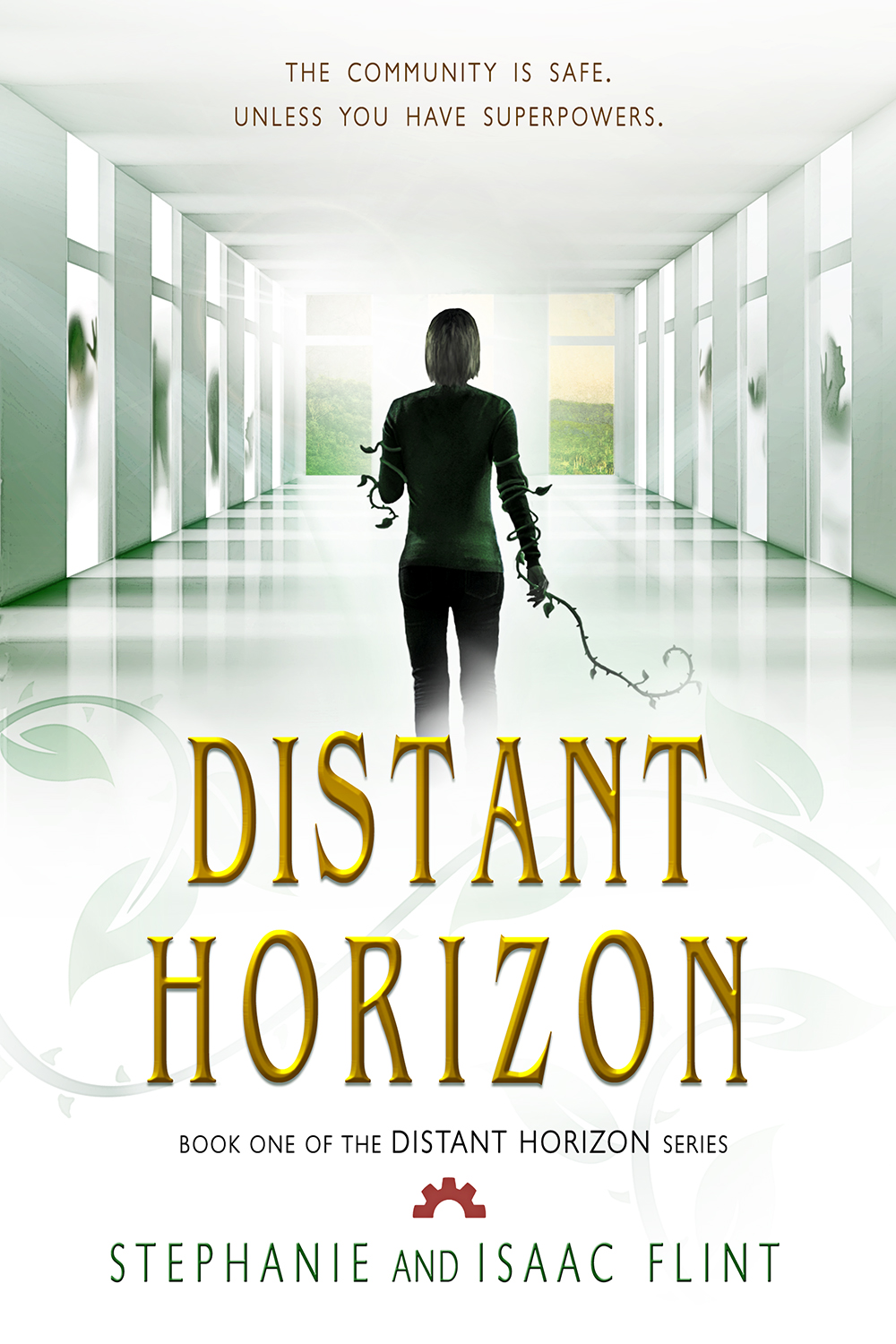
Step 3: Polish the draft. Repeat Step 2 as necessary until I can’t find anything left to polish. I both edit and revise at this point. In some cases, this only takes one or two passes. In others… many, many more. (I really don’t want to think about how many times I’ve read through Distant Horizon. I feel like it’s fairly polished now, but it took several years to figure out this whole writing thing).

Step 4: Send polished draft to beta readers. Step away from manuscript and work on something else while waiting for a response.

Step 5: Ask beta readers questions. Once I have responses from my beta readers, I look through their comments and ask them questions to clarify anything I don’t understand. If one beta reader brings up a question that I think I should ask others, I send them those questions. For Magic’s Stealing, I did this in regards to what age they saw the characters as, as well as the readers’ theories regarding the antagonist. By doing this, I got a broader understanding of problems in the manuscript.

Step 6: Examine beta comments as a whole. Since it has been a while since I last looked at the manuscript, I read through all the comments to jog my memory.

Step 7: Apply critique to one chunk of the manuscript at a time. I examine what all the beta readers said about a particular section (in case there were conflicting opinions), and then applied the appropriate changes as necessary.

Step 8: Read the manuscript aloud. Once a couple sections were completed, I read the revised sections aloud, looking for any areas where I tripped over myself. Since I’m hoping to eventually do an audio edition of Magic’s Stealing, this is especially important. But even if you don’t plan to do an audiobook, reading aloud can help you catch errors or plot holes you wouldn’t catch if you are simply scanning the page. Plus, it’s kind of fun. (My Speech and Debate background likes to kick in here).

Step 9: Make any final adjustments that you know need to be made. For example, I know that the ending of Magic’s Stealing needs a little bit more ‘oomph,’ possibly in the form of one final confrontation with the antagonist. So I’ve been re-examining the rest of the manuscript to see if there are any loose strings there that I can use in that confrontation.

Step 10: Divide story into chapters. If you haven’t done this already, now’s the time to do it. Unfortunately, this is the part I don’t really like. Do I stick with a specific word count? Do I end at a really dramatic scene and have some really long or really short chapters? Should I cut before or after the antagonist view point? Eh… I much prefer revising.

Step 11: Read the full manuscript. If the story is truly polished, you’re only going to be making small changes or adjusting a word here or there. Nit-picking. If you see a major plot hole or flaw, you may want to go back and do further revisions. Each story is different. Like I said earlier, Distant Horizon went through a lot of revisions, and now when I look at it, I mostly nit-pick.

Step 12: Set the manuscript aside. Hand it over to any remaining proof-readers/beta readers. Read through it again after it’s been out of your thoughts for a little while. If readers say you’re good to go, proceed to the next step.

Step 13: Proceed with querying for trade publication or with self-publishing, depending on your goals. For Magic’s Stealing, I’ll be self-publishing, and I intend to print out the manuscript so I can look through it for typos. For Distant Horizon, I’ll intend to hire an editor before self-publishing, since it has been through so many changes that I’m bound to be missing something. The story is also considerably longer than Magic’s Stealing, and has a lot more room for plot holes (Distant Horizon is almost 100,000 words vs Magic’s Stealing’s 31,000 words).

There you have it: my revision process.

I hope you found this post useful. Have you had any revision techniques you found to be particularly helpful? 🙂

Want to share this post on twitter?

Thoughts On Writing – The Revision Process: http://bit.ly/1VcaEAl via @SBibbPhoto

Click to Tweet!

Leave a comment

Filed under Writing

Thoughts on Writing – Humor in Dark Places

After recently watching the full series of Avatar: The Last Airbender, and getting started watching season two of Agents of SHIELD, my husband and I noticed the stark contrast in the style of storytelling. The Last Airbender has a lot of lighthearted humor, with a few dark moments interspersed throughout the series. The first episode in season two of SHIELD is mostly dark with very, very little humor. As such, my husband and I began thinking about the roll that humor can play in the dark moments of  a story.

Let’s examine the two shows closer.

Agents of SHIELD: While the first episode didn’t have quite so many cheesy dramatic pauses that the first season did (one of our qualms with the show), it seemed very gritty and dark. There’s a lot of bad things going on for the characters, so the dark events make sense. Character with brain trauma? Okay. Taking away the one happy point about his character and the entire episode in a big reveal at the end of the episode? Not so okay. The plot twist was actually pretty nice– I didn’t see it coming and it was foreshadowed without being obvious. Good.

But here’s the kicker. During the entire episode, there were a few lines of witty banter, but not much in the way of humor. And without that humor, we didn’t really feel like we had any breathing room. My husband pointed that part out, which reminded me of a blog post by Chuck Wendig about Game of Thrones. Anyway, there was all sorts of awesome stuff happening on screen, all sorts of juicy tidbits that I want to see play out in SHIELD, but if the rest of the season lacks points for breathing, I’m not sure if I’ll really be interested in returning to watch further episodes.

When we watched the next episode, that episode played out much better for us. Despite the heavy matter linked to that previous episode, we had breathing room. Moments of humor, things going right for the good guys, if not completely right, and the character with brain trauma found someone who may be able to help them. The problems are still there, but there were little moments of humor that kept the episode floating, even with the dark moments.

By episode three, I was hooked again. Though I don’t remember many particularly humorous moments (there was one involving a twist on what the viewer expects, due to the information withheld), there were a few, and the action and information was paced well enough to allow for breathing room while still thoroughly holding my attention.

Avatar: The Last Airbender: My husband suggested that part of the problem with the first episode of SHIELD seeming so dark is that we could have used a transition series. We just finished watching Avatar: The Last Airbender. It’s an absolutely amazing series, in which I could easily gush about the characters… (Uncle Iroh is my favorite character, and Toph is so cool…). *Ahem.* (WARNING: There are a few spoilers for The Last Airbender in the rest of this paragraph.) The Last Airbender an anime that, while it has it’s dark, sucker-punch moments (the crazy sister, Azula and when she has her breakdown; Uncle Iroh when he’s in the prison cell and pretending to be a desperate old man (this guy is anything but desperate, so when you first see him groveling, it hurts), also uses a lot of light-hearted humor to break the tension and offer breathing room. Sokka is pretty good at this. He’s the humor guy with some really bad humor, but he helps ground the other characters.

Which brings me to my next point. Stories which are dark can (and probably should) have moments of humor. The main character might not be laughing, but as the reader, we can. There’s many ways to do this. There might be witty banter, a miscommunication, a character reaction that is just too classic that we have to laugh. Or an unexpected reaction. These scenes shouldn’t take a reader out of the story, but they should allow a reader time to breathe.

Continuing with The Last Airbender theme, whenever there was a goofy, over-the-top humorous episode, I automatically assumed that the next episode would probably be dark. There was a case where they had a set of short episodes in one, in which I was trying not to get teary-eyed on the one about Uncle Iroh because he was going about his day all happy and perky, and then it reveals what the day means to him and it was so sad… But in the previous short ‘episode,’ we saw Sokka having a Haiku rhyme competition in which he was trying to impress a bunch of girls. The mix of light and dark moments made for a stronger show, and those moments tied into all of a viewer’s emotions, allowing us to ride a wave without pounding us needlessly against a bunch of really blunt rocks.

Part of this is pacing, knowing when a reader might need time to sit back and take everything in. A story doesn’t have to be entirely pulse-pounding action. Carefully placed moments of humor, or moments of sadness in a comedy (it works both ways, a comedy can have some really heart-rending moments), don’t have to distract from the story. These alternate emotions enhance the story by giving meaning to the other emotion. You can’t have the high without the low, and you can’t have the low without the high. I can’t remember what book series it was (Maybe Pendragon, by D.J. MacHale?), but one of the characters (the villain, I think) said that the most terrible defeat comes after what you think is your greatest victory.

Having both light and dark moments makes the moment when a character succeeds or fails against all odds that much more meaningful.

There was a one-on-one role-play campaign my husband ran in which the team my character was on had suffered some major losses, and one of the characters I cared about had just been captured. Of course we were going to try and rescue the guy. I went into that campaign thinking that at least one of the main team members was going to die, especially since it was the last episode of the story. We’d already had some near misses, and we had recently lost another character who wasn’t the main character, but still very likable. Yet, against all odds, we took the rescue mission by storm, and not only achieved our goal, but far exceeded it… we won. Were we still in hiding? Yeah. But none of the main characters died, and we dealt a major blow to the baddies (at least for the guy who had been a pain-in-the-rear the entire time). It felt like we had saved the world. I actually went and played The World is Saved song afterward.) The feeling was amazing.

But that feeling wouldn’t have been quite so amazing without all the dark moments and the near misses that came before. There were serious moments, but there were also some very humorous moments as well. I look forward to writing those episodes once my current projects are complete. It’s going to be a while, but I have notes! *If I can read the notes. My handwriting while trying to play a character in a campaign is atrocious. There’s scribbles and arrows and half-written sentences everywhere.*

While working on The Little One, a prequel novel to the Distant Horizon series, I had a lot of fun playing with the dark and light moments. The story revolves around a very powerful but childlike spirit who possessed the body of girl who recently died. It’s in a world with powers, but Little One’s powers are beyond normal, and no one is quite sure what to make of her. The scene below is an excerpt from when Knight first encounters Little One, right after she takes the host body for her own and still isn’t quite all there.

The scream had come from the hole, but it didn’t belong to the girl. It was the man’s… a primitive, terrified scream that sent a flock of birds fleeing into the clouded sky. Then everything was silent. Deathly silent, save for the distant cries of the police force who was trying to catch up.

Knight swallowed hard, preparing himself for anything, then raced through the portal.

He was immediately blind. The cave was darker than the night above, and his flashlight and the portal’s glow did little to illuminate the place. He scuttled behind the portal and dropped to a crouch, willing his eyes to adjust quickly.

To his surprise, the sliver of light coming from the hole above him was brighter than he expected. It cast a soft line across the body of a man stretched across the ground. Just beyond him was a little girl, no more than five. She sat on a mound of rocks, swinging her legs.

She looked at Knight.

He looked back.

She didn’t blink.

He did.

He jumped, half expecting her to reappear right next to him, then chided himself when he realized she hadn’t moved from her perch. Late night television getting on his nerves, no doubt. He was wide-awake, on the last vestige of a caffeine high, and he’d been overextending his powers beyond any reasonable hope of a decent morning.

He had every excuse to be jumpy.

But still… shouldn’t a child blink? They couldn’t all be expert stare artists.

Knight shook his head of the notion, determined to keep his wits until he could crash in a hotel room, then slowly stood. “I’m here to help. What happened?”

If this sequence reads the way I intended, there should be a lot of tension. Knight, who’s been running on very minimal sleep and just had a run in with ‘ghosts’ in a previous sequence isn’t sure what’s going on, and there’s a dead body of the man who murdered the girl’s family nearby. Then there’s this little girl sitting on a pile of rocks who isn’t acting quite… normal. But there’s also humor, based on his interaction with the girl and based on his expectations.

I hope you enjoyed this post and found it useful. 🙂

Another good post I found on humor: 7 Tips for Adding Humor by Rhoda Baxter

Want to share this post on twitter?

Thoughts on Writing – Humor in Dark Places: https://sbibb.wordpress.com/2015/07/13/thoughts-on-writing-humor-in-dark-places/ via @sbibbphoto

Click to Tweet!

Leave a comment

Filed under Writing

Thoughts on Writing – How Studying Movie Scenes Can Help With Writing Book Scenes

I’ve been thinking about how movies pace their scenes and use various shots to draw a viewer in. This started after watching an episode of Film Theorists (they’re a Youtube Channel): https://www.youtube.com/watch?v=eyVlnPLaC7s which talked about where some of the common elements of movies got their beginnings.

We can learn a lot about writing scenes in a book by studying the methods used in film. I’m mostly going to take a look at three primary shots used in movies and TV shows: the wide shot, the medium shot, and the close-up. There are several others, though, which can also be incorporated.

For today’s examples, I’m mostly going to be talking about dinosaurs. I recently made some edits to the Multiverse Chronicles story my husband and I are working on (Dragons and dinosaurs and dirigibles, oh my!) And since we watched Jurassic World a week or two ago, that movie is still on my mind. Enjoyable movie, though the deaths didn’t quite hit it right for us.

And I kept wanting to call Owen, ‘Starlord of the Dinosaurs…’

*Ahem.* I digress. Here’s the three primary types of shots we see in movies, as well as my version of shots from Jurassic World (No spoilers, don’t worry).

Wide Shot / Long Shot: When a movie or TV show moves to a new area, they often pan over a larger scene. We get the setting details as to where the movie is taking place. (For example: A plane glides over the ocean and approaches a dense jungle island. (wide shot) Dark green, bushy trees rush underneath the plane (could be a medium shot) and in the distance, a tall pyramid breaks through the foliage, surrounded by a bustling theme park. (wide shot))

Medium shot: After the setting has been established, the movie closes in a bit more on the setting. Not too much, but enough to show who or what the particular scene is about. (For example: (Not related to previous example) Inside a posh, two-story home (a wide-shot), a mother hurries to collect her son from his room (medium shot). The room is a mess of toys, and it’s filled with posters of dinosaurs (medium moving on close-up shot). A curly haired boy sits by his desk with a View-Master in hand. (medium shot))

Close-up: Alternative to a wide shot, you might start with a close-up, then pull back to slowly reveal the surroundings, especially if mystery and tension can be built. (For example: Small cracks form on an alabaster egg. A tiny claw breaks through. It peels back the shell. A slitted, reptillian eye peers out. (All of these were close-ups. As the shot moves out of close-up to a medium shot , we see this:)Behind the dinosaur egg, several scientists wander past the white table, clipboards in hand. (medium shot) They walk around the pristine laboratory, unobservant to the tiny dinosaur. (medium-going-on-wide))

Let’s take a look at the (rough) intro for the Multiverse Chronicles story my husband and I are writing.

Four pterosaurs glided over the cliff-lined coast of Britannia in fingertip formation. Their tawny green backs glistened in the spotty sunlight that filtered through the clouds. The lead drake dipped its wings, following the mental call of its master, and landed on an outcrop of rock just offshore. The other three pterosaurs dropped through the warm, misty air and perched behind it.

As the scene starts, we see the pterosaurs gliding over a cliff-lined coast. A wide shot, to give us a feel of placement. Then we see a medium shot following the appearance of the pterosaurs with their tawny green backs, and finally, a close-up as the lead drake dips its wings. Consider how your mind visualized the image as you read the scene. Does how you visualized the scene follow this kind of sequence?

If you know how a scene looks in terms of the various shots, you can draw a reader’s focus to a particular detail and make it seem more important than before. If a detail is only mentioned in passing, it won’t stand out as much as if you spend a lot of time describing it.

An example from the manuscript of book two of our Distant Horizon series (No dinosaurs here, sorry).

Snow dusted the Community’s long, paved roads, swirling past two-story buildings and pelting my bare face. I wished I’d brought a heavier coat. Lance, my best friend and current partner in crime, tucked his hands under his armpits and grumbled about the wind. Though everything we wore was grey or white, same as the heavy parkas and thick hoods of the people hurrying to work, we had only the lighter jackets we’d left the Community with.

My grandfather, on the other hand, was bundled in a knee-length jacket and scarf, with fitted gloves. He kept his back straight and chin high. A passing security guard only tipped his hat and said, “The Community is safe.”

Pops inclined his head, lips twisted in a smile. “It is our duty,” he replied.

I shuddered and pulled my arms closer, careful not to squish the vines underneath my jacket. Everything I used to believe about the Community… half of it was a well-formed lie even high-ranking officials believed.

We stopped in front of a diner, where blue efficiency lights illuminated the snow outside the window and gave the gray world a little bit of color. “Ready, Jenna?” Pops asked, laying his hands across the top of his cane. His breath came out in short puffs.

Might as well be; we were here.

A blast of warm air whooshed past me, along with the smell of coffee, toast, and freshly scrambled eggs. The diner hadn’t changed much. Same pale colors, swept floors and mended chairs. Pops chose a seat at a round table next to the door, uncomfortably close to the security guards at the table beside us.

The first sentence gives us a feel for the world and setting. It’s snowing outside and cold, and we’ve got a vision of a town with two-story buildings and paved roads. A wide shot. Later, it describes the grandfather as being ‘bundled in a knee-length jacket and scarf, with fitted gloves.’ A medium shot. We see the grandfather and get a feel for his character. Then, ‘He kept his back straight and chin high.’ A close-up, conveying a special detail about him. Later, the characters stop in front of the diner, ‘where blue efficiency lights illuminated the snow outside the window and gave the gray world a little bit of color.’ Personally, I think this straddles the line between medium shot and wide shot, since it shows where the characters are without giving us the full scope of where we’re at. But when we get to ‘A blast of warm air whooshed past me, along with the smell of coffee, toast, and freshly scrambled eggs,’ I’d consider this a close-up, because we’re focusing on particular details. When Pops chooses a seat at a round table, and then we see the security guards at the table next to them, it’s two medium shots side-by-side (or one medium shot that pans across the scene).

That’s my interpretation of the different shots, but I’m not an expert, by any means. These are just my observations. There are several other types of shots and angles that movies employ, and I found several good examples at this site here, if you’re curious: http://www.serif.com/appresources/mlx5/Tutorials/en-us/tutorials/basics_shottypes.htm

By keeping these various shots in mind, you can choose how and when to add emphasis in your own scenes.

Other things to consider is where the focus is placed in a movie. Often, based on depth of field, our eye and attention will follow exactly what the director wants us to watch, even if there’s action happening in the background. A sharper focus on the main character of the scene, while the other characters are blurry, leads our eye to the sharper character. In a story, this happens when a writer gives us more detail about what one character is doing, while maybe only mentioning that another character is there.

This happens in the example, when I mention the people hurrying to work. They’re present in the scene, but they’re not the main focus, so I only briefly allude to them before moving on to the next ‘shot,’ the description of the grandfather. You don’t have as good of a view of them.

If you mention something in your story, the reader ‘sees’ it. Pay attention to this, especially in deep points of view. If you’re writing really close to the main character, and they don’t see something, the reader shouldn’t, either. Now, if you present clues that the character dismisses, but the readers can piece together, that’s a bit different. It links back to my earlier post I wrote about foreshadowing.

Another trick you can employ from movies is evoking the sense of slow-motion. This happens by paying attention to several particular details in a sequential action. One of my favorite examples of this is in Brandon Sanderson’s Steelheart. I don’t want to spoil the scene itself, so I’m not going to give all the details, but during the scene a gun is fired, and due to his description of each of the little details (the trigger being pulled, the hammer striking, the movement of the bullet), it felt like the scene was moving in slow motion, much like a movie sequence.

There’s a lot you can do with description to create pacing and enhance the world, and by choosing which details to focus on, you can employ cinematic effects in your writing.

Knowing how to employ these shots might also prove useful when creating book trailers.

I hope you enjoyed this post, and let me know what you think. 🙂

Want to share this post on twitter?

Thoughts on Writing – How Studying Movie Scenes Can Help With Writing Book Scenes: http://bit.ly/1V0vGBL via @sbibbphoto

Click to Tweet!

4 Comments

Filed under Writing

Thoughts on Writing: Author Interview at Cathleen Townsend’s Blog

Just a head’s up if anyone’s interested, Cathleen Townsend interviewed me at her blog today: http://cathleentownsend.com/2015/07/07/interview-with-stephanie-bibb/

Check it out, and if you like that one, she has a few other author interviews on her blog, as well. Enjoy. 🙂

Leave a comment

Filed under Writing

Thoughts about Publishing – Fireworks and Photoshoots

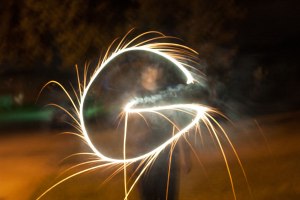
IP---Fireworks

A photograph from our fireworks photo shoot for the book trailer. The ‘scrying bowl’ from Magic’s Stealing.

Over the weekend, my husband and I visited my family for the Fourth of July. Among the things we did… per usual tradition… was to purchase fireworks. In previous years, we’ve typically picked up an assortment of fountains, smoke balls, and sparklers, then headed across town (or recently) up the hill in the evening to watch the fireworks from the city display. Over the years, the people around town have been picking up the big fireworks, so this year we watched them from the front yard. (And I made chocolate chip cookies during the lull… yum!) Anyway, we didn’t find any smoke balls for sale, but we did pick up a couple smoke canisters. The goal? To use the one day we had available to shoot off fireworks in a city area to get potential footage for the book trailer.

IP---Fireworks1

The setup for the 3D camera, ‘scrying bowl,’ and smoke canister.

While we don’t know for certain we’ll use the footage, the shoot was a lot of fun… and very smoky. Me, Isaac, and my dad headed up the hill, scoped out a decent spot for us to lay the bowl and the canister (we brought a couple bottles of water in case the canister didn’t fire properly), along with the 3D camera (it has video capabilities) and the DSLR. I set up the tripod for the 3D camera and kept it low to the ground, then once that was set up, Isaac lit the canister. I shot several still images with the DSLR for potential book cover usage, while Dad kept an eye on what the wind was doing with the smoke. Afterwards, we watered the area around the canisters and set them aside to cool. Dad went back the next day to throw them away.

IP---Fireworks

A still shot from the book trailer video shoot for Magic’s Stealing.

IP---Fireworks

Me having fun with Isaac’s Ultrasaber.

Later that night, I remembered a few photoshoots I’ve done previously using smoke balls and an FX lightsaber (I’m a Star Wars fan). I suggested that we should get a couple more smoke canisters (like Isaac suggested in the first place) and use Isaac’s new Ultrasaber to make long exposure shots. We each got one canister, and we took turns running around in the smoke, trying not to breathe it, to get the various effects. We also shot off a fountain, continued watching the surrounding fireworks show from the neighbors, and played with the sparklers and long exposures to see if we could get any ribbon-like effects for the Magic’s Stealing book cover. We had a lot of fun, and my parents joined in on playing with the sparklers. (We usually take turns lighting the sparklers and twirling them around). And I got poppers. So much fun…you throw them on the ground and they make light and noise… *Happy sigh.* Like my grandma said, “we had a party!”

IP - Fireworks

Isaac got creative with his sparklers and made various video game characters…

The next day we taped a bunch of streamers left over from party streamers ‘fireworks’ to a fan, then took both video and long exposure shots. We got a lot of abstract images, which are great for creating magical effects for the book cover.

IP---Fireworks

Long exposure of streamers for book cover art.


All in all, Isaac and I enjoyed combining our work with play. I hope you enjoyed this post, and I hope you had an enjoyable weekend, regardless of whether or not you celebrate the Fourth. 🙂


Leave a comment

Filed under Book Covers, Business Ventures, Photo Illustration, Writing

Thoughts On Writing – Foreshadowing

I was talking to one of my beta-readers the other day and they got me thinking about foreshadowing. Foreshadowing is important to having a satisfying ending, especially if the reader doesn’t see that ending coming. Without foreshadowing, readers may feel confused and lost. That’s okay if that’s the effect you’re going for, but be warned, sharp turns, like on a really rough, old, wooden roller coaster (I’ll take the smooth metal ones, thank you), can leave a reader nauseated if they aren’t prepared.

For example, I once critiqued a short story which started out sounding like a pleasant memoir. Kind of happy-go-lucky scenes, but the story rambled. It lacked direction. A couple plot points seemed out of place with the tone of the rest of the story, but they still felt… normal. Then, out of nowhere, there was a rather graphic scene that scarred the character (and the unsuspecting reader). In all fairness, I don’t mind stories that have some graphic violence, but in this particular story, that scene came out of the blue. It wasn’t satisfying. Had the foreshadowing been stronger, I think the scene could have worked perfectly, but the author wasn’t inclined to make changes to the manuscript that would allow such foreshadowing to take place. Their story, their say, but that incident did get me to start thinking about how important foreshadowing is to a story’s plot.

Some foreshadowing happens intentionally. You leave clues for the reader to create an expectation about what’s to come. This can occur within a short scene, across a book, or across a series. You might see this in the form of a prophecy. An example of this can be seen in Lord of the Rings movie, when the leader of the ringwraiths tells Eowyn (who is concealed by her armor), “No man can kill me,” and she replies, “I am no man,” then proceeds to defeat him. Prophecies are ripe with foreshadowing, and my favorites are the ones that seem clear but have double-meanings. The Sight, by David Clement-Davies, also uses prophecy to foreshadow events, and then twists the prophecy’s meaning to have a different ending than expected. With foreshadowing, those twists are exciting, rather than confusing. Take a look at any Twilight Zone episode. These shows often take unexpected turns, but those endings were cleverly foreshadowed so that the viewer has an ‘ah-ha!’ moment. Suddenly all the puzzle pieces fall into place and the viewer understands.

Something Wicked This Way Comes by Ray Bradbury also has several examples of foreshadowing. The story revolves around two twelve-year-old boys who discover a dark secret about the carnival that has come to their town. Throughout the book, the tone is dark, sinister, foreboding. Before the carnival arrives, we know a storm is coming because a lightning-rod salesman announces the coming of a storm and proceeds to gift the boys with a lightning-rod that has been adorned with various ancient, mystical symbols. But when the storm arrives, it’s not a lightning storm, as predicted, but the mysterious carnival with a dark, illustrated man and his tricks. The lightning-rod’s ancient symbols hint at the coming dark magic, and even (as the story later reveals) that the magic is ancient. Later in the story (Warning, spoilers ahead!), Will’s father (who has been foreshadowing the sinister purpose of the circus through his unease and concern) discovers that his laughter hurts the dust witch (who is absolutely creepy in her own right). Faced with the chance to confront her during a so-called ‘bullet trick,’ he carves a crescent moon into the bullet before firing. The crescent moon isn’t a moon, however, it’s a smile, and it kills her. (As a side note, the end of this book had me daydreaming an entertaining My Little Pony crossover where Pinkie Pie must face off with the Illustrated Pony…)

Foreshadowing allowed the ending to make sense, and for the reader to anticipate how the main characters would defeat the evil carnival. Readers keep reading in hopes of seeing if their theories prove true.

In a sense, foreshadowing is a shadow cast by the future. It can be a pale shadow, a single line or reference that hints at what’s to come. Or it can be a heavy shadow, a constant application of tone and mood and imagery. Characters may have suspicions (incorrect or not) about the future, which you can use to foreshadow events and to create lovely twists when the reader least expects them. Foreshadowing creates questions that entice a reader to keep turning pages. If you have a genre shift in your book, foreshadowing may be immensely important to keeping readers on board. Foreshadowing is a way to help readers suspend disbelief. Same with characters. If they’re going to need an obscure skill later to save the day, showing this early on, even in passing, allows the reader to believe in the character when the time comes.

Another kind of foreshadowing is the kind you don’t mean to add. Sometimes you write subtle hints into the story that you read later, which point at the outcome even though you didn’t realize you wrote them. There’s a line in Distant Horizon that stopped me cold after I’d written the rough draft of Glitch, a sequel in which one of the main characters dies rather horribly to save their friends. I remembered writing the line, but I hadn’t realized the potential impact it would have and how true it was. Granted, the line only has impact if you read Distant Horizon after Glitch, but it does provide a little bit of set-up for the character in question.

I also use foreshadowing heavily in The Little One, a prequel novel for the Distant Horizon series. Little One is a childlike spirit who has a number of chilling visions which eventually come to pass in one way or another. In several of the scenes (as they currently stand, since I still need to do edits), she references a rising sun. The rising sun is a reference to a symbol in the later stories, but, aside from being an Easter egg for readers, these scenes are meant to add to the story’s mood. The scenes start off lighter and become progressively darker. I’ve truncated a few scenes and edited them to make sense out of context:

First scene where the sun is referenced as foreshadowing…


One morning, Knight had gotten up early to use the restroom and found Little One staring out the window in her make-shift bedroom. Tiny rays of pink sunlight flickered across her face through the trees.


“It’s pretty,” she said absently.


He wandered around the foot of the bed and squeezed in beside her. The air conditioner tickled his feet from the floorboards, and early light twinkled across his eyes. He blinked. He hadn’t really watched the rising sun lately. Most the time he was sleeping. Or if he was headed to work, he was planning out his day. Not watching the sun slowly grow and ascend.


“It’s changing,” Little One said.


He glanced at her. “Yeah. It’s because of the earth’s spin and–”


“Not that. It’s different.”


He tried to tell if there was anything different from this sunrise than all the other sunrises he’d ever seen, but it looked the same as any other sunrise.


Little One shook her head. “It’s different. Just a little. Small. But it’s different.”


Knight twisted his lips. The kid seemed attuned to the subtle variances an adult couldn’t see, and he didn’t want to think about what those variances might be if she had insight for a power.


Later…


Knight sat down the drawings. There were images from Little One’s dreams, but there were other drawings, too. Swirling night skies and rising suns. And each time, Little One drew the sun just a little bit darker.


Later…


Hawk looked one more time at the drawing scribbled on his wall. On the far side, scribbled between the happy images of trees and squirrels, was a rising red sun, with five rays extending from it like spokes, but each cut off halfway through their usual extension.


Later… (One of Little One’s visions)


The poster was blurred to Little One. She paused, taking a second look. She couldn’t see it well, save for the red, rising sun of her usual vision. Then reality shifted. The normal colors downgraded, passing through a dark veil. The sun twisted and darkened, shrinking on itself until only five tiny rays remained, red as fresh-drawn blood. The buildings loomed and darkened, and the crowds thinned… as if a film had been placed over them, and the people raced and ran as flames consumed the new night, warping the street until the colors ran together and bled into one dull, monotonous grey.


Later… (near the end of the story, after a major battle scene)


Behind the city, like a crimson cog, the storm sun rose, its light sending spoke-like rays through the dark thunderheads, and basking the city in a bloody glow.

Note… that’s from the rough draft. I still need to go through and do edits.

There’s a lot of foreshadowing in The Little One for the entire Distant Horizon series. The Little One is a prequel, and the character has ‘insight,’ a power which lets her know more than she should, so it’s to be expected. Those scenes were a lot of fun to play with, and I wonder how different readers will read the various scenes…. especially depending on whether they read The Little One first or the other stories first.

Alternatively, let’s look at Magic’ Stealing. The antagonist has a lot of room for foreshadowing, but beta-readers have pointed out that the references seem odd and pulled them out from the story. There’s a reason those references seem odd, but I want the story to read smoothly, and as much as I don’t want to cut the references, I’m planning to do so (leaving the less obvious ones). Foreshadowing should serve the story, and in this case, beta-readers confirmed that I needed to try a lighter method.

I hope you enjoyed this post and found it helpful. What are your thoughts on foreshadowing? Have you read anything where the foreshadow did or didn’t work well? 🙂

4 Comments

Filed under Personal Work, Writing

Thoughts on Publishing – A Blurb for Magic’s Stealing

As I get closer to publishing Magic’s Stealing, I’ve been compiling the various elements meant to catch a reader’s attention. While a lot of emphasis is placed on the book cover (and I’ve realized the current version I’m considering may be better suited to the third book, so I’m debating what I might use instead for the first), after the cover, a reader inevitably sees the blurb. The blurb should show what the book is about and entice a reader to either buy the book, or at least take a look inside.

However, as a writer, we’re so close to our stories that it’s hard to see what will draw the reader’s attention. I’ve posted my current idea for a blurb on Absolute Write (which is a very useful source of information for authors), and I’ve come up with two slightly different versions. The question is… which works better? Short and snappy? Or more details about the world?

In order to get a little more insight on the subject, I read through a few articles that discussed what makes a good blurb (see the links below if you’re interested), and came up with a list of elements to consider:

  • A sense of the main character(s). Who and what kind of character are they? (For Magic’s Stealing: Toranih is a young noblewoman who would rather have a sword in her hand than use magic to heal or throw fireballs.)
  • Just enough detail to show the type of story and what makes this book different. (For Magic’s Stealing: there’s a kingdom, magical ribbons, mages, shadows who are impervious to mortal weapons… and this is where I start to wonder if I need to hone in on the description)
  • What the main conflict/plot will be. (For Magic’s Stealing: Almost all magic is stolen from the kingdom, leaving two young mages–one of whom doesn’t like magic–to protect their home.)
  • A question that entices the reader, or leaves them wanting more. (For Magic’s Stealing: Will Toranih successfully adopt the responsibilities of a mage so she can fight the shadows? Or will she fail and cause her home to perish?)
  • Offer a taste of the writing style. (Maybe I can include a tiny clip at the beginning of the description. You know, those story bites usually seen in italics?)

These are the current versions of the blurbs that I’m considering for Magic’s Stealing.

Short Version:

Toranih would rather have a sword in her hand than use her powers to heal or throw fireballs, and as a result, her magic skills are lacking. But when the kingdom’s magic is stolen, she’s one of the few whose powers remain. With former mages dying from magic withdrawal, and the looming threat of an army of shadows who are impervious to mortal weapons, she must either adopt her neglected responsibilities as a mage or watch her home perish.

Long Version:

For centuries, ribbons of magic have provided the kingdom of Cirena with light, healing, and protection. Then, in a span of minutes, those ribbons fly from their masters, stolen, save for the ribbons of two young mages. One of these mages is Toranih, a noblewoman who never liked magic to begin with. The other mage is her best friend, Daernan, a gifted shapechanger who uses his magical sight to track the vanishing ribbons. Toranih would rather have a sword in her hand than use her powers to heal or throw fireballs, and as a result, her skills are lacking. But with former mages dying from magic withdrawal, and the looming threat of an army of shadows who are impervious to mortal weapons, she must either adopt the responsibilities of a mage or watch their home perish.

So my question to you is this: Which blurb, if either, holds your attention, and do they entice you to ‘look inside?’ Why? Or if you neither holds your attention, why not?

I’m concerned that the shorter one may read too fast, but that the longer one may loose readers with unnecessary information. One solution I’m considering is that Smashwords offers both a short and long description for retailers, and as such, I could use both descriptions in their respective sections. Anyone who wanted more information could click to read the longer description. In the meantime, if whichever description I choose for Amazon doesn’t seem to be working, I can try switching it out for the other and see which one works better.

I hope you enjoyed the post. Are there any blurbs that worked well for you? Anything you’ve found that didn’t?

A few articles I found particularly helpful while researching the subject:

http://romanceuniversity.org/2011/11/23/5-top-tips-for-writing-a-compelling-book-blurb-by-amy-wilkins/

http://kristenpham.com/2014/01/14/how-to-write-a-great-ya-fantasy-or-sci-fi-book-blurb/

http://www.thecreativepenn.com/2010/11/16/how-to-write-back-blurb-for-your-book/

http://www.lightmessages.com/lm/index.php/blog/writing/229-how-to-write-a-book-cover-blurb

6 Comments

Filed under Business Ventures, Personal Work, Writing

Thoughts on Publishing – Book Trailers

Isaac and I have been considering ways to promote our books once they’re ready. I’ve got a cover in mind for Magic’s Stealing, along with a couple possible blurbs, but we both agree that having a few other promotional materials meant to pique the interest of readers would be handy. One promo piece we’re considering is that of a book trailer.

Love ’em or hate ’em, a good book trailer catches the eye of a potential reader and either gets them to investigate what the book is about, or get them to make that final step toward picking up a book they’ve been on the fence about.

In order to get a feel for what makes a good book trailer, we perused Youtube and watched various (mostly young adult) book trailers. The below is our subjective conclusions.

Elements of a Good Trailer:

  • Music that fits the tone of the book. Compare the kind of music found in movies to your genre. A suspense might have suspenseful music. Horror might have music that is jarring or creepy. Action might be fast paced. Use music (make sure you have the right licence) to help convey genre to the reader.
  • Use cliches to catch interest… sparingly. If your book turns a cliche on its head, such as having a gladiator woman instead of a man… you might want to focus on that. Or you can hint at similarities in your book to other stories. For example, I showed my husband the book trailer for Throne of Glass (Note: I haven’t read the book, so I don’t know how well the trailer matches it), which starts off with a silhouetted version of the character on the cover. Isaac’s first reaction was ‘is this Assassin’s Creed?’ Since the book is about an assassin, then it makes sense that people who enjoyed Assassin’s Creed might enjoy a book about an assassin. Using similarities to other books, games, or movies allows the reader to consider that, if they enjoyed the other story, they might enjoy this one, too.
  • Set the theme. Convey the mood and tone of the book, and offer a sense of setting. This was often done using the imagery and/or animation shown. But also show what makes this book different from other books with similar themes… why readers should pick up this particular book.
  • If you already have a fan base from an existing prequel, touch on what excited them about the first book, but don’t leave new readers without a sense of what’s going on.
  • Include the name of the book and the author, along with when and where it will be available. Include buy links once available, and make it easy for a potential reader to buy your book. Don’t forget to include the cover of the book somewhere in your trailer, so readers can link the trailer to the book when it comes time to buy it.
  • Give readers something to remember. Granted, be careful not to use a cheesy gimmick unless the story calls for it, but if the reader remembers (and likes) the trailer, they may be more likely to pick up the book later, if they choose not to buy it immediately. If the reader doesn’t remember the trailer, they may not be as likely to pick up the book if they come across it later.
  • If writing non-fiction, give a sense of what the book will be about, introduce the author… maybe include a bit of humor, if you’re the kind of author who uses humor in your book.
  • Simplicity is your friend. You may not need a voice-over or a bunch of flashy images. Sometimes a simple ‘what if’ hook will catch a reader’s attention, as can using more ‘booky’ graphics. Words on the screen, skillfully placed, can be effective.
  • When comparing book trailers to movie trailers, Isaac and I noticed that the movie trailer showed the type of characters involved (such as a strong female protagonist and the rough-but-romantic guy). Movie trailers were typically faster paced, and those trailers focused on higher-budget graphics (something books often don’t have… the graphics or the budget). Movies that disappoint in theatres often show clips in the trailer that don’t deliver a consistent feel once you watch the movie.

Elements of a Bad Trailer:

  • Audio: Some trailers were obnoxiously loud or really quiet and hard to hear. Or the dialogue wasn’t clear. Be sure your potential reader can understand what is being said.
  • Too much telling, and/or a trailer that goes on too long. If you go on and on… and on… you may loose the reader. Worse, they may assume your book will drag, too.
  • Don’t quote your blurb verbatim. Readers will read that when they look at the book. Give the reader something new or expand on something that might interest them. You want a hook.
  • Cheesy lines. This can be hard to judge, because certain tropes are common, but make sure your dramatic pauses are actually dramatic… and don’t have you rolling on the floor in a fit of giggles.
    • Unless that’s the kind of story you’re trying to tell. If so, then by all means do so. I bought one book because the campy humor of the trailer was too entertaining to pass up.
  • Too distracting. If the trailer uses flashy elements and distracting colors, or elements that seem out of place, readers may be too distracted by those elements to remember what the actual book is about.
  • Don’t have ads on your book trailer. Seriously… the trailer is an ad. Readers don’t need to see unrelated Youtube ads popping up on the screen while we’re trying to watch it. Having other ads (when you can control them) impedes the message you’re trying to send out.

One thought I had during this whole process was to create a ‘teaser’ for the book rather than a ‘trailer.’ The idea would be to convey a small, interesting part of your story (For Magic’s Stealing, an example might be to voice over a section of the story where the antagonist, Shevanlagiy, is speaking to a rival. The teaser could therefore show what the protagonist is going up against. For example, there’s a line in the current draft of Magic’s Stealing where she say: “I’ll destroy everything,” she whispered, “if it gives me the power I need.” Granted, a little more context might be helpful.) For a trailer, you want to give a sense of the story as a whole. But for a teaser… one trailer we saw used a small bit of dialogue, a small scene that might have been directly from the book to show what the protagonist is dealing with. But it didn’t necessarily say a lot about the larger story.


I hope you enjoyed this post, and in the meantime, Isaac and I will be considering the above when we go to make a trailer for Magic’s Stealing. But what are your thoughts? Have you found any book trailers to be particularly effective (or ineffective)? 🙂


If you want to read more about book trailers:

http://therumpus.net/2013/06/fantastic-book-trailers-and-the-reasons-theyre-so-good/

https://www.goodreads.com/topic/show/1348243-what-makes-a-good-book-trailer

http://www.thecreativepenn.com/2011/01/07/how-to-create-a-book-trailer/


Example trailers, you be the judge of good or bad:

(Note, I haven’t read all of these. I just watched the trailer.)

Throne of Glass: https://www.youtube.com/watch?v=j_t1kXaDtRQ

An Ember in the Ashes: https://www.youtube.com/watch?v=sbvyCrkVT7M

Matched: https://www.youtube.com/watch?v=xaeNWL8rlBI

Steelheart: https://www.youtube.com/watch?v=6sC9NtpXLH4

The One: https://www.youtube.com/watch?v=qVDfV7gCCFE

Fire: https://www.youtube.com/watch?v=IEiijD-tV5M

The Monstrumologist: https://www.youtube.com/watch?v=B4V-biapntE

How to Catch a Russian Spy: https://www.youtube.com/watch?v=W2frzMX4IWM

The Glass Arrow: https://www.youtube.com/watch?v=G20Qz172G4s

Divergent: https://www.youtube.com/watch?v=tu5Erw-posg vs. https://www.youtube.com/watch?v=sutgWjz10sM

Virals: https://www.youtube.com/watch?v=MeBCqpUmPSU

Half Bad: https://www.youtube.com/watch?v=UIcpalOypmo

Three: https://www.youtube.com/watch?v=Zs46WskvpGU

Replica: https://www.youtube.com/watch?v=G62U728THG0

Existence: https://www.youtube.com/watch?v=_pUWjgCTTVg

The Raven Boys: http://maggiestiefvater.com/blog/the-animated-book-trailer-for-the-raven-boys/

The Young Elites: https://www.youtube.com/watch?v=F9VTgbB0dWg

Minder: https://www.youtube.com/watch?v=8lv6eC3E-9k

The Friday Society: https://www.youtube.com/watch?v=xs5rXZrglf4

Miriam Black: https://www.youtube.com/watch?v=gcR1B-48lK4

Leviathan: https://www.youtube.com/watch?v=PYiw5vkQFPw

The Flame Alphabet: https://www.youtube.com/watch?v=YMhEAIDclbI

Reboot: https://www.youtube.com/watch?v=adUV6qZgZdQ&index=8&list=PLogL8GFmSgvnNjVhWtvSFjawIn0HlzTRN

Leave a comment

Filed under Business Ventures, Photo Illustration, Writing

Thoughts on Writing – Aging Up Characters

I’ve been getting feedback from beta readers for Magic’s Stealing, and one of the comments that has been fairly consistent is that the characters (which I intended to be around twenty years old) feel like they’re twelve- to sixteen years old, effectively making the story sound like it’s aimed at a middle grade or the lower end of the YA audience. Which isn’t a bad thing… if I meant for my characters to be younger. However, I’m hoping to get them to sound like they’re at least eighteen, so it’s time to consider what’s making them sound younger, and what can be done to make them sound older. 🙂

To start with, once I knew that their age was an issue, I sought feedback from the beta readers. I needed to know why these characters were sounding younger.

1. Their actual age isn’t mentioned until later in the story. This leaves their age open for interpretation, and by the time a reader gets to the point where their age is mentioned, readers already have a solid idea of the characters’ ages in mind. (As a side note, there’s a book I read recently, Renegade by J.A. Souders, in which a certain intimidating character is revealed to be a child. The story is told in first person by a character who is brainwashed into thinking nothing of this, so she’s not surprised, but it is a twist for the reader. As a reader, I personally loved that twist. However, it did take me a little while to hold the image of a child in my head, rather than that of an older teenager. In  my current manuscript, I don’t want this kind of surprise for the age of my main characters, so I may need to bring up their ages sooner).

2. The characters act younger. In the opening scene, my main character, Toranih, is nervous because she’s been hearing footsteps and thinks she’s being watched. As soon as she ‘turns out the light,’ she dives under the covers of her bed. Personally, I love the image. However… this isn’t what we typically picture an older person doing. Therefore, the first impression is that Toranih must be younger. An option to fix this may be to have her consider diving under the covers, but she forces herself to walk calmly to bed. Or she may walk calmly to bed but reference that she’s going to bed with a knife at her side. Or… some combination thereof. Haven’t decided yet.

Darkness flooded Toranih Covonilayno’s sleeping chambers as she mentally extinguished her magic crystal’s light. She dropped the crystal on her dresser and rushed to her bed, then dove under the covers.

Silly, she knew, but the last few nights had brought strange creaking noises from the attic, soft footsteps and the brushing of rough wool on the edges of the wooden floorboard above. She listened now, waiting to see if the footsteps returned.

3. Lack of romance. The current draft doesn’t show much in the way of a romantic interest between the main characters. Now, that’s not to say you must have romance in a story to make it YA or adult, but without romance, this story seems like a more likely candidate for an MG novella. When I go to edit, I plan to hint a little more at the (lack of) romance between the main characters. I’m toying with the idea of having Toranih and Daernan ‘technically’ courting (mostly so Toranih can keep her father from trying to point other suitors in her direction, since she’s not necessarily interested in Daernan romantically), while Daernan actually does like her. Increases tension in the story, and gives a better clue about their age.

4. Expectations for the type of fantasy. Especially in YA, we seem to get a lot of hints that the teenage main characters are either actively seeking (or avoiding) marriage. These worlds have their characters finding partners at a younger age. In Magic’s Stealing, I’m going with the idea that the characters live longer and have a tiny bit more ‘modern’ of a society (with magic taking the place of electricity, but in an older setting with kingdoms and lords and ladies). However, to pull this off, I’m going to have to show more of their world. We need to see older characters walking in the streets. Maybe a reference to food spoiling when their ‘magic refrigerator’ no longer has magic to keep food cold. Maybe a reference that going to an academy for magic, versus sticking around and getting married, is a common occurrence. I’m considering having Toranih’s sister, Siklana, already be accepted into an academy (think college), rather than expecting to be accepted at the end of the month. Maybe she’s back at the manor because she’s visiting, and she’s planning to oversee the festival that takes place at the beginning of the book. And maybe Toranih actually is studying swordsmanship, rather than dreaming about it, but her lessons are private since she can’t convince her father that being a guardsman is fitting for a lady of her status (but she can’t pass her magic exams, so… what else is she going to do?). There’s a lot of world building opportunities here, and the great thing is that these changes don’t have to be major alterations.

5. Lack of (graphic) violence. Though there are a couple battle scenes, we don’t really see much blood spilled, and nor do we get graphic depictions of the shadows who are burned. Now, this doesn’t mean it isn’t for older readers, but it makes it more open to an MG audience. That being said, I’m  considering adding a bit more detail to these scenes, partially for the impact they have on the main characters, and partially so that once we get to the second book, it doesn’t come as a surprise when we actually start seeing more violence coming into play. Doesn’t mean it’s going to be gratuitous. Just means that the MC is going to be distinctly aware of what’s going on around them.

Her friend had backed into a rocky cove, but he was using that to focus his attention on the growing force of shadows in front. He shifted back and forth, thrusting each hand separately and delivering a blast of air or a blast of fire, to which they ducked and dived away.

The shadows shied from the wind, but they hated fire. They scuttled aside when his magic seared their hands and scalded their weapons. They sent new shadows to fight while they nursed their burns. Those burns healed, but slowly. And one shadow lay dead on the floor, burned beyond recognition, and did not appear to be healing at all.

Toranih shuddered. If these were mortal men, Daernan wouldn’t be using fire like this.

But fire did hurt them, and they weren’t mortal men.

6. How other characters perceive them. The antagonist refers to the main characters as the ‘boy’ and the ‘girl.’ Granted, from a god-like character who can’t die, it makes sense that she’d view these characters as being childlike. But with this scene placed early in the novel, it doesn’t help the perception of the main characters’ ages as being younger. I’ll probably keep these kinds of references for the actual deities, but at that point, the actual ages for the MCs should be established, so the reference should hint more at the internal thoughts of the deities in question.

A cloaked figure knelt beside a sprawling sycamore near the girl’s window, her eyes trained on the two owls.

Finally, they’re gone, the figure thought to herself. She climbed up the tree, bark catching on the tips of her leather boots, then slipped inside the open window. The room was dark, but the light crystal glowed with residual energy and lit the bare essentials.

The girl had rearranged the furniture since the night before. No night table or pile of books, and her usual set of sparring knives didn’t hang from the wall. Probably locked in the chest at the foot of the bed, or buried under the mattress.

There’s a lot of little things that could affect the perceived age of the main characters, and with a few tweaks here and there, I think I can have them sounding like they’re at least eighteen. And it’s worth noting that I do read a lot of YA and the occasional MG book. Therefore, it isn’t surprising that my narrative voice would lean that direction.

I hope you’ve enjoyed this post, and now it’s your turn. Have you had any experiences with your writing or reading where characters don’t sound like the age that they’re supposed to?

6 Comments

Filed under Personal Work, Writing

Thoughts on Publishing – Pricing the Novella

Today, let’s talk business: What are you willing to pay for a novella?

When I went to ConQuest, I knew full well that I planned to fork over twenty bucks for a hardback copy of a book that contained two of Brandon Sanderson’s novellas. Sure, they’re available for purchase in ebook format for considerably cheaper, but having the hardback is nice, and I’m a fan of his work. (A note here: I’m the kind of person who likes having a hard copy, be it paperback or hardback. I’ll happily read non-fiction pertaining to publishing on my Kindle, but I have a difficult time reading fiction.) Anyway, I got the book signed at the convention, and I’ve read one of the stories (Perfect State) thus far. Even though I haven’t read the second one yet, spending that twenty dollars was worth every penny.

But not everyone is going to feel that way, and not for every book.

From the business perspective, I’ve got to figure out what readers are willing to pay for each book. Do I want to come up with a single, standard price range, or price them individually, according to length, genre, and various other factors? I don’t have the advantage of hiring a super-awesome illustrator for the cover art, or a top-of-the-line editor to make sure there aren’t typos. Not to start with, anyway (though I’ll sure do my best to find as many typos and errors as I can before I hit ‘publish’). Can I  make sure that the stories are the best they can be? Can I make sure that they are worth a reader’s hard-earned money?

I’ve determined that The Wishing Blade will be a series of (probably three) novellas. I’ve got the first one written, and it’s going through the process of being beta-read. Now the question I’m pondering is this: What should I price this novella, once I’ve completed edits and created the cover art?

On one hand, it’s a novella, so it’s not as long as a novel. I’m not sure how much money readers will be willing to spend, especially for an unknown author. While I do have several free pieces of flash fiction available on Smashwords, the style of writing varies, so it is unclear how many readers who download the freebies will be interested in the paid stories. I can’t price the stories as high as someone who already has a fan base. On the other hand, I’m trying to start a business. Which means that I actually need to be making money. The joy of self-publishing is that I get to wear two hats. I’m the creator, the author, and I’m also the business woman. So… provided that the stories are of a decent quality: engaging, not many typos, decent formatting, and good cover art, what should a novella be priced at?

I’m mostly going to look at Kindle’s (non-Select) pricing strategy, but I intend to sell on Smashwords as well:

99 cents: Not necessarily a bad spot for a short story, and many authors offer their novels at 99 cents as a way to promote their other works. However, the 99 cent price range only offers 35% royalties (I think it’s closer to 50-60% royalties on Smashwords, given that my “Ashes” short story, priced 99 cents, earned 56 cents after a Smashwords 10 cent cut and 33 cents transaction fee). The downside of this range is that people may pick up a 99 cent book on a whim, then forget about it because of the “it’s only a dollar” mentality.

$1.99: Long considered “the dead zone” in ebook pricing. I read a Smashwords report showing a trend of $2.99 vastly outperforming $1.99, and 99 cents doing just a bit better than the $1.99 range. Also keep in mind that Kindle only offers 35% royalties here. Not a lot of incentive to try this range, though I’ve seen trade publishers discount higher priced books to $1.99 on Book Bub. However, without actually testing this price range, it’s hard to say how well it performs for a specific story.

$2.99: Seems a bit high for a novella, with so many novels selling for $2.99, but is it? (See below list of example novella prices). At 2.99, Kindle authors get 70% royalties.  That’s around $2.00, versus 70 cents from pricing at $1.99, or 35 cents from pricing at 99 cents. And technically, if you hope to sell your novel at $4.99 or $6.99, that’s not too bad.

Now, one catch here is that I’m currently looking at the US dollar pricing. I haven’t even started to look at the UK or other territories. I’ll have to decide whether to try the retailer’s automatic price comparisons, or take a look at what’s selling in those stores and price it directly. This could be a bit difficult, though, given that the Amazon sites for other territories doesn’t show much what price they’re selling at. (Feel free to chime in with your thoughts on pricing, regardless of what currency you buy books with).

Here’s a few examples of novella length ebook prices in USD, from both independent and trade published authors (Note: I haven’t read all of these, I just did some research):

  • Perfect State by Brandon Sanderson sells for $2.99. I think it classifies as a novella. “Mitosis,” a short story from his Reckoners series, sells for $1.99.
  • Fairest by Marissa Meyer sells for $9.99 (46,600 words per Renaissance Learning)
  • The Invasion (an Animorphs book) by K.A. Applegate  sells for $5.99  (33,000 words per Renaissance Learning). Novella length, though meant for a younger audience.
  • Out of the Storm by Jody Hedlung is offered for free on Amazon. (The description suggests this is an introduction to her Beacons of Hope series).
  • Icefall by David Wood sells for $2.99 (approximately 30,000 words per article about the novella, and per Smashwords).
  • Elixer by Jennifer L. Armentrout sells for 99 cents (part of The Covenant Series).
  • Peacemaker by Lindsay Buroker sells for $2.99 (40,000 words, per her blog post).
  • Better World by Autumn Kalquist sells for $2.99. (A prequel novella to a novel series).

By the way, Renaissance Learning is great for finding the word count of books, especially middle grade and young adult. http://www.arbookfind.com/default.aspx

One of the textbooks I was reading recently, which focused on small business management (never mind that it’s from the earlier 90s), talked about the perception of value when marketing a product. There were two factors considered: quality and price.

A note on the chart below: an unknown indie author does not mean low quality, simply untested. Unfortunately, many people still perceive self-published books to be of low quality, whether they are or not.

High quality and high price: Serves clientele with expensive tastes. (Think of a Big 5 publisher selling an ebook for 13.99 from a big-name author).

Low quality and high price: No one buys the product, because the perception of value around it is muddled. (Think of an unknown author selling their ebook at $13.99).

Low quality and low price: “Cheap.” Not highly valued, but considered a decent price. (Think of how 99 cent indie novels are often perceived).

High quality and low price: “A good deal.” (Think of a Big 5 publisher running a $1.99 ad in Book Bub for a regularly $9.99 ebook).

So, at this point, I’m thinking of making Magic’s Stealing available for $2.99. It’s currently sitting at 30,000 words.

I hope you enjoyed this post. 🙂 What are your thoughts and experiences in the matter?

If you’re interested in further reading on the subject, these are a few of the articles I read while doing my research:

Leave a comment

Filed under Business Ventures, Writing