Tag Archives: Isaac Flint

Thoughts on Publishing – Pricing an Indie Card Game

Isaac and I have been working on our upcoming card game, Battle Decks: Trials of Blood and Steel, and we had a gaming-experienced friend come by a few days ago to test the game. He gave us a lot of great advice that we’re now looking into implementing. Our date of release may have been pushed to a later date now, but we should have a better game for it.

In the meantime, Isaac and I have been thinking about how to price Battle Decks, as well as how to make it available to the largest number of people (and still make at least a small profit).

Currently, we’re printing Battle Decks through The Game Crafter, a print-on-demand company for tabletop games.

The downside with any version of print-on-demand is the cost. For books, this has become increasingly better over the past several years, and it is now reasonably possible to be competitive with traditionally published books). For tabletop games… they could use a bit more work.

But here’s the problem. Since a customer typically only buys one game at a time, the cost per game is relatively high (at least compared to what you would find in stores). This can be offset by purchasing a large number of games in bulk, but for a small business, this quickly adds up.

Take, for instance, our current version of Battle Decks with all its bells and whistles (four glossy rules pages, a pair of dice, 108 tokens, 126 cards, and the box). The base cost for buying just one game is $28.00, not including shipping. Once you add the cheapest shipping–short of will call (sorry, we’re not traveling to Wisconsin to pick up a box)–we’re looking at $36.00 per game. That goes down to $26.50 per game if we buy ten games at once, but when we add shipping, the price comes to $303.00, or roughly $30.00 a box.

(Note: Shipping costs may vary by location.)

Say we chose to purchase ten boxes at $30.00 a box. We still want to make a profit. If we sell them ourselves, we could offer them for $40.00 a piece and make $10.00 per game, minus sales tax if we factor tax into that cost. However If we take it to a store and ask them to sell it, they’re going to want a wholesale discount. I expect stores want at least a 35% discount off the retail price, and the one store I’ve spoken to thus far preferred a 50% discount off the retail price. Which means that, if we sold our game at $40.00, we’d be selling the game to 35% stores at 26.00 (we lose $4.00 per box), or at $20.00 to 50% stores (we lose $10.00 per box), which basically means that price isn’t feasible.

So, if we push the price of the game up to $50.00, the 35% store wants the game for  $32.50 (we make $2.50 per box), and the 50% store wants the game for $25.00 (we lose $5.00 per box).

However, now we risk pricing the game too high for potential players to take the risk on a new game.

Now, keep in mind that I haven’t done nearly as much research on what stores want in regards to purchasing indie games as I have with books,  so it may be that they want a lower discount. But given that many stores offer discounts to their customers (such as a 10% student or military discount), and they also want to make money (make sense, since they need money to stay in business), and indie games don’t usually have the name recognition that traditionally published games do to help keep those games selling, rather than sitting on the shelves, untouched, I expect that stores will want a decent-sized discount. (Note: See the comments below for input regarding wholesale discount ranges from an experienced seller. According to him, 50% is much less likely to be the norm than a 35% or smaller discount).

I’ll be doing more research in the form of talking directly to stores in the future, once we have more funding available to do a bulk purchase.

In the meantime, yikes.

Our best bet of keeping the game somewhat affordable and still making a small profit is to sell online. However, we’re still looking at a roughly $35.00 to $40.00 game, plus the cost of shipping.

So how do we make the game more accessible?

There’s a few possible options that I’ve found thus far.

Print-And-Play

While browsing The Game Crafter website, Isaac and I noticed that a few games (card games, in particular), had print-and-play editions. With a little more research, and I discovered that Cards Against Humanity has a free print-and-play edition as well as their regular edition.

Basically, a customer pays a small fee (.99 cents to a few dollars) to purchase a PDF file with all the cards ready to print. They print the cards, cut them out, and read any rules that come with the game. They can start playing almost instantly. No shipping time, and low cost.

The downside is the lack of quality control. If a player’s printer renders cards dark or blurry, it may turn other players away from the game. Or maybe the cards aren’t printed on card stock, and shuffling is therefore terrible. (Cards Against Humanity gets around this by putting a set of instructions at the front of their PDF with suggestions on how to print quality cards).

The other downside is that if your game has a lot of cards, and the player uses their own printer, they may end up using a lot of ink.

So… Isaac and I are thinking this isn’t the best alternative option for Battle Decks.

Card-Only Variety

Another option we’re considering is offering a stripped-down, card-only version of the game. No dice, no tokens, a smaller box, and online PDFs you can download and print at your leisure.

This brings the cost of each box down to roughly $17.00 (plus shipping), and if we wanted to make a $5.00 profit, we could offer the game online for $22.00. Shipping would be anywhere from $3-$9, (not sure, since I couldn’t put an unproofed game in my cart). But it’s considerably more affordable, and suitable for players who have plenty of dice, don’t typically use tokens, and don’t mind printing the rules themselves.

We’re thinking of offering the full edition of Battle Decks, with all the additional pieces, along with the card-only version, which gives players more options in regards to how much they want to spend on the game, and how they want to play the game.

Character Cards Only, and Players Use Free Trial Print Version with Proxy Decks

The final option we have considered is offering a small pack of just character cards. (18 cards in a poker card wrap). Base cost $5.00, plus shipping (probably around $3.00, given the piece of one of our other purchases with a slightly larger tuck box).

The idea behind offering only the characters is so that people who play the trial edition (which is a PDF we plan to release that shows players how to proxy the game using poker decks, and includes a single team for each faction) can enhance their game-play while still using the proxy decks, thus making the game more accessible by offering an even lower cost.

However, this only works if you don’t mind using proxy decks. At the moment, I’m leaning toward offering a card-only variety of the core game, in addition to the full version.

Note: These prices may change over time depending on what is being offered at The Game Crafter. Also, further research is needed to determine what indie games of this particular type would reasonably sell at.

Anyway, those are our current thoughts and theories. We haven’t actually tested selling the game with any of these methods.

I hope you enjoyed this post. 🙂 If you were to buy a new, indie card game, how do you prefer to buy it? What prices do you feel are fair?

Further Reading:

http://gamedev.stackexchange.com/questions/27490/how-do-you-decide-upon-the-price-for-a-game – (2011 article, so information may be out of date) One of the people on this webpage make a great point about pricing (indie computer) games based on what platform you’re selling them from.

http://positech.co.uk/cliffsblog/2011/05/08/indie-game-pricing-pressures/ – (2011 article) This article talks about indie (computer) game pricing pressures. It’s a bit off in regards to how books are produced, but the comments do show concern at an expectation for low prices. Those comments also show example of higher-priced (and high-quality) games selling well).

http://danielsolisblog.blogspot.com/2011/09/q-on-card-game-design-costs-and-prices.html (2011 article) – This post details a card game with components, and what pricing various people consider fair for that game

http://gotgeniusgames.com/kickstarter-topic-4-manufacturing-a-card-game/ – Details on card deck pricing from various printers. (I haven’t read through this yet, but it looks like it has potentially useful information)

https://boardgamegeek.com/thread/926760/card-games-what-price-too-high – Discusses profit difference between core games and expansions.

11 Comments

Filed under Business Ventures, Gaming

Thoughts on Publishing – Infinitas Publishing Status Report

All right, the time has come for another status report. 🙂

When Isaac and I first started Infinitas Publishing, we created an Excel file that listed our goals for releasing our books and games. Some of those are completely in the works (they haven’t yet been started), while others already have a fairly polished draft and just need editing.

Either way, I figured it would be a good idea to take a look at our current projects every once in a while and see how everything is going.

Here are the current projects:

The Wishing Blade: Magic’s Stealing -The ebook is now available and I’ve run our first giveaway via another author’s blog. I have finished formatting the interior file for the paperback edition, and I’m adding the final touches to the wrap-around book cover. I hope to order a proof copy in the next few days.

In the interests of time and money, Isaac and I chose to purchase the $10.00 custom ISBN at Createspace. It lets us list our imprint as the publisher, though we can only use that ISBN when printing through Createspace. Since it will be a while before we can try distributing the book through a site like Ingram Spark, we figured the printing restrictions should be worth it for the time being. At least this way we can have a print edition available (and through the money we saved by waiting to buy a universal block of ISBNs, we can now purchase a box of print books to sell and give away). I’ve also talked to a couple local book stores about stocking copies of the book, so we’ve started making headway there.

The Wishing Blade: The Shadow War – I haven’t made much progress here. I’ve got a partial rough draft from when I was writing Magic’s Stealing, and I’ve got some plotting in place (a few blog posts should be coming from that, too), but that’s about it. This is my next project after I finish editing the first half of Trials of Blood and Steel. Since I have the basic formatting in place from Magic’s Stealing, preparing the ebook and paperback editions shouldn’t take quite so long. We’re off-target on our planned time of this release, but we’ll see how the writing and edits go.

The Multiverse Chronicles: Trials of Blood and Steel – Isaac has finished writing the main plot, and he’s made quite a bit of headway on the “meanwhile” end scenes that go at the end of each episodes. Our plan is to polish the first thirteen episodes (of 28-ish? Haven’t divided all of them yet), and then begin releasing each episode. I’ve got twelve of those thirteen episodes edited, and after I finish episode thirteen, I’ll be editing the end scenes. Then I’ll run through the full thing one more time for continutity before doing a read-aloud with Isaac to make any further changes. Then I’ll proofread on paper, and afterwards we’ll start to release an episode a week.

I’ve begun setting up the Multiverse blog, but the main info still needs to be added, along with creating an episode guide and the main graphics. Due to the nature of this project, we’re considering holding off on beta readers, but otherwise, the first episodes should release on schedule.

Battle Decks: Trials of Blood and Steel – We’re currently on par with this project. We plan to read through our edits of the rules this weekend, and then we’ll be ordering a new proof copy with the edited cards. If everything looks good, we should be able to release on schedule. We still need to create a how-to video, but we’ll need the updated proof to complete that. If all goes well, this should be available in November.

SBibb’s Photographic Illustration – Not part of Infinitas Publishing, but still something I need to schedule (plus, it helps with the initial funding of the company). I have a few book covers to work on, so I’ll be doing those in order of due dates. This is one of the things I’ll be working on this weekend.

I hope you’ve found this post interesting. Once we have solidified release dates, I’ll make them public 🙂

4 Comments

Filed under Business Ventures, Writing

Thoughts on Writing – Transitions and Adding Emotion to a Scene

Every couple of weeks, my husband and I meet with the local writing critique group. While there, everyone shares relevant announcements, and we usually critique a small section of each other’s work.

Last week I brought in an episode of The Multiverse Chronicles. My husband plots and writes the first draft, which I then polish. Most of the other episodes haven’t been too problematic, but this particular episode was giving me issues. I’d already tried editing it a few different times, but it still sounded… flat. I knew the transitions weren’t quite working, but something else was missing, too.

Once I read the piece aloud, the group pointed out that it lacked the usual description and emotion I tried to invoke. Thus, having someone who is familiar with our work can be helpful.

Critique partners can see the things which usually embody our work, even if we can’t.

So, after applying the basic suggestions the group made, I went back and sought ways to deepen the emotions of the main character, along with boosting the imagery in each of her “flashbacks” so that the reader would feel better grounded in the reality of the story.

For example, this is what one section looked like while I was still having difficulties editing it:

Trish had been at camp for seven days now, and thus far her training had consisted of textbooks, tests, practicing basic commands with her pterosaur (which, she noted as she stared at the starry sky, still remained nameless), and meeting with Colonel Pearson.


The meetings were the worst.


“Ivers, you seem to be making good progress,” the colonel would say, trailing his finger along a clipboard of notes, “but—” Always, that annoying ‘but.’ “—you need to work on your skills. Have you remembered to meditate with your drake?”


She flexed her shoulders. Maybe he never mentioned meditating with the pterosaur, but he usually gave her some unimportant task that she needed to complete.


“Ah-ha! Now here is a test that will measure your skills on meditating. Don’t forget to read chapters seven through nine of The Honor of Tactical Flying.”


Trish sighed and bit off another chunk of her granola.


The camp had only one copy of each book, which meant Trish had to go to the quartermaster to check them out.

Not only does the scene need a bit of tweaking in regards to transitioning the flashbacks, it also lacks a sense of the surroundings, and the emotion behind it feels dull.

This is what the section looks like now that I’ve added more description and focused on the emotion:

This was her seventh day at camp, and thus far her training consisted of textbooks, tests, practicing basic commands with her pterosaur—which, she noted as she stared at the starry sky, still remained nameless—and meeting with Colonel Pearson.

(Note that using em dashes instead of parentheses have improved the flow of her thoughts)


She inhaled the brisk air at let it out slowly, counting down from ten to relax her thoughts.


The meetings were the worst thing about being here.

(We’re starting to get a sense of her impatience)


The colonel would trail his finger along a clipboard of notes, tap his chin thoughtfully, then meet her gaze with his piercing blue eyes. “Ivers, you seem to be making good progress, but—”Always that annoying ‘but’ “—you need to work on your skills. Have you been meditating with your drake? Surely you haven’t forgotten.”

(The use of ‘would’ following colonel suggests that she’s thinking about this, not that it’s happening right now. Plus, ‘piercing’ eyes (however cliche) denote that she’s uncomfortable). Adding ‘Surely you haven’t forgotten’ gives her that feeling of being put on the spot. Already, we’ve got a lot more emotional details and descriptors to ground us in the scene)


Trish flexed her shoulders. Maybe Pearson had never mentioned meditating with her pterosaur, but he usually gave her some unimportant task that she needed to complete. Like checking the feed levels of the other pterosaurs, or cleaning the cages while the riders were out, or reading.

(By saying ‘Maybe Pearson had‘ shows that we’re back in the present. And the list of complaints continues to show mounting agitation)


So much incessant reading.


“Ah-ha!” Pearson had exclaimed upon skimming through a tiny red booklet that Trish was fairly certain should have been titled A Thousand Ways to Torture Private Ivers. “Now here is a test that will measure your skills! Read chapters seven through nine of The Honour of Tactical Flying, then report back for your next assignment.”

(By having the line ‘So much incessant reading’ on it’s own line, and then going to ‘ “Ah-ha!” Pearson had…’, we make room for another flashback. The choice of ‘incessant’ further shows Trish’s annoyance. And then we have ‘A Thousand Ways to Torture Private Ivers.’ She feels she’s being treated harshly.)


Colonel Pearson had grinned, tossed his clipboard on a stack of papers, then dismissed her to her chores.

(I’m debating on the phrasing of this, but currently, saying that Pearson ‘had’ done this cues that we’re coming back to the present)


Trish sighed and bit off another chunk of her granola.

(Yay, monotony…)


On the bright side, she didn’t have to go through all the same physical drills as the other riders. She got her exercise from running tent-to-tent, trying to locate the miscellaneous items she needed to please her superior officer. The camp had only one copy of each of the primary textbooks, which meant Trish had to go Corporal Smith, the quartermaster, to check them out.

(Adding the bits about her having to run from tent-to-tent and locating miscelleneous items adds to the feeling that she doesn’t think this is important… especially since she doesn’t bother to consider what those miscellaneous items are)

Overall, I think the edited section reads more like the other scenes now. The flashback transitions read smoother, and there’s enough detail to ground me as a reader in what is happening. Plus, we now have a sense that Trish is genuinely annoyed and impatient, rather than just ‘ho-hum’ about her daily life at camp.

I’m still in the process of editing the rest of the episode, but now that I know where to go with it, I think editing will go much smoother.

If you’re in a problem spot, see if you can find a trusty beta reader or critique partner to take a look, even if it’s just a small scene. They may be able to see what you’re missing, especially if they’re familiar with your work.

I hope you enjoyed this post. Have you found any tricks to adding emotions to a scene or transitioning flashbacks?

***

By the way, author Jordan Elizabeth was kind enough to feature my book on her blog, Kissed by Literature. Check it out to find another sneak peak of Magic’s Stealing, and to see what other books she has featured. 😀

Also, Cathleen Townsend has written the first review of Magic’s Stealing! Find it (and other reviews) at her blog, The Beauty of Words. 😀

2 Comments

Filed under Writing

Thoughts on Publishing – Infinitas Publishing Status Report and First Chapter of Magic’s Stealing

Where does the time go? My day job started up again a couple days ago, and I’m currently readjusting my schedule to be able to be productive and not spend all my time daydreaming about what happened in the role-play campaign that my husband and I just finished this week. (A main character got a bittersweet ending… not the ending he was hoping for (he’s a fourthwaller), but an ending that left him reasonably happy and with his mind intact).

Anyway, while I’m readjusting my after-work patterns,  I thought I’d do a quick status report on the projects of Infinitas Publishing

When Isaac and I started up our business this summer, we created a rough schedule of when we would like to release our books and games. It’s something we created for our own personal use, which gives us an extra push to actually publish things, rather than getting into an endless loop of editing. It’s also a good measure for us to use in terms of how much time we have until we complete a project, even if we don’t release the prospective dates to the public. This should give us a little more wiggle room for when our planning inevitably goes astray.

For Magic’s Stealing, I’m about a month behind on my goal (Shh… don’t tell anyone), but I’m in the final phase. I’ve already got it formatted as ebook, except for the table of contents (easy to do, but needs to be different between Kindle and Smashwords editions), and I’m working on the final proofread for typos on printed paper. Once that’s done, I’ll put it up for pre-order and reveal the cover. Look for that coming soon… which I also need to update on the main website. A few months after that I am hoping to make the paperback edition available.

For Battle Decks: Trials of Blood and Steel, we’re on par. We’ve already ordered the initial proof copy (which I posted about a while back), got feedback, and made edits. I’ve updated the box title to Trials of Blood and Steel instead of Multiverse: 1953, based on further feedback, along with updated the rules (still needs to be proofread) and fixed the cards for consistency (cards now say +2 ATK instead of +2 attack, etc). Once we have the rules proofed, we plan to order a second copy of the game to make sure all of our edits are input correctly. We also need to recreate the trial edition of the game with rules specific to the trial (that way we don’t confuse players with irrelevant rules, such as how to choose heroes for each faction). Based on our current schedule, we should be able to release Battle Decks as planned.

For The Multiverse Chronicles: Trials of Blood and Steel, we should still be on par, but we’ll see as we get closer to our planned release date.  Isaac is currently working on the rough draft of episode 19 of the 24 expected episodes, though some of those we’ve planned to split, so we may be a bit further ahead (and there may be more than 24 episodes). I’ve gotten ten of those episodes edited and semi-polished, ready for us to do the full read-through and see how everything meshes together. I’ve got partial edits done on episode 11. However, once those are complete we will need to send out the episodes to beta readers to look for errors, and then polish the first few episodes to release online. We also need to prepare the blog site where we’ll be publishing the story. The first four episodes need to be ready to go before we release Battle Decks.

Beyond those projects, which are up for release by the end of this year, I also have plans for The Shadow War, (book two in The Wishing Blade series).The first draft is partially written (but requires changes), and I’ve been plotting the rest of the story and making sure it will flow easily into book three. The upside of my day job is that I have plenty of time to plot while I do greenscreen work on photos.

Once I have a definite date for these projects, I’ll make them public.

In the meantime, please enjoy the first chapter of my upcoming YA fantasy novella, Magic’s Stealing. 🙂

Magic’s Stealing


The Wishing Blade - Section Break - Magic Swirl ONE The Wishing Blade - Section Break - Magic Swirl

Darkness flooded Toranih Covonilayno’s sleeping chamber as she mentally extinguished her magic crystal’s light. She tossed the crystal onto her dresser and hurried to her bed. The silk covers rustled as she slipped underneath, where she felt for the leather hilt of the knife under her pillow.


The last few nights had brought strange creaking noises from the attic, soft footsteps and the brushing of rough wool on the edges of the wooden floorboard above. She listened now, waiting to see if the footsteps returned.


They did not.


Instead, wind whistled through a tiny crack in her bedroom windowsill. She peeked over the covers. A shadow passed by the heavy curtains and she clasped the smooth fabric between her fingers.


Ridiculous.


She kicked off the covers, knife in hand, and hopped out of bed. She waited, just in case the shadow returned. Then she walked to her dresser, picked up the crystal, and carefully raised the light again.


The dresser was pristine, with only an oil lamp sitting in the dustless corner. A small oak chest at the foot of her bed remained locked with steel. Heavy brocade curtains obscured the window.


No sign of intruders.


So why couldn’t she shake the feeling that someone had been watching her?


She dimmed the crystal’s light until the room was cast in an eerie twilight, but the only magic present was her own. The crystal’s faint light revealed thin, lime green ribbons of magic floating around her, while glowing turquoise ribbons darted in and out of the crystal.


Her older sister, Siklana, had created the artifact for Toranih when she was little. Few could see magic without a crystal. Whenever a mage used their ribbons to do… well… anything, she couldn’t see the cause.


And what she couldn’t see, she couldn’t fight.


Toranih sighed. She was seventeen now, and she wasn’t afraid of magic. She just didn’t like it. There was a difference.


Something tapped the glass. Toranih shrieked, fumbling with the crystal. She clutched it to her chest and spun toward the window. A cluster of ribbons danced around a small form on the other side.


Well, are you coming? Daernan’s telepathic voice flitted through her mind, amused.


Of all the times for him to show up unannounced—


She dropped the crystal on her dresser, sheathed the knife, then flung open the curtains. “Don’t scare me like that!”


A small, brown, ostensibly cute owl peered at her with bright yellow eyes and giant black pupils. Daernan, judging by the white ring of feathers crowning his left eye.


The owl shrugged and puffed out his plumage like a feather duster. Not my fault you’re so jumpy.


Toranih crossed her arms. Though dim in the moonlight, the crystal’s twilight revealed various blue and yellow and pink ribbons swirling thick through Daernan’s owlish body.


Coming? The pink ribbons carried Daernan’s thoughts to Toranih’s mind, and she fought the urge to swipe them away.


Toranih knelt beside the window so that she was eye-level with the owl. He tilted his head and blinked. She snorted. “I’ve been expressly forbidden from attending the festival,” she said in the most high-and-mighty voice she could muster. “So, no. I’m not coming.”


Not that she minded missing the event. Too much magic and too many people teasing her about when she and Daernan would make their courtship a formal engagement.


She turned from the window, lit her oil lamp, and then mentally killed the crystal’s light.


The ribbons vanished.


Let me guess. Your father wasn’t happy that you challenged Lady Ikara to a duel, then respectfully threatened that she ought to let her fiancé fight for her, lest you knock her off her high horse onto her—he mentally coughed for effect—her lazy ass?


Toranih shrugged. “She insulted you. Good excuse not to go.”


The owl sighed, best an owl could, before tapping the window with his beak. Can I at least come in?


She obliged him with a flip of the latch. Then she plopped onto her bed. The owl swooped inside, changing as he went. By the time he landed, the owl had morphed into a young man with shoulder-length brown hair. A patch of white hair ran through his bangs above his left eye.


Daernan stood from his crouch and shook himself like a dog that had just run through a pond. He looked as he usually did, no more dressed for the festival than any other day. Only a simple cotton tunic and loose fitting breeches, along with a leather belt that Toranih had helped to etch and dye. That belt had been an experiment, to say the least. Daernan proved much better at drawing the various creatures than she had. An owl, a shaggy dog, a horse… his favorite changes.


He tossed her a green velvet satchel. “I know you don’t like this holiday, but that’s for you.”


She scowled, dangling the satchel by its cords. “Really?”


If Daernan had brought her spicy cocoa flowers, like last year, she would swear to Shol that she’d make him pay the next time he tried to duel with her.


Daernan shrugged and leaned against the dresser, perilously close to her oil lamp. “Don’t worry, it’s not flowers or ribbons, or anything silly that you wouldn’t like.”


“I didn’t get you anything,” she said. Well, technically she had, but she’d planned to give him the owl-shaped ginger cookies she’d bought for him tomorrow, when the gift wasn’t linked to Aifa’s Night.


“In that case, you could make it up to me by coming to the parade.” He smiled hopefully.


Toranih raised an eyebrow. She dug into the satchel and paused when her fingers touched cool metal ridges. She withdrew a brooch made of sterling silver. The metal had been crafted into a raven that held a wreath of flowers in its talons. Small and not particularly gaudy, the piece would look nice pinned on the pouch she normally wore on long horseback rides.


Daernan rubbed the back of his neck self-consciously. “I might have lied about the flowers. I hope you don’t mind.”


“It’s…” She let out a breath and smiled. “I like it. Thanks.”


He grinned. “I commissioned the crafter whose goods you keep eyeing.”


“I do not!” Toranih had done her best not to let anyone catch her eyeing the metalsmith’s jewelry… just his weapons. They might think she’d gone soft.


“Sure you don’t.” Daernan chuckled, then glanced around the room. “Redecorated?”


“The room was cluttered. I cleaned it.”


“You? Clean something?” Daernan raised an eyebrow. “Who are you and what have you done with Toranih?”


She scowled. “There were too many things someone could hide behind.”


His smile faltered. “You still think someone’s watching you?”


“I heard noises last night. I checked the attic, but nothing was up there. I even used the crystal to look for magic.” She kicked her feet against the bed and sighed. “I know I don’t have enemies, but someone’s been in here.”


“Lady Ikara, maybe? She isn’t exactly friendly towards you.”


“Oh, please. She could run my ear off but I don’t think she could tell the difference between a dagger and a dirk.”


“She doesn’t have to know the difference to stab you,” Daernan pointed out.


Toranih punched his shoulder.


“Ow! I’m just saying!”


She snorted. He wasn’t helping. Lady Ikara wasn’t the kind to go snooping around the manor, and Toranih’s father, Lord Covonilayno, had relatively few enemies. Though he was officially a viscount who oversaw the day-to-day proceedings of Viyna, he was also tasked with guarding the kingdom’s armory, so most nobles chose to stay on his good side.


Daernan sighed. “The parade is starting soon. If you really don’t want to be seen, we can go as owls. There’ll be dancing…”


“Which we can’t enjoy since we’ll be owls.”


“Free food…”


“As owls? Do you want mice? Besides, you get free food anyway. Everyone likes you.”


“They like you, too,” Daernan protested.


“They bow and curtsy to me.”


“Unless you challenge them to a duel.”


“There is that.” Toranih grinned and eyed the raven brooch. Lady Ikara could sniff the air all she liked, but she wouldn’t keep calling Daernan a street mutt. Besides, he did have claim to noble lineage, even if his father wasn’t around to prove it. His mother permitted the commoners to tend to their estate in return for access to a small cottage inside the city. No one paid attention to the fact that she had married into nobility.


Seemed that was how she liked her life.


“And we’ll get to watch all the mag—entertainment.” Daernan closed his mouth quickly.


Toranih rolled her eyes. “Magical entertainment, right. Know what? You go. Report to me in the morning about all the beautiful light showers and flashy streamers, and don’t forget to tell me how the gracious Aifa blessed the newlyweds. If you get back here before sunrise, you might even beat Siklana to the story.”


Her sister always did like magic. She cast enough for the two of them.


Daernan groaned and tugged Toranih’s arm. “Come on—it’s no fun if I go by myself. And everyone’s expecting us, even if we are owls. You should come.” He beamed, giving her his kingdom-class puppy-dog eyes.


She swallowed uncomfortably. “This is a bad idea.”


“Please? It’ll be fun. I promise.”


Toranih sighed. Sometimes she wondered if he had ribbons of the persuasive nature, though she’d never caught him. Wasn’t likely, anyway. That kind of magic was rare.


She rose from her bed and set the raven brooch beside her prized lamp. Then she raised her crystal’s light until it was just right for seeing magic. After she extinguished the oil lamp, she focused on her royal blue ribbons and stretched her arms, her palms open to the ceiling. Tickles rolled through her fingers, then her hands, then her body. Blue ribbons swirled around her, merging into a thick smoke that rushed to her toes. She shrunk. Her bones mended into the form of an owl. Her magic glowed bright, twisting and fading with a heartbeat of its own.


 Ready? Daernan asked, already perched on the windowsill.


Toranih killed the crystal’s light and hopped toward the window with her leathery feet.


She preferred raven form— though it wasn’t much better—but at least now she could see.


Daernan hooted. Let’s hurry—the show should be starting! He dropped off the windowsill, his wings outstretched, and caught the air with a quick swoop.


Toranih cringed. What would happen if she hadn’t made the change properly? What if she didn’t actually fly?


The ground teetered beneath her, perilously far from the ledge. She spread her wings, prayed to Shol she wouldn’t crash, and dropped into the night.

* The Wishing Blade - Section Break - Magic Swirl *


A cloaked figure knelt beside a sprawling sycamore near the young woman’s sleeping chamber, her eyes trained on the two owls.


Finally, they were gone. She climbed the tree, bark catching on the tips of her leather boots, then slipped inside the open window. The room was dark, save for moonlight, but it was just enough for her to see that the young woman had rearranged the furniture since the night before.


No night table or pile of books, and her usual set of sparring knives didn’t hang from the wall. Probably locked in the chest at the foot of her bed, or buried under the mattress.


She didn’t bother to check, though, instead stopping beside the dresser and stroking her fingers across the light crystal. It responded eagerly, and turquoise ribbons flared to life.


She quickly extinguished the crystal and peered into the distance, waiting to see if her own sight revealed the magical ribbons that would signal the two’s return to investigate.


The night remained empty.


The only magic she saw was her own. The rest of the family was at the parade.


But there was something new in the room. Ashen moonlight shone through the oil lamp at the edge of the dresser. Skewed light reflected onto a metal brooch—a brooch with a raven and a wreath of flowers.


The intruder held her breath, reaching her fingers toward the jewel piece, then quickly withdrew. She couldn’t leave any trace that she’d come. That meant leaving objects where they’d been found.


She left the sleeping chamber for the hallway. Bronze wall sconces flickered with pale, turquoise light across elaborate tapestries. The crystals cast shadows along the crimson throw rugs, each one embroidered with curling gold patterns.


She paused, recalling the two owls flying into the night.


Always strange to see the young woman, but stranger still to see Daernan alive.


She wrapped her cloak tight around her shoulders, then traveled the familiar stairs downward, downward, and deeper—under the manor and into the kingdom’s dwindling armory.

Stay tuned for cover reveal and release date! 😀

3 Comments

Filed under Business Ventures, Personal Work, Writing

Thoughts on Publishing – Guest Author – The Importance of the Title

Quick Announcement: Thank you to everyone who pitched in with their thoughts about which author photo they liked best. I’m currently deciding between 1 and 4, and I plan to announce which one I’ll primarily use when I do the cover reveal for Magic’s Stealing. Thanks again!

* * *

Today I’m doing something a little different. Today my husband (and co-founder of Infinitas Publishing), Isaac, is going to be a guest author. He’s written a post about the importance of a title.

Take it away, Isaac! 🙂

* * *

Author Photo - Isaac FlintHere is a quick little brain exercise.
Recall a chapter, short story, or article that you’ve recently read. Now imagine trying to sum that up in 500 words. Now try summing that up in a two-to-five word phrase. This phrase needs to be eye-catching and communicate the essence of the work.

This phrase is the title.

Creating an effective title in real life it is not an easy task. Arguably, the title of your work is one of the most important things to keep in mind when trying to attract the attention of an audience. This can be especially true if you are a new, unknown author, since the people browsing through your book don’t know you or your style. If your book is shelved face-out, the first thing readers are likely to notice when they pick up your book is the cover art. After that, they read the title. But odds are that your book will not be face-out on a bookshelf. The book will show only its spine, so the title is all a potential reader gets. Together, the title and the cover must persuade a reader to look at the back-cover blurb. And while some readers may overlook a tacky cover, if the title is bad, the book may never leave the shelf.

What makes a good title?

First, many good titles are similar to the other books in their genre. Why? Wouldn’t it be better to be the rebel and make your title stand out from the rest? The answer is often no. When readers–or anyone buying a new product–are looking for something different, they are not likely to go for something totally different. They are likely to try something close to what they already know they like.

Thus, when an author of a mystery novel names his new book My Puppy, Spot, odds are she won’t do as well as if she named her novel The Canine Case.

There are two reasons for this. The first being that the title of a book is often used by readers to identify what genre it belongs to. (For example: Magic’s Stealing is decidedly fantasy). The second has to do with a psychological phenomenon known as the ‘mere exposure effect.’ Simply put, the mere exposure effect states that people are going to prefer things they have already been exposed to, over new things. This is not always the case, but there is a definite trend.

Second, a good title can set the tone without a blurb or cover art. Many young adult dystopian titles will use a single subject as their title, such as the trial or hardship the protagonist must face, to set the tone. For example: the Frost Trials. On the other hand, many romance stories will use a steamy phrase or specific fantasies as their title. For example:  Arctic Pleasures.

In Frost Trials, ‘frost’ sets the reader up for a cold setting, while ‘trials’ tells the reader the protagonist is going to be under pressure to pass some kind of test. Opposed to Arctic Pleasures, in which ‘Arctic’ implies somewhere exotic, even dangerous, and ‘pleasures’… well… you get the point.  

Now try to image how well a young adult novel about the life of a teenager living in post World War III Alaska, which is titled Arctic Pleasures, would sell. The title might get someone to read the blurb, but they are going to be in for a big letdown.

Third, the title must be relevant to the story. Not only does Arctic Pleasures set the wrong tone for our post-war Alaskan protagonist, but it’s also not relevant. Sure, the story takes place in the arctic, but it’s mostly about finding one’s self in a desolate, frozen wasteland while trying to survive the harsh climate and undead polar bears.

Not exactly an arctic pleasure.

As the author, you might know the connection, but the new reader won’t.

For example, my wife and I are writing a series of short stories currently titled The Multiverse Chronicles: 1953. We named it such because it takes place in an alternative dimension in their year of 1953. However, after reading a couple samples to our critique group, it became apparent that this name was misleading.

Why?

In our alternative universe, the progress of technology has been hindered due to many of its people using magic-like powers. Thus, their 1953 looks more like ‘18’-53 (Okay… technically it’s a tad bit later than that, but the point remains).

When we told our critiquers the name of the story, they were confused. From the title, they expected propeller-driven airliners and cars with white-rimmed tires and fenders, not dirigibles and motor carriages.

These are few things to keep in mind when creating titles for any type of writing, unless you want to go bold and create a title that will have your readers confused about what your book is about when they pick it up. However, this is not an all-inclusive list, more like a little brain exercise.

Also, all the titles mentioned in this are fictitious save for Magic’s Stealing and The Multiverse Chronicles: 1953, so if anyone now wants to write the steamy version of Arctic Pleasures, have at it.

* * *

Thanks, Isaac! 🙂

Now I thought I’d chime in with a couple notes. Having a strong title is important even before your book hits the shelves. In traditional publishing, a strong title can make your query stand out among the other queries in an agent’s inbox, sometimes speeding up the long wait for someone to read your manuscript.

The other thing to keep in mind is whether or not there is already a similar title out there. For example, you might find that certain keywords, which are great titles in themselves, have already been used.

In some cases, this isn’t a problem. You can’t copyright a title, so you can use the same title as someone else. (However, using a trademark in the name gets into a whole different set of legal ramifications).

However, if that book has a strong following, you run the risk of confusing readers who are looking for the other book. They may be less than pleased if they pick up the wrong one. If your story is different enough that there would be very little confusion (and here the book jacket can help), then by all means, reuse the title. Otherwise, use a similar title at your own risk.

At the moment, we’re considering renaming the first season of Multiverse to “The Trials of Blood and Steel,” but we haven’t settled on that title yet, and there is a book series that has a similar name (A Trial of Blood and Steel), which appears to be high fantasy. I don’t think the two stories would easily be confused, especially given that the book covers would be sufficiently different and that the other series appears to be a few years old. At the same time, what are your thoughts about changing The Multiverse Chronicles: 1953 to The Multiverse Chronicles: The Trials of Blood and Steel? What genre does that convey to you? Do you see it as a problem if two books have the same name (Even if one is a series title, and the other a book title)?

Anyway, I hope you found this post useful. 🙂 Have you had any experiences with a title not conveying the correct reading experience?

2 Comments

Filed under Business Ventures, Writing

Thoughts on Writing – What does a Serial Episode need?

While waiting for the final round of beta comments on Magic’s Stealing (there are a lot of waiting phases… which is why it is really helpful to have another project on hand), I’ve been working on editing The Multiverse Chronicles.

As I’ve said before, The Multiverse Chronicles is a set of short stories written by my husband, which I then revise and edit. Our current goal is to have twenty-four episodes in the first season, which will be released weekly over a period of six months.

There are a few specific challenges associated with this project. While all the episodes must fit together as a whole (and I’m not sure I’d recommend reading them out of order), they each need to stand alone on some level.

The reason is this: Not everyone who might stumble upon the Multiverse blog will read them from the very beginning, and readers who do start from the beginning may miss a week. While each episode stands alone, Isaac and I must decide how much information to remind a reader of in each episode (since we don’t want to remind them that Alia is the bodyguard of Prince Alfons every episode–that would get monotonous very quickly if they’re reading the full season all at once).

So what do I want us to achieve in our upcoming serial blog series?

Each episode needs to be compelling. There needs to be:

  • A strong sense of character, and relationships between characters.
  • Both humor and serious notes… usually involving some bit of quirkiness.
  • A strong sense of world-building.
  • Conflict and/or tension.
  • A reasonable beginning, middle, and end.
  • Something that propels this episode into the next.

With these core elements, I believe each episode has the potential to draw a reader back the next week, or, if they aren’t interested in serial fiction, maybe get them intrigued by the complete volume of season one (which needs to be complete in itself while opening up questions of interest for season two).

Isaac and I intend to have the entire first season written  (at least a rough draft), as well as the first four episodes polished, before releasing the first episode. This way we have a month’s worth of episodes ready to release without worrying about what happens if we run into a snag while polishing a later episode. Of course, I’m hoping we will have the majority of the season polished beforehand, but we’ll see. I’ve also got to continue writing the rough draft of the second book in The Wishing Blade series.

Will this work? Can we successfully imbue each episode with these elements? Will readers enjoy The Multiverse Chronicles?

Hard to say until we start releasing episodes, but if I think that if we keep the above ideas in mind, I’ll have a decent guide to work from as I edit each episode.

I hope you enjoyed this post. Do you have any serial stories that you’ve enjoyed? Are there certain traits of serial fiction that you like or dislike?


Further Reading About Writing Serial Fiction:

http://tuesdayserial.com/?p=2032

http://riptidepublishing.com/faq/all-about-serial-fiction

http://thewritepractice.com/serial-novels/

http://blog.karenwoodward.org/2013/04/how-to-write-episodic-serialized-fiction.html

http://ezinearticles.com/?How-To-Write-Serial-Fiction—The-Four-Keys&id=6243275

http://www.justinmclachlan.com/1948/5-tips-writing-serial-fiction/

http://writerunboxed.com/2014/02/24/serial-fiction/

http://blog.janicehardy.com/2013/04/what-downton-abbey-can-teach-us-about.html

5 Comments

Filed under Business Ventures, Writing

Thoughts on Writing – The Omniscient POV

For most of the stories I’ve written, I prefer a deep point of view. I like being right next to the character, getting their thoughts and feelings as they see it. Most of the time I choose either first person (Distant Horizon and Glitch), or close third (Magic’s Stealing and The Little One). While I might swap point of view characters between scenes, those scenes stay distinctly in one person’s head.

And then I started working on The Multiverse Chronicles.

The Multiverse Chronicles is pseudo-steampunk fantasy that consists of a series of short episodes (each around 1,000 to 2,000 words long) that will posted weekly on a blog dedicated to the series. My husband, Isaac, writes the rough draft, which I edit.

At first, editing an omniscient point of view drove me nuts. I wanted one person to follow, and I wanted to stay with that person. (This despite toying with the omniscient POV in The Little One, where one of the characters is a fourthwalling telepath). All of those rules about not head-hopping? They kept poking me while I tried to edit. But once I finished editing the first episode, I tentatively took it to the writing group we attend. To my surprise, they didn’t have a problem with the point of view.

Okay, cool. So I just need to keep up whatever we did with the first episode, right?

I started work on the next episode. I initially wrote with the expectation that I was writing from the bodyguard’s point of view, but then I realized she wouldn’t see the scene in the way we’d written it. In this particular episode, the bodyguard is grudgingly attending a ball in which the man she loves is about to be formally engaged to a snobby princess who looks down at her.

But what I’d embellished focused on the splendor of the ball… not the dark side of the festivities.

Let’s take a look at the current (rough) intro for this episode:

The grand hall of Britannia’s castle was adorned with ornate, stained-glass lanterns. Their yellow arc lights depicted the glorious reign of the Dragon Dynasty across the cream-colored wallpaper. Flickering images of gold and crimson dragons danced among pink-tinted clouds at sunrise. Further down the grand hall, these lanterns revealed the proud history of Britannia. The first Dragon Queen sent her dragons to battle an unkempt hoard of miscreants, and later, she stood with her proud chin high as she morphed into the form of a glistening dragon, uniting her subjects into an unshakable empire for the past two-and-a-half centuries.


Beneath the lanterns, diplomats from across the continent mingled, tipping crystal goblets at each other with brilliant smiles as they eagerly awaited the announcement from the current Dragon Queen, Queen Catherine V.

Not exactly the reaction I’d expect from a scorned bodyguard.

However, it did match the mood of the queen, who is pleased with the arrangement of her daughter to the prince.

Suddenly, it made sense. I needed to write part of this scene from the perspective of the queen. Because we’re writing this in omniscient, I could bring in her point of view, even in the same scene, allowing us to see the contrast between the two characters and sense the rising tension.

For example, compare the queen’s thoughts about the bodyguard with the bodyguard’s thoughts about the royalty:

The queen had to admit that the prince was bit relaxed, slacking on the formalities she’d worked so hard to instill into her daughter. But he would come around, just as her Ramón had.


Her telepaths had assured her that the prince was faithful, even if his doting bodyguard was something of a slob. She rapped her fingers on the armrest’s dragon head, exhaled in time with the methodical orchestra, and returned her attention to the guests.

Now, for the bodyguard:

“Indeed, this has been a marvelous party, fit for the First Queen, and now, for my daughter.” The queen cast a loving gaze to Princess Cassandra, who beamed with pride.


As if she was ever anything but prideful.


Alia kept her face blank, but her cheeks burned at the thought of that snooty, high-horsed princess being anywhere near Alfons.


Not that there was anything she could do about it.


“Over these past months,” the queen continued, “I have been thrilled with the courtliness of Prince Alfons, crown prince of the house of Egilhard, who has treated my daughter with the utmost respect that can be expected from a man of his station.”


Because anyone who isn’t raised like some prude isn’t expected to be respectful, right? Alia clenched and unclenched her fists, but Alfons was too busy fawning over his princess to notice the queen’s slight.

Neither queen nor bodyguard like each other. Since we’re in an omniscient point of view, we get to see inside the heads of both characters.

The question I pondered, then, was how to make sure the transition was smooth. The danger of omniscience is head-hopping, a disorienting feeling of being thrown from one person’s point of view to another.

In order to avoid that problem, I decided to make sure that whenever a transition occurs, that transition must be clear. Our focus subtly shifts to the new character with a few cues, such as naming the character and quickly getting into their thoughts with a thought that is clearly not the thought of the former character.

As I considered the topic, I realized we could model this concept after movies and TV shows. Different camera shots let us see what different characters are up to, even in the same scene. (Off the top of my head, I’m thinking of Agents of SHIELD and Once Upon A Time). Without leaving the scene, the camera subtly pans to a character with an ulterior motive. We see their reaction, whether it be a malicious smile or a sad lowering of the eyes. We don’t hop heads, but we do switch point of view.

Let’s take a look at the current draft of The Multiverse Chronicles, in which the point of view switches from the queen to the bodyguard.

The queen’s telepaths had assured her that the prince was faithful, even if his doting bodyguard was something of a slob. She rapped her fingers on the armrest’s dragon head, exhaled in time with the methodical orchestra, and returned her attention to the guests.


Amongst the rigid guards and the pristine diplomats, amongst the proper dukes and the swirling, bejeweled duchesses who danced at their side, stood a lone, blue-uniformed soldier.


Alia Behringer, the prince’s favorite bodyguard. She was tall, especially among this crowd, with wheat blond hair and a lean, muscled body.


Alia cast a furtive glance toward the Dragon Queen, caught her glower, and looked away. She remained stoic as the redcoats, but unlike her counterparts, her blue-eyed gaze returned to the prince.


He was her charge, and she would defend him with her life.


She avoided the queen’s heavy gaze and gave her attention to the prince. Months ago he would have been joking at her side, not perched on miss high-and-mighty’s ‘graceful, endearing, and oh-so-lovely’ arm.

This scene could still use some tightening in terms of point of view, but we can see the switch from the queen to the bodyguard. The queen focuses on the bodyguard, we get a bit of information about her, and then we start seeing her thoughts, things she would know but the queen wouldn’t. Calling the guards redcoats, for example, or noting that she would defend the prince with her life, or how she calls the princess ‘high-and-mighty.’

The queen would not think in these terms.

The Multiverse Chronicles is still very much a work in progress. But the beginnings of the omniscient point of view is there, slowly unraveling itself and making itself useful.

I’ve tried taking cues from other books that feature an omniscient point of view (Ray Bradbury’s Something Wicked This Way Comes, for example) but I’ll admit, I haven’t read many stories with an omniscient POV that I remember, though I know I’ve read them.

I hope you enjoyed this post. Have you had much experience in reading or writing omniscient points of view? 🙂

Further reading I found on the subject:

http://io9.com/5924661/how-to-write-an-omniscient-narrator-if-youre-not-actually-omniscient-yourself (A really nice explanation of omniscient narration, and how to make it work)

http://www.scribophile.com/academy/using-third-person-omniscient-pov (Explains the difference between subjective and objective narrators, and potential pitfalls with an omniscient point of view)

4 Comments

Filed under Writing

Thoughts on Gaming – The Importance of Clear Instructions

Isaac and I recently went to St. Louis to visit friends, and while there, we had them test out our new Battle Decks: Multiverse 1953 game (Thanks, guys!). The goal was to see how easy the rules were to follow without our intervention, as well as to make sure the game played as we intended based on those rules. Think of it kind of like beta-reading… you want to make sure your readers are getting the information and the meaning you intend. Where there is confusion, there is trouble.

It quickly became apparent that our rules could use some tweaking for clarity, namely in the form of pictures and diagrams explaining how to read the cards. The back of the box has a diagram showing the set-up of the game, but that was it. When we offered the diagram found in the trial version of the game, which allows players to play the game with a couple print-outs and two decks of poker cards, we found that the rules were a bit easier to follow. Especially if the player has played similar games, such as Magic: the Gathering or Pokemon. I haven’t played the latter to be able to say how close those rules play, but that was the comparison one of our friends made.

Battle Decks Basic Card Game Setup

The first version of the picture instructions for the trial version of Battle Decks.

As you can see in the picture, it tells what each card is, but not how to read them. Also, from using this picture, we found that it was confusing to have notes on both the opponent’s playing field and your playing field. We’re considering limiting the text to the player’s side of the field, that way players don’t have to feel like they’re reading the cards upside down (especially problematic if the player hasn’t had much sleep).

Isaac and I are also considering creating a diagram of the basic card types to explain how to read each card. For example, we’ll point out the HP, DEF, ATK, and DMG information and what those numbers pertain to, along with where the point cost of a hero card is and where abilities can be found. We’ll add pictures of counter tokens and explain how to use them (something we neglected entirely in the text-based rules).

Beta-testers are important!

We learned from our testing experience that being able to verbally explain the rules made the learning process go much smoother. Players understood the game much faster when we showed them how to play through a round. And once they figured out the rules, we got to see them effectively using abilities (the bodyguard ability in this case) in a way that we rarely used in our own game play. We also found where a certain young dragon character card had a potentially game-breaking trait, which we intend to remove before publishing the final version of Battle Decks.

Though we had entertained the idea before, we now know that a video explaining the rules and showing a round of the game is crucial. With a video, potential players can see how the game is played without having to wade through a lot of text rules… and we can include supplemental videos which explain the different cards’ abilities. Our goal is to make the game easy to understand and play. Otherwise, someone who chooses to give it a try might decide the game is too difficult and set it aside.

For example, when I first tried picking up the Star Wars: Miniatures game with my dad, it took a while to figure out since we didn’t know anyone else who played. We started out with simpler cards and ignored rules that didn’t make sense to us, and eventually, we figured it out. Later, I began playing the game with Isaac and we moved on to more difficult characters with bigger abilities.

We kept this in mind when creating Battle Decks. We included characters who only have a few abilities, along with characters who have several. That way players can ease their way into the game. We’re also considering creating “campaigns” with set characters for each player, or a limited S&R deck to vary game play.

Overall, I’d say this first round of beta-testing was successful, and we have quite a few ideas of how to improve the rules and improve a player’s experience.

I hope you enjoyed this post. 🙂 Have you ever found a game to have really difficult rules to understand? What did you do about it?

Leave a comment

Filed under Business Ventures, Gaming

Sneak Peek – Battle Decks

If you’ve been reading my blog lately, you may know that my husband, Isaac, and I are starting a publishing company for our stories and games. Well, I’ve talked a lot about the stories, but today I’m going to give you a peek into one of our games-in-progress: Battle Decks.

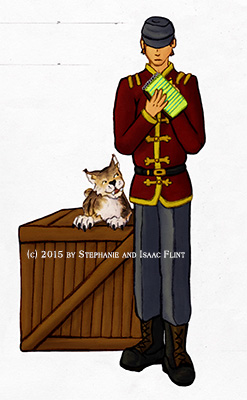
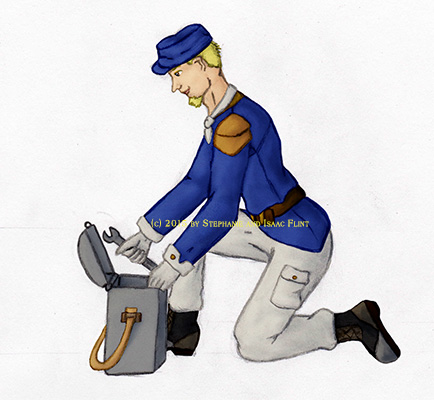
I’m not going to give a whole lot of detail on the game just yet, but I will say this: it’s a fantasy pseudo-steampunk table-top card game, where there are two battling factions and your goal is to take out the opponent’s hero cards. We’re considering the catch-phrase of “Dragons, dinosaurs, and dirigibles, oh my!”SBibb - Battle Decks Sneek Peek

Anyway, at this point in time, we have the basic mechanics of the game, stand-in cards, and we’ve played it on and off between ourselves over the past couple years. Currently, we’re in the process of creating the art for the actual cards. For the typical card, Isaac creates the base image with pencil on sketchbook paper. Then I go in and add the details, smoothing out the line art in the process. We then scan the page onto the computer. I retouch the pencil art in Photoshop CS6. Isaac does the basic coloring. Then I do the final touch-ups to the coloring and shade the image. That completes the basic art, up to the point we add them to their actual cards.

We’ve already ordered one proof of the first few cards, and there are tweaks to be made for readability. But it’s coming along, slowly but surely. There might be a set of stories planned around this game, too…

Your sneak peek is one character from each faction. 🙂

SBibb - Battle Decks Sneek Peek

Leave a comment

Filed under Business Ventures, Photo Illustration

The Infinitas Publishing Site is now Live!

I’m happy to announce that Isaac and I now have our Infinitas Publishing site live. 😀

http://infinitaspublishing.com

Took most of yesterday (including a couple photoshoots) and a few hours here and there to get it up and running, but after finally figuring out how to get the domain properly mapped, it’s now up. You can read about the behind the scenes process on our first blog (written by Isaac): http://infinitaspublishing.com/blogs/post/Behind-the-Website/

A few parts of the site aren’t quite working yet (the upper banner doesn’t want to resize for mobile devices), but I’ve sent an email to the web host to see if they can help.

Also, we have a new twitter account where we’ll be making announcements in regards to the books and games we’re publishing: https://twitter.com/InfinitasPub

Not much up at the moment, but it’s a start. We hope you enjoy it, and we have more plans for it as we continue to move forward. 🙂

Leave a comment

Filed under Business Ventures, Personal Work