Tag Archives: Magic’s Stealing

Thoughts on Writing – Creating a Fantasy Map

I recently received my final beta-reader comments for Magic’s Stealing, and I’ve been making edits (I’ll be doing a cover reveal soon!), but today I’m going to focus on one of the ideas that the beta-reader suggested, which was to include a map of the region.

A lot of fantasy stories include a map of some sort as a way to help readers envision the layout of the land, or the city where the story is taking place. Maps can be used to enhance the feeling of the story (seriously, take a look at the map of Middle Earth) and one article I read suggested that a well-drawn map, which includes elements of the story, can make the world feel more real. It’s sort of like having an artifact from the world itself.

I’ve debated before on including a map, but I originally put the idea aside because I wasn’t sure if I could make it look professional, and also because I didn’t want to lock down the distances before I finished the series.

Then my husband pointed out, having a map would be a good tool for future reference. Not only that, but I wouldn’t have to include it in the first edition of the ebook. I could wait until I release the print edition, then update the ebook at that time.

Anyway, let’s take a look at the steps I’m taking to create the map. I have a rough guide. When I wrote the first draft of this story twelve years ago, I also drew a map in Paint. It’s horribly inaccurate

The estate where Toranih lives probably shouldn’t be as large as the capital city of Cirena. The Cantingen Islands probably shouldn’t be quite so tiny. And there are plenty of other problems.

SBibb - Old Cirena Map

Original map… made many years ago

My husband suggested that I start by writing down the places referenced in the story, then taking note of their directions and the amount of time it takes to travel from one place to get to another, as mentioned in the story.

So I went through Magic’s Stealing and searched for key phrases related to traveling. Minute, hour, road, travel, east, west… etc. I didn’t include directions within buildings, such as going downstairs. Just the kingdom and the cities.

This is what I found in Magic’s Stealing through a basic search.

Fifteen minutes later, Toranih reached the place of the healers. (From the seer’s cottage, jogging)


In minutes they had left the square behind and pounded into the lower city. (Riding hard on horseback)


“We’re two hours from Viyna. A guard could stop here, and we’d be reasonably undercover…” (At the mountain forge, riding on horseback, not rushing)


They fled into the heavy rain, mud spattering them on the road to Viyna. (From the Covonilayno estate)


…and then stormed through yet another portal into the temple in the northern district of Ashan. (Directions within a large city)


The girl was cold and shadowy, colder than the northern village of Reveratch. (Region layout)


“Go to the northern tunnel. Tell Cafrash to send more of his shadows into the city…” (Directions of a tunnel)


“This is it. Sid-Dreh.”//“What’s Sid-Dreh?”//Siklana pushed Toranih out of the way and squinted at the plaque. “South and west, respectively…” (Cardinal directions in Old Cirenan)


…but many of them used the communal oven in the marketplace that had developed in the eastern side of the city. (Layout of Viyna)


The marketplace brimmed with travelers from Ashan, the eastern port. (Region directions)


The ribbons streamed into the sky, a dazzling array of colors, then fled East, away from the city in a glaring river. (Direction the magic is stolen, from Viyna to the mountain forge)


“…If the Trickster branches into the Islands or crosses the sea to the eastern lands, there is no telling how quickly he could rise.” (Region layout)


Ferta was several days out, even by carriage. (Regional layout)


“…When I’m at the academy, I practice in the forest outside of the city walls.” (Reference to Cirena City)

While I may not want to draw out the tunnels on the main map, having a map may make the tunnels be a little more understandable. At this point, though, I’m seeing potential for some interesting back story. How far out do these tunnels actually extend? As you’ll see in a bit, the distances between cities and towns is much greater than the original map suggests. Do the tunnels extend to other cities? Are there towns or dwellings I haven’t mentioned before? Or do they open in the middle of nowhere?

Anyway, instead of trying to mark out the full range of a city or estate, I’m considering following the lead of a few other maps I looked at, which use a basic symbol to designate the location of a city or important landmark. In order to figure out the rough scale, I’ll need to look up the average travel times of riding horseback or walking, and then place my locations based on that scale.

According to this site: http://www.lrgaf.org/guide/writers-guide.htm horses can walk 3-5 miles per hour, trot 8-10 miles per hour, canter at 15 miles per hour, or gallop at 25-30 miles per hour. Now, keeping in mind that weather, type of horse, and condition of horse will effect speed, let’s go with the idea that we’re talking about a horse with decent stamina and who hasn’t been tired from a lot of riding. And let’s go with the idea that the roads in Cirena are of decent quality, and the map is counting on non-rainy days. A general internet search suggests that a fit person can walk 4 miles in an hour (or 1 mile every fifteen minutes), on relatively flat terrain.

So… now that we’ve got some numbers, let’s look back at the descriptions pulled from the story.

Fifteen minutes later, Toranih reached the place of the healers.

In this scene, Toranih is jogging/quickly walking to the temple. She is in reasonably good physical condition, as she’s trying to train to be a guardsman. I had a hard time finding a single average for jogging, so let’s just say that she’s walking. In this case, she walked a mile to reach the temple from the seer’s cottage. If the temple is supposed to be relatively central in the city, then Viyna may be a couple miles wide.

In minutes they had left the square behind and pounded into the lower city.

The characters are riding hard in this scene, but they are likely cantering instead of galloping due to street layout and rain. At the quoted 15 miles per hour, a quarter of a mile per minute, and let’s say 4 minutes, then they have traveled 1 mile from the courthouse to the lower city.

“We’re two hours from Viyna. A guard could stop here, and we’d be reasonably undercover…”

Here, the characters reached the mountain forge by riding on horseback. They took it easy, probably walking or trotting, which puts us at 3-10 miles per hour. Let’s say they traveled at an average of 5 miles per hour. The mountain forge would be roughly 10 miles from Viyna, or if they had cars and a 60 mph speed limit, ten minutes to drive. Picture someplace that takes you ten minutes to drive to on the highway, and now you have the rough distance. (And the kingdom suddenly feels much smaller).

It was going to be a long week (of traveling through the wood).//Scene break//After a full day of assuring her sister that not only were bandits rare in this forest, but she was protected by two mages and– ahem– a well-aimed knife thrower, Toranih finally led Starlight to the forest edge. The dusty road from Viyna to Ashan wound its way in the distance around the edge of the forest. Though the road was smoother, the route jogged several miles north and was usually filled with travelers, adding almost a week to the trip when a couple days of hard riding through the forest would do.

They’re in a hurry to get through the woods, but it’s been raining and they’re somewhat tired. Let’s say their pace averages a fast walk, at five miles per hour, for seven hours of the day. That’s 35 miles a day, or 175 miles after five days of traveling. According to the narration, the road between Viyna and Ashan that avoids the forest adds a day to the trip, whereas hard riding (when possible), gets them quickly through the forest. Say ‘hard riding’ is 7 hours a day (based on 7.5 hours I read somewhere on the internet…which I don’t remember where now and may not be all that accurate) at 10 miles per hour due to rough terrain, so that would be 70 miles per day, or 140 miles in two days.

If they took the road directly from Viyna to Ashan, instead, then they would be walking 7 hours a day, 4 miles per hour, and let’s go with a full seven days, approximately 196 miles. Granted, if they stop to rest one or two of those days, and that’s been taken into account, then the distance isn’t quite as great.

But I went ahead and plugged 196 miles into Google Maps to get a comparative distance with a road I’m used to traveling, and eeps.

Ranging from 140 to 200 miles wide, that forest is much larger than what I was picturing.

This is why having a scaled map is a useful tool for world building. Even if you don’t give the readers the actual scale, you can figure out relative distances without having them wobbling all over the place.

So, for my test run, let’s say that this forest is 140 miles. I picture the edge of the forest not being too far from Viyna, maybe a quarter mile, and maybe a couple miles from Ashan. For the Cantingen Islands (which are mentioned in the second book as being ‘near’ to Ashan but without a more concrete detail), I went to look at the distances from other islands to a mainland. Miami, Florida, to Bailey Town, Bahamas, is about 55 miles out, according to Google Maps and a trusty ruler.

Let’s say the Cantingen Islands are 60 miles from Ashan.

Now, let’s look at another city…

Ferta was several days out, even by carriage.

Horses trot at 8-10 miles per hour, and I read that a pair of horses pulling a carriage would move faster than the average horse alone, so let’s go with 10 miles per hour. Then 8 hours of riding for 4-5 days, we’re looking at around 320 to 400 miles away.

It doesn’t even fit on my initial map attempt.

SBibb - Cirena Map Test Run

Then my husband reminded me that people rarely travel in straight lines. There’s hills, glades, rivers, lakes, avoiding certain unfriendly estates, resting the horses… a number of things that could increase the time, but not the distance.

So I took my current references, redrew a map that actually includes geography, replaced the cities with the scale as a general guide, not rule, and now I plan to check the narration to revise for the updated travel times (or have them be a little more accurate, anyway). I don’t plan for this to be the final version (since it’s missing a few cities and roads), and I probably won’t put this in the ebook.

But it should make a lot more sense than the original version–other than the fact that this map has the mountain forge at 90 miles away from Viyna, which doesn’t exactly work for the story.

Oh, well. It’s a starting point.

SBibb - Cirena Map Updated

I hope you enjoyed this post. 🙂

Have you ever tried making a fantasy map? What difficulties have you run into?

4 Comments

Filed under Photo Illustration, Writing

Thoughts On Writing – The Revision Process

I recently finished the major revisions on Magic’s Stealing, and though I’m still in the process of making a few tweaks (trying to give the end just a bit more ‘oomph’ and trying to make sure that the antagonist has a clear motive while maintaining her mysterious persona) I thought I’d spend today’s blog post talking about my revision process.

First off, the difference between editing and revising. Honestly, I confuse the two and tend to use the terms interchangeably. But for the purpose of this post, I wanted to make sure I was talking about the right thing. So I did a quick web search, and this is what I found:

Editing is when you focus on a manuscript’s grammatical conventions. You’re looking for typos, words that like to get flip-flopped (my offenders were rein/reign and lose/loose), and grammatical issues. The story looks better when you edit.

Revising is when you focus on the big picture. You’re checking that the reader understands what you mean, that the story is clear, and the plot makes sense. The story sounds better when you revise.

Sometimes the two might clash, depending on whether you’re going for how something sounds, or how something looks. I’m fairly certain I drove one of my beta readers up the wall for my tendency to have ‘ , then ‘ in the middle of a sentence. For example: The owl sighed, best an owl could, then tapped the window with his beak. To be grammatically correct, the sentence should read: The owl sighed, best an owl could, and then tapped the window with his beak.

To be fair, I was doing this quite a bit, and I did go through and fix a number of those issues. However, as I was revising, I chose to keep certain instances because I liked how the sentence sounded, especially when compared to other sentences in the paragraph.

Here’s a breakdown of my revision process:

Step 1: Write rough draft. I don’t usually do much editing/revising at this stage. I just want to see the story completed.

Step 2: Examine rough draft. Tighten the writing, cut/add scenes as needed, now that I know how the story flows, and look for loose ends. Mostly revision.

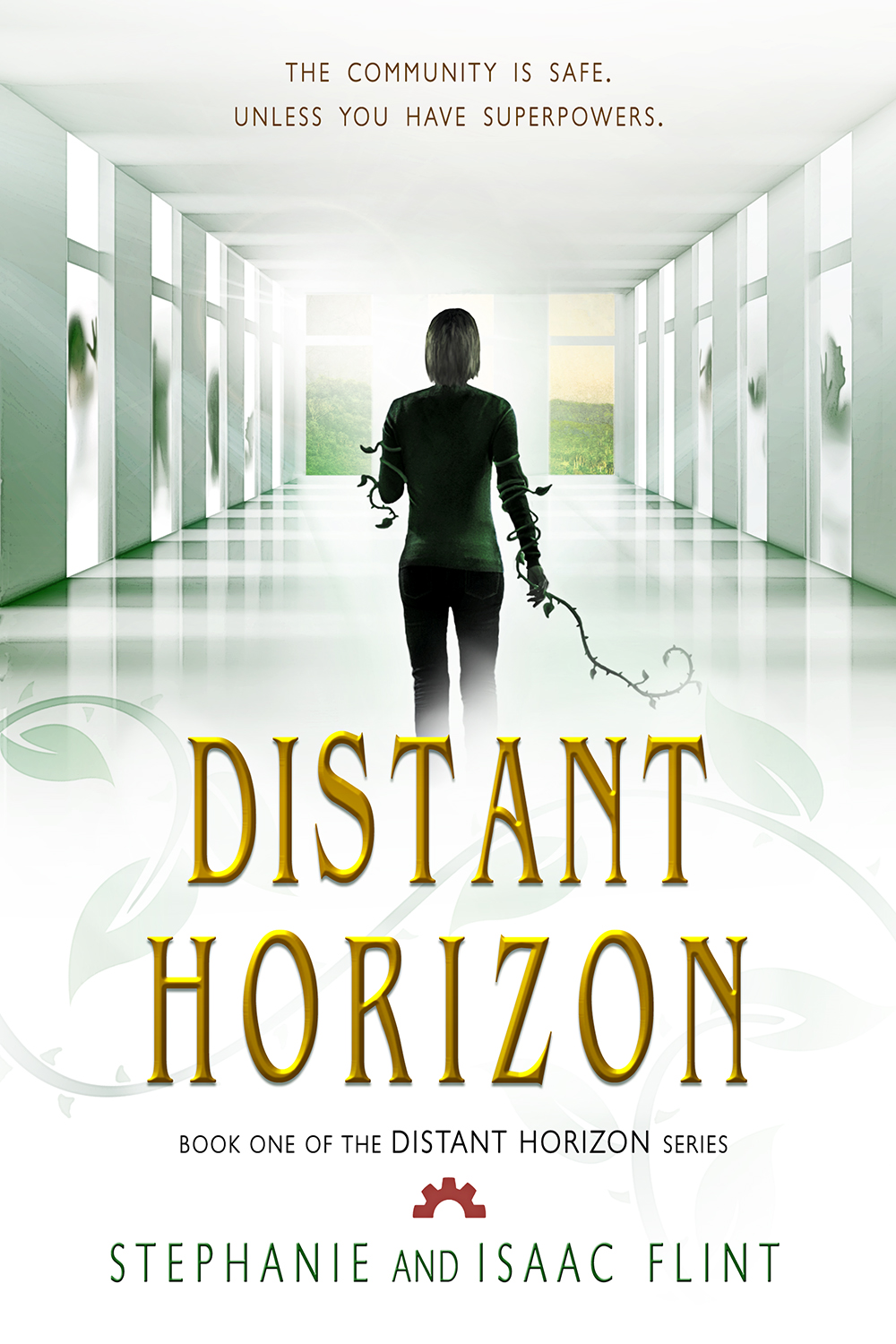
Step 3: Polish the draft. Repeat Step 2 as necessary until I can’t find anything left to polish. I both edit and revise at this point. In some cases, this only takes one or two passes. In others… many, many more. (I really don’t want to think about how many times I’ve read through Distant Horizon. I feel like it’s fairly polished now, but it took several years to figure out this whole writing thing).

Step 4: Send polished draft to beta readers. Step away from manuscript and work on something else while waiting for a response.

Step 5: Ask beta readers questions. Once I have responses from my beta readers, I look through their comments and ask them questions to clarify anything I don’t understand. If one beta reader brings up a question that I think I should ask others, I send them those questions. For Magic’s Stealing, I did this in regards to what age they saw the characters as, as well as the readers’ theories regarding the antagonist. By doing this, I got a broader understanding of problems in the manuscript.

Step 6: Examine beta comments as a whole. Since it has been a while since I last looked at the manuscript, I read through all the comments to jog my memory.

Step 7: Apply critique to one chunk of the manuscript at a time. I examine what all the beta readers said about a particular section (in case there were conflicting opinions), and then applied the appropriate changes as necessary.

Step 8: Read the manuscript aloud. Once a couple sections were completed, I read the revised sections aloud, looking for any areas where I tripped over myself. Since I’m hoping to eventually do an audio edition of Magic’s Stealing, this is especially important. But even if you don’t plan to do an audiobook, reading aloud can help you catch errors or plot holes you wouldn’t catch if you are simply scanning the page. Plus, it’s kind of fun. (My Speech and Debate background likes to kick in here).

Step 9: Make any final adjustments that you know need to be made. For example, I know that the ending of Magic’s Stealing needs a little bit more ‘oomph,’ possibly in the form of one final confrontation with the antagonist. So I’ve been re-examining the rest of the manuscript to see if there are any loose strings there that I can use in that confrontation.

Step 10: Divide story into chapters. If you haven’t done this already, now’s the time to do it. Unfortunately, this is the part I don’t really like. Do I stick with a specific word count? Do I end at a really dramatic scene and have some really long or really short chapters? Should I cut before or after the antagonist view point? Eh… I much prefer revising.

Step 11: Read the full manuscript. If the story is truly polished, you’re only going to be making small changes or adjusting a word here or there. Nit-picking. If you see a major plot hole or flaw, you may want to go back and do further revisions. Each story is different. Like I said earlier, Distant Horizon went through a lot of revisions, and now when I look at it, I mostly nit-pick.

Step 12: Set the manuscript aside. Hand it over to any remaining proof-readers/beta readers. Read through it again after it’s been out of your thoughts for a little while. If readers say you’re good to go, proceed to the next step.

Step 13: Proceed with querying for trade publication or with self-publishing, depending on your goals. For Magic’s Stealing, I’ll be self-publishing, and I intend to print out the manuscript so I can look through it for typos. For Distant Horizon, I’ll intend to hire an editor before self-publishing, since it has been through so many changes that I’m bound to be missing something. The story is also considerably longer than Magic’s Stealing, and has a lot more room for plot holes (Distant Horizon is almost 100,000 words vs Magic’s Stealing’s 31,000 words).

There you have it: my revision process.

I hope you found this post useful. Have you had any revision techniques you found to be particularly helpful? 🙂

Want to share this post on twitter?

Thoughts On Writing – The Revision Process: http://bit.ly/1VcaEAl via @SBibbPhoto

Click to Tweet!

Leave a comment

Filed under Writing

Thoughts about Publishing – Fireworks and Photoshoots

IP---Fireworks

A photograph from our fireworks photo shoot for the book trailer. The ‘scrying bowl’ from Magic’s Stealing.

Over the weekend, my husband and I visited my family for the Fourth of July. Among the things we did… per usual tradition… was to purchase fireworks. In previous years, we’ve typically picked up an assortment of fountains, smoke balls, and sparklers, then headed across town (or recently) up the hill in the evening to watch the fireworks from the city display. Over the years, the people around town have been picking up the big fireworks, so this year we watched them from the front yard. (And I made chocolate chip cookies during the lull… yum!) Anyway, we didn’t find any smoke balls for sale, but we did pick up a couple smoke canisters. The goal? To use the one day we had available to shoot off fireworks in a city area to get potential footage for the book trailer.

IP---Fireworks1

The setup for the 3D camera, ‘scrying bowl,’ and smoke canister.

While we don’t know for certain we’ll use the footage, the shoot was a lot of fun… and very smoky. Me, Isaac, and my dad headed up the hill, scoped out a decent spot for us to lay the bowl and the canister (we brought a couple bottles of water in case the canister didn’t fire properly), along with the 3D camera (it has video capabilities) and the DSLR. I set up the tripod for the 3D camera and kept it low to the ground, then once that was set up, Isaac lit the canister. I shot several still images with the DSLR for potential book cover usage, while Dad kept an eye on what the wind was doing with the smoke. Afterwards, we watered the area around the canisters and set them aside to cool. Dad went back the next day to throw them away.

IP---Fireworks

A still shot from the book trailer video shoot for Magic’s Stealing.

IP---Fireworks

Me having fun with Isaac’s Ultrasaber.

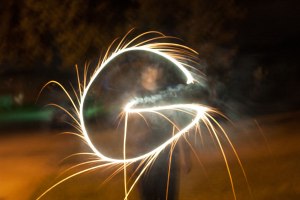
Later that night, I remembered a few photoshoots I’ve done previously using smoke balls and an FX lightsaber (I’m a Star Wars fan). I suggested that we should get a couple more smoke canisters (like Isaac suggested in the first place) and use Isaac’s new Ultrasaber to make long exposure shots. We each got one canister, and we took turns running around in the smoke, trying not to breathe it, to get the various effects. We also shot off a fountain, continued watching the surrounding fireworks show from the neighbors, and played with the sparklers and long exposures to see if we could get any ribbon-like effects for the Magic’s Stealing book cover. We had a lot of fun, and my parents joined in on playing with the sparklers. (We usually take turns lighting the sparklers and twirling them around). And I got poppers. So much fun…you throw them on the ground and they make light and noise… *Happy sigh.* Like my grandma said, “we had a party!”

IP - Fireworks

Isaac got creative with his sparklers and made various video game characters…

The next day we taped a bunch of streamers left over from party streamers ‘fireworks’ to a fan, then took both video and long exposure shots. We got a lot of abstract images, which are great for creating magical effects for the book cover.

IP---Fireworks

Long exposure of streamers for book cover art.


All in all, Isaac and I enjoyed combining our work with play. I hope you enjoyed this post, and I hope you had an enjoyable weekend, regardless of whether or not you celebrate the Fourth. 🙂


Leave a comment

Filed under Book Covers, Business Ventures, Photo Illustration, Writing

Thoughts on Publishing – A Blurb for Magic’s Stealing

As I get closer to publishing Magic’s Stealing, I’ve been compiling the various elements meant to catch a reader’s attention. While a lot of emphasis is placed on the book cover (and I’ve realized the current version I’m considering may be better suited to the third book, so I’m debating what I might use instead for the first), after the cover, a reader inevitably sees the blurb. The blurb should show what the book is about and entice a reader to either buy the book, or at least take a look inside.

However, as a writer, we’re so close to our stories that it’s hard to see what will draw the reader’s attention. I’ve posted my current idea for a blurb on Absolute Write (which is a very useful source of information for authors), and I’ve come up with two slightly different versions. The question is… which works better? Short and snappy? Or more details about the world?

In order to get a little more insight on the subject, I read through a few articles that discussed what makes a good blurb (see the links below if you’re interested), and came up with a list of elements to consider:

  • A sense of the main character(s). Who and what kind of character are they? (For Magic’s Stealing: Toranih is a young noblewoman who would rather have a sword in her hand than use magic to heal or throw fireballs.)
  • Just enough detail to show the type of story and what makes this book different. (For Magic’s Stealing: there’s a kingdom, magical ribbons, mages, shadows who are impervious to mortal weapons… and this is where I start to wonder if I need to hone in on the description)
  • What the main conflict/plot will be. (For Magic’s Stealing: Almost all magic is stolen from the kingdom, leaving two young mages–one of whom doesn’t like magic–to protect their home.)
  • A question that entices the reader, or leaves them wanting more. (For Magic’s Stealing: Will Toranih successfully adopt the responsibilities of a mage so she can fight the shadows? Or will she fail and cause her home to perish?)
  • Offer a taste of the writing style. (Maybe I can include a tiny clip at the beginning of the description. You know, those story bites usually seen in italics?)

These are the current versions of the blurbs that I’m considering for Magic’s Stealing.

Short Version:

Toranih would rather have a sword in her hand than use her powers to heal or throw fireballs, and as a result, her magic skills are lacking. But when the kingdom’s magic is stolen, she’s one of the few whose powers remain. With former mages dying from magic withdrawal, and the looming threat of an army of shadows who are impervious to mortal weapons, she must either adopt her neglected responsibilities as a mage or watch her home perish.

Long Version:

For centuries, ribbons of magic have provided the kingdom of Cirena with light, healing, and protection. Then, in a span of minutes, those ribbons fly from their masters, stolen, save for the ribbons of two young mages. One of these mages is Toranih, a noblewoman who never liked magic to begin with. The other mage is her best friend, Daernan, a gifted shapechanger who uses his magical sight to track the vanishing ribbons. Toranih would rather have a sword in her hand than use her powers to heal or throw fireballs, and as a result, her skills are lacking. But with former mages dying from magic withdrawal, and the looming threat of an army of shadows who are impervious to mortal weapons, she must either adopt the responsibilities of a mage or watch their home perish.

So my question to you is this: Which blurb, if either, holds your attention, and do they entice you to ‘look inside?’ Why? Or if you neither holds your attention, why not?

I’m concerned that the shorter one may read too fast, but that the longer one may loose readers with unnecessary information. One solution I’m considering is that Smashwords offers both a short and long description for retailers, and as such, I could use both descriptions in their respective sections. Anyone who wanted more information could click to read the longer description. In the meantime, if whichever description I choose for Amazon doesn’t seem to be working, I can try switching it out for the other and see which one works better.

I hope you enjoyed the post. Are there any blurbs that worked well for you? Anything you’ve found that didn’t?

A few articles I found particularly helpful while researching the subject:

http://romanceuniversity.org/2011/11/23/5-top-tips-for-writing-a-compelling-book-blurb-by-amy-wilkins/

http://kristenpham.com/2014/01/14/how-to-write-a-great-ya-fantasy-or-sci-fi-book-blurb/

http://www.thecreativepenn.com/2010/11/16/how-to-write-back-blurb-for-your-book/

http://www.lightmessages.com/lm/index.php/blog/writing/229-how-to-write-a-book-cover-blurb

6 Comments

Filed under Business Ventures, Personal Work, Writing

Thoughts on Writing – Aging Up Characters

I’ve been getting feedback from beta readers for Magic’s Stealing, and one of the comments that has been fairly consistent is that the characters (which I intended to be around twenty years old) feel like they’re twelve- to sixteen years old, effectively making the story sound like it’s aimed at a middle grade or the lower end of the YA audience. Which isn’t a bad thing… if I meant for my characters to be younger. However, I’m hoping to get them to sound like they’re at least eighteen, so it’s time to consider what’s making them sound younger, and what can be done to make them sound older. 🙂

To start with, once I knew that their age was an issue, I sought feedback from the beta readers. I needed to know why these characters were sounding younger.

1. Their actual age isn’t mentioned until later in the story. This leaves their age open for interpretation, and by the time a reader gets to the point where their age is mentioned, readers already have a solid idea of the characters’ ages in mind. (As a side note, there’s a book I read recently, Renegade by J.A. Souders, in which a certain intimidating character is revealed to be a child. The story is told in first person by a character who is brainwashed into thinking nothing of this, so she’s not surprised, but it is a twist for the reader. As a reader, I personally loved that twist. However, it did take me a little while to hold the image of a child in my head, rather than that of an older teenager. In  my current manuscript, I don’t want this kind of surprise for the age of my main characters, so I may need to bring up their ages sooner).

2. The characters act younger. In the opening scene, my main character, Toranih, is nervous because she’s been hearing footsteps and thinks she’s being watched. As soon as she ‘turns out the light,’ she dives under the covers of her bed. Personally, I love the image. However… this isn’t what we typically picture an older person doing. Therefore, the first impression is that Toranih must be younger. An option to fix this may be to have her consider diving under the covers, but she forces herself to walk calmly to bed. Or she may walk calmly to bed but reference that she’s going to bed with a knife at her side. Or… some combination thereof. Haven’t decided yet.

Darkness flooded Toranih Covonilayno’s sleeping chambers as she mentally extinguished her magic crystal’s light. She dropped the crystal on her dresser and rushed to her bed, then dove under the covers.

Silly, she knew, but the last few nights had brought strange creaking noises from the attic, soft footsteps and the brushing of rough wool on the edges of the wooden floorboard above. She listened now, waiting to see if the footsteps returned.

3. Lack of romance. The current draft doesn’t show much in the way of a romantic interest between the main characters. Now, that’s not to say you must have romance in a story to make it YA or adult, but without romance, this story seems like a more likely candidate for an MG novella. When I go to edit, I plan to hint a little more at the (lack of) romance between the main characters. I’m toying with the idea of having Toranih and Daernan ‘technically’ courting (mostly so Toranih can keep her father from trying to point other suitors in her direction, since she’s not necessarily interested in Daernan romantically), while Daernan actually does like her. Increases tension in the story, and gives a better clue about their age.

4. Expectations for the type of fantasy. Especially in YA, we seem to get a lot of hints that the teenage main characters are either actively seeking (or avoiding) marriage. These worlds have their characters finding partners at a younger age. In Magic’s Stealing, I’m going with the idea that the characters live longer and have a tiny bit more ‘modern’ of a society (with magic taking the place of electricity, but in an older setting with kingdoms and lords and ladies). However, to pull this off, I’m going to have to show more of their world. We need to see older characters walking in the streets. Maybe a reference to food spoiling when their ‘magic refrigerator’ no longer has magic to keep food cold. Maybe a reference that going to an academy for magic, versus sticking around and getting married, is a common occurrence. I’m considering having Toranih’s sister, Siklana, already be accepted into an academy (think college), rather than expecting to be accepted at the end of the month. Maybe she’s back at the manor because she’s visiting, and she’s planning to oversee the festival that takes place at the beginning of the book. And maybe Toranih actually is studying swordsmanship, rather than dreaming about it, but her lessons are private since she can’t convince her father that being a guardsman is fitting for a lady of her status (but she can’t pass her magic exams, so… what else is she going to do?). There’s a lot of world building opportunities here, and the great thing is that these changes don’t have to be major alterations.

5. Lack of (graphic) violence. Though there are a couple battle scenes, we don’t really see much blood spilled, and nor do we get graphic depictions of the shadows who are burned. Now, this doesn’t mean it isn’t for older readers, but it makes it more open to an MG audience. That being said, I’m  considering adding a bit more detail to these scenes, partially for the impact they have on the main characters, and partially so that once we get to the second book, it doesn’t come as a surprise when we actually start seeing more violence coming into play. Doesn’t mean it’s going to be gratuitous. Just means that the MC is going to be distinctly aware of what’s going on around them.

Her friend had backed into a rocky cove, but he was using that to focus his attention on the growing force of shadows in front. He shifted back and forth, thrusting each hand separately and delivering a blast of air or a blast of fire, to which they ducked and dived away.

The shadows shied from the wind, but they hated fire. They scuttled aside when his magic seared their hands and scalded their weapons. They sent new shadows to fight while they nursed their burns. Those burns healed, but slowly. And one shadow lay dead on the floor, burned beyond recognition, and did not appear to be healing at all.

Toranih shuddered. If these were mortal men, Daernan wouldn’t be using fire like this.

But fire did hurt them, and they weren’t mortal men.

6. How other characters perceive them. The antagonist refers to the main characters as the ‘boy’ and the ‘girl.’ Granted, from a god-like character who can’t die, it makes sense that she’d view these characters as being childlike. But with this scene placed early in the novel, it doesn’t help the perception of the main characters’ ages as being younger. I’ll probably keep these kinds of references for the actual deities, but at that point, the actual ages for the MCs should be established, so the reference should hint more at the internal thoughts of the deities in question.

A cloaked figure knelt beside a sprawling sycamore near the girl’s window, her eyes trained on the two owls.

Finally, they’re gone, the figure thought to herself. She climbed up the tree, bark catching on the tips of her leather boots, then slipped inside the open window. The room was dark, but the light crystal glowed with residual energy and lit the bare essentials.

The girl had rearranged the furniture since the night before. No night table or pile of books, and her usual set of sparring knives didn’t hang from the wall. Probably locked in the chest at the foot of the bed, or buried under the mattress.

There’s a lot of little things that could affect the perceived age of the main characters, and with a few tweaks here and there, I think I can have them sounding like they’re at least eighteen. And it’s worth noting that I do read a lot of YA and the occasional MG book. Therefore, it isn’t surprising that my narrative voice would lean that direction.

I hope you’ve enjoyed this post, and now it’s your turn. Have you had any experiences with your writing or reading where characters don’t sound like the age that they’re supposed to?

6 Comments

Filed under Personal Work, Writing