Tag Archives: writing

Thoughts On Writing – Using Subplots To Tie Everything Together

Last time I blogged, I talked about figuring out what happens next in a scene. That process helped me out considerably with the scene I was working on, along with a few scenes before that. However, I’ve been running into a new problem–figuring out how to get the ending to fit together.

The story I’m currently working on is supposed to be a romance with science fiction elements. One of the scenes I visualized for the ending was… well… not romantic. The characters stay together, but there’s this looming shadow of oppression hanging over them both.

Not exactly a happy ending.

I tried day-dreaming alternative ways the scene could play out. I originally had Special Forces tapping Cole’s phone, and so they overhear when Amy says that Mr. Rivera is a member of Challenge, a supposed terrorist organization. But then my husband pointed out that, as Cole’s supervisor, Mr. Rivera would be the one to hear the message first.

No Special Forces agents descending on the group, leading to a major fight scene that doesn’t end well for anybody. Not unless Tamara called the police earlier, but that didn’t make sense with her motives.

So I started plotting what might be said if Tamara and Cole sat down confront Mr. Rivera directly. One of the things I pictured Mr. Rivera saying was that not all members of Challenge were the bad guys. Then I realized that I already had the elements in place to include an actual bad guy who was working for Challenge.

All in the form of a separate subplot that I’d largely forgotten.

This is a scene from earlier in the story, one which made me realize I had an undeveloped subplot waiting to be used.

“What took you so long?” Amy looked up from her phone and raised an eyebrow. She was probably playing an EYEnet game, or something like that. “Get lost in the cafeteria? Or did you meet somebody cute downstairs?” She eyed my empty laundry basket suspiciously.


“Unless you count the police officer, not really.” I dropped onto the bed and yawned.


Admittedly, the guy had been cute. Light brown hair, closely cropped to his head. Square jaw, and a smattering of super-light freckles across his cheeks. Didn’t look badly built, either. But I’d been too worried about the ‘painting’ to dwell on his looks.


“Police officer?” She frowned and lowered her phone to her lap. “What happened?”


“Someone drew a picture on the wall.” I sighed, already removing my phone from my pocket to show her.


“A policeman came for a picture?”


“Not just any picture.” I passed her the phone. Her green eyes widened as she stared at the picture I’d taken. “You okay?”


I wrestled the phone back from her fingers. Her knuckles had gone white from how tight she was gripping that thing.


“Yeah,” she whispered. “Wish I’d thought of that.”


I blinked. “What?”


She laughed dismissively. “Using laundry detergent to paint a picture. It’s imaginative. Even if it is… well… you know.” Her voice dropped off, and her lips twisted into a frown. She was still eyeing my phone.


“Should I delete the picture?” I asked.


“What?”


“You know… so it doesn’t look like I’m supporting them?”


She scoffed. “You? Supporting them? Please. You’re like… the community ideal. Or you will be, if the whole EYEnet Match thing works out. You already reported this to the police, didn’t you? That’s how they found it?”


I nodded.


“Then you’re fine. Long as you weren’t the one who painted it.” She swiveled around to her computer.


“I’m fine? Someone around here is painting terrorist symbols on campus. In our dorm.”


Amy shrugged. Her blond ponytail bobbed inconspicuously. “I’m not worried. It’s probably just a student wanting to cause a ruckus. And even if it is someone from Challenge, I still wouldn’t worry too much. Didn’t you read those articles I gave you? Most those people probably aren’t going to do an outright attack. They need allies, not enemies, and attacking innocent people isn’t going to win them brownie points.”

Originally, I had planned for Amy to be the one doing the painting, since she has ties to Challenge. But as I wrote this scene, I got the distinct impression that Amy wasn’t the culprit. While I want readers to wonder if she is the culprit, this scene is also foreshadowing. If I weave in other incidents similar to this one, I can hint that there’s someone else on campus who is leaving behind these symbols.

Someone being reckless.

When I get to the scene where Tamara and Cole must choose between reporting to the police that Mr. Rivera is part of Challenge, or working with him, it helps if they have someone to rally against. In this case, a rogue member of Challenge who might actually be a threat.

The stakes are high for both sides. If this rogue is discovered, they draw attention to the ‘good’ Challenge members–Mr. Rivera and Amy. In addition, if this rogue makes an attack, innocent people are at risk. Since Tamara is interested in finding out the truth behind Challenge, she’s likely to get involved. Cole may get involved to protect Tamara and learn more about his supervisor’s (Mr. Rivera’s) secrets, while Amy would get involved because she wants to dispel the notion that all members of Challenge are terrorists.

Thus, by following a subplot that got planted earlier in the story, I may have a way to bring both sides together, raise the stakes, and still have the potential for a happy-ever-after.

But that’s still to be determined.

Now that I know someone other than Amy is leaving the symbol in public places, I’ve got to decide who they are, what they want, and how far they’ll go to get that.

Lesson learned? Subplots can be a helpful tool to move your story along and flesh out the world.

I hope you enjoyed this post. 🙂

Have you ever found a piece of foreshadowing or minor subplot to be useful later when writing a story?

7 Comments

Filed under Writing

Thoughts on Writing – Consistency of Style

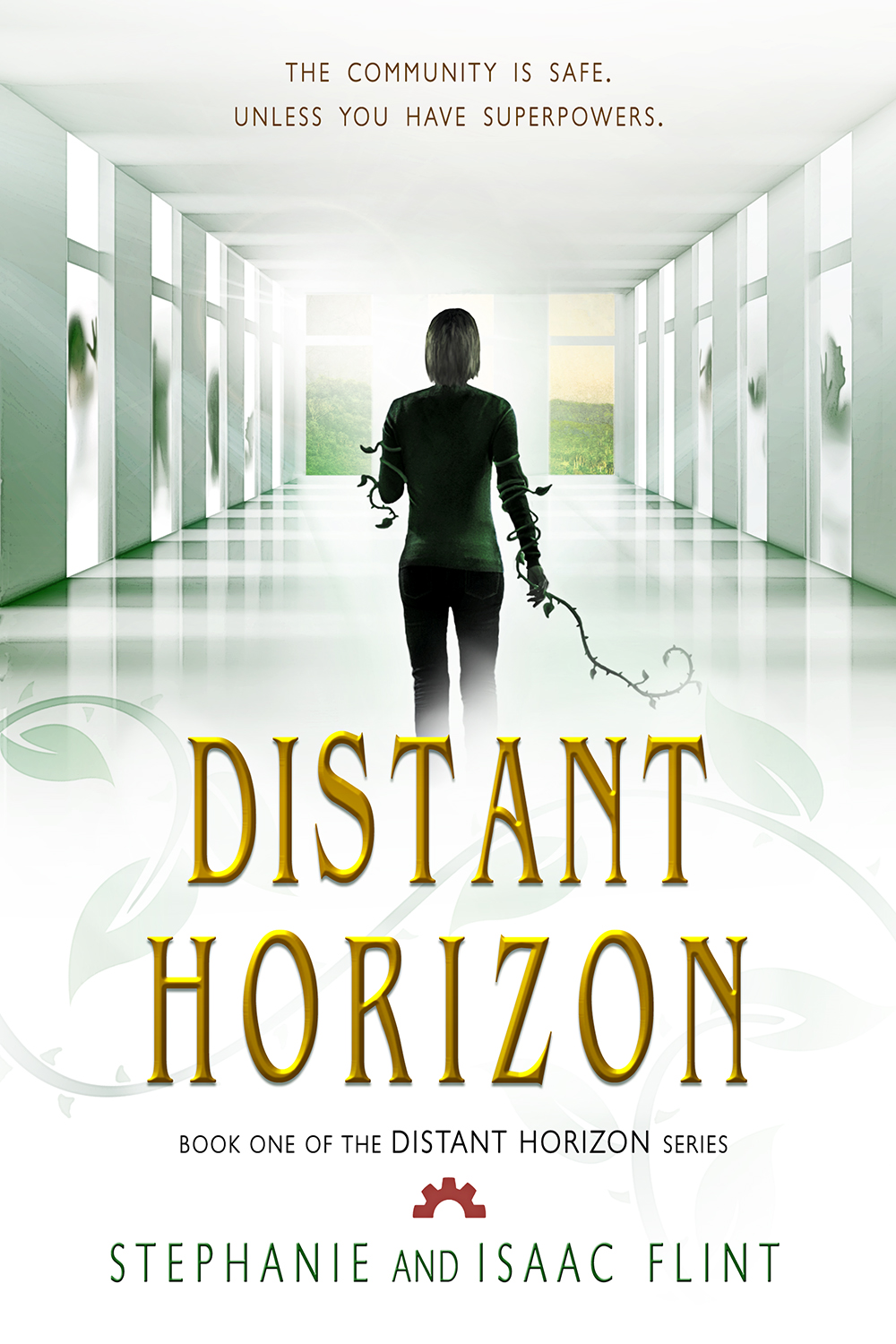
With Magic’s Stealing out to beta readers, I’m trying to avoid working on that story line until I get the collected thoughts of the readers. That way I can evaluate all the comments and figure out how best to apply them. In the meantime, I’ve switched gears. I’m working on Isaac’s and my Distant Horizon story line. The first book is written and mostly polished, so I’m working on plot consistency in the second book. To do that, I’m rereading the first book to refresh my memory on what changes were made. (Seriously… my notes suggest I’ve read the first book twenty times. Granted, some of those rounds only involved skimming for minor edits, but some of those included major overhauls, and needless to say, I’m starting to get a little tired of rereading it.)

During my read-through, I realized that there’s a shift in the writing style from the first few chapters to the later chapters. There’s less description, more every-day action, and the slow set-up of things starting to go wrong for the protagonist. Events are happening, but I’m worried that they aren’t as enticing as they could be. Now, one possibility is that I’ve read through these first few chapters so many times that it’s all kind of a gray blur. I know the plot too well, but the story may be fine as-is. The other possibility is that there’s a definite shift in writing style that needs to be corrected, or risk turning away readers who might otherwise be interested in the story.

When the story first starts, its sounds very much dystopian:

The first time I flushed adominogen, the oblong capsule tumbled from my hand and bounced off the bathroom sink, once, twice, then fell into the toilet with a finalizing plop.

Gone.

I waited all day for someone to ask why I didn’t report accidently losing my pill. But no one did, and I didn’t have any of the hallucinations that I might have had for not taking adominogen. Instead, the world around me felt so much more alive. My attention improved, not that it was bad to begin with, and I could think clearer. Be more efficient.

After that, I stopped taking the pill. I graduated high school and moved into my first year of college, no sign of theophrenia. But when our hall advisor announced that the annual Health Scan would take place in two days, I panicked.

I needed three things to graduate: excellent grades, as many efficiency points as possible, and to pass the scan. It wasn’t often that someone failed, but it did happen. One of my friends in high school had a sister who failed. Galina. She took the scan at the clinic downtown, and Special Forces escorted her away, all while assuring her everything would be fine.

I didn’t want to end up like her, so right after the announcement yesterday, I took the pill. It was like throwing a clear, plastic tarp over my world. I couldn’t concentrate, but I couldn’t go to the doctor for the symptoms.

Not taking the pill was an international offense.

And a little bit later, still in the same style:

After the incident with Lady Black, I had this constant, nagging feeling that someone stood right behind me, watching me. Stalking me. If this was the plague, then I could only guess this was the onset of paranoia, the delusion that I was somehow important enough to warrant special attention.

Or I maybe I was just paranoid; the Health Scan was less than twenty-four hours away.

My bedroom door rattled and I looked up from my biology book. Faint, golden light traced my desk, highlighting the leaves of my plant and trailing along the edge of my bookcase.

The doorknob rattled again, followed by a new, chinking sound of metal.

I scooted from my chair, then sidled against the wall before checking the door’s peephole.

No one was out there.

Maybe the air pressure was playing with the hinges.

I opened the door and stuck my head into the hall. A couple students passed by, but they’d been too far back to affect the door.

But, as the story progresses (leaving act one into act two), the style shifts, bringing on more description:

Pops led us into a dark, narrow hall, a far cry from the neatly glowing dorm corridors. What might’ve gleamed with bronze reflections was now a dull, dented bit of metal. Yellow lights ran the length of the ceiling in small round inlets, casting a weird, brownish glow over the area. One of the lights was burnt out, and another was completely missing, the socket bare.

We headed up the second flight of stairs. The elevator we passed had a piece of yellowed paper with a DO NOT USE warning taped across it.

“We’ve been running on minimal repairs,” Pops explained. “We have decent funding, but we haven’t had a chance to resupply, and Crush only has so much time to work. He usually monitors the computers for signs of enemy activity.” Pops stopped at a plain, bronze door at the top flight of steps. “This is Jim’s office. My room is across the hall.”

Inside, a dusty world globe sat on the corner of an ornate, wood desk, obscured by various file folders and papers. Books were piled high, their spines haphazardly stacked like a puzzle game. An ancient, faded rug lay beneath the desk, so worn that its vibrant, geometric shapes and numbers were barely distinguishable. Bookshelves surrounded us from floor to ceiling, organized and decorated with models of antique stealth planes and trinkets. A giant, arched window graced the far wall, overlooking the night sky, and two red, plush chairs sat opposite the desk, where a reading lamp blanketed the room in a warm glow.

Later, part of an action sequence:

I followed Lance, since he was closest, and we huddled in the leaves, taking shelter from the fight. A local rushed the monster, and the beasts grabbed him by the throat and yanked him from the ground. Bones snapped and his screams fell short.

“We’ve got to help,” Lance said.

I wasn’t sure if it was his heart or mine pounding double-time in my ears.

No wonder Inese gave me her gun.

Behind us, there was no sign of Jack or Matoska, and I couldn’t hear anything more than a mingled mass of screams and shouts. Ahead, more beasties darted through the field, half-loping, half-running. One was lanky and pale, what little clothing it wore hooked over its bony waist. Crusted blood and clods of dirt plastered its skin. A feline eye stared my direction, while the other was swollen shut.

Other beasts were bulky and heavily muscled, swinging swords or metal clubs, bashing in the locals’ skulls if they got too close. A large glob of water hovered around a beast that stood straighter, more human than the others. The creature lunged at a man and water splashed onto the electric spear. Static traversed the metal shaft. Both man and beast crashed to the ground as electricity coursed over the beastie’s water-slick skin.

In the long run, I see a potential benefit of keeping the story the way it is because, as the style shifts, it suggests that the main character, Jenna, opens her eyes and really starts to see the world as it is, not how it’s portrayed by the sheltered Community. The story goes from being light on description to heavy on description, and the writing style includes thicker paragraphs. In addition, at least in the examples I’ve posted, the character goes from reflecting on the world around her (distant), to becoming heavily involved, a participant. Which might not be a bad thing. I won’t know until I have it available for readers to read.

I hope you enjoyed this post (and the sneak peek at Distant Horizon), and I’d love to hear your thoughts. Have you experienced any issues with keeping the style and tone of a story consistent? Have you read any books where the style shifted subtly, or even dramatically?

Leave a comment

Filed under Personal Work, Writing

Thoughts on Publishing – A Novel or Three Novellas?

In general, I write novels. Then I trim said novels because their early drafts are excessively long. However, I’ve recently become fascinated with the concept of serial novelization. You release the novel in several parts, with the idea that readers know they aren’t getting a complete work at one time and that the next installment will come in a timely manner. I toyed with the idea of doing this for my current manuscript, The Wishing Blade, with each installment between 10,000 to 15,000 words. But as I started the rewriting stage, I realized that each section didn’t feel complete. The sections left on a cliffhanger, and weren’t really satisfying.

The other serialized option I’d studied was to write a complete short story (or novella), and make sure it had a full beginning, middle, and end, even if it was part of a larger work. At the moment, I’m thinking that might actually work well for The Wishing Blade. Each installment would be around 30,000 words, maybe more, with an expected three installments. I could release the story sooner, while still producing a reasonable quality work. Each story would be complete in itself, so there would hopefully be fewer unhappy readers who aren’t satisfied with the ending. With each installment, the reader should feel the series has made progress. Think about the show Avatar: The Last Airbender. (I think Legend of Korra and Fullmetal Alchemist where this way in their first seasons, too, but it’s been long enough since I’ve watched them that I don’t remember). For the most part, each episode (or set of episodes) felt complete, even though there was a larger story arc in progress. Granted… I’m still in the second season of Avatar, so that might change.


So here’s how it would work.

1. I separate The Wishing Blade into three novellas. They’re tentatively called Magic’s Stealing, The Shadow War, and The Immortal Realm. (What do you think of the names? Good? Bad? Neutral?)

2. I then figure out the story arc for each individual novella. This is crucial, because while reading them in order would be preferable, I also want readers to be able to pick up book three, enjoy it, then go back to book one. I personally have a habit of grabbing whichever book interests me… even if it’s in the middle of the series.

So the novellas would look something like this:

  1. Magic’s Stealing: Focus on the loss of ribbon magic in Cirena. Main character who hates magic is suddenly one of the few who can still use magic, and she’s trying to figure out what happened to the magic and where she fits into the whole scheme.
  2. The Shadow War: Main characters get separated. One works from within the shadows to foil the trickster god’s plot to kill the gods and get magic for himself. The other seeks out glass-stone, a material which has been proven to kill shadows and not be susceptible to shadow magic, then seeks to protect and warn others in the mortal realm. (For those of you who read my post on creating fantasy languages, this is where word magic shows itself).
  3. The Immortal Realm: Character in shadow realm escapes into ‘immortal realm’ and seeks out artifact (from book one) which could wipe out shadows for good. Other character defends Cirena’s capitol city from the shadows’ massive onslaught. They’ll either succeed in their separate goals, which serves to aid the other, or they’ll fail and the shadows will take over the kingdom.

3. Edit book one and make shiny. Send to beta readers for feedback. Work on a different story in the meantime (either finish the rough draft for The Wishing Blade: The Shadow War, or work on long-overdue edits to book two in my husband’s and my Distant Horizon universe). Once beta readers return comments, I’ll review said comments, make edits as necessary, then set book one aside for a while. Work on The Shadow War in the meantime.

4. Polish book one. Do what editing I can, maybe get an additional beta reader to proofread for errors.

5. Begin publishing process. Upload to Kindle and Smashwords, and consider other markets (I’m currently considering Drive Thru Fiction and Draft2Digital, but I haven’t had experience with either). For now, The Wishing Blade will be in ebook format only. I hope that once I have all three books out, I’ll be able to earn enough from them to purchase a block of ISBNs. Then I’ll need to decide if I want to make a collected print edition with all three books, or make a separate edition for each story. (If you’re looking for a length comparison, I’ve been looking at the old Animorphs series. Wrong genre and age group, but the word count is about right.)

6. Continue process with book two. I’m hoping to release each book around two months apart, though I may change my mind on that once I get further into this process.


Granted, there’s a lot more going on in the background (my husband and I setting up a partnership to publish this, and we’re picking up the DBA, EIN, and trying to figure out tax forms, etc…) but this is what I’ve got going on in the front end. Hopefully you found this post to be interesting, and I’d love to hear what your thoughts are regarding this process. 🙂

6 Comments

Filed under Business Ventures, Personal Work, Writing

Thoughts on Writing – To Time Travel or not to Time Travel

In my current manuscript, The Wishing Blade, I’ve been streamlining the original story while striving to maintain the overall tone. I started the original draft in 2003, and I set it aside for several years before pulling it out again this year to revise it into a workable manuscript. While some plot points have been easy to keep or discard, there’s one point I’ve been going back and forth on… whether or not to keep the time travel incident in the novel or whether to remove it all together.

Now you get to have a first hand look at my thinking process regarding revisions… all while I try to work this out for myself.

First, let’s look at reasons to remove this incident:

1. Potential Confusion: I have a tendency to confuse people once I start talking about time and dimensional travel in my stories, and I’ve seen agents list ‘no time travel’ in what queries they accept. (However, the last point is negated since I intend to self-publish this particular story. And technically, while some agents might not want time travel, others might. So this bullet revolves entirely on whether or not the incident is confusing to readers and pulls them out of the story.)

2. Potential Loss of Tension: One of the main characters must ‘die’ if the time travel incident remains. The other character goes back in time with the aid of the gods, and they prevent the death of the other character. There are complications that arise once the character returns to the present, but those complications are minimal. Worse, by showing readers that there’s an object that does allow time travel in this particular universe, any future sequences threatening the main characters’ lives is moot, because readers may then wonder why the characters don’t just go back in time and fix it?

3. Unnecessary Plot Point: At this point, the time travel device only allows time travel once in the story. It does do other things, but I could pretty easily remove the time travel incident and chalk up its bizarre powers to other magic.

Possible solutions:

1. Streamline the sequence: Make sure what happens is clear to readers (or is as clear to the readers as it is to the main characters…).

2. Consequences: To avoid loss of tension, I could make sure there are consequences to going back in time. (In this case, I need to make sure those consequences are clear to both character and reader). Also, I could make the complications that arise from time travel a little more immediate. This was actually the case in the original draft, but was removed when I didn’t find a reasonable place to reinsert the point. (And this is a good example of where having fresh eyes to look at a manuscript can be useful, because you might remove an important tidbit without noticing the resulting effects).

3. Increase Relevance: Similar to the point about consequences, if I can better tie in the time travel incident to the main plot, along with making the incident crucial with what’s to follow (along with the irony of the incident regarding the antagonist), the incident shouldn’t feel out of place. Linking the antagonist further into this scene could also improve the overall story.

Besides the reasons I might remove the incident, I’m also considering reasons to keep the incident:

1. Character Development and Increased Tension: We get to see the antagonist step forward to protect one of the main characters– and get a hint as to why, and what she’s willing to do if that character dies (and remains dead). The goal? Tension rises as the character she’s trying to protect risks their life time and time again, because if the antagonist loses said character, all bets are off in regards to what she’s willing to do to achieve her larger goal, and what she isn’t.

2. Magical World Building: We have an explanation of why the ‘time travel device’ reacts a certain way to the bad guys later. Cause and effect comes into play, and the world gets a little more exploration. And we get to see more of the various character relationships.

3. Time Travel Is Cool: I like time travel and dimensional world travel. I know, that’s not a good excuse. But really… we’ll get to see the effects of time travel first-hand in the story. We don’t just hear about it from a side character.

4. Paradoxes! Or so the characters think…: The incident sets up tension between the antagonist and protagonist, because the protagonist knows who the antagonist is but doesn’t know how they got there…

This is a case where beta readers will come in handy. They’ll help decide if the time travel plot point should be removed altogether (requiring a light restructuring of the plot), or whether the plot point works. For now, (thanks in part to having a friend enthralled by the backstory of the antagonist), I’m going to keep the incident.

So… onward to editing, and I hope you enjoyed this post. Let me know what you think, and please let me know if there’s any topics you’d like me to cover. 🙂

2 Comments

Filed under Personal Work, Writing

Thoughts on Writing – Creating Fantasy Languages

One of the topics I’ve been thinking about recently is creating fantasy languages. Reason being, I’m creating a language for use in my YA fantasy manuscript, The Wishing Blade. Now, in the original draft (and even across several drafts for different books in that world), I only had a handful of made-up words sprinkled into the story to give it flavor. This time, however, the use of the language system suddenly had a reason to shine– I actually intended to show ‘word magic,’ one of the magic systems in my Cirena stories coming from the Cantingen Islands. Suffice it to say, creating a language has been fun, if not a bit difficult.

When I attended ConQuest, one of the panels I attended was about creating alien languages. Some of the topics in the panel included: deciding how in-depth you wanted the language to be– do you want to have a word here and there, or will there be full sentences in this language? How does it look? How does it sound to the ear? Might it have odd sounds (like clicks) that you might not normally read? Do you base your new language off of a current language, and if so, how do you change the language to fit the needs of your story? For example, does a word or phrase mean something now that it doesn’t mean in the future where your story takes place?

All of this is food for thought and can be applied to a fantasy language of your creation. For example, I like the idea that language changes over time. We can portray this in our stories. An example of this in The Wishing Blade is the name of a town, Shuhritan Fritarando. Which no one says because it’s ridiculously long. Most characters, unless they happen to be upper class or a particular linguist (I’m debating on my word mage correcting my main characters about the city’s name), are simply going to call the town Shu Frit. It gets even more fun, because the full name isn’t entirely exact. Shuhritan is an ancient Cantingen word for ‘male royalty’ or ‘king.’ Fritarando translates to ‘small male kin.’ Which could mean nephew, cousin, son, etc., but in this instance refers to ‘son.’ Shu Frit becomes ‘Little King’ in the terms of cultural history, even though neither word actually means that. It’s a colloquialism, informal and a pain to translate, but a natural part of how languages evolve.

Of course, this whole explanation may never show up in the story itself (and probably shouldn’t), but it shows how you can play with language to create cultural history in your novel. It’s a way to add flavor.

However, not everyone in my story is going to use such colloquialisms. In the example I gave, the characters are referring to a language that’s outdated. Outside of naming conventions, the language is only used by word mages. Due to the nature of word magic, these mages need to make sure that what they say is exact– or risk the consequences of having a fireball light them on fire instead of their opponent. Pronounciation is key. Which is why, when I went to place all the words and phrases I had thus far into an Excel spreadsheet, I realized that I needed to change one of my words. I had qui meaning ‘as,’ quis meaning ‘good health,’ and ki being an emphasized word that connects an unusual modifying word to what it is modifying. And they were all pronounced like the English ‘key.’

That could get dangerous for a word mage who is trying to say something about ‘good health’ and instead has his word translated to ‘as.’ (As what? Something deadly?)

So I changed qui to li and did a word search in my manuscript to make the changes. Small details, but hopefully fun for anyone who pays attention to the language in the novel. Eventually I want to make symbols that represent each phonetic pronunciation. (Oh, IPA (international phonetic alphabet)… so fun in high school theater).

If you decide to create a language for your story, I highly recommend writing down the words in a spreadsheet and keeping track of your rules. I recently updated my word document of notes into an Excel Spreadsheet. When I did, I saw several potential problems that I went ahead and fixed. Primarily verb conjugations. (Spanish… French… these classes are starting to be rather helpful, even if I never did become a proficient reader of either language). The Cantingen language is supposed to be precise. Repetitive, even. And I really didn’t want to mess with irregular verbs. So I adjusted each verb that I ran across. As long as you know the ending for “I did something” versus “you did something” or “he did something,” you’ll be able to tell who or what the verb refers to. None of this irregular verb mess we commonly deal with in English. In addition, a single add-on to the word will signify if something is past or future.

Is this a simplification?

Oh yeah. Definitely. But I’m not trying to be Tolkien (though I did try to learn Sindarin Elvish several years ago. Didn’t get far, but I got a few words of Enya’s “May It Be” translated into Sindarin beyond what was already translated). My goal is to add flavor to the story, and keep the language consistent.

And maybe try writing a song in pure ancient Cantingen. That would be fun, though that’ll be after I get more words and verbs ironed out. There’s plenty more that can be said about creating languages, but I’ll leave that for a later post. Let me know what you think, and I hope you enjoyed my ramblings. 🙂

21 Comments

Filed under Personal Work, Writing

Thoughts on Writing – Writer’s Block

Writer’s block… that pesky concept that makes writing difficult and that everyone loves talking about. How to break writer’s block, how to deny writer’s block…

When it comes to writer’s block, I find that trying to write something, anything, is better than writing nothing at all, because it pushes me to another point in the story. But how to work through ‘writer’s block’ is different for everyone. For plotters, this is where having that outline is handy. You write what’s next on the outline, even if you’re cringing as you write. It might not be as terrible as you think once you go back and take a second look. For pantsers, this is where deviating from what you thought you had planned and saying ‘Forget what’s supposed to happen next. I’m going to write whatever comes to mind.’ comes in handy. It might end up leading you to the break-through you need.

One of the things mentioned at ConQuest was that you can’t always force a novel to do what you want. Having trouble writing a scene can be a sign that what you’re trying to write doesn’t fit the novel you’re writing. On the other hand, one of the most important things I took from my creative writing minor in college was that the difficult scenes we tend to avoid writing can also be the best ones to read. With a little polish (or a lot), these scenes can be fantastic. Or… you might read back through the scene and wonder what you were thinking. This has happened to me, especially in my Distant Horizon manuscript. *Cough.* So you learn from trial and error which scenes are causing difficulty because they’re taking you out of your comfort zone, and which scenes are causing difficulty because they simply don’t fit.

For example, I’ve run into a set of scenes in my current manuscript, The Wishing Blade, which are completely new to the story line. These scenes aren’t in my original manuscript, but with the edits I’ve written, they are necessary to keep the story moving forward. Ultimate goal: The good guys want to stop the bad guys from gaining enough power to attack the gods and successfully plunge the country into shadow. Literal shadow… the bad guys’ magic consumes the mortal realm and thrusts it into a dreary half-dimension where the bad guy have complete control over everyone in it. There are two main characters, Toranih and Daernan, and a goddess has granted them some of her magic in an effort to fight the bad guys. Thing is, Toranih absolutely hates magic and would rather be a swordsman. But she gets caught by the bad guys, turned into a shadow, and she has to deal with resisting the bad guy’s magical commands. Daernan isn’t particularly gifted with weapons, but he’s got a decent skill when it comes to wielding magic, and he’s working with a group of people in an attempt to help refugees escape from a city under siege by the bad guys, all while trying to figure out how to get Toranih out from the shadow realm.

Problem is, in the original version of this story, Daernan thinks Toranih is dead, and there is no one else to help him with magic, so he ran along to the king to warn the country about the attacks and put up a defense at the castle. Now he has different motivations, which I’m trying to sort out before I write the next few scenes. I need to know how much he’s going to do to help save the innocent townspeople, which will help for a time, and at what point will he abandon them to go retrieve a weapon that will defend against the shadows in the long run. As for Toranih, she’s trying to slow the spread of the shadows, but I’ve been having a terrible time trying to get through the scene where she acts against their leader. (Because she’s overconfident and actually thinks she might be able to assassinate him. Yeah– that’s going to work so well).

But every time I sat down to write the scene, I wasn’t sure where to go next. My plotting sort of… stopped.

Then my husband, Isaac, gave me the solution that I needed all along. Toranih doesn’t like magic, but she likes swordplay– which is something the bad guy is good at. In the original version of the story, she’s caught in the shadow realm and forms an uneasy friendship with the bad guy, learning from him as she tries to foil him. In this version I have her trying to assassinate him, but I wanted to have her fail miserably. Unfortunately, I wasn’t sure where to go once her attempt failed and he got her back in line. But when Isaac suggested that she attempts to attack the bad guy, who then casually tosses her one of his swords and more or less starts training with her (much to her confusion), this opened up a whole new possibility. Because now she’s not the moping and following the bad guy around because she’s being magically commanded to. Now she’s having to deal with inner conflict. She can learn quite a bit from the bad guy if she sticks around, and it puts her in a position to be close enough that she might be able to strike him later. However, she still doesn’t like being a shadow, and as long as she’s nearby, he might order her to do something she doesn’t want to do.

Which keeps the story rolling and keeps me interested in writing what happens next.

The whole point of this example is that when you’re stumped, you may want to explore new options, or step back and consider character motivations. Or maybe step in and examine character motivations. For my story, there’s a lot of other stuff happening off-screen that affects the main characters. But if I put too much attention there, the task of writing becomes overwhelming and I forget to focus on the characters who are actually important. So try approaching the scene from a different angle. Stop worrying about what the rest of the story world is doing and write what matters to your main characters. Once you’ve got the rough draft written, then revisit the rest of the world.

That being said… it is entirely possible to be stumped on a scene and to use your procrastination as a tool to get chores done. I think this is how I actually remember to do laundry.

Anyhow, I hope this post was helpful, and please let me know what you think. 🙂

Leave a comment

June 1, 2015 · 8:00 pm

Thoughts on Publishing – Author Central and Kindle Keywords

While at ConQuest last weekend, one of the panels I attended focused largely on ‘Navigating the Amazon.’ One of the points the panelists made is that sometimes the best way to make Amazon work for you is by not focusing too much on how to make Amazon work. Essentially– don’t get caught up in the minute details of using the algorithm to push books to the top or mass produce downloads. The algorithm changes constantly, and really, if we spend our time writing the next book, that will help us increase our sales– since we can’t sell something we don’t have. That being said, there were a couple important Amazon tips that the panel offered: the use of Author Central and a note about Kindle keywords.

First– Author Central. It’s a handy tool Amazon uses to collect all the work of one author into one spot. You’ll need to set this up yourself, but it’s ridiculously easy. The landing site can be found here: https://authorcentral.amazon.com/ You log in using the Amazon account you have, confirm your email address,  then fill in the extra information about yourself as desired. I added an author photo and bio, and connected my twitter feed and WordPress blog. For the blog, it asks for an RSS feed. I copied my WordPress blog address and added /feed at the end of the URL, and it appears to be working. I then added my books, which was as simple as typing in my name and clicking on the button that said ‘this is my book.’ I was even able to add 1000 Words, which is under my maiden name. Both books are now connected to my author page, which means that anyone who likes one story can easily find the others. It’s a really great way to make it easy for potential readers to find your books. No hassle.

The panelists pointed out that the nice thing about Author Central is that once you set it up, you can pretty much leave it alone. The caveat is that you may need to add each new book to your page when you release the book, but it’s super easy to do, and takes hardly any time at all. And since you can connect the author page to your blog and twitter, it’s really easy to drive readers to your other sites.

I hadn’t realized Author Central would be this easy to set up, but I’m glad I heard about it. Plus, it looks kind of cool seeing the page with all your info. Makes it feel more ‘official.’ When I signed up, Amazon said the page could take up to a week to go live, but the page was up within a few minutes for me. Not bad.

If you want to see an example of an author page, you can see mine here: http://www.amazon.com/author/stephanieflint Or you can look up your favorite authors and see if they have a clickable name under their book title. If so, they might have an author’s page. 🙂

As a side note, Author Central offers you the option of creating a short URL for your author page. You only get to choose the URL once, so you might not want to rush, but I went ahead and selected my name since I don’t plan to use a pen name or nickname. (See above for example link).

Now, I’m not sure how pen names would work, but I’ve heard there are ways to separate pen names in Author Central. Might be worth looking into if you plan to use more than one name.

Author Central not only organizes your information for readers, but also provides information to you as the author, in regards to how and where their print books are selling, sales rank, author rank, and recent reviews. You do have to set up your author page separately for each of the different countries available, if you want the page available in more than one area. I’ve created the page for the UK, but I haven’t tried the other ones. Not sure I want to accept the terms of service without at least skimming the contract, and while I can recognize a few words in French, I don’t even no where to begin on the other languages.

As for keywords, the panelists brought up something else I hadn’t paid attention to. In regards to uploading a Kindle ebook via KDP (Kindle Direct), you have the option of including seven keywords. I knew that, but here’s the kicker. You have the option to include seven keywords… including phrases. Since Ashes, my YA sci-fi romance, hasn’t really recieved much interest through Kindle, I decided to swap out the single keywords with mostly phrases. Each relate to the book, but since my main keywords were already included in a phrase, I tried out a few combinations I wouldn’t have tried before. It may not do anything helpful, but it’s worth a shot.

Which is the other important thing the panelists said. Don’t be afraid to experiment. If it doesn’t work, well… try something different.

And that’s what I plan to do. Hopefully this post was helpful, and please let me know if you want to see more of this kind of information. 🙂

2 Comments

Filed under Business Ventures, Writing

Author Interview – Jordan Mierek (Treasure Darkly)

Today we have an author interview with Jordan Elizabeth, the author of the upcoming book, Treasure Darkly. 😀

***

Beware a Treasure Darkly…


(The stunning cover art is thanks to Amalia Chitulescu– find her here)

Treasure Darkly - Book Cover

Seventeen-year-old Clark Treasure assumes the drink he stole off the captain is absinthe… until the chemicals in the liquid give him the ability to awaken the dead. A great invention for creating perfect soldiers, yes, but Clark wants to live as a miner, not a slave to the army—or the deceased. On the run, Clark turns to his estranged tycoon father for help. The Treasures welcome Clark with open arms, so he jumps at the chance to help them protect their ranch against Senator Horan, a man who hates anyone more powerful than he.

And he is not alone. His new found sister, Amethyst, thinks that’s rather dashing, until Horan kidnaps her, and all she gets is a bullet through her heart. When Clark brings her back to life, she realizes he’s more than just street-smart – and he’s not really a Treasure. Amethyst’s boring summer at home has turned into an adventure on the run, chock full of intrigue, danger, love, and a mysterious boy named Clark.

Treasure Darkly Full Cover Preview

TREASURE DARKLY, Book 1 of the Treasure Chronicles

The young adult novel is a dark mix of steampunk, the paranormal and romance in a “Wild West” setting.

Below is an excerpt from TREASURE DARKLY. You can read more on the Curiosity Quills Press website.

“Looks like he did drink it up.” The general client spoke from the right. “Must’ve interacted with all that bloody hertum. Look at ‘im, he’s bleeding already.”

“What’s it gonna do to him?” the guard from the morning asked.

“Lots of stuff.” The general laughed. “When he touches the dead, he’ll be able to bring them back, and exchange that life for another. Perfect soldier, huh? We only have one vial ready and I was going to give it to a lucky fellow. Guess it will be this boy.”

“Whatcha gonna do with him?” The guard snickered.

“Have to be a test subject,” the general said. “Sure thought it was that Judy who stole my bottle. Pity I killed her. She sure knew how to make my pecker sing.”
Judy.

Clark’s mother.

Clark bolted off the ground and ran. He could hide in the hole under the shed behind the brothel. Mable never found him under there. He might be cursed with raising the dead—he’d already done that to the poor mine worker—but it didn’t mean he’d let them take him for tests.

###

And now for the interview with Jordan Elizabeth:

Tell us about your latest book:
Right now I’m working on Book 4 in the Treasure Chronicles, for those who want more of Clark and Amethyst!

How did you get your start writing?
I wrote my first novel back in high school. When I looked into how to get published, I saw that I needed credentials for agents to even look at my work. I started submitting short stories anywhere I could.

What publishing credits do you have under your belt?
I was published in numerous online journals before signing with Curiosity Quills Press. I like to embark upon writing exercises by working on short stories; you can find them in anthologies published by Horrified Press and in the anthology 13 HAUNTING TALES.

What is your writing process?
I take an idea and run with it. I only make notes as I write, so I can keep track of names, locations, appearances…

What has been your most rewarding writing experience?
That has to do with my story TABITHA’S DEATH (you can find the first three chapters on WATTPAD). One of my critique partners contacted me a year after reading it to say it still gives her nightmares! Now, I don’t want to give people nightmares (insert malicious laugh), but I was delighted that something I wrote stuck with someone for so long.

What writing projects are you working on now?
Right now I’m working on Book 4 in the Treasure Chronicles, for those who want more of Clark and Amethyst!

What is your favorite thing about writing?
Creating worlds. All day I think about characters, settings, and adventures, so it is a great release to get home from work and be able to write.

What was your favorite thing about writing this book?
One of the main characters, Amethyst. She’s so selfish and flighty – I had a blast writing about her!

Was there anything you found particularly difficult about writing this book?
Pleasing my critique partners. I don’t always have this problem, but for this book, my critique partners each wanted something different. I love my critique partners, and I hope they’re happy with the final product. Their excitement for different characters is what inspired me to create books 2, 3, and now 4 in the series.

What was the process like for writing, editing, then finally publishing the book?
The process for this book was the quickest! I wrote it, and along the way I shared snipets with my critique partners. Curiosity Quills Press accepted it, it was edited, and now it is published. TREASURE DARKLY really flew…like the airship I’m including in book 4.

Who’s your favorite character in the book? Why?
Although I loved writing about Amethyst, Clark is my favorite. He’s a handsome rogue, who knows how to be bada** while still being a gentleman. Plus he’s sexy as all brass glass.

Since every author wonders… how did you find the publisher for your book?
I’m honored to be critique partners with Eliza Tilton, who is published through Curiosity Quills Press. I compiled GEARS OF BRASS and Eliza contributed to it. She showed it to the publisher, they accepted it, and I was able to show them more of my work.

What’s the cover creation process like?
I explained to the cover artist what the characters looked like and an idea of the story. She came up with the rest.

Anything else you want to tell us?
The sequel, BORN OF TREASURE, comes out September 21, 2015. You will get to see more of the Steampunk Wild West world and there will be plenty of ghosts. The romance will be even hotter.

###

You can read more about Amethyst Treasure in GEARS OF BRASS, a steampunk anthology from Curiosity Quills Press available now from Amazon and Barnes & Noble.

Jordan Elizabeth - Author Photo

Jordan Elizabeth, formally Jordan Elizabeth Mierek, is the author of ESCAPE FROM WITCHWOOD HOLLOW, available from Curiosity Quills Press. Check out Jordan’s website, JordanElizabethMierek.com, for contests and book signing locales. Jordan is represented by Belcastro Agency and she is president of the Utica Writers Club.

Gears of Brass - Book Cover

No blog tour is complete without a giveaway. Enter here for a chance to win a paperback copy of GEARS OF BRASS.

***

Thanks so much for the interview, Jordan, and good luck with your book! 😀

Leave a comment

Filed under Writing

Blog Hop Tour

I was recently invited to participate in a blog hop, and though I usually tend to write about book cover related topics, I thought it’d be fun to join in and talk a bit about the writing side of things. I was invited to participate in the blog hop by R.T. Driver on Absolute Write, an author who has recently published a young adult, science fiction novel: Isaac Comett: My Life as a Shard Knight.  You can find his blog here: http://rtdriver90.tumblr.com/ and his book here: Amazon

As part of the blog-hop, each person is asked a series of questions. These are the questions, and these are my answers. 🙂

Q: What am I working on?

A: I’m currently working on the Distant Horizon series and The Messenger of Gaia. Distant Horizon is in the process of being beta read before I start querying agents again, while I’m just now starting the first edit of Messenger. Distant Horizon (which includes several stories, some just plotted, some written and in need of editing) is set in a world where super heroes have been wiped out and super villains rule half the world. The main character, Jenna, learns that she has super powers and sets out to put an end to a government conspiracy that turns those with powers into sub-human monsters for a secret army.

Messenger of Gaia is about a space colonist who wakes up on the wrong moon and finds she’s being worshiped as a goddess. She convinces them she’s not the goddess, and ends up playing the part of their messenger. The story follows her charade while she searches for what happened to the colony ship she was on.


Q: How does my work differ from others in its genre?

A: There’s a lot of genre-bending going on. Distant Horizon takes place in the future, but it’s in a world where super heroes used to exist, super villains fly around on airships (which are decorated to look Victorian/steampunk, though more advanced), people with powers are turned into sub-human monsters, and powers range from your typical telepathy/telekinesis, to ones like fourthwalling (later in the series) and the ability to manipulate plant growth.

As for Messenger, the twist revolves around her trying to charade as someone more powerful than she thinks she is.


Q:Why do I write what I do?

A: Because I enjoy it. 🙂 Really, I enjoy exploring the worlds and all the nooks and crannies, and seeing how everything ties together. I write what I want to read, and I hope that someday, other readers can join in on the fun and enjoy those worlds the way I do.


Q:How does my writing process work?

A: Lately, my stories have been collaborations with my husband, Isaac. We create the story with table-top role-play games. He creates the world and a majority of the characters, as well as the basic plot. I then create my character, and we see what happens. Once the campaign is over, I write what happened– or a variation of it.

It started with Distant Horizon, which, about half-way through the campaign, I decided to write down so I wouldn’t forget the main character’s feelings. It evolved into a series of novels; the first one is in the process of being beta-read. The second one has been through a few rounds of edits, and the third one is a rough draft. I try to write all the books (or have a good chunk written/outlined) before publishing, that way I can iron out any plot holes and add stronger foreshadowing.

The DH series has evolved quite a bit since the original campaign– and spans outwards into what I hope to be a series of short stories/novellas.

For Messenger, we also did a role-play to get the basic story down. Once we had the plot, I started writing the story. (And taking notes, since it may be a while before I write part two). Afterwards I’ll edit and revise as needed, and then it’ll go to beta readers. And then it’ll go back to edits. Right now it’s a bit of a long, winding process.

***

Next week there are two more blogs up for questioning, and I look forward to reading what they have to say. 🙂

Carissa Taylor –  who writes YA science fiction [ http://carissa-taylor.blogspot.com/ ]

 Jordan Elizabeth Mierek – who writes YA/MG fantasy [ http://kissedbyliterature.blogspot.com/ ]


Leave a comment

Filed under Writing

NaNoWriMo 2013

Hello everybody! We interrupt this week’s usual cover reveal (Next week I’ll be revealing the details behind a new cover, don’t worry), to remind all you writerly-inclined folks out there that NaNoWriMo is just around the corner. A couple days away. As in, I really should finish reading through my current manuscript (Distant Horizon, book 3, part 1) so I can be ready to start writing part 2 of book 3. Anyways.

For those of you who aren’t familiar with NaNoWriMo, it’s National Novel Writing Month, which just so happens to be set in the busy month of November. You set out to write 50,000 words in one month, racing against yourself to crank out the rough draft of a short novel. (Or, if your like me and some of the other rebels out there, starting your word count as of November 1st to finish a current manuscript). The goal isn’t to have a complete, polished manuscript, it’s more to motivate yourself to keep writing, not get hung up on going back and re-editing, and simply get that idea that’s in your head down on paper… or in computer hard drive space.  The computer works a lot easier for that word count check in the end.

There’s no punishment for failure, it’s all in good fun. I’ve participated in one year previously (2008, that nice, reasonably quiet freshman year of college). Though I ended up trunking that particular novel, a few of its characters have snuck their personas into my other works. As have a few ideas. Even if you don’t use your story later (I didn’t even try editing that one), you may still find some good from it. Plus, it’s fun to watch your word count slowly heading for the 50,000 mark, and if you want a writerly community there to cheer you on, they’ve got the forums, too.

So, what are you waiting for? Got a novel in mind? Always wanted to write but never had the excuse? Want to get that pesky first draft done? Then check out NaNoWriMo’s website to get started. 🙂

http://nanowrimo.org

So, anyone else out there participating this year? 🙂

Leave a comment

Filed under Writing