Behind the Scenes – One More Night – Book Cover

For this cover, we wanted to keep to a similar theme as the first book, Separate Lives, but with enough differences to show the different tone and themes. So I kept the same general format and images, but found new silhouettes to link to the new characters. To distinguish the modern-day character, I gave him a dark, shadowy appearance that still let some of his features show through, unlike the ghostly characters in the background. For the back cover, I simply changed the color scheme of the first book’s back cover to mimic the color scheme of the second book.

This is the result:

SBibb -One More Night - Book Cover

SBibb -One More Night - Book Cover Back

Stock images from Dreamstime:

http://www.dreamstime.com/stock-photo-judge-gavel-image16964080 – gavel
http://www.dreamstime.com/stock-photography-texture-creamy-white-rice-paper-torn-edges-isolated-white-background-image29821402 – paper texture
http://www.dreamstime.com/stock-images-brown-package-paper-torn-to-reveal-white-panel-ideal-copy-space-image34962594 – torn paper texture

Stock images from Dollar Photo Club:
https://www.dollarphotoclub.com/Search?k=77165739 – saloon
https://www.dollarphotoclub.com/Search?k=95395250 – lady
https://www.dollarphotoclub.com/Search?k=60664546 – farm guy
https://www.dollarphotoclub.com/Search?k=70544393 – captain
https://www.dollarphotoclub.com/Search?k=80095962 – man

Leave a comment

Filed under Book Covers, Client Work

Thoughts on Publishing – A Video Blog Post – Reading Chapter Six of Magic’s Stealing

Today, I’ve not only got chapter six of Magic’s Stealing read for you, I’ve also got an announcement: I’ve got books!

My order of fifty books came in today, so I shall soon be approaching local bookstores and I am currently debating doing a Goodreads giveaway. 😀

In the meantime, I hope you enjoy the reading. 🙂

Click here for the link if you can’t see the video.

Chapter One

Chapter Two

Chapter Three

Chapter Four

Chapter Five

Leave a comment

Filed under Business Ventures, Writing

Thoughts on Writing – Combining Characters Part 2

In my previous post, I talked about a couple characters of whom I decided not to combine in Distant Horizon, and why. Today I’m going to talk about a couple characters who I very well might combine into a single, hopefully stronger character, in The Shadow War.

I’ve been plotting for The Shadow War (book two after Magic’s Stealing) for a little while now, and when I was telling Isaac about some of my ideas last week, he suggested that I consider combining two of my characters who will be introduced in the second book. Let’s take a look at the characters in question: Nihestan and Shalant.

Both characters are secondary. They’re important to the plot, but they’re not main characters. Each serves to aid the character of Daernan (Toranih and Daernan each have their own point of view in this story), but in different ways.

Nihestan Nivasha is Cirenan-born, a weapon’s mage, and has dealt directly with Shevanlagiy and Lord Menchtoteale (the bad guys from the first book). Nihestan also works closely with Madiya, the goddess of the dead (who features more prominently in the Cantingen patheon than Cirenan) and he leans toward the immortal spectrum thanks to a run-in with unicorns. (Unicorns aren’t exactly the friendliest creatures in the Cirenan universe).

In the current draft, Nihestan plays the role of a cynic, always watching the world and being wary of the future… mostly because he got a glimpse of the potential damage that the Wishing Blade could do (his weapon’s magic allows him to see potential and past acts of violence within an object). He’s actively trying to thwart Isahna, the trickster god, and has been undercover for many years to protect his family.

He also knows a bit about how glass-stone works (though he’s still trying to figure out the finer points of the confounded stuff), which is one of the reasons that Daernan gets involved with him.

Then there’s Shalant. He’s Cantingen-born, a word mage, and something of a seer. Daernan first runs into him when he goes to the temple in Ashan, where he finds Shalant using his word magic to help the high priestess after the stealing. Shalant acts as an enthusiastic (if slightly wary) mentor. His knowledge of the gods and (word) magic often comes in handy, and his ability to use word magic is crucial in fighting the shadows. As a seer, he knows a bit more than he should (especially regarding Shevanlagiy), and he’s spent some time working with Nihestan on the mage’s glass-stone project.

Now, the problem I was having is that many of the scenes I plotted in my head could work well for both Nihestan and Shalant. Other than their cynical versus enthusiastic personalities, and their ribbon versus word magic capabilities, they play similar roles.

There’s a particular scene I’ve been planning that involves a confrontation with Shevanlagiy, one which works similarly well with both characters.

If Nihestan confronts her, he uses his knowledge of glass-stone and weapon’s magic against her. But now that I’ve been thinking about it, I need to decide whether or not he’ll still have that magic. He has been working with the gods, and he knew the stealing was coming, so there’s a chance he could have prevented his magic from being lost.

If Shalant does the confrontation, he doesn’t have any personal stakes (other than potential foreshadowing for a future series idea that I have in mind), but his scrying would have given him insights that Shevanlagiy would prefer he doesn’t know… including a weakness that she herself doesn’t fully understand. The problem is that I’m afraid his character would open up the story to a new plot line that I’m not ready to delve into. I like the idea of bringing this guy’s character in, but I’m not sure it’s necessary for this particular story.

The two characters were getting lost in the crowd.With so many characters, I wasn’t sure what each one was doing at any particular moment.

So, when Isaac suggested that I try combining Nihestan and Shalant, I began picturing the resulting character and liked the result.

First off, Nihestan’s last name, Nivasha, sounds more Cantingen in origin than Cirenan, and vice versa for Shalant. I’d been toying with the idea that Nihestan had converted to the Cantingen pantheon at some point in his past, and the idea of combining these characters solidified that. He could have originally been Nihestan Shalant, and later taken the last name of Nivasha after his dealing with Madiya (or one of her agents). Thus, we would still get some insights into the Cantingen culture without pulling the main story too far off track (again, I’ve got that sequel series brewing in my head–though it will probably be a while before you see that–and it will likely deal heavily in Cantingen mythology).

Second, their combined knowledge would allow Nihestan to play a mentor figure… even if the person he’s mentoring is skeptical of his motives. It also stands to reason why he knows so much about Shevanlagiy, since he’s worked with her before, and his vast knowledge of things he technically shouldn’t know about would come from his time spent working with the gods.

Third, Nihestan as both a ribbon and word mage… whew!

He’s going to be a tough cookie in a fight. Seriously. Even if he’s without his ribbon magic, he would have word magic at his disposal… and perhaps be able to achieve a few plot points that I don’t want to spoil here.  The first book has a few lines of foreshadowing that could easily reference his character. Not only that, but he might actually be able to keep some of his ribbon magic through the use of word magic, since he already expected the stealing to come.

This allows the confrontation scene with Shevanlagiy to work smoothly. This version of Nihestan has personal stakes in the matter, and the ability to be a threat.

Fourth, I don’t have to keep track of who is doing what. The tough part comes if these two characters are doing completely separate actions, but I don’t think there will be too many problems there.

The other problem, however, is that where Shalant is playful, Nihestan is cynical.

Merging the personalities might prove tricky. Most likely, I’ll keep some of my original ideas of a younger Nihestan (who has a more carefree attitude), while giving him the wary outlook that comes with what he’s seen and knows.

As for Shalant, he may appear again in a different form with a different name… as he was apt to do in my plotting. (Seriously, in my super rough draft from many years ago, Shalant was an arrogant god who mentored Daernan mostly because he needed someone to represent the immortals… and had fun watching Daernan fumble. Very different character. I’m considering making a darker version of that character into a small-time antagonist for Toranih. Maybe. Not sure yet. We’ll see if it serves the plot).

I haven’t decided if this is the route I want to take, but I’m giving it serious consideration. Overall, I think the story will be stronger for the merge.

I hope you enjoyed this post. 🙂 Have you ever combined any of your characters?

4 Comments

Filed under Writing

Thoughts on Writing – Combining Characters Part 1

One of the writing tips I’ve heard for making stories stronger is to combine characters. Theoretically, combining characters cuts down the number of supporting characters (thus making the cast easier to remember) and makes for a stronger single character (by bringing in conflicting, but often interesting behaviors).

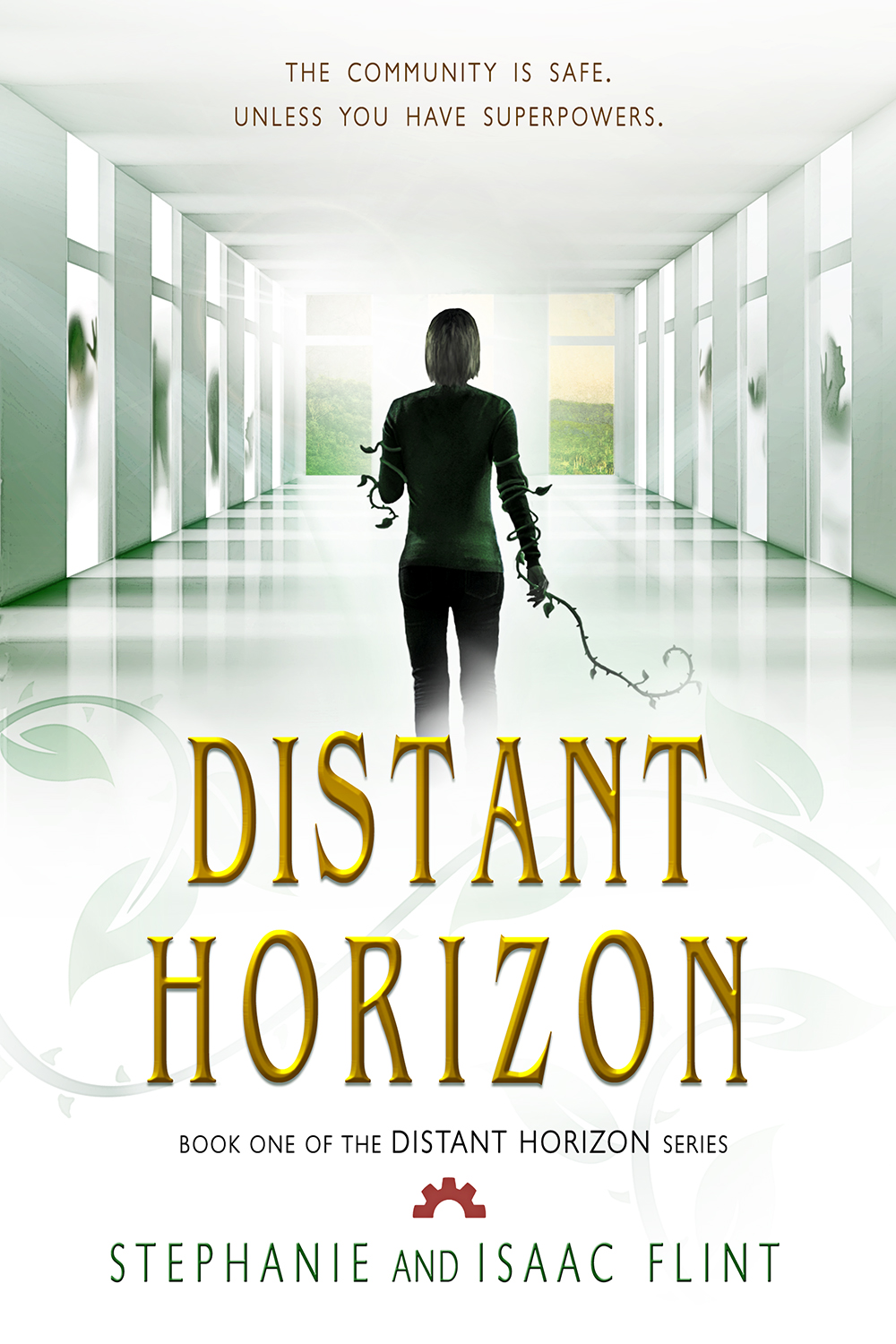
When I was working on Distant Horizon, a YA science fiction novel I’m co-authoring with my husband, Isaac, a suggestion we got from one of our beta-readers was to combine two characters who both played the role of a mentor. Ultimately I turned down the idea, because each character had conflicting backstories that I wanted to be able to bring in later (though that isn’t technically a good excuse–somewhere I read a similar train of thought about a Wheel of Time character, but I can’t remember which article that was).

However, by realizing how similar the two characters were, I realized how important it was to differentiate between them if I chose not to combine them.

Let’s take a quick look at these two characters, Pops and Jim, from Distant Horizon.

Pops is the main character’s grandfather, though she knows him for the same length of time as Jim. He has the wisdom of experience from working with the people he now fights, and he wants to protect the main character from those people.

Jim, on the other hand, is older than Pops, and he’s never worked with the bad guys. He knows the time from before the bad guys took over, and thus, he took on the role of the rebel’s historian.

Both characters are mentor figures, and in my earlier drafts, had a tendency to convey repetitive information.

I needed to determine what made each separate character crucial to the plot, and why I wanted them to be different characters.

One reason was their respective eras.

Pops grew up during a time when the bad guys had almost full control of their territories, but their reign was still uncertain. They were no longer seen as the bad guys, and thus, Pops took part in helping their agenda. He grew up familiar with the earlier uncertainty where the lack of jobs and money were a problem, and he understood the promise of the coming “Community ideals.” But in his work he’s seen the darker side of the Community, and while he still values the ideals, he no longer supports the bad guys. While with them, he trained as a scientist who studied powers, and so he is the resident expert.

As for Jim, he grew up in the age of superheroes (relatively similar to our world, but with powers). He saw the fall of the Super Bureau, and the fall of the free world. He is familiar with the concept of democracy, various religions (which were largely wiped out by the bad guys) and freedom. He was there to watch the world spiraling out of control, and he was there at the founding of the rebels’ group. He’s seen the change of eras. Paralyzed from the waist-down in his early days, he no longer fights direct battles, but he provides useful information regarding the past as it was… and how the bad guys have covered up that past with lies. He is the only surviving member of the Super Bureau.

Each character has several similarities. But they are also different. When the main character wants information regarding how the bad guys act from within their ranks, she should go to Pops. When she needs more information on powers, she should go to Pops. When she wants comfort in the Community ideals she believed in, she should go to Pops.

But when she wants to know why this rebel group behaves as they do, she needs to go to Jim. Only he can give her the dynamics that neither she, nor Pops, can fully understand. When she wants information on the world as it was, and might be yet again, or answers that don’t involve the Community’s dark secrets, she needs to go to Jim. He has a different perspective than Pops, and unlike Pops, who is jaded from the world he’s seen, Jim still has some lingering hope within the sadness of everything he’s lost, in part because of how he was raised.

Now, would it be possible to combine these characters? Probably. The ages might change. The new character might have been a superhero trained in the science of powers who worked for the bad guys for a while, then quit for reasons that are revealed in the story. The new character would still be a mentor, but due to the change in backstory, how they see the world–and how others see them–would be different.

It’s not quite what Isaac and I were going for. There’s a certain symbolism we’re hoping to achieve through the two characters, and they each have different outlooks on life. Maybe the story would have been stronger if they were merged. Maybe it wouldn’t.

For now, I’m planning to keep them separate. But having considered merging them helped me to consider what made them stronger separately.

I hope you enjoyed this post, and next time, I’ll be talking about a couple characters I’m considering combining in The Shadow War. 🙂

Have you considered combining any of your characters? Why or why not?

EDIT: You can read the second part of this post here.


4 Comments

Filed under Writing

Thoughts on Publishing – A Video Blog Post – Reading Chapter Five of Magic’s Stealing

Woot! I actually got this recording done on time! Anyway, here it is: the video blog post and the reading of Magic’s Stealing, chapter five. I hope you enjoy it. 🙂

Chapter One

Chapter Two

Chapter Three

Chapter Four

Leave a comment

Filed under Business Ventures, Writing

Thoughts on Writing – Analyzing the “Jessica Jones” TV Show

(Warning: I’ve only watched the first three episodes, and I have tried to avoid major spoilers, but read at your own risk).

Recently, my husband and I started watching Jessica Jones on Netflix. I was introduced to the show while browsing through a CNN article that mentioned that David Tennant (Doctor Who’s tenth doctor) was playing Killgrave, a Marvel villain with mind control powers, and that the main character, Jessica Jones, has a few super powers of her own. Despite the article mentioning that this particular show is considerably darker than the other Marvel shows (and ooo-boy, it is), the super powers sounded interesting, so I tentatively (Or Tennant-ively, if you like puns), decided to give this show a try.

And yes, it is dark.

The main villain of this story is actually evil. Downright despicable, cruel, manipulative, and abusive.

And you know what? As a writer, I’m impressed. I haven’t seen very many shows lately where the villain was actually a pure bad guy. Now, I’ve only seen the first three episodes of Jessica Jones as of writing this post, so maybe Killgrave has a soft side–maybe. And granted, my weekly go-to show has been My Little Pony: Friendship is Magic. The bad guys there don’t tend to last long before being converted by the powers of friendship.

Anyway, I generally lean toward villains who have logic behind their actions, who are at least a tad bit sympathetic. They tend to be more interesting, and you want to root for them at least a little… even if the hero is likely to win. (Janice Hardy has a great article on sympathetic villains).

In the first season of Heroes, Claire’s father is all set up to be the big bad guy. But he has good reasons for his actions… even if he doesn’t always make the best choices.

In Avatar: The Last Airbender, Zuko is out to capture Aang… but he’s trying to prove himself as having honor by his father’s standards, and he slowly comes to the realization that honor isn’t what he thinks.

In the Thor movies, Loki steals the show. He’s not a good guy, obviously, but he’s probably the most entertaining of the characters, and I found myself rooting for him more than any of the other characters. (Granted, I’m not much of a Thor fan. I like Captain America, and I’m super-excited to see the upcoming Civil War movie.)

Really, these are all very different shows from Jessica Jones. I’ve never read the comic (this show is the first I’ve heard of her character), but this Youtube video does  a pretty good job at summarizing how the comic is vastly different from many of the other comics in the Marvel universe. Quite simply, Jessica Jones was meant for an adult audience, with the freedom to explore heavier topics that are typically shunned in mainstream comics and TV shows.

Regardless, the first episode of Jessica Jones blew me away. I loved analyzing the show.

Sure, it’s darker than I normally prefer, but the creators set that tone right from the get-go, so the darkness doesn’t come as a surprise. Take a look at the opening line of the show (as paraphrased from my memory):

“New York City may be the city that never sleeps, but it sure does sleep around.”

This line is not only memorable (because it delivers a twist on an old saying), but it sets the tone for the rest of the episode.

Jessica Jones is a private investigator who makes her money by helping disgruntled spouses find proof if their husband/wife is cheating on them. And the show doesn’t mind showing exactly what those couples are doing. Right from the beginning, we know that there’s going to be on-screen sex.

Setting the tone at the beginning helps audience members who aren’t interested know whether or not they want to keep watching.

Having the gritty setting at the beginning also allows the show to naturally segue, piece-by-piece, into revealing that Jones has been psychologically (and sexually) abused by her former captor, Killgrave.

The first time we hear him, his dialogue is a bit ambiguous. We don’t know if he’s really there of if she’s having a flashback, but we do know that dark blue lights are going to be a symbol of his influence. (As a side note, I loved some of the artistic options of this show. Some of the scenes can seem to be a bit slow… but the tension is mounting, the hotel hall is lengthening, and you wonder who, or what, lies just behind that door…)

The artistic choices also helped address one of my initial concerns about the show: Would David Tennant be able to portray the villain without reminding the audience of the Doctor? Granted, we’ve seen the tenth doctor have a few rather dark-sided moments, but nothing like this.

I needn’t have worried. The first few times we see Killgrave, his face is in shadow. The lights change to a dark blue-violet, and we mostly just hear a few lines of dialogue. This is an excellent choice to build up Killgrave’s character before we actually see his face. Then, in the second episode, when we finally see Killgrave, if only for a moment, we’re not exactly picturing the good-hearted Doctor.

That’s another thing this show has been doing well. Instead of showing the villain outright, we first see shadowy glimpses of him. We hear his voice. There’s a moment in the third episode where he delivers a long line of dialogue that is amazing, in part because it’s a threat we know he’ll actually follow through, but he’s entirely off-camera.

We have two major things going for this villain: the show teases us, only showing his face on occasion. We’re never quite sure if he’s going to be standing around the next corner. This is great for building tension. Second, he’s perfectly capable of doing his evil deeds. We see the results of his actions, and we know he will do terrible things. The show hints at it first, then shows us bits and pieces. The only question is who he will target next. As such, the writers have proven that he is a threat for the hero.

The villain, terrifying as he is, makes the hero so much stronger (and not because she has super strength. Killgrave is capable, he’s dangerous, and Jessica has stakes. The whole first episode is about drawing her into this conflict. She has a traumatic history with the guy, and every reason to run.

The show has to prove why she doesn’t.

It does. It does by pushing the villain’s already evil deeds to a whole new level (Seriously… Killgrave is evil. Just watch the first episode).

Jessica can either run, or she can confront him.

Better yet? The show makes it possible for either to make sense for her character. Either she’ll run, and we expect Killgrave to follow, or she’ll fight, and we’re biting our nails hoping she doesn’t dig herself in too deep.

Regarding digging itself too deep… Jessica Jones continued to impress me by not restricting itself to being super-depressing or overly dramatic.

My problem with the first season of Agents of SHIELD was how over-dramatic it was, and with the second season, how it would linger too long in the depressing stage. Jessica Jones, on the other hand, resorts to situational and dry humor to help lighten the mood when necessary, and some of the moments are quite amusing. They’re placed at key moments to relax tension or bring you back from “eeps!” moments, without seeming contrived.

Plus, there are references to the rest of the Marvel universe (especially in the third episode) that helps tie everything together.

Overall, I’m really enjoying the show. I was hesitant at first, knowing that it would be darker than the other Marvel shows,but I’m glad I gave it a shot. If Jessica Jones continues as it has thus far, I think I’ll enjoy it… and I’ll be happily rooting for Killgrave’s downfall… a character I suspect that I’ll “love to hate.”

I hope you enjoyed this post. Have you watched any episodes from Jessica Jones? 🙂

5 Comments

Filed under Writing

Thoughts on Publishing – Infinitas Publishing Status Report

It’s that time again! Time to evaluate the current status of Infinitas Publishing. 🙂

The Wishing Blade: Magic’s Stealing: As of Monday, the first book is complete. Done. Finis. I’ve finished proofing the print edition and approved it through Createspace. I’ve also uploaded the updated versions to Smashwords and Kindle. If it has the Cirenan map in the preview, then it should be the updated edition.

Magic’s Stealing is now available in paperback! 😀

The Wishing Blade: The Shadow War (Book Two): My NaNoWriMo goal of fully revising the first half of this book fell through, but I did get a bit further in on the edits. I’ve also been plotting a bit of backstory that may or may not make it into the final version. This book may take a bit longer to work through than its predecessor (It’s longer, for one thing. The rough draft is currently the same length as the first book), but now that my time is starting to free up again (Finished several book covers, just about finished with a surprise bit of dental work, and releasing the print edition of Magic’s Stealing) I should have more time now to actually proceed with writing.

The Multiverse Chronicles: Trials of Blood and Steel: I haven’t made a whole lot of progress here, either. Our beta reader has read the first four episodes, and I recently sent her the fifth episode. I’m hoping to work on the sixth episode in the next few days, and go from there. Our plan is still to release the first six episodes around the same time that we release Battle Decks: Trials of Blood and Steel, and then an episode a week after that.

Isaac has been making good progress on the rough draft of the second season, though. He’s currently on episode 19, and once all the episodes are complete, he plans to go back and do basic edits before handing them off to me. 🙂

Battle Decks - Steam Tank Preview Card

Battle Decks: Trials of Blood and Steel: We’re off our target schedule for this, but we have made progress. We’ve updated all the cards, updated the rules and glossary (which need to be proofread… one of our weekend plans) and we’ve finished the new Steam Tank card, which replaced an older card. (I’ve included a sneak peak of the game card… minus the rounded corners and general trimming). This weekend, our goal is to refit the box art to the smaller boxes, finalize the last few tweaks, and order a proof of the updated game.

SBibb’s Photographic Illustration: I’m finishing up the last of a string of covers I was working on last month, and I only have a couple covers slated for this month, which gives me time to catch up on some of my other projects. Of course, I’ll be posting the behind-the-scenes info as the publishers and authors release their covers to the public. 🙂

In the meantime, I have a manuscript that I need to beta-read for a friend. I’m hoping to finish my read-through in the next two weeks, in order to give her time for her own personal deadlines.

That’s all for now. I have a book cover to finalize tonight, and tomorrow I have a new cover proof to start before I get back to work editing The Multiverse Chronicles.

I hope you’ve enjoyed this status report. 🙂

Leave a comment

Filed under Business Ventures, Writing

Thoughts on Publishing – A Video Blog Post – Reading Chapter Four of Magic’s Stealing

Well, I had planned on getting this post up yesterday, but there was fun holiday decorating to attend to. So the video a day late, but here is the reading of chapter four of Magic’s Stealing. In other news, I’ve finished proof-reading the print edition, which should be available on Amazon in a few days. 😀

Chapter One

Chapter Two

Chapter Three

I hope you enjoy this post. 🙂

Leave a comment

Filed under Business Ventures, Writing

Thoughts on Writing – Tightening Prose to Improve a Scene

Isaac and I are getting close to having all the edits made to our most recent version of Battle Decks, which reminded me that I needed to continue editing the blog series that goes with it. So, at the most recent writer’s club meeting, I decided to work on episode five of The Multiverse Chronicles rather than The Shadow War, which I’m currently doing  background plotting and research for. Since The Multiverse Chronicles will start coming out before that book, I didn’t mind putting The Shadow War on a temporary hold.

Anyway, there are three sections in episode five of The Multiverse Chronicles: Trials of Blood and Steel. The first section details interactions between a dejected pigeon, the taskmaster, and the general. The second deals with Trish and the colonel, and the third (the obligatory end-sequence at the end of the episode) with a group of airship pirates. The last two scenes I’m fairly happy with, and I’m ready to send to our beta reader. However, there’s something still irking me about the first section.

My instincts said that the scene dilly-dallied too long. So, after editing the general episode, I went back to the first scene and began looking for ways to tighten the prose and make the wording more concise.

However, when I looked at the resulting edits, I found that the same chunk of information was actually a few words longer than the former introduction. But wordy sections had been tightened, offering room for stronger world and character building.

Let’s take a look at the previous intro.

A lone dragoon pigeon flew over gently swaying trees. It had a very important mission, which could not be deterred. For on its back, in a tiny, dark green capsule, the pigeon carried a message for General Buford of the Queen’s Army.

It was an important message, as all messages sent via pigeon were. (Thus far, the prose feels stilted, because the sentences are fairly similar.)

The pigeon swept over a sleeping red dragon with harsh, glimmering scales, then skimmed through a squad of pterosaurs, quickly diving to avoid having its tail nipped as some scoundrel drake’s lunch. (Feels lengthy). A few minutes later, the pigeon arrived at a large wooden building that smelled of hay and feathers. The bird swooped into its loft, surpassed the landing board, then took roost in the one of the homing cages. It cooed, head held high and chest out, standing tall while it waited for the pigeon fancier to come take its message.

The pigeon ruffled its feathers proudly. A successful mission, to be sure.

After tightening the prose and adding voice, this was the result:

A lone dragoon pigeon with a very important mission flew between gently swaying trees. (I combined a couple sentences, and changed how the bird is flying in regards to the trees). It could not allow itself to be deterred. (Here we get that the pigeon is the one who does not want to be deterred… not that it can’t happen in general). For on its back—in a tiny, dark green capsule—the pigeon carried a message for General Buford of the Queen’s Army. (I’ve found that using the dashes help separate the thought better and adds flavor).

The message was of the utmost importance, as were all messages sent via pigeon. (I clarified “the message” instead of “it,” and changed the placement of “were” so that the sentence ends on a stronger visual word).

The bird swept over a sleeping red dragon with harsh, glimmering scales, then skimmed through a squad of pterosaurs. It dived, avoiding having its tail nipped by some scoundrel drake wanting an early lunch. (Early lunch helps imply that the pterosaur is acting out of bounds per the pigeon’s rules… (adds voice), and splitting the sentences adds urgency to the action).

A few minutes later, the pigeon arrived at a large wooden building. The musky scent of hay and feathers wafted through the air. (Splitting the sentences helps pacing, and we get a better visual). The bird swooped into its loft, surpassed the landing board, and then took roost in the one of the homing cages. It cooed, head held high and chest out, ruffling its feathers as it waited for the pigeon fancier to take its message.

A successful mission, to be sure. (I combined a couple sentences, slowing the pace a tad bit, but also cut needless repetition.)

Overall, I’m much happier with the latest edit. After tightening the prose and adding a bit more voice, the scene has a tiny bit more “pizazz.”

In one of my previous posts, “What does a serial episode need?” I included a list of traits I wanted to instill into each episode:

  • A strong sense of character, and relationships between characters. (The updated version includes a little more of the pigeon’s personality.)
  • Both humor and serious notes… usually involving some bit of quirkiness. (By adding more of the pigeon’s personality, we added the quirkiness.)
  • A strong sense of world-building. (This remained about the same for the intro, except that I tightened and condensed points. However, I suspect that I need to build on this further into this scene.)
  • Conflict and/or tension. (Will the pigeon deliver its message?)
  • A reasonable beginning, middle, and end. (This selection only shows the intro, but the end of the scene will show the pigeon flying off with a new message.)
  • Something that propels this episode into the next. (This isn’t seen in this particular section, but the end of the scene introduces Trish’s arrival coming in the next scene.)

I also re-read another post I wrote, “Creating Tension,” which reminded me to look into the scene and see if the tension and point of view lagged.

I hope you’ve found this post enjoyable. Have you found any tips for tightening your prose (even if it caused your word count to increase)? 🙂

Leave a comment

Filed under Writing

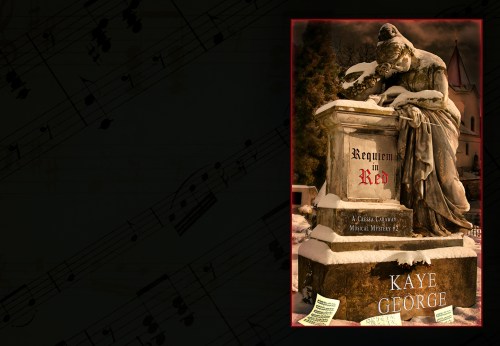
Behind the Scenes – Requiem In Red

A cover for Barking Rain Press.  This is the sequel to Eine Kleine Murder by Kaye George. (Note that the publisher’s version of the cover is slightly different, and I modeled the sequel cover’s border around the main image after their version). For this cover, the publisher wanted to convey the dark mood of the book, along with a hint at the musical themes involved. They provided a couple possible background images and ideas, which I then put together in a rough comp. I also found the music sheets (part of one larger image of multiple music sheets, which I cut-and-pasted, and then used Photoshop CS6’s warp tool in order to place them in varying positions). I also added the conductor’s baton in the hand of the statue, made it look like the baton was the same material as the statue, and added the directional shadow. The goal was to have everything fit together smoothly.

Afterwards, the publisher asked about adding a church in the background, behind the woman’s statue. So I placed the church (careful to get the size and placement in the image right so that it looked like it was in the background), blurred the background around the statue a bit for a focal effect, added more now to the steeple, and also played with the darker sky from the church image.

This is the result:

SBibb - Requiem In Red - Book Cover

SBibb - Requiem In Red - Wrap-Around Book Cover
Stock images from Shutterstock:

http://www.shutterstock.com/pic.mhtml?id=101040352 – musical background

http://www.shutterstock.com/pic.mhtml?id=22681549 – graveyard

http://www.shutterstock.com/pic.mhtml?id=15224833 – baton

http://www.shutterstock.com/pic.mhtml?id=22723609 – music sheets

http://www.shutterstock.com/pic-22681552/stock-photo-village-church-in-snow-czech-republic.html – church

Leave a comment

Filed under Book Covers, Client Work