Tag Archives: Stephanie Flint

Thoughts on Publishing – Infinitas Publishing Status Report

All right, the time has come for another status report. 🙂

When Isaac and I first started Infinitas Publishing, we created an Excel file that listed our goals for releasing our books and games. Some of those are completely in the works (they haven’t yet been started), while others already have a fairly polished draft and just need editing.

Either way, I figured it would be a good idea to take a look at our current projects every once in a while and see how everything is going.

Here are the current projects:

The Wishing Blade: Magic’s Stealing -The ebook is now available and I’ve run our first giveaway via another author’s blog. I have finished formatting the interior file for the paperback edition, and I’m adding the final touches to the wrap-around book cover. I hope to order a proof copy in the next few days.

In the interests of time and money, Isaac and I chose to purchase the $10.00 custom ISBN at Createspace. It lets us list our imprint as the publisher, though we can only use that ISBN when printing through Createspace. Since it will be a while before we can try distributing the book through a site like Ingram Spark, we figured the printing restrictions should be worth it for the time being. At least this way we can have a print edition available (and through the money we saved by waiting to buy a universal block of ISBNs, we can now purchase a box of print books to sell and give away). I’ve also talked to a couple local book stores about stocking copies of the book, so we’ve started making headway there.

The Wishing Blade: The Shadow War – I haven’t made much progress here. I’ve got a partial rough draft from when I was writing Magic’s Stealing, and I’ve got some plotting in place (a few blog posts should be coming from that, too), but that’s about it. This is my next project after I finish editing the first half of Trials of Blood and Steel. Since I have the basic formatting in place from Magic’s Stealing, preparing the ebook and paperback editions shouldn’t take quite so long. We’re off-target on our planned time of this release, but we’ll see how the writing and edits go.

The Multiverse Chronicles: Trials of Blood and Steel – Isaac has finished writing the main plot, and he’s made quite a bit of headway on the “meanwhile” end scenes that go at the end of each episodes. Our plan is to polish the first thirteen episodes (of 28-ish? Haven’t divided all of them yet), and then begin releasing each episode. I’ve got twelve of those thirteen episodes edited, and after I finish episode thirteen, I’ll be editing the end scenes. Then I’ll run through the full thing one more time for continutity before doing a read-aloud with Isaac to make any further changes. Then I’ll proofread on paper, and afterwards we’ll start to release an episode a week.

I’ve begun setting up the Multiverse blog, but the main info still needs to be added, along with creating an episode guide and the main graphics. Due to the nature of this project, we’re considering holding off on beta readers, but otherwise, the first episodes should release on schedule.

Battle Decks: Trials of Blood and Steel – We’re currently on par with this project. We plan to read through our edits of the rules this weekend, and then we’ll be ordering a new proof copy with the edited cards. If everything looks good, we should be able to release on schedule. We still need to create a how-to video, but we’ll need the updated proof to complete that. If all goes well, this should be available in November.

SBibb’s Photographic Illustration – Not part of Infinitas Publishing, but still something I need to schedule (plus, it helps with the initial funding of the company). I have a few book covers to work on, so I’ll be doing those in order of due dates. This is one of the things I’ll be working on this weekend.

I hope you’ve found this post interesting. Once we have solidified release dates, I’ll make them public 🙂

4 Comments

Filed under Business Ventures, Writing

Thoughts on Publishing – The Excerpt at the Front of a Print Book

I’m in the process of creating a paperback edition of Magic’s Stealing. I’ve got most of the formatting complete, save for a couple blank pages, and I’m currently focusing on adding an excerpt at beginning of print book. The idea is that as soon as a potential reader opens the book, the first thing they see is a teaser that makes them want to read more (and encourages them to be patient if that scene takes time to reach).

Keep in mind, when a reader is browsing a book store or examining a book at an author’s table, they will likely look at the cover, then at the back cover blurb, then at the excerpt on the first page of the book. The goal is to draw them in more and more until they choose to buy the book.

This is how I ended up buying The Girl with the Iron Touch by Kady Cross (and ultimately loving it) at a Barnes and Noble. I’ve seen other books do the same. Adding the excerpt provides a teaser so that the reader knows what to expect.

(You might see another form of this on a hardcover book, but the excerpt may be on the back cover, usually something of action or intrigue, with the blurb inside the cover flaps).

Let’s take a look at Magic’s Stealing and see how this compares.

Back Cover Blurb:

For centuries, ribbons of magic have provided the kingdom of Cirena with light, healing, and protection. Then, in a span of minutes, those ribbons fly from their masters, stolen, save for the magic of a few chosen mages. One of these mages is Toranih, a young noblewoman who would rather have a sword in her hand than use her powers to heal or throw fireballs. As a result, her magic skills are lacking. But with former mages dying from magic withdrawal, and the looming threat of an army of shadows who are impervious to mortal weapons, she must either embrace the responsibilities of a mage or watch her home perish.

Whatever excerpt I choose, the excerpt should enhance the understanding of the content inside the book.

These were the two excerpts I’m considering:

First Excerpt

Toranih cast a glance toward the distant mountain and shivered. The closer they came, the more her unease grew. It wasn’t her usual dislike of magic. As close as they were now, the magic inside the forge glowed like a star. Yet the whole place was shrouded with a thick fog, a veil that kept the magic hidden from the distance.

She frowned.

She could almost see thin filaments weaving through the fog, like the shadows of strings from a poorly played puppet theatre. The filaments lashed out in different directions, disappearing as they touched bright, sunlit sky. She tilted her head and squinted, but the strings vanished altogether.

She shivered and returned to picking at the soft innards of her roll.

There was something different about that magic. Wild. Unsteady. Like a foal that hadn’t been broken, and might never be. The magic was curious, like a dark storm cloud spewing cracks of thunder and lightning when the rest of the land was gold.

Toranih shivered.

All this magic was bound to cause strange visions.

So why was she drawn to follow?

In this excerpt, we get a glimpse at shadow magic, a sense of eeriness, and a taste of the writing style. There is a also a question at the end, which would hopefully draw a reader’s attention. However, this scene doesn’t jibe with the back cover blurb. We have a mountain forge, shadowy, string-like magic, strange visions, and some kind of call to follow that magic. While the scene should be intriguing in itself, it doesn’t mesh well with the blurb.

Second Excerpt

Toranih could actually see faint ribbons in the distance, rising from their masters. The ribbons streamed into the sky, a dazzling array of colors, then fled east, away from the city in a glaring river.

She looked at the bowl again and blinked her eyes to clear the spots. She had to know what was going on. The liquid had gone milky-white, but if she could see what was happening . . .

She ran her fingers along the strings at the top of the water. One here, one there. The tips of her fingers tingled as lavender wisps flooded the bowl. The image swirled, faint. The mountain forge reappeared. The man held his sword fixed between both hands, raised to the sky. His feet were spread strong under his shoulders. Ribbons streamed to his sword from across the kingdom. The sword glowed bright and brighter, and as the screams outside died into a disjointed murmur, the sword faded and the image darkened.

The water was clear now, devoid of life.

Everyone’s magic had fled into the stranger’s sword.

First, this excerpt shows the ribbons mentioned in the blurb. Second, we see Toranih using magic (which conflicts with her dislike of magic, but the blurb does say she must embrace the responsibilities of being a mage). Third, we see a bit about the antagonist. Fourth, we see the event that the blurb mentions, and the end of the excerpt sets the problem up further.

Ultimately, I’m thinking the second excerpt is a lot stronger as a potential hook, especially when paired with the back cover blurb.

I hope you find this post helpful. 🙂 Have you considered adding an excerpt to the front of your book?

Leave a comment

Filed under Business Ventures, Writing

Thoughts on Writing – Subplots and End Scenes

Isaac has finished writing the rough draft of Trials of Blood and Steel, and I’m about half-way through editing his draft (with plans to go back at the halfway point and start polishing, that way we can start releasing episodes), so Isaac is now working on the little segments that go at the end of each episode.

We’ve been calling these segments end caps (a cross between recap and end of the scene? I’m not sure how we started calling it this), but I realized that wasn’t the actual name for those scenes. Did a bit of research, and they aren’t exactly a post-credits scene/stinger (they don’t come after the “credits,” just at the end of the episode, and they aren’t a teaser, since they come at the end of the episode rather than at the beginning. They also aren’t finales or cappers or endgames, per Merriam-webster.com.

So… I’m still not sure what to call these segments.

For now I’ll call them end scenes (though even that isn’t technically correct, per this site).

Anyway, our goal is to have a small scene at the end of each episode which provides a bit of extra background without being required for the main plot. Preferably, it will be something that makes readers wonder what’s going to happen next, and how this scene will get tangled into the main story.

For example, this is one of the end scenes (Still semi-rough), which references a carrier pigeon that was set loose earlier that episode:

Miles into its flight, the pigeon reached the border of the northern Prussian forest. The bird flapped tirelessly, trained for such flights, though it planned to take a food-break once it reached the other side.

Or it would have had a break, if it had made it that far.

A pair of glowing gold eyes spotted the pigeon from the ground, waited until the bird was within range, then lifted its rifle, sighted the target, and fired.

The shot echoed across the trees, but due to a slight miscalculation in wind speed, the bullet only clipped the bird’s wing. The pigeon faltered, but it had been trained as an elite war bird. It compensated for its broken wing, angling its beak and tail feathers in its best attempt to direct its plummet away from its assailant. The wind coasted under its good wing, and the bird directed its dive into the thicker part of the nearby woods.

The marksman waited as the bird disappeared into the trees. Despite being ordered to retrieve the bird, it turned around on its spiny legs and began its trek back to camp. The bird had fallen into the Deep.

The Deep… even in the marksman’s strained memory… resonated with its core and sent a tingle of fear through its metallic body.

Despite being a small part of the woods, no one who entered the Deep ever came out.

The goal of this scene is to raise the stakes (an important message has now been delayed), to set up the strange, metallic marksmen (which will become a major foe later), and to do the first foreshadowing of the Deep (which our heroes will encounter very soon).

Technically speaking, this scene isn’t absolutely necessary to the main plot.

It does raise the stakes, but if we remove this from the story, the rest of the plot would still make sense, though we might lose some of the richness.

This is, effectively, a subplot.

One of the interesting things about watching Isaac add the end scenes after writing all of the other episodes is seeing how they effectively develop into a subplot (mostly detailing what the bad guys are up to).

Not only that, but the end scenes significantly boost the word count.

Something to keep in mind if you have a bare-bones story that you want to develop further–or need to increase the word count of–is that you can add subplots.

Are there any plot threads that readers might find interesting that add to the story?

On the other hand, if you need to reduce your word count, cutting a subplot may be the way to go, particularly if there’s a thread that slows things down rather than keeps the pace moving. (If you need a breather, a subplot may be a nice way to release tension).

The next decision Isaac and I need to make is whether to have these end scenes be a separate post of their own, so it’s clear that they don’t have to be read for the main story to make sense (though I certainly enjoy them), or whether to include them at the end of the episode, perhaps with a telling Meanwhile… to denote that these are something separate from the main story.

I hope you’ve found this post helpful. 🙂 Have any thoughts about subplots you’ve found to be effective or ineffective?

4 Comments

Filed under Writing

Behind the Scenes – Beyond the Eyes – Cover Remake

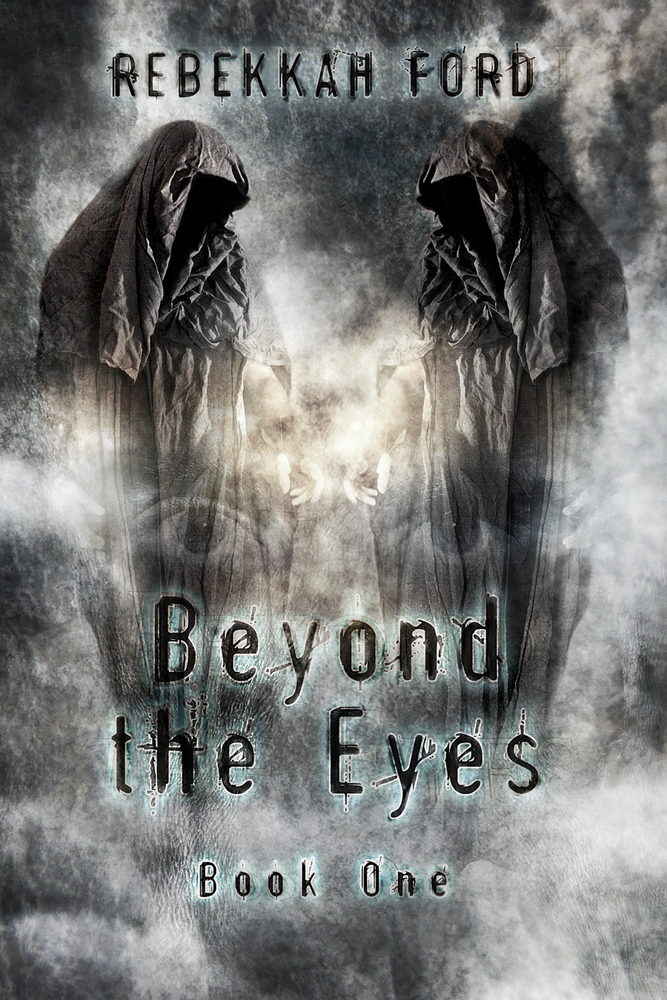
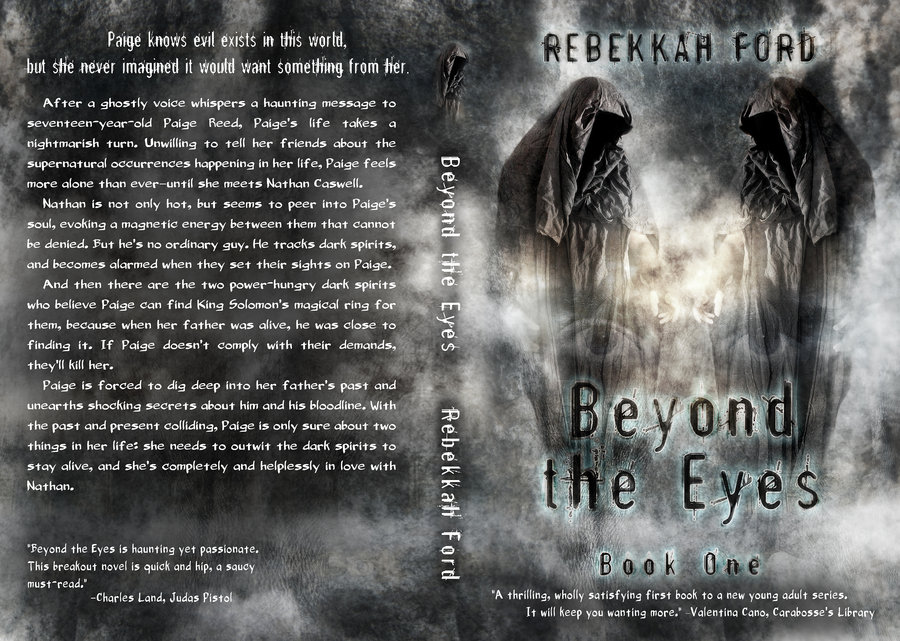
This is a cover for Rebekkah Ford. For this cover, we redid a cover I created for her three years ago, back when I was trying to find willing authors to take a chance on me so I could build my portfolio (thank you!).

At the time, we came up with this:

SBibb - Beyond the Eyes Book Cover

SBibb - Beyond the Eyes - Wraparound Cover

The goal was to create something mysterious, with a bit of a taste of horror for her first YA paranormal. At the time, I took inspiration from the cover of Clockwork Angel, the cover art of which I adore.

However, this was an earlier cover of mine, so the font effects are a tad amateurish (and I hadn’t even justified the original back cover copy… which I later updated once I discovered that trick). Not only that, but the cover felt too much like a horror novel, and wasn’t attracting as many romance readers as it should (since this is definitely a paranormal romance).

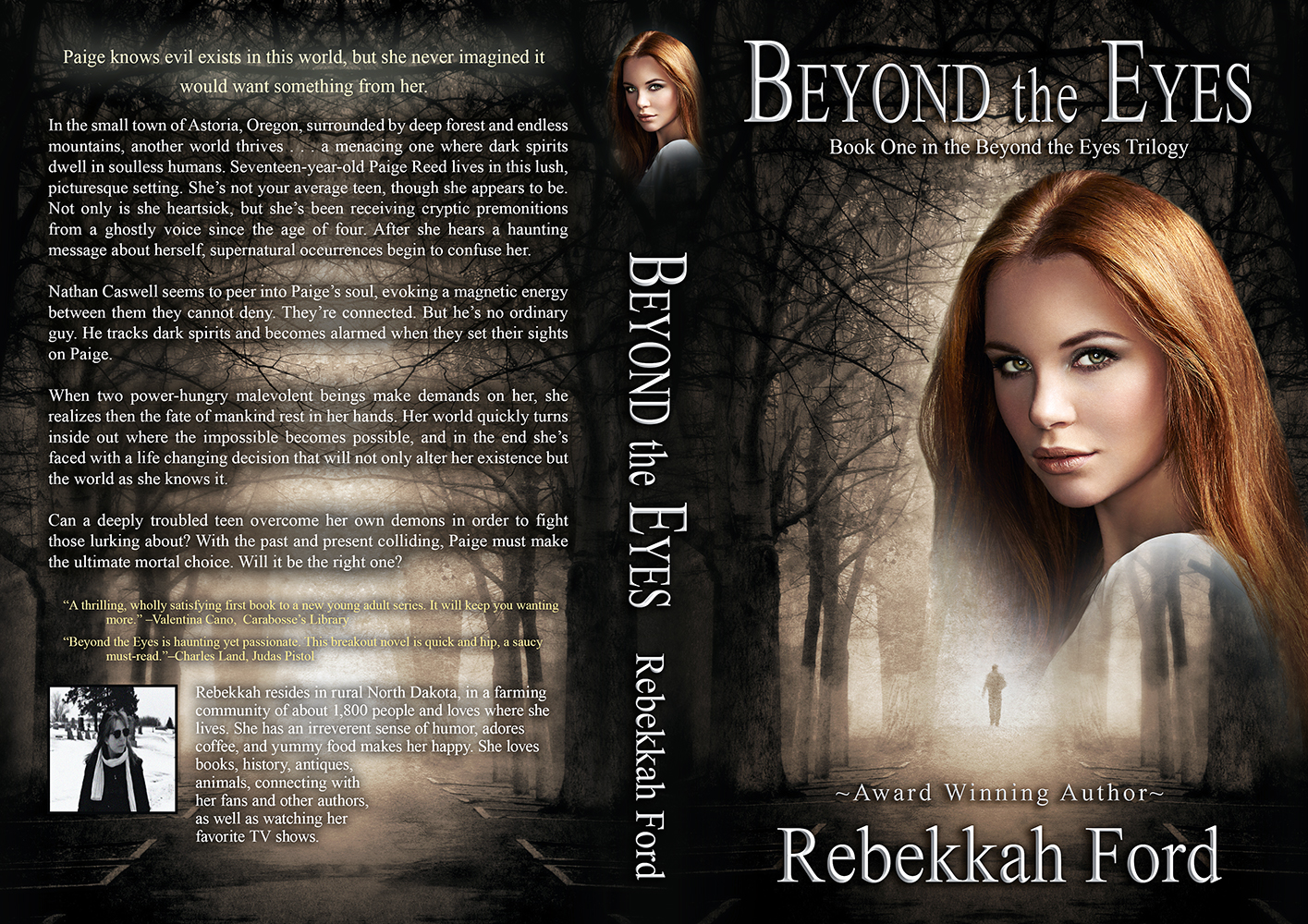
So Rebekkah contacted me again a couple months ago to see about updating the covers for this series. She had a few stock images in mind, and after working through a few proofs and font placement, we came up with this remake for the first book:

SBibb - Beyond the Eyes Remake Cover

SBibb - Beyond the Eyes Remake Cover

(See how much better the back cover formatting looks after three more years of experience?)

The woman on the cover clearly resembles the main character, Paige, the shadow in the distance could easily be a sinister dark spirit (or a mysterious immortal), and the eerie forest distinctly fits a prominent setting of the story. I blurred the background to help make the model stand out, then flipped it for the back cover, and darkened the spine to make sure the words were readable. This cover should now attract paranormal romance readers. In addition, the straightforward text should attract a bit of an older audience (this series fits the upper YA/NA categories).

Personally, I like both covers, but having read the book, I suspect the new cover will attract more of the target audience.

You can find Beyond the Eyes on Goodreads.

Stock images from Shutterstock:

http://www.shutterstock.com/pic.mhtml?id=281147264

http://www.shutterstock.com/pic.mhtml?id=107037647

Read more from the author’s point of view:

http://rebekkahford.com/2015/09/25/two-mistakes-i-made-with-my-first-book-cover/

2 Comments

Filed under Book Covers, Client Work, Photo Illustration

Thoughts on Publishing – Starting a Publishing Imprint

A couple days ago I was talking with an author friend, and they asked about the process of how my husband and I started Infinitas Publishing. I typed up a response, then realized that other people might also find this information useful. So here it is… the basics of how my husband and I started a business.

IMPORTANT: I am not a lawyer nor am I certified in taxes, so please do not take this as legal advice. These are just my experiences thus far, and are meant to be useful in figuring out what steps you may need to take.

Also note that this process varies depending on your location and the kind of business you want to start. This particular post is tailored to my experiences starting a publishing imprint in Missouri, in the United States of America. (Business law varies from state to state).

Choosing a Name

First off, my husband and I chose the name of our business. We chose Infinitas Publishing. We did a Google and Bing search, since the results are different, to see if there was anything too similar to the name already.

We found a few similar names, but we decided that our specific product (speculative fiction and games) and branding was different enough that the two companies wouldn’t easily be confused.

Once we found that we were in the clear for general terms, we did a trademark search. Since trademark law tends to be a pain and I still don’t feel like I have a good grasp on it, I figured we’d be best off avoiding anything too close to something that already existed.

As a side note, if the trademarks can’t easily be mistaken for each other, and they involve unrelated products, they should be free for use. (For example, if two trademark names were similar, but one related to a brand of vacuums and the other to a doggy day care. Completely different uses, so the companies can have similar trademarks.)

As an example, at one point Isaac and I called Battle Decks “Beastie Wars”… only to discover that “Beast Wars” was already in use by Transformers. Since both products involve entertainment and games, we decided to steer clear of the name. Not only that, but renaming the game Battle Decks gives us more versatility in future game expansions… never mind that there’s a PowerPoint slide competition of the same name. The game and event shouldn’t be easily be mistaken, however, so that shouldn’t cause any mix-ups.

To look up a trademark, I used the Basic Search Database (Under TESS, click “Search Trademark Database”), and told it to search “all” words.

Fictitious Name Registration / DBA
After we chose the name, we registered for a fictitious name / Doing Business As (DBA) license. For Missouri, this cost $7.00 and lasts for five years (which reminds me that I’ll need to renew my SBibb’s Photographic Illustration DBA soon). This allows you to legally use the business name instead of your own.

Determine the Business Type
You also need to decide what kind of business you’re starting. There are four major structures, including Corporations, but a Sole-proprietorship, Partnership, and Limited Liability Corporation (LLC) are the ones you’re most likely to run into at this stage.

Nolo has some great information in regards to business practices.

An LLC has the benefit of protecting your personal assets in the event of a lawsuit, but it does have a higher start-up cost. There are also certain tax benefits, and the salary structure is different but I’m not as familiar with this business structure, so I can’t say what those benefits are off the top of my head. If you are if you are publishing multiple authors or publishing materials that could result in a lawsuit, you may want to go the route of an LLC.

EDIT: Check out Raistlin212’s comments below for a better explanation of the benefits of the LLC business structure.

A sole-proprietorship is by far the easiest business to start, as all money coming into the business flows directly to you. Technically, once you have the DBA and EIN, you have the basics you need to start the business online. (This is the structure I use for SBibb’s Photographic Illustration).

A partnership is like a sole-proprietorship, except you have multiple people involved and there’s an extra form you need to fill out for income taxes (Form 1065 and the resulting K-1, which I’m not looking forward to figuring out next year, but I know a couple people I can ask for assistance). This is the structure my husband and I chose for Infinitas Publishing.

Employer Identification Number (EIN)
Once you have the DBA, you can apply for an EIN (Employer Identification Number) through the IRS (so many acronyms, I know). This number is handy because it identifies your business on tax forms. The EIN is registered on the federal level. You apply online and you get the number immediately upon completing the form. Doesn’t cost anything either, and you have a different number for each business (Infinitas Publishing has a different EIN than SBibb’s Photographic Illustration).

If you have any questions about filling out the form, your local bank may be able to help. I had a bit of trouble trying to call the IRS help line (I felt like I was playing a Choose Your Own Adventure game, phone style), but the people at the bank were able to answer my questions in regards to start dates and such.

If you are doing freelance work, having this number is nice because it gives you a number to give contractors for the Form 1099-Misc without having to give them your social security number.

Business Bank Account
It is usually recommended that you have a separate banking account for your business to keep your income and expenses organized. This may especially be helpful if you’re ever asked to produce records for tax purposes.

Check with your bank to see what they require to start an account. I went to US Bank, since I was familiar with them and they had a basic package that suited our needs and wouldn’t cost us money to use. This was important since we didn’t expect a high inflow of money to start with. For a partnership, our local branch required a General Partnership Agreement (an LLC needed an Operating Agreement). They also needed the EIN, and I think they needed proof of the registered DBA. It took a couple weeks for this to show up in their system, so be sure to plan ample time between getting everything registered and actually starting the business.

If you need assistance with the General Partnership Agreement or Operating Agreement, there are several sites online that offer free templates. Once you find a suitable template, you can tweak it to fit your needs.

If nothing else, this agreement acts as a guide to each partner’s responsibilities in the case of misunderstandings or if anything gets rough. Now, if you want to be sure that everything is legally correct, you may want to hire a lawyer to look over your forms.

Since Infinitas Publishing is between my husband and I, we didn’t do this, though we did make sure that we understood everything in our agreement and that it suited our needs.

For SBibb’s Photographic Illustration, I don’t use a separate bank account. Due to the nature of my work, I have very few expenses that I apply to that business. However, I do keep a ledger of all income, and it is still advisable to have a separate account, even if you’re a sole-proprietor.

Online Payments
Once the business bank account was set up, I created a business Paypal account and input the new information into my Kindle, Createspace, Smashwords, and The Game Crafter settings. Now when we receive royalty payments or purchase proofs, they’ll be linked to the business, rather than our personal accounts.

Smashwords Publisher Account
Smashwords has a “publisher” account option, which I upgraded to so that my works would show up as published by Infinitas Publishing. Then I created “ghost” author accounts for my Stephanie Flint and Stephanie Bibb names, and I’ll add Isaac’s name once we start publishing our co-authored works.

Sales Tax
Our next step will be to fill out the Missouri Sales Tax form. During the time that we only had ebooks, we didn’t need to worry about sales tax, but once we get print books made, which we plan to offer to bookstores and try selling at a local holiday market, we’ll need to collect Missouri sales tax.

As a side note, I’m not sure about what differences we’ll see when I get to selling wholesale (to bookstores) versus retail (holiday market). I’m still researching this, so I’m a bit sketchy on this. However, when emailing the Missouri Department of Revenue, I’ve been able to get some very helpful information on what forms we’ll need to fill out (Form 2643 and 53-1), along with details about the form.

Give yourself a bit of time to get through it all, but definitely ask if you have questions.

Important: Check with whichever state(s) you’re doing business in, because the requirements vary.

Final Notes
Of course, all of this information is for if you plan to self-publish rather than seek representation through a trade publisher. Be sure to research both sides thoroughly, as there are pros and cons to each.

Granted, this doesn’t even cover creating a logo, a website, buying ISBNs, approaching book stores, and everything else I’ve forgotten at this point. But hopefully it will give you a starting point, and maybe I’ll talk about the “branding” and marketing side of things at a later date.

Also, If you’re curious to read more about the business side of publishing, take a look at Kristine Kathryn Rusch’s “Freelancer’s Survival Guide.”

I picked up a copy through a StoryBundle offer, and while I’m still in the process, it has been immensely helpful in considering what steps to take to start the business. Plus, some of the articles are on her website for free, so you can read through whichever ones you need. 🙂

I hope you find this post useful. Do you have any tips for starting a publishing business?

***

By the way, Carissa Taylor was awesome and agreed to host a give-away of one free, ebook copy of Magic’s Stealing, so if you’re interested in winning a copy, head over to her blog.

She also has some really useful information on Twitter pitching and a list of literary agencies that accept YA science fiction and fantasy, so be sure to check those out as well. 😀

10 Comments

Filed under Business Ventures, Writing

Thoughts on Writing – Transitions and Adding Emotion to a Scene

Every couple of weeks, my husband and I meet with the local writing critique group. While there, everyone shares relevant announcements, and we usually critique a small section of each other’s work.

Last week I brought in an episode of The Multiverse Chronicles. My husband plots and writes the first draft, which I then polish. Most of the other episodes haven’t been too problematic, but this particular episode was giving me issues. I’d already tried editing it a few different times, but it still sounded… flat. I knew the transitions weren’t quite working, but something else was missing, too.

Once I read the piece aloud, the group pointed out that it lacked the usual description and emotion I tried to invoke. Thus, having someone who is familiar with our work can be helpful.

Critique partners can see the things which usually embody our work, even if we can’t.

So, after applying the basic suggestions the group made, I went back and sought ways to deepen the emotions of the main character, along with boosting the imagery in each of her “flashbacks” so that the reader would feel better grounded in the reality of the story.

For example, this is what one section looked like while I was still having difficulties editing it:

Trish had been at camp for seven days now, and thus far her training had consisted of textbooks, tests, practicing basic commands with her pterosaur (which, she noted as she stared at the starry sky, still remained nameless), and meeting with Colonel Pearson.


The meetings were the worst.


“Ivers, you seem to be making good progress,” the colonel would say, trailing his finger along a clipboard of notes, “but—” Always, that annoying ‘but.’ “—you need to work on your skills. Have you remembered to meditate with your drake?”


She flexed her shoulders. Maybe he never mentioned meditating with the pterosaur, but he usually gave her some unimportant task that she needed to complete.


“Ah-ha! Now here is a test that will measure your skills on meditating. Don’t forget to read chapters seven through nine of The Honor of Tactical Flying.”


Trish sighed and bit off another chunk of her granola.


The camp had only one copy of each book, which meant Trish had to go to the quartermaster to check them out.

Not only does the scene need a bit of tweaking in regards to transitioning the flashbacks, it also lacks a sense of the surroundings, and the emotion behind it feels dull.

This is what the section looks like now that I’ve added more description and focused on the emotion:

This was her seventh day at camp, and thus far her training consisted of textbooks, tests, practicing basic commands with her pterosaur—which, she noted as she stared at the starry sky, still remained nameless—and meeting with Colonel Pearson.

(Note that using em dashes instead of parentheses have improved the flow of her thoughts)


She inhaled the brisk air at let it out slowly, counting down from ten to relax her thoughts.


The meetings were the worst thing about being here.

(We’re starting to get a sense of her impatience)


The colonel would trail his finger along a clipboard of notes, tap his chin thoughtfully, then meet her gaze with his piercing blue eyes. “Ivers, you seem to be making good progress, but—”Always that annoying ‘but’ “—you need to work on your skills. Have you been meditating with your drake? Surely you haven’t forgotten.”

(The use of ‘would’ following colonel suggests that she’s thinking about this, not that it’s happening right now. Plus, ‘piercing’ eyes (however cliche) denote that she’s uncomfortable). Adding ‘Surely you haven’t forgotten’ gives her that feeling of being put on the spot. Already, we’ve got a lot more emotional details and descriptors to ground us in the scene)


Trish flexed her shoulders. Maybe Pearson had never mentioned meditating with her pterosaur, but he usually gave her some unimportant task that she needed to complete. Like checking the feed levels of the other pterosaurs, or cleaning the cages while the riders were out, or reading.

(By saying ‘Maybe Pearson had‘ shows that we’re back in the present. And the list of complaints continues to show mounting agitation)


So much incessant reading.


“Ah-ha!” Pearson had exclaimed upon skimming through a tiny red booklet that Trish was fairly certain should have been titled A Thousand Ways to Torture Private Ivers. “Now here is a test that will measure your skills! Read chapters seven through nine of The Honour of Tactical Flying, then report back for your next assignment.”

(By having the line ‘So much incessant reading’ on it’s own line, and then going to ‘ “Ah-ha!” Pearson had…’, we make room for another flashback. The choice of ‘incessant’ further shows Trish’s annoyance. And then we have ‘A Thousand Ways to Torture Private Ivers.’ She feels she’s being treated harshly.)


Colonel Pearson had grinned, tossed his clipboard on a stack of papers, then dismissed her to her chores.

(I’m debating on the phrasing of this, but currently, saying that Pearson ‘had’ done this cues that we’re coming back to the present)


Trish sighed and bit off another chunk of her granola.

(Yay, monotony…)


On the bright side, she didn’t have to go through all the same physical drills as the other riders. She got her exercise from running tent-to-tent, trying to locate the miscellaneous items she needed to please her superior officer. The camp had only one copy of each of the primary textbooks, which meant Trish had to go Corporal Smith, the quartermaster, to check them out.

(Adding the bits about her having to run from tent-to-tent and locating miscelleneous items adds to the feeling that she doesn’t think this is important… especially since she doesn’t bother to consider what those miscellaneous items are)

Overall, I think the edited section reads more like the other scenes now. The flashback transitions read smoother, and there’s enough detail to ground me as a reader in what is happening. Plus, we now have a sense that Trish is genuinely annoyed and impatient, rather than just ‘ho-hum’ about her daily life at camp.

I’m still in the process of editing the rest of the episode, but now that I know where to go with it, I think editing will go much smoother.

If you’re in a problem spot, see if you can find a trusty beta reader or critique partner to take a look, even if it’s just a small scene. They may be able to see what you’re missing, especially if they’re familiar with your work.

I hope you enjoyed this post. Have you found any tricks to adding emotions to a scene or transitioning flashbacks?

***

By the way, author Jordan Elizabeth was kind enough to feature my book on her blog, Kissed by Literature. Check it out to find another sneak peak of Magic’s Stealing, and to see what other books she has featured. 😀

Also, Cathleen Townsend has written the first review of Magic’s Stealing! Find it (and other reviews) at her blog, The Beauty of Words. 😀

2 Comments

Filed under Writing

Thoughts on Writing – Developing a Mythology

Now that I’ve launched Magic’s Stealing, it’s time to get back on task with other writing projects. In this case, the next project is The Multiverse Chronicles. My husband plots the story and writes the rough draft, while I polish and edit each episode. I’m currently sitting on episode 11 (I’ve got a few ideas on how to fix the problems I’ve been having with it, thanks to the critique group I attend.), and once I edit episode 12, I’ll go back through the first twelve episodes and look for continuity errors. I’ll also be looking at the sections at the end of each episode, which detail what’s going on behind the scenes and hopefully adds suspense, along with fixing a few areas I have highlighted as “Elders.”

For example:

Alia kicked a pebble. It skipped across the bricks and clanged against the iron fence. One of the guards, an older man with more physical prowess than she could ever hope to achieve, gave her a knowing, sad smile before returning his attention to the passing motor carriages.

She sighed and sat on the edge of the fountain at the center of the courtyard. Water trickled behind her, courtesy of the fountain’s elder statue. The elder’s copper limbs were buffed and polished of the green tarnish that constantly tried to creep in.

(MAYBE HAVE HER THINK SOMETHING ABOUT A RELEVANT ELDER HERE).

A round of applause and raucous laughter burst forth from the open palace doors, and Alia squeezed her eyes shut.

The engagement had been announced.

The reason I made note of areas like this is to remind me that there is a reference to world-building here that hasn’t been developed. In this case, the mythology that develops in the story’s world in place of traditional Greek/Roman mythology.

A quick run-down regarding Multiverse… it’s a pseudo-steampunk world (more fantasy now than steampunk) that takes place in a different universe during the year of what is our world’s 1953. Unlike our world, their world developed “magic” and their progress with technology slowed and took a different track. A few pre-historic and mythical creatures remained alive and well (pterosaurs and dragons), and several world religions didn’t take hold.

While Isaac and I went with the idea that they still developed the Greek/Roman culture to a large extent, the pantheon is different. We determined there would be five elders (which would tie into the five pendants of a later story), who were each people who had made themselves “immortal” by tying their spirits to an a jeweled artifact. At some point, one of these five elders (a trickster) gets greedy and attacks the others for their power, successfully defeating them until a “hero” rises to defeat the trickster and, despite being able to become a spirit herself, chooses to live to an old age and die along with the rest of the normal mortals.

That’s the gist of the mythology, but that was all we had. No detailed names or personalities, which makes it really hard to reference in a story.

So, today, I daydreamed of possible details for the mythology for the elders.

First, it had been a while since Isaac and I talked about the concept, so I’d forgotten about the hero existing, and instead placed the first Dragon Queen in the hero’s place.

Second, since this was supposed to be set in Greek/Roman times, I figured I’d draw on what I knew of that mythology to create personalities for the elders. I wasn’t too worried about it being exact, however, since this is a very, very alternate timeline. (Though I did do a bit of quick research once I started writing this post).

Third, the mythology of the elders doesn’t need to be exact since a lot of time has passed in the story, and lore naturally splinters with time.

Fourth, the artifacts each is elder is connected to would be probably be something special to them, and thus the people who worship them might swear upon those objects (by Athena’s sword…)

Fifth, this particular world already has ground rules in regards to what can be done with the various powers (such as only being able to have three powers before the human body begins to breaks down) and certain aspects of later lore (such as the jewels their artifacts would hold, since those are tied to the pendants I mentioned earlier).

So, with those things in mind, this is what I came up with.

For the first elder, I chose Athena as the base personality. I decided she would have shapeshifting (thanks to the story about Arachne… and the song “The Goddess and the Weaver” by Spiral Dance that  I now have stuck in my head), life-spirit (possibly… I may change this later), and super intellect (for being the goddess of wisdom). Her artifact would be based on ruby, for power.

For the second elder, I kept thinking of Ares and Hephaestus (Sad to say, I thought one was Greek and the other Roman, not that they were brothers. *Ahem.* Google searches are helpful). I debated making him a fire elemental and having him be a blacksmith, but that seemed too typical (I already have one of those guy’s in Magic’s Stealing, after all). Instead, I gave him a rare extended power… the ability to manipulate the shape of any metal. (Think ‘metal bending’ from Avatar: The Last Airbender). I’m debating on having him be the brother of the first elder. His artifact would be based on sapphire, for creation.

For the third elder, I decided he would be based somewhat on Demeter (for the harvest… and possibly referencing fertility, though a quick search shows that Aphrodite is better suited to that side of things). I also considered having him based on Artemis (which would put him at odds with the fertility reference), and giving him a relation to “the hunt.” Ultimately, I decided that he would have plant manipulation, beast mastery, and life-spirit for his powers. He is the elder of all things related to growth, and he’s the go-to elder if someone wants to request a bountiful harvest. His artifact would be based on an emerald, for growth.

For the fourth elder, I considered giving him time-bending powers, but then I realized that I was going to end up with six elders, and so he got cast aside and is now the “forgotten” elder. Don’t know if I’ll ever reference him or not.

Anyway, I’m thinking of giving this guy the ‘death’ extended power, which allows him to pretty much kill anyone without a second thought. (A very rare power, and obviously dangerous). If I recall, Isaac and I have that power set as being the combination of life-spirit, radiation, and carbon alchemy. (So he’d be a Hades/Thanatos reference, perhaps?) I’m thinking that he and the first elder were business partners when they were still human, and the first elder used her intellect with his alchemy to figure out how to make themselves spirits (and relatively immortal), and thus rise to power. His artifact would be  based on a diamond, for command over life.

For the fifth elder, I went less the way of a trickster, as originally planned, and instead considered referencing Pandora and/or Prometheus. This elder would have a “jack of all trades” power, which meant that she would be able to do minor dealings with all the elements involved, and she would be of the curious sort. Her artifact would be based on amber, for binding/time.

Based on these personalities, I figure that they successfully ruled their subjects for a long time, until “Pandora” got bored and decided to see how far she could take her powers. She steals a powerful artifact from “Demeter,” and goes about trying to create a strange land of her own, which would later be known as the Deep, a weird forest that, once entered, cannot be escaped. However, her experiments wreak havoc on the surrounding land, and the other elders attempt to attack her. However, due to the various magics in the Deep, and “Hades’ ” attempt to use radiation (known to harm spirits) to subdue her, he accidentally transforms her into a wraith-like monster, and she in turn attacks the elders.

I wasn’t satisfied with this.

Instead of wreaking havoc intentionally, what if “Pandora” stole the secret for becoming an elder from the others, and gave this to the regular humans around her (where we get the Prometheus reference)? Seeing that she’s reduced their power, the other elders attempt to contain her by creating the Deep (a labyrinth of sorts), but when “Hades” attempts to do the final containment with his powers over light, he overdoes his power, which then conflicts with the strange magic in the area and transforms “Pandora” into a wraith-like spirit, who must now feed off other spirits to sustain herself. She goes mad, and the first person she attacks upon breaking free is “Hades.” She then proceeds to torment the land in elemental whirlwinds and firestorms as she searches out the other elders to kill them.

(At one point, I considered that the elders would either go into hiding, according to those who might still worship them, or that “Athena” and “Hephaestus” would survive long enough to seek out a promising young woman who could talk to dragons, thus leading into the Dragon Queen lore, but then Isaac reminded me that the main cultures in the Multiverse story at this point didn’t worship them, and that the Hero, not the First Dragon Queen, slayed the trickster.)

She eventually does kill the elders, and continues wreaking havoc until a lone hero rises up to defeat her (we can thank the anime, The Devil is a Part-Timer, for this little bit of story). Once “Pandora” is defeated, the Hero could choose to become immortal herself, but decides instead to end the reign of the spirits over them, and thus ends the time of the elders.

I still like the idea of her stealing Demeter’s artifact, so maybe she does do that, but nothing is set in stone. A lot of this will probably change.

But this version does work well in connection with the pendants, because now a certain alchemist in one of the later stories has research fodder that can be used to achieve his goals. Everything ties together, and there might even be a bit of a cycle from this story which will be relevant to other stories in this universe.

Maybe. We’ll see.

I talked to Isaac about the latest idea for the history of the elders, and he seemed to like it. We still need to come up with names for them, preferably based on Greek or Roman names, but I suspect it would be better not to name them directly since they’re supposed to be characters in their own right.

But, more importantly for now, I have a loose mythology that I can reference in Multiverse. Now that statue Alia sits by can finally have a name. 🙂

I hope you enjoyed this post. How deep do you like to delve into the mythology of your fictional universes?

Leave a comment

Filed under Writing

Launch Day! Book Birthday! Magic’s Stealing…

Today is the day! Magic’s Stealing is now available for the public to purchase and read! *Squees and does happy dance.*

SBibb - Magic's Stealing Cover

Purchase on Amazon US

Purchase on Amazon UK

Purchase at BN.com

Purchase for Kobo

Purchase on Smashwords

(Also available on iTunes, but I’m not sure how to link that)

Add to Goodreads Shelf

Now that the book is out, I’ve got to figure out how best to market it… without, you know, spamming everyone.

There’s a fine line when deciding how often to tweet an announcement that you’re super excited about… (I’m going with the plan that if I’m self-advertising, I need to have retweeted several useful articles or interesting tidbits between ads. That, and I’ll only do one or two announcement  tweets with the cover and buy link for Magic’s Stealing. After that, I’ll try to either post little quote pictures maybe once a week (if I remember, and can restrain myself to that), or once a week continue my occasional “pitch line” tweet with a buy link, kind of like I’ve done for my short stories.

Here’s an example of a quote picture (not sure if there’s a technical name for these or not… if there are, please enlighten me).

Magic's Stealing - Mountain Forge Quote

I personally think they’re kind of cool, but we’ll see if everyone else thinks they’re interesting or annoying. Either way,  they’re fun to make. I’m thinking of doing one for Shevanlagiy, too…

What are your thoughts? Have you found any quote pictures to be particularly interesting?

Other than that, I shall try to refrain from active “advertising” other than what other people share, what I reference in blog posts, and a possible giveaway I’ve considered. That way I can focus more on actually writing stories (which hasn’t been happening over the past few days).

In the meantime, I’m debating whether a Facebook author page would be of interest to readers… but I’ve heard that they’ve been a pain lately, in regards to getting the people who follow you to actually see your content (maybe a “group” would be better?). But I’m not even sure what I’d put on one. More pretty quote pictures? Not sure that would be terribly interesting after a while.

What are your thoughts? Have you had any experiences in successfully marketing your book without waving the cover around like a giant, virtual banner?

Now… back to the happy dance. 🙂

20 Comments

Filed under Writing

Thoughts on Writing – To Swear or Not To Swear

Warning: This post is meant to be an informative article about swearing in fiction. As such, I have not censored the words involved. If you do not wish to read the actual words, you may wish to skip over this particular post.

Before I finished editing Magic’s Stealing, one of the lines I was torn on changing involved whether or not to have a character swear. In all fairness, I tend to lean on the side of, ‘as few swears as possible, but do what feels right for the character and sounds better.’ However, I ran into the problem that this particular swear would be in the very first chapter, and I was worried that readers who generally avoid swearing might avoid the book if they happened to see a curse word so early.

First chapters set up a standard of what the reader should expect. If you see magic early on, you expect magic. If you see dark, creepy landscapes, you expect horror. Clones? Sci-Fi. And if you see swearing in the first few pages, you’re likely to expect swearing later.

However, in Magic’s Stealing, this is the one time throughout the entire book that we see a modern day swear. Everything else is set specifically to the world.

Here’s the passage:

Coming? The pink ribbons carried Daernan’s thoughts to Toranih’s mind, and she fought the urge to swipe them away.

Toranih knelt beside the window so that she was eye-level with the owl. He tilted his head and blinked. She snorted. “I’ve been expressly forbidden from attending the festival,” she said in the most high-and-mighty voice she could muster. “So, no. I’m not coming.”

Not that she minded missing the event. Too much magic and too many people teasing her about when she and Daernan would make their courtship a formal engagement.

She turned from the window, lit her oil lamp, and then mentally killed the crystal’s light.

The ribbons vanished.

Let me guess. Your father wasn’t happy that you challenged Lady Ikara to a duel, then respectfully threatened that she ought to let her fiancĂ© fight for her, lest you knock her off her high horse onto her—he mentally coughed for effect—her lazy ass?

Toranih shrugged. “She insulted you. Good excuse not to go.”

Originally, the line read

Let me guess. Your father wasn’t happy that you challenged Lady Ikara to a duel, then respectfully threatened that she ought to let her fiancĂ© fight for her, lest you knock her off her high horse onto her—he mentally coughed for effect—her lazy bum?

Given the circumstances, showing Daernan quoting Toranih exactly, and having her say a curse word (in this context), helps to clearly show the type of character she is… even if most of her other curses are either world based (“For the love of Shol,” “Cursed Trickster,” “Isahna-cursed…”) or simply said as She cursed under her breath.

In the long run, I decided to use the actual word. For one, it fits her character and the situation, and for another, it’s not that “bad” of a swear. (Keep in mind, this is YA. We can see some really strong cursing depending on the characters and genre involved). In all honesty, I don’t know if I would have thought about it twice if it hadn’t been for the fact that–before edits–the story almost felt like it could be classified as middle grade.

I tend to look at cursing as having a variety of “types.” You have what feels to me more like classic curses (whether they are or aren’t)… such as damn, hell, ass, etc… and then you have what feels more modern (even if they have been around for ages) fuck, crap, heck… and even then, the ‘strength’ of the reaction a person will give to each varies entirely upon the person. Others could care less what curse you use as long as you don’t curse in vain (This is an interesting article on the subject of cursing in vain, if you’re interested in Christian theology. It also shows how deeply ingrained religion is regarding various curses). Consider that you can get creative, too. (“Odin’s beard” for Norse mythology, anyone?… Take a look at this site (renaissance faire-themed) for a few examples of how you can string together world-based curses).

(As a side note, this post as a whole has the most curse words I’ve ever written in one place. Outside of the occasional “frack” I used when role-playing a certain character a while back (you can probably blame the original Battlestar Galactica for that one) you will rarely hear me curse. Rarely. Can’t say it doesn’t happen, because things sometimes take me by surprise, but still. This is rather interesting to write).

Curses also tend to be based on context clues and tone.

Take a look at the word “ass.” When refering to a certain barnyard creature, it’s not a curse. Call the guy sitting next to you an ass, and now you have a swear word. (According to dictionary.com, a swear word is “a word used in swearing or cursing; a profane or obscene word.” That is, something that is offensive.

The great fun of trying to decide whether to swear or not is largely based on whether or not you wish to risk offending someone, or alienating members of your audience who might find certain terminology offensive. On the other hand, you risk offending someone if you don’t include the swear where they feel one should be.

Isn’t writing wonderful?

This is why it pays to know your audience, and know what terminology they accept. If you’re writing for yourself, you can do whatever [the fuck] you want. Note that adding the swear doesn’t fit my normal writing style, and writing it felt really out of place. If we’re looking at this from a character point of view, this doesn’t fit the established rules for my “character.”

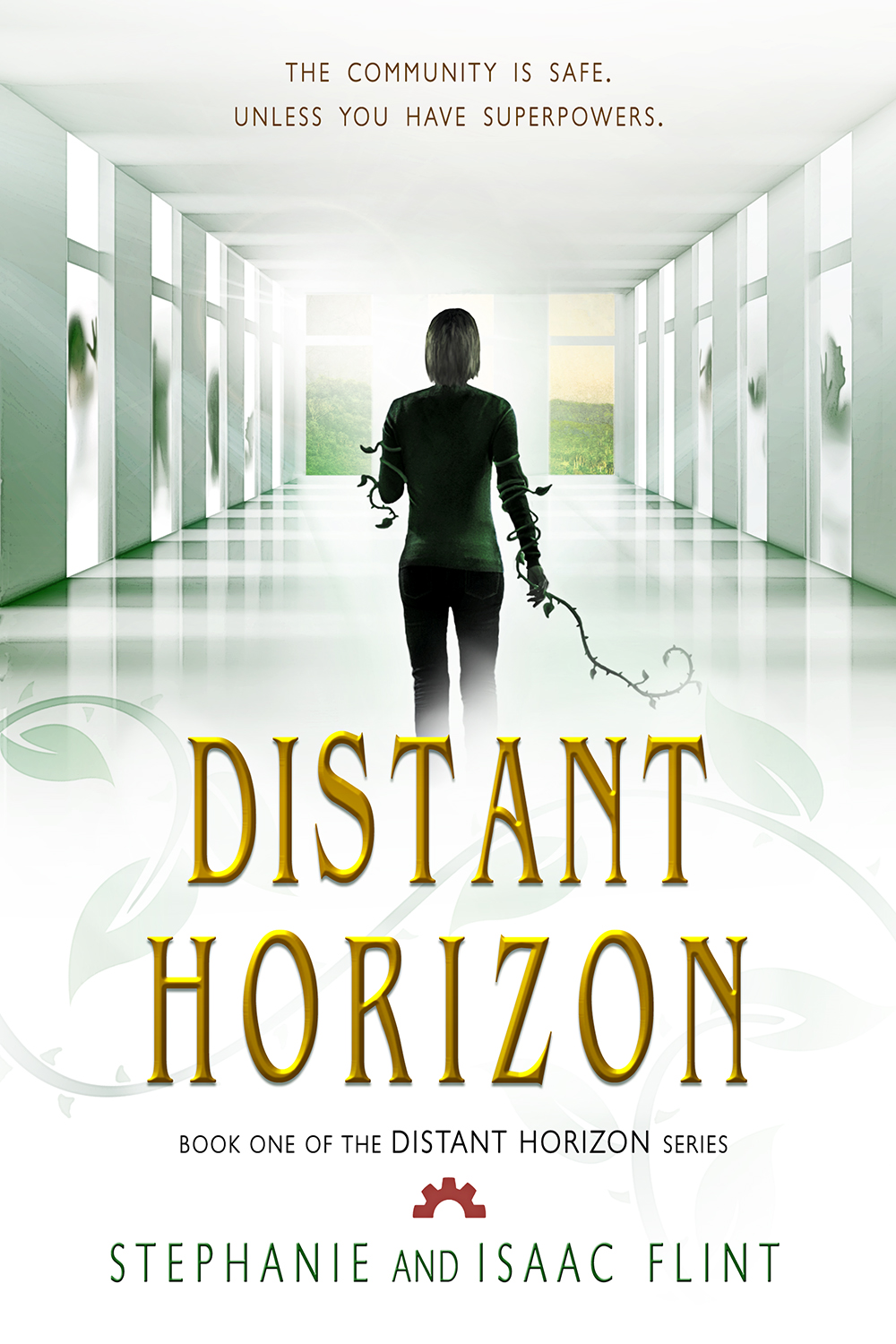
Take a look at this scene from my husband’s and my manuscript of Distant Horizon:

Behind us, Jack snorted. “Superheroes– like comic books. You’ve heard of comic books, right? Video games?”

The three of us exchanged glances. We’d played interactive educational activities on EYEnet, but those weren’t particularly humorous.

“You’ve
 you’ve heard of video games, right?” Jack pushed himself from the doorway and gaped at us.

Lance shook his head ‘no.’

Jack grunted. “Pops, I’m telling you– the Community sucks.”

Tim stuffed his hands in his pockets. “The Community is safe, secure, efficient. It’s not… bad.”

Jack is anti-Community, very much a rebel, so he’s going to use curses however he [damn] pleases. Tim, on the other hand, has been raised in the Community, where cursing is seen as inefficient… though they have a few of their own choice phrases (For the love of efficiency, Jenna, hurry up and finish your homework!). When Tim tries to refute Jack, he almost quotes him, but he doesn’t, because saying a curse makes him feel awkward. (Like me and writing half the curses in this post. Though, arguably, it’s questionable whether Tim would have even heard that particular swear). Again, this reveals characterization… not that all characterization is in whether they curse or not. That’s just one tiny aspect of dialogue you can fiddle with.

Now let’s take a look at how we can approach cursing in fiction.

Say the actual word: If you’re writing an adult novel or upper YA, you’re probably safe to use the actual word given your target audience. If you’re writing middle grade, using a substitute might be better. The benefits of saying the actual word come when it isn’t avoidable (the sentence doesn’t work without it, or removing it makes a scene unnecessarily comical), or when it shows a personality trait of the character. You might not use swear words in regular prose, but you might add them to dialogue. Whether you sprinkle them in or apply a heavy dosage depends on the genre you’re writing and your target audience.

Use a substitute: Particularly useful if you’re writing middle grade (where parents tend to be a bit pickier about what their children read), or if you want to add comedy. Also useful if you want to add flavor to the world. Of course, some people prefer to see the actual word, others don’t. Just make sure that the word used fits the situation and feels natural.

However, there are downsides to using a substitute.

If you aren’t careful, you can turn a completely innocent word into a curse for your poor, unsuspecting reader.

When I was a kid, my parents had a filter on the TV. It censured and replaced certain words from the captions (I have a partial hearing loss, so I have captions on whenever possible). I didn’t really care for cursing, so I didn’t mind… with a couple exceptions. One, the filter didn’t always recognize the difference between names and swears… Principal Prickly on the TV show, Recess always had his name filtered, and while watching 8 Simple Rules, the word ‘sex’ would often be translated to ‘hugs.’ (It was a really strict filter).

The problem was that my mind automatically began to translate everything back… even when I wasn’t watching TV.

This is around the same time that a certain “Free Hugs” movement became popular.

*Ahem.* (See what my mind translated that to? Took a while for me to stop wincing every time I saw a sign for free hugs).

Let this be a warning… people will still know the original meaning.

Alternatively, you can also create a negative meaning to an otherwise innocent word. For example, if you tell kids to substitute ‘witch’ for ‘bitch,’ we now apply a derogatory meaning to the word ‘witch.’ Of course, you have the Halloween nasty, evil witch (of which this is probably meant to reference), but keep in mind that there are people who consider themselves witches in practice and don’t act in the way that the term ‘bitch’ usually implies.

That particular factor was brought up when I was reading articles regarding the Clean Reader app (Read the article here about what the Clean Reader app is, and here for the article that mentions the problem of substituting “witch” for “bitch,” if you’re interested).

Also, slight derail, words can take on negative sub-text through similar routes.

For example, take a look at the word ‘gyp’ (as in… I’ve been gypped!) It wasn’t until recently that I became aware that the term derived from the word “gypsy,” referring to a stereotype of gypsies as thieves. Now, in some areas, calling someone a gypsy is a major slur. In others, not at all. Depends on who you’re talking to and how you’re using the term. But it’s something to be aware of.

Like all curses, slurs, and swears… whether or not something is offensive depends entirely on the audience. (In fiction, you can recognize this in how characters react to each other based on what they say or don’t say).

So, you can use a substitute, but make sure it has the meaning you intend.

Reference without specifying: You can sometimes suggest that a person cursed without ever saying what was said. He turned the corridor. Three giant monsters stood in his way. He cursed. This plan was getting worse by the minute.

We’re told that the character curses, but it’s left to our imagination as to what he actually says. I tend to use this one when a world-based curse won’t work. Alternatively, how other characters react to something said in a foreign language we don’t understand can give us the impression that they cursed or said something insulting… even if we don’t know for certain. (Consider how R2-D2 and C3p0 talk in Star Wars. We don’t know what R2-D2 says, but we have a pretty good idea thanks to C3P0’s reactions.)

Eliminate: When in doubt, leave it out… or not. Sometimes a sentence really doesn’t need the cursing to flow properly, and will feel stronger without it. (Remember earlier, where I bracketed the curse words) Sometimes a slight rephrasing of the sentence can eliminate the need for a particular word. Test how the sentence sounds with and without the curse (speaking aloud can be helpful here… though you might want to be alone when you try this) to determine whether the curse adds to the story.

There are some words I tend to avoid when I write, because I personally don’t like them or want to perpetuate a stereotype. For example, I tend to avoid slut because I don’t like vilifying someone just because they sleep with multiple partners, or bastard because I don’t like vilifying people born out of wedlock.

Granted, there may be times when they story calls for these particular slurs, and to use anything else sounds ridiculous. But I typically try a bit harder to avoid those than other curses.

The point is, whether you use cursing in your writing is entirely up to you. If you get your stories published through a publishing press, they may have their own house rules about what stays or goes. But otherwise, you get to decide based on your own needs, and whether or not you think it will work for your target audience.

Like all words in a story, the swear should serve the story. If it doesn’t, cut it. (Your word count will thank you). If it does, keep it.

I hope you found this post useful. How do you handle swearing in your stories?

Further articles of interest:

https://www.goodreads.com/author_blog_posts/2636571-by-odin-s-beard-what-the-frack-is-all-this-sprock

https://dailypost.wordpress.com/2013/10/24/cursing/


Leave a comment

Filed under Writing

Thoughts on Writing – A Short Post

Well, I was going to have a longer post up today, but I forgot to write it yesterday and today was even busier than I expected. So, instead, I’m going to make a quick note on the benefits of scheduling early.

When you have a blog (especially one that allows you to schedule posts, as WordPress does), you may find it handy to write your posts at the time you have the initial idea, then set them to release on a later date. This is what Isaac and I plan to do when we release The Multiverse Chronicles, and what I often do for regular posts (except today). This is a great way to ensure that your posts have a reasonable consistency of release, a great way to schedule guest posts without worrying that you’ll forget to post them on the right day, and a great way to relieve the stress involved with trying to get a post done by 8:00 Monday night. *Ahem.*

You can also schedule tweets, if you use Twitter. I’ve used Tweetdeck, which is also a great tool for managing hashtags and watching a conversation unfold. (A necessity if you work during the day of #Pitmad, which has new rules for next time).

With that said, I hope those are helpful insights.

In other news, Rebekkah Ford did a book feature of Magic’s Stealing on her blog. Click here to find another excerpt from the book (an excerpt which isn’t available in the preview on Smashwords!), and check out the other books she features while you’re at it. 😀

Now I’m off to write a much longer post. Have you found any handy tricks to managing a blog?

2 Comments

Filed under Writing