
So far, Isaac and I have done all the photography for The Wishing Blade series covers. And when it came to the cover of Magebane, we’d been planning that cover for a while… even bought the candle holder specifically with the intention of shooting this image.
(It wasn’t entirely an excuse to buy more Depression era glass. Not at all… *Cough.*)
And though it’s been a while since we released Magebane, today I want to talk more about the glass on the cover.

True story… when first proofing the cover, I asked for feedback and someone said it seemed a little too radioactive green. Funny thing about that… That green was intentional, and they weren’t actually wrong.
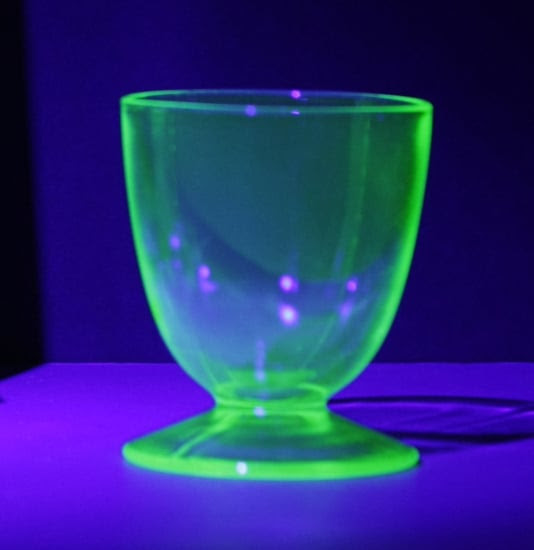
That glow is the result of UV light shining on the glass and fluorescing with the uranium salts coloring the glass. I actually had to lower the amount of light coming from the candleholder while working on it in Photoshop.
Don’t believe me?
Here’s a look at an unedited photo from the photoshoot:

There’s a model lamp at the top providing a general light, but that purple light you see is from the UV light. The glass is Depression Era glass.
Here’s a look at the same glass but without the UV light.

We also shot a set of daisy button glass dishes we considered using (which I believe are actually Victorian era, rather than Depression era, based on their color and pattern), but decided to stick with the candle holder as the main image.
This one just has UV light on it, and no modeling lamp.

It glows hot. Which has been my experience with most yellow uranium glass that I’ve come across.
This, by the way, was with the cheapy UV light we bought at Walmart. Later, we acquired a more powerful UV light (different wavelength, better visible light filter), and these pieces were even brighter.
Now, let’s go into more detail about the real life inspiration for the story’s “magebane” / “charlago.”
The good news is that this glass is not as destructive as it is in the story.
However that “radioactive green” look might be a little more accurate than you first expect. Often known as “Depression Era glass,” these pieces are usually a kind of odd, Vaseline green or “canary yellow” color. You’ve probably seen them hiding in China cabinets or antique stores.

(Pictured Above: Green Depression Era Glass)
Usually, it doesn’t stand out. Some pieces are a little more flowery in their designs, but what makes them so special?
They glow under ultraviolet light (blacklight).
(Well… some do. The frustrating part of hunting for glowing Depression Era glass is that not all green or yellow glass glows. UV flashlights are useful for checking to see which pieces do and don’t. And just because it glows, doesn’t necessarily mean that’s it glowing for the reason I’ll explain in a moment. But when you find the piece that does… there’s the magical “ah-hah!” moment of success.)
See, here’s the thing. For a long time, glassmakers have been using uranium oxide to give glass a rich green or yellow color.
Yes, uranium.
The glass is technically radioactive.
However, according to most internet sources (take these with a grain of salt) and the mineralogist I asked, these glass pieces aren’t so radioactive as to be harmful, at least if you’re not constantly handling them, ingesting pieces of glass (you shouldn’t do that anyway), or messing around with them aside from using them as pretty decoration.
(I would like to add here that I am not an expert in radiation, and I have not actually tested these pieces with a Geiger counter. Please don’t go out and do something that’s going to give you radiation poisoning. There are some antiques that actually do have harmful amounts of radioactive material in them. Stuff with radium, for example. And certain orange or red Fiestaware ceramics from before a certain year. Both are details I play with in Magebane.)
So, that “radioactive green” glow?
Well, it does contain radioactive material.
At the same time, the term is a little misleading because the UV light causes the uranium within the glass to fluoresce, not because it gives off its own creepy light due to nuclear radiation.
You can find a lot of Depression Era glass in antique stores because it was popular during the Depression due to being inexpensive. Though a ban was plaed on putting uranium in the glass during World War II, the process was allowed again later (using depleted uranium), which means that not all uranium glass is Depression glass. Some pieces are replicas and are much more recent.
(In some cases, you can tell when it was made based on the specific markings added by the manufacturer).
However, some pieces are even older than the Depression:
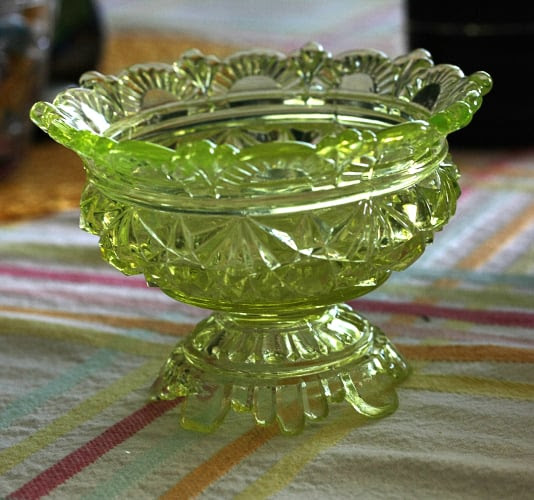
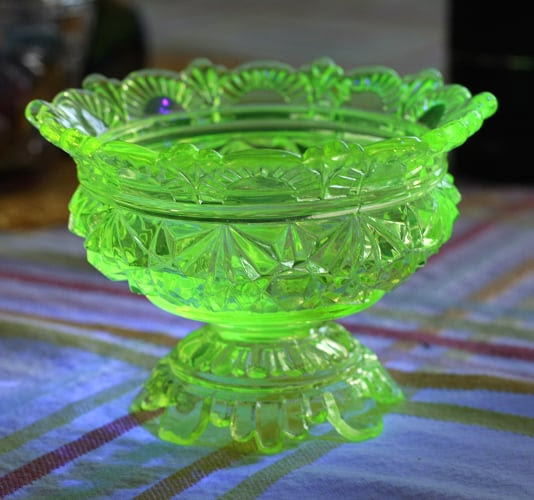
(Pictured above: Canary Yellow Daisy Button Sauce Dish, circa 1880s. Though this is uranium glass, this isn’t actually Depression glass.)
Uranium glass was also made in the late 1800s, meaning that you could find it in the Victorian era. (I was rather thrilled to have ended up finding a piece that, based on its pattern, Isaac and I are pretty sure is from that time frame).
As for the story…
This means that Maijev — that mage-hating place that’s supposed to be pulling from Industrial Revolution and Victorian era tendencies (yes, I know, I’m blending time periods) — could have uranium glass.
And, in the world of The Wishing Blade, ribbon magic and nuclear radiation (even trace amounts) don’t mix well. (Unless you like world-unraveling explosions).
Hence… magebane!
Now that you’ve read about real-life uranium glass, here’s an excerpt from Magebane, a scene in which Siklana gets her first look at charlago glass. 🙂
Unlike real life, though, “Depression era” glass isn’t inexpensive in Cirena… it’s coveted, largely because of its tendencies to ward away mages.
Ruderk examined Siklana soundlessly, then moved to the stove where a tea kettle warmed. “Tea?” He held up the kettle and a green glass cup, paused, and then extracted a different cup. “I’d offer you the finer glassware, but you said you were a mage, didn’t you? I’m not sure how much residual magic might stick around, and I don’t want you getting sick.”
She blinked. “You have charlago glassware? May I see it?”
He shrugged. “Long as you don’t go throwing ribbons at it. One wound a day is plenty enough for me.” He passed over the green cup.
She flinched at the hint of a sting when it touched her skin, and she kept her navy ribbons deep inside herself, where they could not reach the glass. While Ruderk poured them each a cup of tea, she turned the piece in her hands. It was smooth and plain, with a pair of seam lines on either side from the mold, and a simple round base to keep it upright. She sorely wished she had her light crystal with her. Though she could not let the ribbons come into direct contact with the glassware, the light the crystal produced was not magical, and Camir had said kosa light would cause certain forms of charlago to glow.
“It’s beautiful.” She handed back the glassware, and Ruderk exchanged her offering with a steaming, white ceramic cup.
“You should see some of the more meticulous pieces,” he said. “Far more than I can afford, but they have a pretty selection of flowers and patterns to choose from.” He sat himself across the table from her, then reached behind him, snagged a tin, and dropped it onto the table with a clatter. “Biscuits. Help yourself. I made them this morning, so they shouldn’t be too stale.”
* * *
See uranium glass in a fantasy world…

* * *
Happy reading and writing!




 Stephanie Flint - Author and Artist