Tag Archives: writing tips

Thoughts on Writing – Formatting Telepathy in a Novel

There’s a section I’m currently working on formatting in Distant Horizon, which has a lot to do with telepathy. And of course, that had me puzzling over the best way to format telepathy.

Originally, I had planned to designate telepathic sections using colons and italics, like this:

:This is a thought that you hear in your head,: the blogger thought to her readers.

However, I had several beta-readers say they didn’t like that formatting (never mind that I loved it in Mercedes Lackey’s Magic’s Pawn), so, since I want to make the book easier on the readers to read and enjoy, I made the change. They suggested keeping with simple italics, tagged like dialogue to note that it’s telepathy.

That worked well in Magic’s Stealing, where telepathy is mostly limited to communication.

Then we get to Distant Horizon.

*Flop.*

There are several forms of telepathy in the Distant Horizon universe. Most telepaths specialize in one or two abilities, but a really powerful telepath can do any of these:

(Note: These aren’t their formal classifications, just how I’ll refer to them for the moment)

  • Communication (Sending thoughts).
  • Mind Reading (Getting a sense of what someone else is thinking).
  • Perception Manipulation (Changing what someone thinks they see/hear/touch, etc.)
  • Possession (Taking control of someone’s body through a mental link).

(…Hehe. I feel like I’m writing out optional skills for a role-play character. Let’s take three points in communication and two in perception manipulation, please…)

The problem I’ve run into is how to denote each of these things, among other normally italicized sections.

Originally, I used italics to denote a few different things: telepathy, flashbacks that the characters is “experiencing” at the moment,” and telepathic attacks, in which what is happening is perceived entirely in the narrator’s mind.

When I was using the colons, it was easy to show that someone was communicating via thought, versus a person was having a short flashback, and when someone was communicating via thought during a flashback.

Fun, right?

Now, however, things have gotten a little more difficult.

For example, if the main character is thinking to herself, it usually isn’t too hard to switch the italicized parts to a non-italicized thought, given this story is 1st person, past tense.

For instance, this:

He winced, then handed me the notebook. “Look– I don’t know about either of us, okay?”

Wait. Either of us?

I gaped at him. “You’re not taking the pill, either?”

Becomes this:

He winced, then handed me the notebook. “Look– I don’t know about either of us, okay?”

Wait. Either of us?

I gaped at him. “You’re not taking the pill, either?”

No big change, and in fact, I like it better. Otherwise, it really felt more like it was italicized for emphasis.

I read an interesting article that mentioned using italics for thoughts creates greater narrative distance. Since I want readers close to the MC’s perspective, removing as many of these as possible could prove beneficial. (Plus, it makes Isaac happy. He never was a fan of all the italicized chunks I had in the earlier drafts).

But what about thoughts that are active? Thoughts that, by all right, should be 1st person present?

“What about you? Do you have this so-called persuasion power?”

He inclined his head. “Yes.”

You’re admitting to it? “You were using it last night,” I tested. “To get me to come with you.”

If I try to remove the italics, the paragraph doesn’t read right (or maybe it does, and I’m just being finicky). Technically, I could change the thought to “He was admitting to it?” and the sentence would read fine, but I’m thinking it sounds punchier if she’s directing an active thought toward him.

So I’m considering removing italics for thoughts that flow with the the past tense prose, or rearranging them into past tense when feasible, while leaving italics for thoughts that are in present tense, along with thoughts which are directed toward another person, even if that person can’t hear them.

The reason for this is that there’s a scene in which the main character unintentionally uses telepathy (I won’t say how, to avoid spoilers). However, some of what she’s broadcasting isn’t actively targeted, at least, it wouldn’t appear to be at first glance.

He gave me a pointed look. “Be careful with that thing.”

I winced. “I don’t plan on using it.”

“What you plan to do and what you do are two different things.”

“Yeah,” I mumbled, ducking my eyes from his scowl. All I wanted was a stupid reminder.

“And what you’ve got is trouble,” Inese retorted. I stared at her. I hadn’t said—

“Now stop worrying about the shiny. We’ve got work to do.”

See what I mean?

If I remove the italics, it won’t be clear that the narrator broadcasted the thought. But it isn’t directed at anyone, either, and kind of reads as if it’s just being emphasized.

But what if I only italicized thoughts that she knows is telepathic. She’s new to the concept of superpowers. If the characters around her react appropriately, she doesn’t have to realize what she’s doing, and the readers will learn at the same time she does.

Try reading this passage again:

He gave me a pointed look. “Be careful with that thing.”

I winced. “I don’t plan on using it.”

“What you plan to do and what you do are two different things.”

“Yeah,” I mumbled, ducking my eyes from his scowl. All I wanted was a stupid reminder.

“And what you’ve got is trouble,” Inese retorted. I stared at her. I hadn’t said—

“Now stop worrying about the shiny. We’ve got work to do.”

Since Inese is commenting directly on the narrator’s thoughts, and the narrator reacts with confusion, we can guess what has happened.

Plus, this allows for a lot of fun when she’s dealing with high-end telepaths. After all, they’re strong enough to manipulate her mind without her knowing that they’re changing her thoughts. Neither the narrator, nor the reader, actually know what is real and what isn’t, and which thoughts are actually hers.

Unreliable narrator, anyone?

Now, the problem with doing it this way is that there’s always the chance that the larger scenes involving telepathy (and there’s a huge one at the end of the story that prompted this particular blog post) may be confusing for the reader. That’s why I’m hoping to find a proofreader for this style of formatting before Isaac and I release the book. But for now, I think I’ve settled on this:

  • Thoughts directed toward someone/something in present tense will be italicized.

He inclined his head. “Yes.”

You’re admitting to it? “You were using it last night,” I tested. “To get me to come with you.”

  • Telepathic communication (when the narrator is aware these are not her own thoughts) will be italicized.

Brainmaster clucked her tongue. Poor Miss Nickleson… Let me show you what happens to the people who rebel.

  • Flashbacks/memory attacks, where the narrator is experiencing them but does not know this is a flashback will not be italicized. Tags may need to be included in the prose to help aid the reader.

Brainmaster clucked her tongue. Poor Miss Nickleson… Let me show you what happens to the people who rebel.

A rocket slammed into the ground, blowing a beast to bits. Sun scorched the back of my neck, and the stench of burnt flesh tainted the air. A blast of heat rolled over me. I shielded my eyes while debris pelted me with dirt. Something smashed into my chest. I removed my hand from my shirt and found it hot and sticky. The pain threatened to destroy my vision—

(Since the main character cannot distinguish the manipulation from reality, this is not italicized).

  • Flashbacks/memory attacks that the narrator is actively experiencing and is aware of, will be italicized.

The winding corridor opened to rows upon rows of floor-to-ceiling tanks, each filled with thick, greenish fluid. Bubbles traveled up the tubes, passing over occupants who had been stripped of everything but a breath mask. A helpless, sickening sensation spread through me. I stared at the liquid, petrified.

Brianmaster dragged me into a tube and shoved me inside, the numbing liquid surrounding me, slick against my skin. Burning.

I needed to escape, to breathe, to run—

“Let’s not open these doors, ‘kay?” Jack said, jarring me from my nightmare.

(In this scene, Jenna is having a memory attack, and though she can’t escape it, she’s aware that the attack is happening).

  • Flashbacks where the character is “remembering,” but not really “experiencing” will not be italicized.

He put the training weapons aside and sat on the floor, stretching his fingers to his toes. “Besides, the Community’s boring. There’s no excitement. Do you remember when we used to pick blackberries off the neighbor’s bush?”

I nodded.

Walking home from school, we used to take the back ally to our parents’ houses. One time I noticed a dark blackberry poking out from a broken slat in the fence. It was ripe, and touching the berry left a deep red juice stain on my fingertips. The neighbors could’ve been fined because the fence hadn’t been repaired in a timely manner.

(She’s recalling a memory, but she isn’t “experiencing” it, per se).

And, of course, I’ll use italics to emphasize certain words. And also for sound effects, foreign languages, etc, though I’ll try not to overdo it. 🙂

So, now that I’ve got this sorted out in blog-post form, I’m off to finish formatting the italics in the manuscript. It’s not perfect, but hopefully the formatting will be smoother now.

I hope you’ve found this post helpful. 🙂 Have you ever had to make a particular type of formatting distinguishable?

Leave a comment

Filed under Writing

Thoughts on Writing – Series Titles

Now that Battle Decks: Trials of Blood and Steel has been published (Woot!), I’m starting to look at what’s next. Isaac is already working on expansion card ideas, and he will soon be creating the rules document for his upcoming Phalanx game. I’m going to be working on writing the rest of The Shadow War, and I also need to start formatting the book we co-wrote, Distant Horizon, since that’s otherwise ready to go (minus proofreading, which I plan to do after the basic formatting is in place).

However, there are still a few things that remain to be worked out.

For one, the series title.

There’s a lot of ways you can go with a series title. You can name it after the first book (The Hunger Games, Hunger Games Trilogy, Book 1). You can give it some kind of cycle/chronicles/saga title (Twilight, The Twilight Saga, Book #1 // Eragon, The Inheritance Cycle, Book 1 // The Horse and His Boy, Chronicles of Narnia, Book 3). You can name it after the main character (Harry Potter and the Sorcerer’s Stone, Harry Potter #1). You can name it after a group in the series (Steelheart, The Reckoners, Book 1 // Among the Hidden, The Shadow Children, Book 1).

There are all sorts of options.

Needless to say, I’ve been trying to brainstorm ideas for what Isaac and I might call the Distant Horizon series.

The simplest option, of course, would be to call it that. The Distant Horizon series. The concept spans all five planned books, and to some extent covers the stand-alone books involved in the story’s cycle.

Before I go too much further, let’s take a quick look at what Isaac and I have planned.

Distant Horizon – Effectively the first book. Follows the main character, Jenna Nickleson.

Glitch – Stand-alone novel that overlaps the time between book 1 and 2. Follows Tim Zaytsev.

Fractured Skies – The second book that follows Jenna Nickleson.

The Little One – Ties into final planned book of the series, but this is very much a stand-alone novel. This is really more of a prequel, and follows the characters of Little One and Knight, several decades before the events of Distant Horizon. Written 3rd person, multiple points of view, whereas the others are in 1st person with a single narrator.

Changing Tides (?) – The title may go to the 3rd or 4th book, we aren’t sure yet). The third book that follows Jenna.

Coalition Sign – Another prequel, entirely stand-alone, which details the origins of the team Jenna joins with. Takes place a few years after The Little One.

Distant Horizon Book 4” – Currently untitled. 4th Book following Jenna. Ties up main story arc, but opens a new direction.

Distant Horizon Book 5” – Currently untitled. Not sure about the details of this one, though Isaac and I have discussed bits and pieces of the story arc. Not sure yet whether this will be styled more like The Little One or the rest of the Distant Horizon series, and it might not even be included in the technical “series.” However, it does conclude the cycle which starts in The Little One.

As you can see, we’ve got a few options. Within this, I’ve been referring to this cluster as the Distant Horizon series. That covers all the books that pertain to that story arc, even if they aren’t directly in that time frame.

Alternatively, I’ve thought of calling it The Distant Horizon Cycle (which, if I remember right, I don’t think Isaac was fond of), which would reference the cyclical nature of the full story.

Personally, I don’t want to call it The Distant Horizon Saga, because that reminds me too much of The Twilight Saga (Nothing against the books, just not my cup of tea). Plus, I’m not sure it really follows the definition of a saga. (Or, well, after reading that definition, minus the Norse bit, maybe it does. Might have to give this title a second consideration).

We could call it The Jenna Nickleson Chronicles, but not only do I trip up on Jenna’s name as a series title (though I had thought of calling the first book The Mysterious World of Jenna Nickleson… which doesn’t fit the mood of the book), we’ve already got The Multiverse Chronicles(Which, I might add, is tied into the Distant Horizon series.)

Other options I had considered were relating the series name to themes or symbolism from the book.

Based on that, I brainstormed:

The Distant Horizon Series

Seeds of Memory

Seeds of Time

The Lady of the Vine

The Travelers

Child of the Future/Child of the Past

A Lady of the Cog Novel

The Rising Sun Cog/Rising Cog

A Novel of the Rising Cog

Cycle of Memory/Cycle of Memories

The Telepath Chronicles

The Jenna Nickleson Series

Roots of Time/Leaves of Time

Stone Cycle/Circle of Stone series

Coalition Sign (as a series name, instead of a single book title)

Several of these I threw out immediately, for various reasons. Some were focused specifically on Jenna (anything plant related), and some didn’t work for all the books (Coalition Sign wouldn’t work for Glitch, which is focused more heavily on the Camaraderie– the opposing faction).

Others simply don’t have the feel that Isaac and I are going for with this series (Lady of the Cog would be better suited for focusing on a certain character from the Camaraderie, and doesn’t have the dystopian/science fiction feel that might be better suited for the series, and The Travelers really should reference a specific group we don’t see until later, not the main characters).

The Lady of the Vine does fit for parts of the series, but it might lean too much into possible spoiler territory, or not make sense until later in the series. Better to have something that ties in from the get-go.

Child of the Future/Child of the Past… I keep thinking of Little One’s character here, even though Jenna could also fit that category.

Something referencing the rising sun half-cog (one of the Camaraderie’s symbols) might work, as that symbolism is present in all of the books mentioned. However, it would need a bit more tweaking, since this series is not specifically about the Camaraderie. Not sure if further tweaks might be a bit wordy, too. The Fall of the Rising Sun Half-Cog. *Ahem.* See what I mean?

The Telepath Chronicles… this actually sounds cool to me, and telepathy does play a large part in all the books (mostly in that they tend to play the part of the antagonists), but I’m not sure it quite fits what we’re going for. Might keep the title in mind though for other book ideas…

Roots of Time/Leaves of Time… Maybe the first one, though I want to say that feels more historical, and the second one just doesn’t sound catchy to me.

Seeds of Memory… Oh, the references it would make for Jenna’s storyline, and it’s kind of referenced in Little One’s storyline, and… hmm. It does play a role in Glitch

Let’s see:

Distant Horizon, Seeds of Memory Book 1

Glitch, A Seeds of Memory Novel (I don’t know, Glitch, A Companion to the Distant Horizon series might have a better ring)…

But is this series title memorable?

Might not be quite as obvious in the first book as in the second, but it does play with the idea of Jenna’s plant powers, and references a particular telepathic ability that causes all sorts of problems for the main characters across all the books.

Essentially, there’s a lot of ways Isaac and I could go with naming the series, and I need to talk to Isaac and see what his thoughts are… you know… seeing as how he created the world and the majority of the characters in this world.

The point is, brainstorming a lot of options, then narrowing down the best ones can help you decide what might work best. Or maybe help you think of an idea you hadn’t thought of before. Granted, it’s a good idea to Google-search your ideas to see if any already have a popular book series to their name that you don’t know about or haven’t considered.

(This method is how we came up with The Multiverse Chronicles: Trials of Blood and Steel title).

Whatever the series title,  it should be catchy, memorable, and somehow relate to the books. I’ve noticed that I tend to jump back and forth about what I call The Wishing Blade series, even though that’s it’s official title. So you might also consider, what comes naturally when talking about the books?

I hope you’ve found this post helpful for your own writing. 🙂

Thoughts? Have you had any experience trying to figuring out a good series title? Noticed something that didn’work?

Are there any of the titles I brainstormed up there that you really like or don’t like? How come?


4 Comments

Filed under Writing

Thoughts on Publishing – Results of My First Book Signing

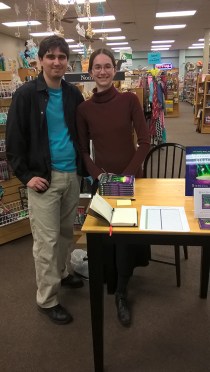
Yesterday I had my first book signing! It was held from 4-6 pm at Reader’s World in Sedalia, Missouri. I sold five books–four to people I knew from my workplace, and one to a person I didn’t know but who showed interest in my signing table (thank you, everyone!).

Today I’m going over my process of setting up and holding the book signing, in case it helps any of you who are considering doing a book signing in the future. 🙂

First, of course, I talked to the bookstore. In this case, I went in with a copy of Magic’s Stealing a couple months ago to see if they might be interested in carrying the book. They took four copies on consignment (they don’t pay me until they sell the book, we have an agreed upon royalty, and I’ll pick up any unsold copies at a later date).

I signed those copies (a simple signature, not personalized) and left them with the store. One of those copies sold to my husband’s uncle, who lives in the area (thank you, too!) and knew I’d left copies there.

Then, a couple weeks ago, I arranged a signing with the manager.

I tried sending an email at first, but when I didn’t hear back from them, I was worried that maybe my email hadn’t gone through (since I’m still new to that particular email service and that does happen). Turns out the manager was out of town, but I was able to call once she came back in, and we got everything scheduled–they were really friendly and easy to work with.

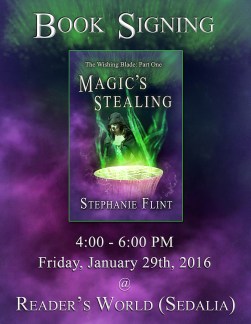
I asked if there was anything they wanted me to bring in, to which the manager suggested a flyer for their door and any promo materials I wanted to leave on the table. I was still waiting for my promo cards to come in, so I created a set of small “mini” flyers which contained a picture of the book on the front, with info about the signing (date, time, location), as well as the book’s blurb on the back. I also created a larger flyer that I hoped might catch the attention of store-goers.

It took a couple tries to get the flyer to look right (the printer needed to be set at “matte” photo paper before it would print reasonably high quality on regular print paper– and even then I switched to a “parchment” paper to get the best results. I also printed about 40 of the mini fliers (four per page, duplex setting for the front-back parts) to use as walk-by ads and reminders for my book.

Readers World - Magic's Stealing Book Signing Flyer

On the bright side, I did receive the metallic print mount for Magic’s Stealing in time to drop that off with the fliers, so after work the next day, I dropped off my various pieces.

Upon verifying that the flier would work, I printed two more copies and, at the end of the day Monday, posted one to each of the employee bulletin boards where I work. I didn’t mention anything directly to my coworkers, but they did see the fliers and started asking me about it after lunch… which was really cool. The next day, during morning announcements, one of them mentioned the fliers, so I was able to announce the date and time of the signing (yay!). I’d been wondering if I should ask about announcing it, but they did that for me. 😀

Anyway, I got the promo cards in the mail shortly after, so I dropped off a set at the bookstore. They had set up a small table with the mounted picture, the fliers, and the remaining three books. Plus, they had the flier on the door. I asked if I could drop off the promo cards/bookmarks, which they said was fine. I set them up on the table, then headed out.

MS_RWS_2

The day before the signing, Isaac and I went to Walmarts and picked up supplies for the signing (other than books, I counted and found I had nineteen books (I first thought I only had seventeen) still in stock with me, so I hoped I wouldn’t need more than that). I wanted to have a few extra pens on hand (ballpoint pens keep disappearing around here–I’m not sure where), plus a pen that was a little more nice looking and wouldn’t leave a heavy indention in the paper or smear. I also found a couple “precise” Pilot pens that looked like the ones I had borrowed previously from the bookstore manager to sign their in-store copies.

In addition to the pens, I picked up a set of sticky-notes. I’d seen them mentioned before on the web, and I’d seen them in use at Conquest when I was standing in line for Brandon Sanderson’s book signing, and the sticky notes seemed like a really good idea. The concept is that, when personalizing a signing, you ask people to write the name they want the book dedicated to on the sticky note so that you make sure to spell it correctly. Not only does this avoid spelling mistakes, it’s helpful if you have a hard time hearing them (and it also avoids the inevitable embarrassment of not remembering their name if you know them but you’re terrible with names. Seriously… I spent the last week at work trying to match faces and names in my head).

The final thing Isaac and I picked up was candy to offer people walking by the table. We spent some time looking for pieces that would represent the book. We ultimately chose Hershey kisses (for the papery ribbons coming out of the wrapper, and for the colors. The chocolate truffle ones for their dark pink and brown swirls, and the special dark ones for their purple wrappers). We also picked up a bag of Andes mints (for their green wrappers).Magic's Stealing Book Signing - Candy Bowl

As a note here, only a couple people actually took a piece of candy, so I guess we’ll have plenty left over for the next signing. But several people showed excitement about the candy matching the book cover. (Even the pink and brown actually matched a shade). We served it in the same bowl that’s used as the scrying bowl on the cover. 🙂

Finally, the day arrived for the book signing! I decided what to wear (business casual), and then did some last minute research on book signings to see if there was anything I was missing. First off… the email newsletter signup sheet! I put something together quickly in Excel, because I do plan to do an email newsletter, but no one actually signed up to be included. I still plan on bringing it to future signings, though.

Excel - Newsletter Signup Sheet

I also found an article mentioning the idea of having a guest book of sorts for the people who came to the signing to sign their name. I loved the idea, so I picked out a small journal that I was fairly certain could lay flat before the signing officially started, made a quick purchase, and added that to my table. I arrived about 30-45 minutes early, so I could help set up. I checked to make sure the bookstore was okay with having the candy there (they were). Then Isaac took a setup picture.

Afterward, we waited for people to show up. The very first person was one of my coworkers, as were the next couple of people. During the signing, we had one person we didn’t know show interest, to which I asked if they liked fantasy. She said yes, but she mentioned she didn’t typically buy paperbacks (instead preferring the Nook). We did give her a promo card, and Isaac said we could sign that for her, if she wanted (I was having a bit of trouble hearing her– something I hadn’t considered before that might be a problem for me. While I hear fine in most situations, if people are whispering due to being in a bookstore or library, etc, then I sometimes have a bit of trouble understanding them). After a moment, she decided to go ahead and pick up a book. I used the sticky note system so I could make sure I spelled her name right, and yay! Another book sold to a potential reader. 😀

A couple other people showed interest, and we gave them the cards, but that was about it. Overall, we sold five books during the two hours, mostly during the first hour. There were always about 2-3 groups of people in the store at a given time, with the exception of the last half hour, when the store quieted down. I would have liked to have had more people stop by, but there were two factors that might have been at play here.Magic's Stealing - Book Signing - Reader's World Sedalia

First, in regards to work, one of my co-workers mentioned that they had let a lot of people in my department go home early, which means that the event’s timing wouldn’t have been quite as convenient as it would have been if work let out at normal time (we’re in the season where jobs come in at varied intervals). Second, one of the employees at the bookstore said that one of the schools had cancelled school that day due to a stomach virus going around, and that parents might not have been taking their kids out as much as usual.

Still, I count the signing as a success, and I’m hoping to do more of these in the future. Is there still to learn? Plenty, especially as Isaac and I try to figure out how to bring more people into the events of the target audiences.

I hope you enjoyed this post. Have you attended any book signings, and if so, was there anything you found that they did that was particularly helpful or neat?

6 Comments

Filed under Business Ventures, Writing

Thoughts on Writing – How Genres Are Like Different Types of Stores

The other day, I had the thought that book genres are like different stores. I’m not really sure how I got to that particular idea, but it stuck around. So, today, I’m going to delve into that analogy.

Genres are like stores.

You have all kinds of stores. Big stores, small stores. General stores, clothes stores, game shops, book stores, specialty stores.

Each type of store has certain things that make it that particular type of store, just like a genre will have particular elements that make it that genre. While two genres may have similar traits (example, science fiction and fantasy both tend to have speculative ideas, surprising tech/magic, and vivid worlds), they aren’t the same. A reader may enjoy seeing those traits in either book, but there are certain traits they expect will be there, regardless.

For example, someone going to a grocery store versus a convenience store isn’t going to expect the same product availability.

A grocery store sells food–usually a decent variety, along with various other household goods that might be useful… like toilet paper.

A convenience store has a large variety of items, but a limited number of each, and they’re oriented towards quick, on-the-go products and essentials. Plus, they sell gas.

(There’s a nice article on the difference between grocery and convenience stores here)

If you want gas, you’re going to go to a convenience store, and you’ll be sorely disappointed if there are no gas pumps to be found. However, you might be pleasantly surprised to discover they have donuts available, something the grocery store also has. On the opposite end, if you want a bag of spinach, you’ll probably head to the grocery store, because that’s where you expect to find what you’re looking for.

If you want a book with shiny magic and mystical worlds, you’ll choose a fantasy book. You might be pleasantly (or unpleasantly, if you’re not a fan) surprised when there’s a decent romance on the side. But if you’re looking for a romance with a  lot of tender, loving kisses, you’re going to look for a sweet romance book… and if that just so happens to be found in fantasy trappings, great!

Each book has a primary genre, but it may delve deeper to appeal to a specific audience. The same is true of stores.

For example, a clothing store sells clothes. Obviously.

But break that down, and you get different types of clothing stores. It’s kind of like the romance genre. There’s a large market for romance books, but they can each be broken down into sub-categories to better target their reader.

You might be looking for clothes, but if you have the option to choose, are you going to grab the first thing you’re offered? Probably not.

More likely, there’s a particular store you drift toward.

Here’s what I mean. Out of clothing stores (and their comparable romance sub-category):

  • Children’s stores, which cater to kid’s sizes and trends. (YA Romance)
  • Fancy upscale stores, which cost a lot of money for brand name alone. (Category romance, in this case, with a rich man or woman as the love interest)
  • General clothing stores… with just about everything you need to make sure you at least have something. (General romance)
  • Western stores, everything blue jeans and leather. (Western romance. Cowboys, ranches, etc…)
  • Adult stores with “special” lingerie. (Erotica)
  • Eclectic stores, with alternative culture clothing (Romance with fantasy elements)
  • Pop culture stores, with clothes tied into popular movies and games. (Romance with science fiction elements)

The list goes on. (And of course, these are just examples, by no means cut-and-dry).

I like incorporating elements of different genres into the same book. A story will have it’s primary genre, but you can use pieces from other genres to help flesh out the story.

For example, if you go into a fancy upscale store, and notice that the products have been highlighted with specialty lighting which really makes a certain pair of slacks catch the customer’s eye, you might consider using the same technique in a children’s store. Sure, each store targets a different audience, but good techniques often have multiple uses.

In books, this might be stylizing writing to match a certain mood. If you want a fast-paced action sequence in your western romance, it probably wouldn’t hurt to read a few thrillers and see what keeps the pace moving along.

If you want to include a warm, heartfelt romance in your science fiction novel, reading a sweet romance might give you a few ideas of how to build character chemistry.

In the YA science fiction novel that my husband and I are writing, Distant Horizon, I used elements of horror to build tension. When the main character reaches a facility where people are being transformed into sub-human monsters, I include elements that are typically associated with horror. I want the reader to sense the creepiness.  The story isn’t horror, but using those techniques helped to set the mood.

Just remember, when you’re trying to pitch your book to an agent (or to a reader), it helps to know what type of reader they are. Just because a person likes romance, doesn’t mean they’ll like all types of romance. Some people may only like westerns. Others, science fiction. Others prefer contemporary.

I hope you enjoyed this post. Have you found any good analogies for various genres? 🙂

(For examples of other types of stores to fuel your imagination, see this article)

2 Comments

Filed under Writing

Thoughts on Publishing – Infinitas Publishing Status Report

First day of the new year, and time for a status report. 🙂

Magic’s Stealing: I’m currently working on promoting Magic’s Stealing. Primarily, I’ve been looking to get this book into local bookstores (Three nearby stores currently carry copies of the book. Woot!) The next step is holding book signings to raise awareness of the book’s existence. I’m also planning to hold a Goodreads give-away, so look for that to come soon. Isaac and I intend to get a P.O. Box so we don’t have to use our personal address when sending out copies. We may also start a newsletter once we get the P.O. Box address (since newsletters require a mailing address be included).

The Shadow War: While I haven’t made much progress writing the second book of The Wishing Blade series, I have gotten quite a bit plotted for both the second and third books. My hope is to finish editing what I already have written, then write both the end of book two, and the parts I already know of book three (or at least create a detailed outline).

The Multiverse Chronicles: Trials of Blood and Steel: Our beta-reader has given us comments on the first six episodes, so I’m ready to make the polishing edits to those episodes. I’m almost finished editing episode seven. Once we release Battle Decks, we’ll also start releasing this series. In the meantime, I’m trying to get ahead with writing these episodes. Isaac and I have discussed releasing each episodes on Friday (on their own separate blog page), thus taking place of these Friday blog posts. The goal is to give me more time to get an episode edited each week.

Battle Decks: Trials of Blood and Steel: Isaac and I recently reviewed our proof copies of the basic and deluxe editions. We’ve sent a few questions to The Game Crafter regarding printing, and in the meantime, we’ve got a few ideas about improving the rules document for clarity. We also decided to go ahead and make the rules document a booklet after shuffling through six separate pages, which was proving to be a real pain. It may still be a while before we release the game for sale, but we want this game to be polished as possible. Also, if all goes well, we’re hoping to demo this game at a new, local convention in February. More on that later, once we’ve solidified the details. 😉

SBibb’s Photographic Illustration: I’m plugging away on covers as usual, and I’m going to start writing the due dates in a planner to keep track of when I need to start each proof to get them completed by the preferred time.

Beta-reading: I have a book I’m beta-reading for a friend in the writing group I attend, and this is going much slower than I expected (partially due to all the recent holiday activity). On the bright side, I’m taking a few vacation days in January, so that should give me more time to read and make notes, and I plan to include reading time in my planner as well.

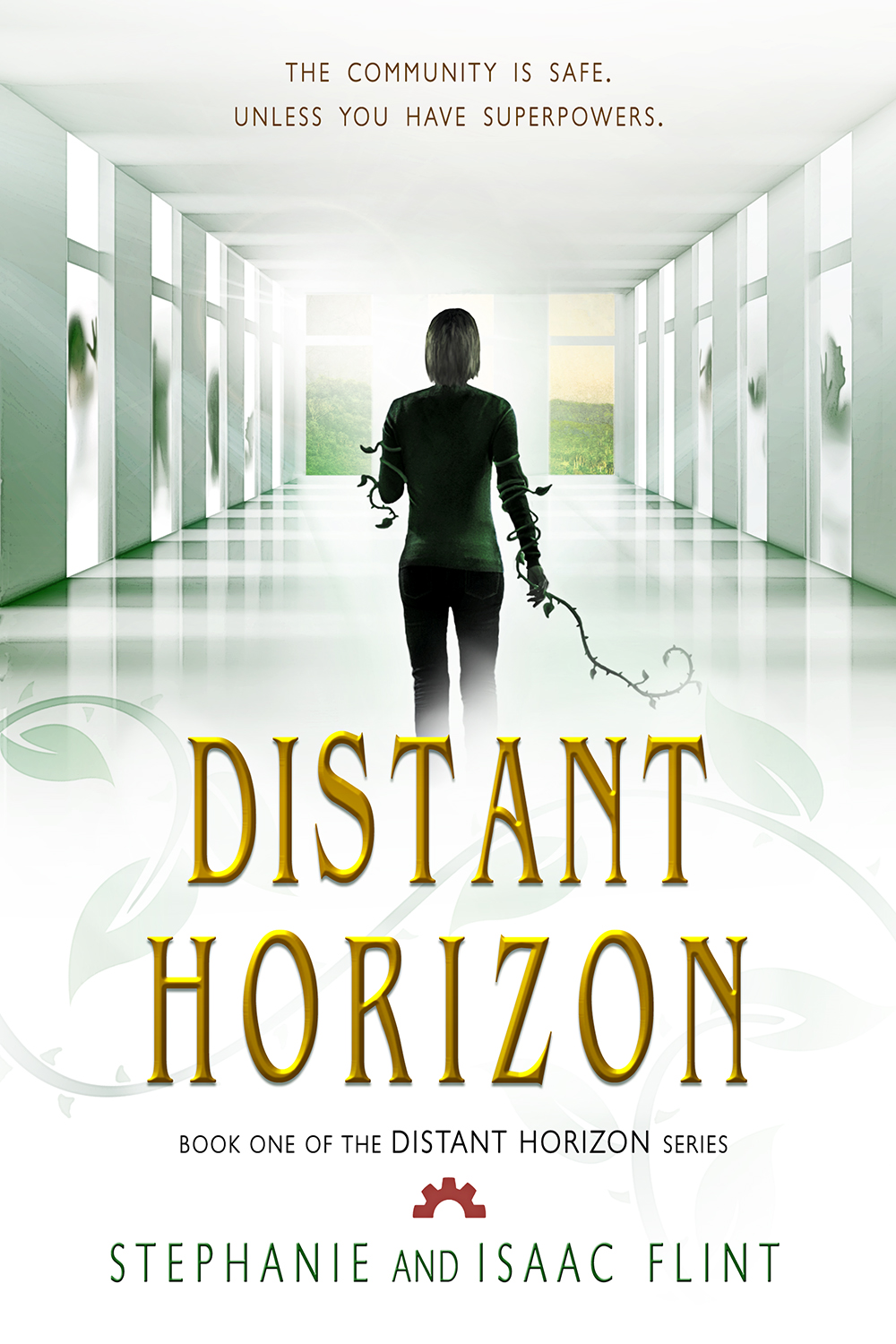
Distant Horizon: At this point, Isaac and I feel that the basic story is complete. It’s been through many different beta-readers, and we’ve let it sit while working on other projects. I’ve recently started working on basic formatting for this particular story, with the intent of looking for typos and minor grammatical issues. We don’t expect to release Distant Horizon just yet, and we don’t currently have a projected release date. However I want to start working on proofing, since I know that takes awhile. Depending on how well that goes, the release date may be sooner or later. The front cover is complete, however, with only a few minor changes expected.

Video Blogging: Back in October, Isaac and I started doing video blogs with readings from my stories. If you haven’t already, check out the Infinitas Publishing Youtube channel to listen to chapters of Magic’s Stealing and various short stories.

That’s it for now. I hope you enjoyed this post. 🙂

6 Comments

Filed under Business Ventures, Writing

Thoughts on Writing – Researching Real World Languages

At my day job, one of my jobs is to organize composite images. Think: class pictures composed of individual student pictures. I start with a basic form, input the data on that form, sort through a list of classes already in the database, make sure the correct names are in the the right fields, and that the grades are formatted properly for the group pictures. I also scan the names of teachers and students to make sure that the apostrophes are in the right place, “Jr.” has that period at the end… etc. That’s the simplified version, but needless to say, I get to see a lot of names (which is great when you’re trying to brainstorm name ideas).

Today, though, one of the other composite creators called me over, baffled by the names in the grade field: AnangoonsagMiigwanensag, and Noodinensan. (Yes, I wrote these down so I could look them up later).

I was baffled, too. While we see a lot of Spanish names, these words weren’t familiar. Problem was, we have a particular format we try to follow when creating composites, and we weren’t sure how to place them. It’s not uncommon for preschools to have grade names like Infant Sunflowers, but this particular job has less information than usual to go off of. However, we suspected they had meaning to the school using them, so we didn’t want to simply remove them from the grade field.

My first suspicion was German (probably because of the double “i” in miigwanensag… but that really didn’t look right. And the words definitely weren’t French or Spanish.

We glanced through one of the classes, hoping to get an idea from the pictures, and several of the students looked like they might be of Native American descent.

Okay, cool. That gave me a way to narrow down my future search if the search returned several hits.

I wrote down the three words, and then once I got home, did a Google search.

Needless to say, it actually narrowed down quicker than I expected.

There aren’t a lot of results for anangoonsag (I’ve got six results from my Google search), but Google immediately came up with an Ojibwe-English dictionary translation page. The translation read: “star: ~little”

Now, I noticed earlier that two of those words end in “nsag,” so I wondered if this might be a suffix of some kind (for “little”).

A few more searches, and I suspected anangoonsag did indeed have something to do with stars. Once I plugged in the other words, Inarrowed down the idea that these words were from Anishinaabe, a language of the Ojibwe/Chippewa people. I used Wikipedia to get a quick overview (Note: Wikipedia is good for overviews, but I wouldn’t advise relying on it for accurate information), and found that, according to Wikipedia, the Ojibwe are the second largest of the First Nations, and historically, they are known for their birch bark canoes and their use of cowrie shells for trading. (This reminded me of history classes I had back in grade school, so this struck a “ah-ha!” connection point with me). I was also curious about their legend of the Wendigo.

Fascinating, how three unfamiliar words can start a bout of research.

Still curious about what those words might mean, I looked for search results that included the word (or a part of the word) and mentioned either Ojibwe or Anishinaabe. I found this site, which has a wealth of information, including a note on diminutive terms. This was important, because I found both -an and -ag.

But these weren’t suffixes. It seems (if I understand the chart correctly), that these are just parts of the particular word. The chart for diminutive terms shows (and includes the pronunciation for) the basic singular form of several words, then the singular “small” form of the word, then the plural form of the word, and then the “small” form of the plural word.

Based on my (relatively quick) searches, I think the three words have something to do with “star” (anangoonsag), “wind” (noodinensan), and “feather” (miigwanensag). There may be more to each word, such as a suffix or prefix I haven’t discovered yet, but still, it’s a starting point.

If I planned on using these details while writing fiction, I would want to delve more into the words and their various forms to make sure the form was correct–or as close to correct as I was going to get.

At the same time, I’ve got more information than I had before, and now I’m curious to know more about the Ojibwe language and culture.

If you find something that your curious about–a word, a myth, a culture–do a quick search. You might find that you want to learn more about it. 🙂

Have you ever come across an unfamiliar word, searched to learn what it meant, and become fascinated with what you found?

2 Comments

Filed under Writing

Thoughts on Writing – Literary Doppelgangers

You know those times when you’re writing a story, and you think you’ve finally created a character that’s at least a little bit different… and then you find their literary doppelganger?

That character which just seems far closer than you would have liked?

While watching Jessica Jones (which is an awesome show, by the way), one of the things that struck me and Isaac was the similarities between the villain of the show, Killgrave, and Brainmaster, the villain of our story, Distant Horizon.

They’re definitely different, but they do have some striking similarities (except that Killgrave is just so much more evil… An absolutely fascinating character, but evil). Note: I have only seen the show, so I’m not sure how he compares from the comics.

First, let’s take a look at Killgrave.

Killgrave has mind control powers. He can walk up to a person, tell them to do something, and they’ll do it. His powers have a time limit (12 hours), and a limited range. He’s obsessed with Jessica Jones, trying to win her back after she finally managed to escape his grasp. He doesn’t mind leaving behind a body count just to get Jessica to move in closer as she tries to stop him. (But he doesn’t do the dirty work. No. He comes up with creative ways for other people to kill each other or themselves… and leaves an even bigger mess for Jessica to clean up).

Also, he wears a purple suit. Kind of his style.

Now, let’s take a look at Brainmaster, from the story Isaac and I are working on.

Brainmaster has telepathy, which, in our story, equates to three possible options… mind reading, mind control, or communication via thought. Powerful characters can do all three. We see her doing all three of these things, but one of her trademark moves is taking control of characters by implanting suggestions in their brains… some of which cause them to attack others or themselves.

And she wears purple robes.

(This is where I was cringing watching Jessica Jones. Killgrave, also a mind controller, has a purple suit. I’d never even heard of his character (at least, not other than a single cartoon episode of X-Men with a very different version of him) until a few weeks ago.

These characters are different, but they do have similarities. Both have mind control powers. Both haunt the main characters (Jessica has traumatic flashbacks of Killgrave, Jenna has traumatic memories that Brainmaster plants in her head), and both wear purple. Maybe it’s because of the idea that the color purple often reflects royalty and power. (There’s an interesting web page about the historical uses of the color purple here).

For characters who are meant to be powerful, it makes sense to have them wearing purple.

Anyway, I thought it would be fun to post a short scene from Distant Horizon, one where we get to see Brainmaster for the first time.

Note: This scene has been truncated to minimize spoilers.

I pushed the door open.

Inside, a lady wearing a flowing, deep purple robe stood at the end of a long metal table. Her robes were fringed by golden swirls and thick, bold lining. Part of her white hair was rolled into an elaborate bun; the rest cascaded to her shoulders.

The lady’s eyes narrowed and her face contorted into wrinkles. She wore just enough eyeliner to accentuate her fierce eyes, and her nails were painted a gold that matched her outfit. More than most leaders, she was dressed for appearance.

Beside her, an elderly woman with graying hair was bound to the chair. Her shoulders were slumped and her head lolled back.

Go away.

I jumped. I hadn’t heard anything, but it was clear that the woman standing with her manicured hand on the corner of the woman’s chair had spoken. She lifted her chin and scowled.

“Let her go.” I tightened my grip on my spear.

Brainmaster smirked and slid her nail along the edge of the chair. Something forced me– my mind– away.

I couldn’t move. My arms were frozen in place.

She smiled and brushed back a wisp of white hair. Drop the spear. Close the door behind you. Take a seat. She gestured to the chair, a slow, elegant motion.

I dropped the spear, took a seat. Listened.

A slow smile crawled across her cheeks. She gestured to the woman in the chair. “The true plague is disobedience. It makes our society inefficient. This woman is a traitor. She spreads the plague by her presence. She’s a lost cause. Kill her.”

I stood, vines uncoiling from my arms, and walked the length of the table. Power pulsed through my vines, urging me to take control. To let them flourish. To use them.

The traitor turned her head, her eyes half-shut.

“She’s the true monster,” Brainmaster murmured. “A threat to everything we hold dear.”

I wrapped my vines around the woman’s throat. Felt their pressure against her skin. Closed them tight. The woman coughed, gasping, but I didn’t let go.

Funny thing, Nickleson. Do you ever wonder how a beast feels when it’s given orders? Is this what you want?

I stared at the dying woman, confused.

A beast is such a mindless thing. You could be so much more.

The woman sputtered and fell limp. Her head lolled.

A chill clawed through my spine.

She was dead.

I’d killed her.

And that’s where I’m going to leave that scene…

*Cough.*

Brainmaster. Yeah, she likes messing with people’s minds. Maybe that’s why I enjoyed watching Killgrave’s character so much.

Anyway, I hope you enjoyed this post. 🙂 Have you ever written a character, then found their literary doppelganger?


2 Comments

Filed under Writing

Thoughts on Writing – Combining Characters Part 2

In my previous post, I talked about a couple characters of whom I decided not to combine in Distant Horizon, and why. Today I’m going to talk about a couple characters who I very well might combine into a single, hopefully stronger character, in The Shadow War.

I’ve been plotting for The Shadow War (book two after Magic’s Stealing) for a little while now, and when I was telling Isaac about some of my ideas last week, he suggested that I consider combining two of my characters who will be introduced in the second book. Let’s take a look at the characters in question: Nihestan and Shalant.

Both characters are secondary. They’re important to the plot, but they’re not main characters. Each serves to aid the character of Daernan (Toranih and Daernan each have their own point of view in this story), but in different ways.

Nihestan Nivasha is Cirenan-born, a weapon’s mage, and has dealt directly with Shevanlagiy and Lord Menchtoteale (the bad guys from the first book). Nihestan also works closely with Madiya, the goddess of the dead (who features more prominently in the Cantingen patheon than Cirenan) and he leans toward the immortal spectrum thanks to a run-in with unicorns. (Unicorns aren’t exactly the friendliest creatures in the Cirenan universe).

In the current draft, Nihestan plays the role of a cynic, always watching the world and being wary of the future… mostly because he got a glimpse of the potential damage that the Wishing Blade could do (his weapon’s magic allows him to see potential and past acts of violence within an object). He’s actively trying to thwart Isahna, the trickster god, and has been undercover for many years to protect his family.

He also knows a bit about how glass-stone works (though he’s still trying to figure out the finer points of the confounded stuff), which is one of the reasons that Daernan gets involved with him.

Then there’s Shalant. He’s Cantingen-born, a word mage, and something of a seer. Daernan first runs into him when he goes to the temple in Ashan, where he finds Shalant using his word magic to help the high priestess after the stealing. Shalant acts as an enthusiastic (if slightly wary) mentor. His knowledge of the gods and (word) magic often comes in handy, and his ability to use word magic is crucial in fighting the shadows. As a seer, he knows a bit more than he should (especially regarding Shevanlagiy), and he’s spent some time working with Nihestan on the mage’s glass-stone project.

Now, the problem I was having is that many of the scenes I plotted in my head could work well for both Nihestan and Shalant. Other than their cynical versus enthusiastic personalities, and their ribbon versus word magic capabilities, they play similar roles.

There’s a particular scene I’ve been planning that involves a confrontation with Shevanlagiy, one which works similarly well with both characters.

If Nihestan confronts her, he uses his knowledge of glass-stone and weapon’s magic against her. But now that I’ve been thinking about it, I need to decide whether or not he’ll still have that magic. He has been working with the gods, and he knew the stealing was coming, so there’s a chance he could have prevented his magic from being lost.

If Shalant does the confrontation, he doesn’t have any personal stakes (other than potential foreshadowing for a future series idea that I have in mind), but his scrying would have given him insights that Shevanlagiy would prefer he doesn’t know… including a weakness that she herself doesn’t fully understand. The problem is that I’m afraid his character would open up the story to a new plot line that I’m not ready to delve into. I like the idea of bringing this guy’s character in, but I’m not sure it’s necessary for this particular story.

The two characters were getting lost in the crowd.With so many characters, I wasn’t sure what each one was doing at any particular moment.

So, when Isaac suggested that I try combining Nihestan and Shalant, I began picturing the resulting character and liked the result.

First off, Nihestan’s last name, Nivasha, sounds more Cantingen in origin than Cirenan, and vice versa for Shalant. I’d been toying with the idea that Nihestan had converted to the Cantingen pantheon at some point in his past, and the idea of combining these characters solidified that. He could have originally been Nihestan Shalant, and later taken the last name of Nivasha after his dealing with Madiya (or one of her agents). Thus, we would still get some insights into the Cantingen culture without pulling the main story too far off track (again, I’ve got that sequel series brewing in my head–though it will probably be a while before you see that–and it will likely deal heavily in Cantingen mythology).

Second, their combined knowledge would allow Nihestan to play a mentor figure… even if the person he’s mentoring is skeptical of his motives. It also stands to reason why he knows so much about Shevanlagiy, since he’s worked with her before, and his vast knowledge of things he technically shouldn’t know about would come from his time spent working with the gods.

Third, Nihestan as both a ribbon and word mage… whew!

He’s going to be a tough cookie in a fight. Seriously. Even if he’s without his ribbon magic, he would have word magic at his disposal… and perhaps be able to achieve a few plot points that I don’t want to spoil here.  The first book has a few lines of foreshadowing that could easily reference his character. Not only that, but he might actually be able to keep some of his ribbon magic through the use of word magic, since he already expected the stealing to come.

This allows the confrontation scene with Shevanlagiy to work smoothly. This version of Nihestan has personal stakes in the matter, and the ability to be a threat.

Fourth, I don’t have to keep track of who is doing what. The tough part comes if these two characters are doing completely separate actions, but I don’t think there will be too many problems there.

The other problem, however, is that where Shalant is playful, Nihestan is cynical.

Merging the personalities might prove tricky. Most likely, I’ll keep some of my original ideas of a younger Nihestan (who has a more carefree attitude), while giving him the wary outlook that comes with what he’s seen and knows.

As for Shalant, he may appear again in a different form with a different name… as he was apt to do in my plotting. (Seriously, in my super rough draft from many years ago, Shalant was an arrogant god who mentored Daernan mostly because he needed someone to represent the immortals… and had fun watching Daernan fumble. Very different character. I’m considering making a darker version of that character into a small-time antagonist for Toranih. Maybe. Not sure yet. We’ll see if it serves the plot).

I haven’t decided if this is the route I want to take, but I’m giving it serious consideration. Overall, I think the story will be stronger for the merge.

I hope you enjoyed this post. 🙂 Have you ever combined any of your characters?

4 Comments

Filed under Writing

Thoughts on Writing – Combining Characters Part 1

One of the writing tips I’ve heard for making stories stronger is to combine characters. Theoretically, combining characters cuts down the number of supporting characters (thus making the cast easier to remember) and makes for a stronger single character (by bringing in conflicting, but often interesting behaviors).

When I was working on Distant Horizon, a YA science fiction novel I’m co-authoring with my husband, Isaac, a suggestion we got from one of our beta-readers was to combine two characters who both played the role of a mentor. Ultimately I turned down the idea, because each character had conflicting backstories that I wanted to be able to bring in later (though that isn’t technically a good excuse–somewhere I read a similar train of thought about a Wheel of Time character, but I can’t remember which article that was).

However, by realizing how similar the two characters were, I realized how important it was to differentiate between them if I chose not to combine them.

Let’s take a quick look at these two characters, Pops and Jim, from Distant Horizon.

Pops is the main character’s grandfather, though she knows him for the same length of time as Jim. He has the wisdom of experience from working with the people he now fights, and he wants to protect the main character from those people.

Jim, on the other hand, is older than Pops, and he’s never worked with the bad guys. He knows the time from before the bad guys took over, and thus, he took on the role of the rebel’s historian.

Both characters are mentor figures, and in my earlier drafts, had a tendency to convey repetitive information.

I needed to determine what made each separate character crucial to the plot, and why I wanted them to be different characters.

One reason was their respective eras.

Pops grew up during a time when the bad guys had almost full control of their territories, but their reign was still uncertain. They were no longer seen as the bad guys, and thus, Pops took part in helping their agenda. He grew up familiar with the earlier uncertainty where the lack of jobs and money were a problem, and he understood the promise of the coming “Community ideals.” But in his work he’s seen the darker side of the Community, and while he still values the ideals, he no longer supports the bad guys. While with them, he trained as a scientist who studied powers, and so he is the resident expert.

As for Jim, he grew up in the age of superheroes (relatively similar to our world, but with powers). He saw the fall of the Super Bureau, and the fall of the free world. He is familiar with the concept of democracy, various religions (which were largely wiped out by the bad guys) and freedom. He was there to watch the world spiraling out of control, and he was there at the founding of the rebels’ group. He’s seen the change of eras. Paralyzed from the waist-down in his early days, he no longer fights direct battles, but he provides useful information regarding the past as it was… and how the bad guys have covered up that past with lies. He is the only surviving member of the Super Bureau.

Each character has several similarities. But they are also different. When the main character wants information regarding how the bad guys act from within their ranks, she should go to Pops. When she needs more information on powers, she should go to Pops. When she wants comfort in the Community ideals she believed in, she should go to Pops.

But when she wants to know why this rebel group behaves as they do, she needs to go to Jim. Only he can give her the dynamics that neither she, nor Pops, can fully understand. When she wants information on the world as it was, and might be yet again, or answers that don’t involve the Community’s dark secrets, she needs to go to Jim. He has a different perspective than Pops, and unlike Pops, who is jaded from the world he’s seen, Jim still has some lingering hope within the sadness of everything he’s lost, in part because of how he was raised.

Now, would it be possible to combine these characters? Probably. The ages might change. The new character might have been a superhero trained in the science of powers who worked for the bad guys for a while, then quit for reasons that are revealed in the story. The new character would still be a mentor, but due to the change in backstory, how they see the world–and how others see them–would be different.

It’s not quite what Isaac and I were going for. There’s a certain symbolism we’re hoping to achieve through the two characters, and they each have different outlooks on life. Maybe the story would have been stronger if they were merged. Maybe it wouldn’t.

For now, I’m planning to keep them separate. But having considered merging them helped me to consider what made them stronger separately.

I hope you enjoyed this post, and next time, I’ll be talking about a couple characters I’m considering combining in The Shadow War. 🙂

Have you considered combining any of your characters? Why or why not?

EDIT: You can read the second part of this post here.


4 Comments

Filed under Writing

Thoughts on Writing – Analyzing the “Jessica Jones” TV Show

(Warning: I’ve only watched the first three episodes, and I have tried to avoid major spoilers, but read at your own risk).

Recently, my husband and I started watching Jessica Jones on Netflix. I was introduced to the show while browsing through a CNN article that mentioned that David Tennant (Doctor Who’s tenth doctor) was playing Killgrave, a Marvel villain with mind control powers, and that the main character, Jessica Jones, has a few super powers of her own. Despite the article mentioning that this particular show is considerably darker than the other Marvel shows (and ooo-boy, it is), the super powers sounded interesting, so I tentatively (Or Tennant-ively, if you like puns), decided to give this show a try.

And yes, it is dark.

The main villain of this story is actually evil. Downright despicable, cruel, manipulative, and abusive.

And you know what? As a writer, I’m impressed. I haven’t seen very many shows lately where the villain was actually a pure bad guy. Now, I’ve only seen the first three episodes of Jessica Jones as of writing this post, so maybe Killgrave has a soft side–maybe. And granted, my weekly go-to show has been My Little Pony: Friendship is Magic. The bad guys there don’t tend to last long before being converted by the powers of friendship.

Anyway, I generally lean toward villains who have logic behind their actions, who are at least a tad bit sympathetic. They tend to be more interesting, and you want to root for them at least a little… even if the hero is likely to win. (Janice Hardy has a great article on sympathetic villains).

In the first season of Heroes, Claire’s father is all set up to be the big bad guy. But he has good reasons for his actions… even if he doesn’t always make the best choices.

In Avatar: The Last Airbender, Zuko is out to capture Aang… but he’s trying to prove himself as having honor by his father’s standards, and he slowly comes to the realization that honor isn’t what he thinks.

In the Thor movies, Loki steals the show. He’s not a good guy, obviously, but he’s probably the most entertaining of the characters, and I found myself rooting for him more than any of the other characters. (Granted, I’m not much of a Thor fan. I like Captain America, and I’m super-excited to see the upcoming Civil War movie.)

Really, these are all very different shows from Jessica Jones. I’ve never read the comic (this show is the first I’ve heard of her character), but this Youtube video does  a pretty good job at summarizing how the comic is vastly different from many of the other comics in the Marvel universe. Quite simply, Jessica Jones was meant for an adult audience, with the freedom to explore heavier topics that are typically shunned in mainstream comics and TV shows.

Regardless, the first episode of Jessica Jones blew me away. I loved analyzing the show.

Sure, it’s darker than I normally prefer, but the creators set that tone right from the get-go, so the darkness doesn’t come as a surprise. Take a look at the opening line of the show (as paraphrased from my memory):

“New York City may be the city that never sleeps, but it sure does sleep around.”

This line is not only memorable (because it delivers a twist on an old saying), but it sets the tone for the rest of the episode.

Jessica Jones is a private investigator who makes her money by helping disgruntled spouses find proof if their husband/wife is cheating on them. And the show doesn’t mind showing exactly what those couples are doing. Right from the beginning, we know that there’s going to be on-screen sex.

Setting the tone at the beginning helps audience members who aren’t interested know whether or not they want to keep watching.

Having the gritty setting at the beginning also allows the show to naturally segue, piece-by-piece, into revealing that Jones has been psychologically (and sexually) abused by her former captor, Killgrave.

The first time we hear him, his dialogue is a bit ambiguous. We don’t know if he’s really there of if she’s having a flashback, but we do know that dark blue lights are going to be a symbol of his influence. (As a side note, I loved some of the artistic options of this show. Some of the scenes can seem to be a bit slow… but the tension is mounting, the hotel hall is lengthening, and you wonder who, or what, lies just behind that door…)

The artistic choices also helped address one of my initial concerns about the show: Would David Tennant be able to portray the villain without reminding the audience of the Doctor? Granted, we’ve seen the tenth doctor have a few rather dark-sided moments, but nothing like this.

I needn’t have worried. The first few times we see Killgrave, his face is in shadow. The lights change to a dark blue-violet, and we mostly just hear a few lines of dialogue. This is an excellent choice to build up Killgrave’s character before we actually see his face. Then, in the second episode, when we finally see Killgrave, if only for a moment, we’re not exactly picturing the good-hearted Doctor.

That’s another thing this show has been doing well. Instead of showing the villain outright, we first see shadowy glimpses of him. We hear his voice. There’s a moment in the third episode where he delivers a long line of dialogue that is amazing, in part because it’s a threat we know he’ll actually follow through, but he’s entirely off-camera.

We have two major things going for this villain: the show teases us, only showing his face on occasion. We’re never quite sure if he’s going to be standing around the next corner. This is great for building tension. Second, he’s perfectly capable of doing his evil deeds. We see the results of his actions, and we know he will do terrible things. The show hints at it first, then shows us bits and pieces. The only question is who he will target next. As such, the writers have proven that he is a threat for the hero.

The villain, terrifying as he is, makes the hero so much stronger (and not because she has super strength. Killgrave is capable, he’s dangerous, and Jessica has stakes. The whole first episode is about drawing her into this conflict. She has a traumatic history with the guy, and every reason to run.

The show has to prove why she doesn’t.

It does. It does by pushing the villain’s already evil deeds to a whole new level (Seriously… Killgrave is evil. Just watch the first episode).

Jessica can either run, or she can confront him.

Better yet? The show makes it possible for either to make sense for her character. Either she’ll run, and we expect Killgrave to follow, or she’ll fight, and we’re biting our nails hoping she doesn’t dig herself in too deep.

Regarding digging itself too deep… Jessica Jones continued to impress me by not restricting itself to being super-depressing or overly dramatic.

My problem with the first season of Agents of SHIELD was how over-dramatic it was, and with the second season, how it would linger too long in the depressing stage. Jessica Jones, on the other hand, resorts to situational and dry humor to help lighten the mood when necessary, and some of the moments are quite amusing. They’re placed at key moments to relax tension or bring you back from “eeps!” moments, without seeming contrived.

Plus, there are references to the rest of the Marvel universe (especially in the third episode) that helps tie everything together.

Overall, I’m really enjoying the show. I was hesitant at first, knowing that it would be darker than the other Marvel shows,but I’m glad I gave it a shot. If Jessica Jones continues as it has thus far, I think I’ll enjoy it… and I’ll be happily rooting for Killgrave’s downfall… a character I suspect that I’ll “love to hate.”

I hope you enjoyed this post. Have you watched any episodes from Jessica Jones? 🙂

5 Comments

Filed under Writing