Category Archives: Business Ventures

Thoughts on Publishing – A Video Blog Post – Reading Chapter One of Magic’s Stealing

Today I’m continuing the trend of doing a weekly video blog post, but instead of doing a reading from 1000 Words, I’m reading the first chapter of Magic’s Stealing. 🙂

(And  a Youtube link in case you can’t see it).

This is a day late–I normally try to post on Fridays– but this time I edited the audio to remove the more obvious stumbles where I tripped over my words. It’s been a while since I used  Premiere Pro, so it’s not perfect (and I caught a couple spots I missed once I listened to the full video), but hopefully the edits will make the overall listening experience smoother.

As a side note, I started doing the video blogs as an experiment in seeing whether or not that would help shorten the amount of time I spent producing material for the blog.

Did it?

Nope.

I want the videos to look and sound at least semi-professional, so I practice the reading at least once beforehand, so that the actual reading has as few stumbles as possible. Since I’ve now rediscovered how to use Premiere Pro, removing obvious stumbles also takes time, and then I have to export the edited clip from Premiere Pro and create a “movie” image in Movie Maker for the book (because I haven’t quite figured out the video options in Premiere Pro). Then I upload the different clips to Youtube (I do the reading separate from where I talk beforehand). Depending on my internet speed (which has been lacking as of late), those clips can take a while to upload. Then, once uploaded, I need to splice them together using Youtube’s video editor (handy thing, though limited), listen to transition points to make sure those flow smoothly, and create the new video. Once that’s uploaded, I listen to the full thing to make sure that everything has correctly processed.

It’s a lot more time-consuming that I thought it would be, but I suspect part of that is the learning curve involved with each program.

I still enjoy doing the readings, however, and I hope you enjoy them, too. 🙂

2 Comments

Filed under Business Ventures, Writing

Thoughts on Publishing – Infinitas Publishing Status Report

Wow, time flies. O_O

It’s time for another Infinitas Publishing status report!

The Wishing Blade: Magic’s Stealing (Book One) – I’ve just about got the print version ready. I’ve gone through the first proof and searched for typos, and one of my beta readers graciously agreed to look through it a (third? fourth?) time, and they pointed out a few grammatical suggestions here and there. I’ve made notes about which changes I plan to implement, and my next step is to apply those changes across the three files (print edition, Kindle edition, and Smashwords edition), then order a proof copy to make sure my formatting is still correct. Shouldn’t take too long, but I don’t want to rush and accidentally botch something.

Also, at the suggestion of my beta reader (and the encouragement of Isaac), I went ahead and polished up the Cirena map. So the print edition should have this map, and once I release the print edition, I’ll also update the ebook editions with it, as well. 🙂

SBibb - Cirena Map

(Read about my earlier map-making process here.)

The Wishing Blade: The Shadow War (Book Two)- I’m about where I was last time I wrote one of these reports (*Cringe*). However, my NaNoWriMo goal is not to complete 50,000 words, but to revise the first portion of this book, then finish writing the rest of it so that I can hand this over to beta readers. Let’s see if we can get this story on track.

The Multiverse Chronicles: Trials of Blood and Steel – I’ve given the first thirteen episodes their basic revisions, and I’m currently polishing episode five, including the end scene. In addition, I’ve been sending these off as I finish them to our beta reader for this series, and she’s been giving us good notes that I intend to implement. Then Isaac will go over them one more time to make sure any revisions I made fit with his vision, and afterwards, we’ll start releasing them. The goal is to release the first six episodes at one time, with one episode a week following that. We still need to make tweaks to the Multiverse blog site, and the release has been put on hold until we have our Battle Decks game ready.

In the meantime, Isaac’s NaNoWriMo goal involves writing the rough draft for season two of The Multiverse Chronicles. 🙂

Battle Decks: Trials of Blood and Steel -We’re off schedule on this project. Got the latest proof in, found a few minor edits to tweak, but then we had a friend come over who pointed out a lot of things that could help make the game stronger. As such, Isaac adjusted one hero character card into a basic reinforcement card, brought in a new hero card (he already had the sketch completed, but I need to clean it up in Photoshop and color it). Plus, Isaac’s changed a few stats and abilities on the other cards, and changed what certain abilities actually do. As such, this game is going to be released later than planned. Hopefully next month, if we’re able to get a new proof ordered in the next couple weeks. Not only that, but we’re currently considering offering two editions–one that has dice and tokens and a full, easy-to-read set of rules, and one version which only has the cards and a single sheet of rules (harder to read, but we’ll have the rules available for free online), which should also be a bit easier on players’ pocketbooks.

Phalanx – Won’t be released for a while, but this is a board game Isaac put together based on a game that’s mentioned in one of the Multiverse episodes. Something like a cross between Chess and Tetris. Look for more details in the upcoming months. 🙂

SBibb’s Photographic Illustration – Working through book covers, per usual. Finalizing a couple and working on the proof of another.

Lesson to be learned?

Give yourself plenty of time to complete projects. Count on needing to make more revisions than planned. Come out with a stronger product in the end…

And try not to pull out your hair in the meantime.

I hope you enjoyed this post. 🙂

Leave a comment

Filed under Business Ventures, Writing

Thoughts on Publishing – A Video Blog Post – Reading Four Way Stop

Last week I did my first video blog post, in which I read “The Magician,” one of my 1000 Words short stories. Tonight I’m continuing  that trend by reading “Four Way Stop” (also from 1000 Words), in a special, Halloween edition. 🙂

I had a bit of help with this one from Isaac, who helped create a few themed props, and the process which much faster than last time, since I had a better idea of what I was doing.

Anyway, here’s the video!

(And  a Youtube link in case you can’t see it).

I hope you enjoyed this post. Please let me know if you would like to see more of these. 🙂


Leave a comment

Filed under Business Ventures, Writing

Thoughts on Publishing – YA Paperback Prices

In my last post, I discussed my thoughts on pricing an indie card game. That got me thinking back to pricing paperback books. I’ve already determined that I’ll probably sell the paperback edition of Magic’s Stealing for $7.99. It’s an odd price, but a compromise since there weren’t a whole lot of YA novellas in paperback that I could find to reference, and the ones I did find were by well-known authors, and therefore priced higher.

Since there’s a slight possibility that Magic’s Stealing may appeal to the upper range of the middle grade audience, I referenced the $7.99 price point of similar-sized books. Here, AR quizzes can be of use determining word count.

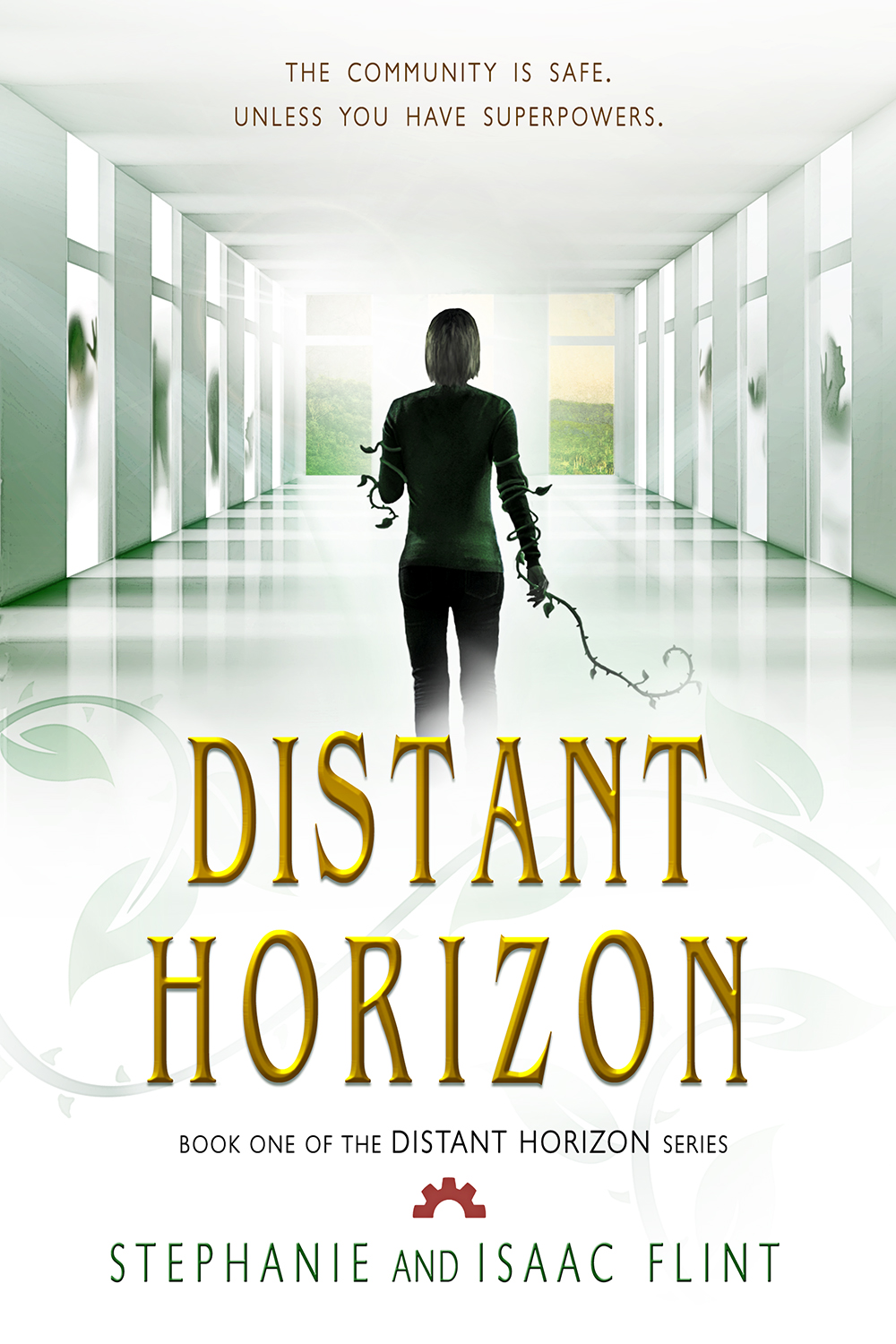
However, I’ve now been thinking about Distant Horizon (a 97,500 Ya/NA science fiction novel), and wondering how I want to format the print edition. Granted, it still needs to be proofread, and Isaac and I are quite a ways from releasing it, but I like figuring out these things.

The print format that I used for Magic’s Stealing won’t work… we would end up with a huge page count, which means that the production costs would be too high to bring the book into local stores.

Createspace gives us the option to compare basic book costs, shipping, and royalties. With a quick check of the Distant Horizon file in the same format as Magic’s Stealing, I found that the initial page count was 450. That’s not including getting the chapter spacing formatted to look nice.

But let’s plug that into the calculator and get some numbers.

For a single copy of a 5.25 x 8 book, black and white pages with bleed, we’re looking at $6.25 for the book and $3.59 for standard shipping. $9.84 per book.

Let’s take a look at volume discounting for a moment, since that’s what makes it possible to get these books into stores.

If we buy 25 copies of the book, we pay $156.25 plus $15.50 for shipping, for a total of $171.75, or $6.87 per book. Notice how much the cost per book went down? If we buy 50 copies of the book, we pay $312.50 plus $23.00 shipping (be sure to adjust your quantity value in both calculators). That’s $335.50 total, or $6.71 per book. A slight difference from 25, but not so different that we couldn’t purchase the smaller quantity of books if funds are tight.

For royalties on Amazon (not looking at any expanded distribution options), we start making a profit at $10.99 (34 cents), $11.99 (94 cents), $12.99 ($1.54), $13.99 ($2.14), and $14.99 (2.74). Books printed in Great Britain need to be priced higher than the converted $12.99, or they lose money, while books printed in Europe need to be priced higher than the converted $10.99 or they lose money.

Keeping in mind that we can adjust those prices separately, I’m not worrying about non-US prices right at the moment.

However, without knowing how to format the book, it’s hard to say what the right price point is.

So I decided to run over to Hastings and take a look at their YA section. Figured I’d take twenty minutes to do some quick research.

One hour later…

*Ahem.*

Anyway, I came up with a list of various young adult books across different genres. I noted their title, my best guess at their genre (I referenced Goodreads for a few of them), their page count (by last page of the story, not including front and back matter), line count per page (unfortunately I didn’t think to count the average words per line), price (there may be some variation here due to price stickers covering the price listed on the book), and book size.

I found that, overwhelmingly, the young adult paperbacks were 5.25 by 8 inches, or very close to that size (some variations from printer to printer should be expected). In general, if they came from a traditional publisher, they were 5.25 x 8. Keep that in mind if you’re self-publishing, and you want your book to “look” professional. On the other hand, I briefly skimmed the adult section with the 6×9 book, and there were several more instances of the 6×9 trade paperbacks available. At some point I would like to go back and check the adult book price points and line counts and such, since I think my previous research has suggested that the average adult trade paperback would sell for roughly $14.99.

Keep your target audience in mind, and research similar books to get a feel for how to format and price your own book.

This is the list of YA books I compiled at Hastings.

Michael Vey: Rise of Elgen (Science Fiction) – 6 x 9 – 335 pgs – 35 lines per page – $10.99

Hush, Hush (Paranormal Romance) – 5.25 x 8 –  391 pgs – 25 lines per page – $11.99

Perfect Chemistry (Contemporary Romance) – 5.25 x 8 – 359  pgs – 29 lines per page – $9.99

Barely Breathing (Romantic Thriller) – 5.25 x 8 –  502 pgs – 32 lines per page – $9.99

Perfect Ruin (Dystopian) – 5.25 x 8 – 356 pgs – 29 lines per page – $9.99

The Jewel (Dystopian Romance)- 5.25 x 8 – 359 pgs – 30 lines per page – $9.99

Beautiful Creatures (Paranormal Romance) – 5.25 x 8 – 563 pgs – 30 lines per page – $9.99

Eye of Minds (Science Fiction) – 5.25 x 8 – 310 pgs – 30 lines per page – $9.99

The Dark Is Rising (Complete Sequence, Fantasy) – 6 x 9 – 1082 pgs – 30 lines per page – $16.99 (The Amazon edition is different than the edition I found)

The Hunger Games (Dystopian – Original Edition) – 5.25 x 8 – 374 pgs – 29 lines per page – $8.99 originally. Now has sticker that says $10.99

The Hunger Games (Dystopian – Movie Edition) – 5.25 x 8 – 374 pgs – 29 lines per page – $12.99

The Hunger Games (Dystopian – Shiny Gold Edition) – 5.25 x 8 – 436 pgs – 27 lines per page – $12.99

City of Bones (Urban Fantasy – New Cover) – 5.25 x 8 – 485 pgs – 30 lines per page – $13.99

The Sight (Fantasy) – 5.25 x 8 – 464 pgs – 33 lines per page – $8.99

Graceling (Fantasy) – 5.25 x 8 – 471 pgs – 28 lines per page – $8.99

The Demon King (Fantasy) – 5.25 x 8 – 506 pgs – 29 lines per page – $9.99

The Testing (Science Fiction Dystopian) – 5.25 x 8 – 325 pgs – 29 lines per page – $9.99

The Darkest Minds (Dystopian) – 5.25 x 8 – 488 pgs – 30 lines per page – $9.99

(About here I discovered that Dreamland is out. *Squee!* I’ve been wanting to read that since I read the first few chapters… *Ahem.* Back to cataloging…)

Mortal Gods (Mythology Fantasy) – 5.25 x 8 – 366 pages – 33 lines per page – $10.99

Never Fade (Dystopian) – 5.25 x 8 – 507 pages – 30 lines per page – $10.99

Fourth Comings (Contemporary Romance… looks New Adult) – 6 x 9 – 310 pages – 31 lines per page – $13.99 (Amazon has the list price at $15.00, so I think this may technically be categorized as an adult romance, though it was in the young adult section)

IMPORTANT: Some of these numbers may be incorrect due to my notes having tiny handwriting. I’ve linked to the books in the Amazon store where available, and those may have product details for the print editions that include the front and back matter. As another note, you could probably do a lot of this same research on Amazon by checking the scratched-out list price when you have the paperback edition selected.

I also found that hardback books tend to lean toward the 6 x 9 mark, but they completely vary as to the exact size, and some are considerably smaller. Also, font size and line spacing varied from book-to-book, so when formatting your own book, be sure to take that into account, and study your favorite books in the genre of the book you are formatting.

Now, let’s do the same categorizing for Magic’s Stealing that I did for the above books.

Magic’s Stealing (Fantasy) – 5.25 x 8 – 158 pages – 28 lines per page – $7.99 (once the print edition is available)

Based on the above list, most of the YA books are sized 5.25 x 8 inches, typically range around $9.99 to $10.99, higher if they’re a well known book. Based on this sampling, there aren’t as many at $11.99 as I originally thought, though more research may be needed regarding specific genres. The biggest benefit to this list that I see for Distant Horizon is that a large number of those books allow for 30 lines per page, which can significantly decrease page count. Additionally, something I didn’t check for at the time is the average word count per line, which would give a rough font size estimate.

Let’s go back to our Distant Horizon book and see what happens. I lowered the font size (which isn’t the end-all answer, but this is a rough estimate), which brought the line count to 31 lines per page (a little high, but still acceptable), and now only have 370 pages. Let’s round this to 400 pages, since formatting changes could increase the count.

With those variables, a single book is $5.65 plus $3.59 shipping, or $9.24 per book. A volume purchase of 25 books would be $141.25 plus $15.50, for a total of $156.75, or $6.27 per book. 50 copies would be $282.50 plus $23.00, for a total of $305.50 or $6.11 per book.

At the common price points, a 5.25 x 8, 400 page book would profit on US Amazon at 34 cents ($9.99), 94 cents ($10.99), and at the uncommon prices $1.54 ($11.99), and $2.14 ($12.99)

Let’s say that we want to take this into local bookstores. We choose to pick up 50 books to start with, so each book costs us $6.11. At the high end, a store asks for a 40% discount, which doesn’t work at all for the $9.99 book, but yields about 50 cents for the $10.99 book, or $1.09 for a $11.99 book.

So… it is possible to sell the book to stores at a 40% discount, though the profit wouldn’t be high. The profits would increase as the store’s requested discount decreases.

Alternatively, we could hand-sell the book at conventions, keeping all profits for ourselves (minus sales tax… and the cost of a booth), earning $3.88 per $9.99 book. Potentially, we could list it as $11.99, and still have room to discount it at conventions. However, it’s still not the best price point available, and I’d need to play with formatting to get the lowest number of pages possible, while still keeping the book as readable as possible.

Remember, poor formatting can drive a reader away from a book without them ever knowing why, while good formatting can help them ease into the reading experience, so make sure your book is readable to your target audience.

I hope you enjoyed this post, and these are just a few things to consider when you’re preparing to format your book. Good luck. 🙂

2 Comments

Filed under Business Ventures, Writing

Thoughts on Publishing – Pricing an Indie Card Game

Isaac and I have been working on our upcoming card game, Battle Decks: Trials of Blood and Steel, and we had a gaming-experienced friend come by a few days ago to test the game. He gave us a lot of great advice that we’re now looking into implementing. Our date of release may have been pushed to a later date now, but we should have a better game for it.

In the meantime, Isaac and I have been thinking about how to price Battle Decks, as well as how to make it available to the largest number of people (and still make at least a small profit).

Currently, we’re printing Battle Decks through The Game Crafter, a print-on-demand company for tabletop games.

The downside with any version of print-on-demand is the cost. For books, this has become increasingly better over the past several years, and it is now reasonably possible to be competitive with traditionally published books). For tabletop games… they could use a bit more work.

But here’s the problem. Since a customer typically only buys one game at a time, the cost per game is relatively high (at least compared to what you would find in stores). This can be offset by purchasing a large number of games in bulk, but for a small business, this quickly adds up.

Take, for instance, our current version of Battle Decks with all its bells and whistles (four glossy rules pages, a pair of dice, 108 tokens, 126 cards, and the box). The base cost for buying just one game is $28.00, not including shipping. Once you add the cheapest shipping–short of will call (sorry, we’re not traveling to Wisconsin to pick up a box)–we’re looking at $36.00 per game. That goes down to $26.50 per game if we buy ten games at once, but when we add shipping, the price comes to $303.00, or roughly $30.00 a box.

(Note: Shipping costs may vary by location.)

Say we chose to purchase ten boxes at $30.00 a box. We still want to make a profit. If we sell them ourselves, we could offer them for $40.00 a piece and make $10.00 per game, minus sales tax if we factor tax into that cost. However If we take it to a store and ask them to sell it, they’re going to want a wholesale discount. I expect stores want at least a 35% discount off the retail price, and the one store I’ve spoken to thus far preferred a 50% discount off the retail price. Which means that, if we sold our game at $40.00, we’d be selling the game to 35% stores at 26.00 (we lose $4.00 per box), or at $20.00 to 50% stores (we lose $10.00 per box), which basically means that price isn’t feasible.

So, if we push the price of the game up to $50.00, the 35% store wants the game for  $32.50 (we make $2.50 per box), and the 50% store wants the game for $25.00 (we lose $5.00 per box).

However, now we risk pricing the game too high for potential players to take the risk on a new game.

Now, keep in mind that I haven’t done nearly as much research on what stores want in regards to purchasing indie games as I have with books,  so it may be that they want a lower discount. But given that many stores offer discounts to their customers (such as a 10% student or military discount), and they also want to make money (make sense, since they need money to stay in business), and indie games don’t usually have the name recognition that traditionally published games do to help keep those games selling, rather than sitting on the shelves, untouched, I expect that stores will want a decent-sized discount. (Note: See the comments below for input regarding wholesale discount ranges from an experienced seller. According to him, 50% is much less likely to be the norm than a 35% or smaller discount).

I’ll be doing more research in the form of talking directly to stores in the future, once we have more funding available to do a bulk purchase.

In the meantime, yikes.

Our best bet of keeping the game somewhat affordable and still making a small profit is to sell online. However, we’re still looking at a roughly $35.00 to $40.00 game, plus the cost of shipping.

So how do we make the game more accessible?

There’s a few possible options that I’ve found thus far.

Print-And-Play

While browsing The Game Crafter website, Isaac and I noticed that a few games (card games, in particular), had print-and-play editions. With a little more research, and I discovered that Cards Against Humanity has a free print-and-play edition as well as their regular edition.

Basically, a customer pays a small fee (.99 cents to a few dollars) to purchase a PDF file with all the cards ready to print. They print the cards, cut them out, and read any rules that come with the game. They can start playing almost instantly. No shipping time, and low cost.

The downside is the lack of quality control. If a player’s printer renders cards dark or blurry, it may turn other players away from the game. Or maybe the cards aren’t printed on card stock, and shuffling is therefore terrible. (Cards Against Humanity gets around this by putting a set of instructions at the front of their PDF with suggestions on how to print quality cards).

The other downside is that if your game has a lot of cards, and the player uses their own printer, they may end up using a lot of ink.

So… Isaac and I are thinking this isn’t the best alternative option for Battle Decks.

Card-Only Variety

Another option we’re considering is offering a stripped-down, card-only version of the game. No dice, no tokens, a smaller box, and online PDFs you can download and print at your leisure.

This brings the cost of each box down to roughly $17.00 (plus shipping), and if we wanted to make a $5.00 profit, we could offer the game online for $22.00. Shipping would be anywhere from $3-$9, (not sure, since I couldn’t put an unproofed game in my cart). But it’s considerably more affordable, and suitable for players who have plenty of dice, don’t typically use tokens, and don’t mind printing the rules themselves.

We’re thinking of offering the full edition of Battle Decks, with all the additional pieces, along with the card-only version, which gives players more options in regards to how much they want to spend on the game, and how they want to play the game.

Character Cards Only, and Players Use Free Trial Print Version with Proxy Decks

The final option we have considered is offering a small pack of just character cards. (18 cards in a poker card wrap). Base cost $5.00, plus shipping (probably around $3.00, given the piece of one of our other purchases with a slightly larger tuck box).

The idea behind offering only the characters is so that people who play the trial edition (which is a PDF we plan to release that shows players how to proxy the game using poker decks, and includes a single team for each faction) can enhance their game-play while still using the proxy decks, thus making the game more accessible by offering an even lower cost.

However, this only works if you don’t mind using proxy decks. At the moment, I’m leaning toward offering a card-only variety of the core game, in addition to the full version.

Note: These prices may change over time depending on what is being offered at The Game Crafter. Also, further research is needed to determine what indie games of this particular type would reasonably sell at.

Anyway, those are our current thoughts and theories. We haven’t actually tested selling the game with any of these methods.

I hope you enjoyed this post. 🙂 If you were to buy a new, indie card game, how do you prefer to buy it? What prices do you feel are fair?

Further Reading:

http://gamedev.stackexchange.com/questions/27490/how-do-you-decide-upon-the-price-for-a-game – (2011 article, so information may be out of date) One of the people on this webpage make a great point about pricing (indie computer) games based on what platform you’re selling them from.

http://positech.co.uk/cliffsblog/2011/05/08/indie-game-pricing-pressures/ – (2011 article) This article talks about indie (computer) game pricing pressures. It’s a bit off in regards to how books are produced, but the comments do show concern at an expectation for low prices. Those comments also show example of higher-priced (and high-quality) games selling well).

http://danielsolisblog.blogspot.com/2011/09/q-on-card-game-design-costs-and-prices.html (2011 article) – This post details a card game with components, and what pricing various people consider fair for that game

http://gotgeniusgames.com/kickstarter-topic-4-manufacturing-a-card-game/ – Details on card deck pricing from various printers. (I haven’t read through this yet, but it looks like it has potentially useful information)

https://boardgamegeek.com/thread/926760/card-games-what-price-too-high – Discusses profit difference between core games and expansions.

11 Comments

Filed under Business Ventures, Gaming

Thoughts on Publishing – A Video Blog Post and a Reading – The Magician

Today I’m doing something a little different. In an effort to save time (which didn’t work this time around, but hey, now I know what I’m doing, so next time may go faster), I decided to try making a video for a blog post. This is also the unveiling of the Infinitas Publishing Youtube channel. 😀

This was an experiment, to say the least.

I knew bits and pieces of what I was doing, but I had never used Youtube’s video editor before (it allows you to splice videos, add multiple video clips, add music, etc), nor have I tried using Windows Movie Maker for a really long time (and trust me, the older version I used was much more user-friendly).

Anyhow, I managed to get a video tied together, which includes a reading of “The Magician” one of my 1000 Words short stories. It’s also the first time I’ve made an audio edition of any of my stories together, so we’ll see how it goes.

Now, I’m not using a professional mic by any means, so the sound has a lot of hissing at times (and you can hear a car’s speakers in the background at one point).

Since I only rehearsed the story once before I read it, I did stumble a few times. If I try to do a true audio book with any of Isaac’s and my stories later, I’ll want something with a bit clearer sound, and I’ll probably practice each chapter a bit more before I do the recording.

I also keep noticing little tiny phrases that I would reword for accuracy in the video portion, but I guess that’s downside of doing an unscripted video.

But other than that, here it is!

(And  a Youtube link in case you can’t see it).

I hope you enjoyed this video/blog post. If you liked the video and/or the reading, please let me know. I may do more of these. If not, oh well. Worth a shot. 🙂


Leave a comment

Filed under Business Ventures, Writing

Thoughts on Publishing – Magic’s Stealing – The Paperback Proof Is In!

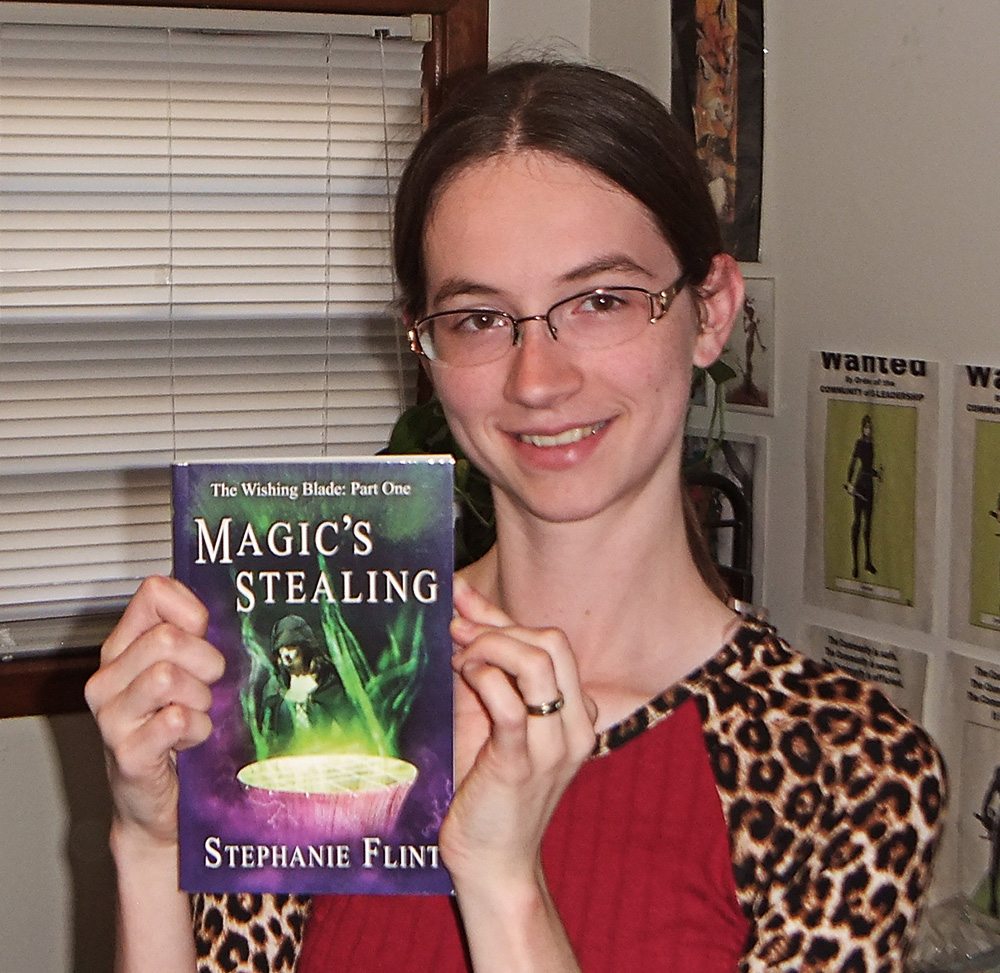
Today I’m going to interrupt my usual post with an announcement: I have received my paperback proof of Magic’s Stealing!

It came in a small, cardboard wrap (not quite a box, but not a bag, either), and was delivered to my front door. Upon opening the package, I took a few pictures. 😀

SBibb - MS Proof(( Please ignore the various HeroMachine pictures and cool artwork in the background… those aren’t our personal works (Though if you want a good way to organize the general look of your characters, HeroMachine is quite fun. There’s a whole row of pictures off the frame that we based on one of our campaigns). ))

SBibb---MSproof2

Fancy Title Page

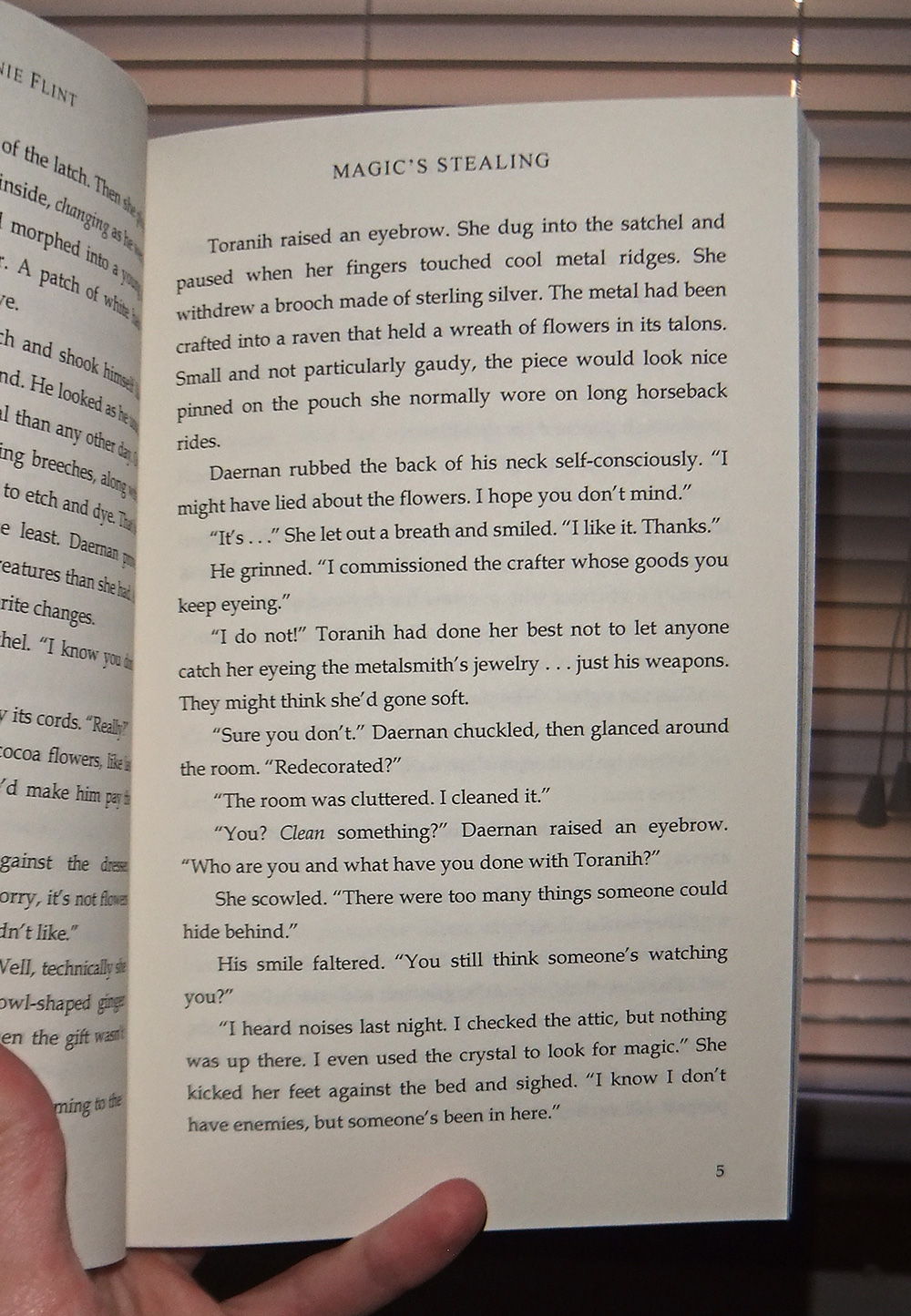
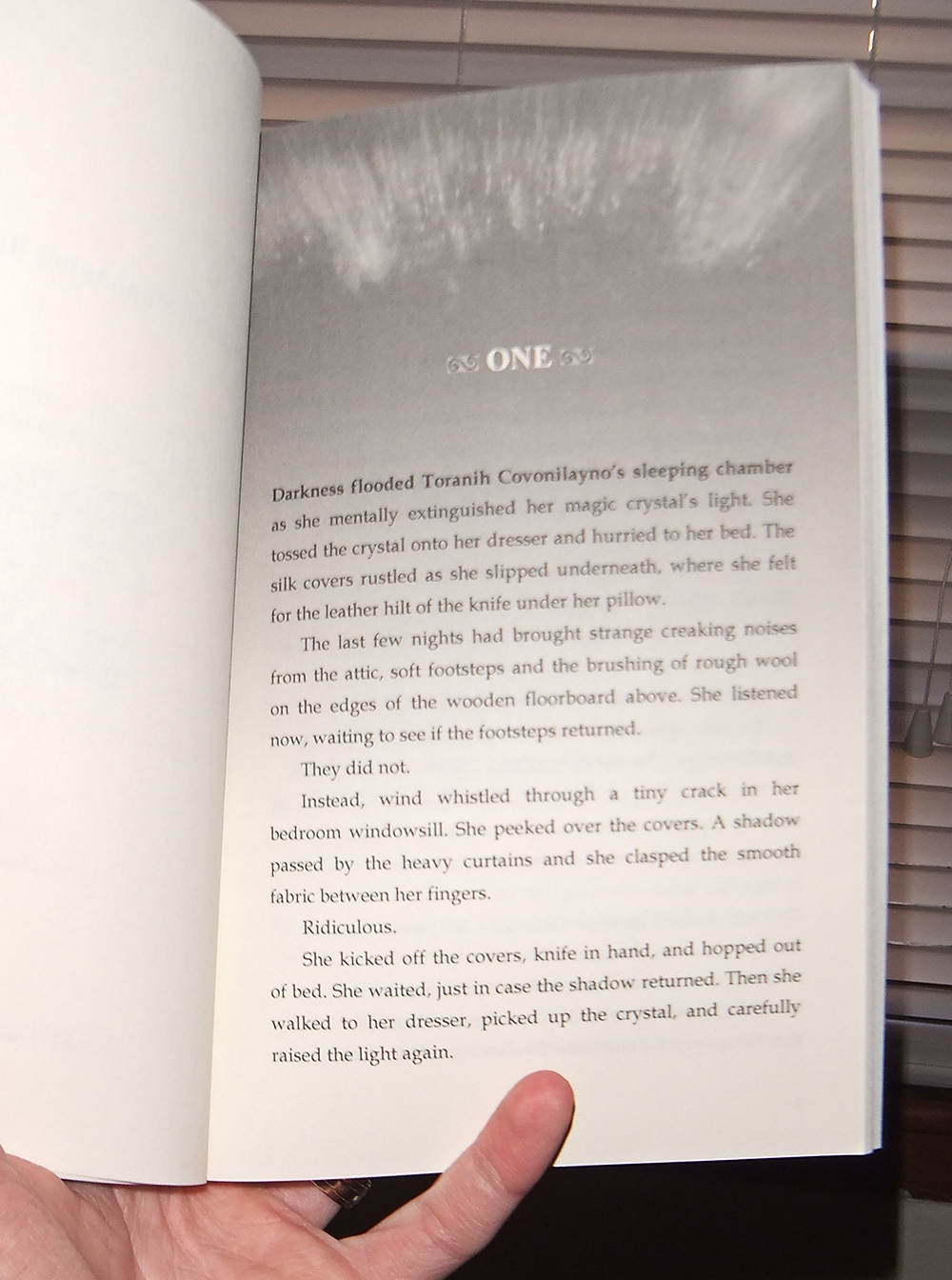
Anyway, this book has 158 pages of content, plus additional pages for the front and back matter, and it clocks in at 170 pages long. Here you can see the the title page (there’s a few pages before it), and further down this post are samples of a chapter page and a regular, full-text page. You can click the images to see them at a larger size.

I did all the formatting in Microsoft Word 2007, and I hope to do a post later on some of the fun tools you can use to add a professional touch to your books. Once I tested a few pages out on my printer for various fonts and sizes and line spacing, I saved this as a PDF, and checked it in the digital proofer on Createspace. Once that looked good, I ordered the print edition.

This particular book is 5.25 x 8 inches (based on a few of my favorite books with easy-to-read formatting), which uses the same dimensions as a 6 x 9, so the cover converted easily. Glossy cover and black-and-white, cream pages. I chose the “bleed” option so that I could use the full page image treatment (pulled from the background of the cover) for the chapter intros and title page.

SBibb---MSproof3

Page Full of Text

I did notice that the words got a tad bit close to the gutter, so that’s something I’ll have to keep in mind for future series, but it’s still readable. Of course, I also justified the text.

This is the end result, and I’m now reading through the book to make sure the formatting is correct before I release the print edition (Amazon only, for now).

I’ve found a couple typos, which I’ve made note of, but if those are all I find, I will most likely let those slide for now so that I don’t potentially mess up the formatting right before ordering a large number of books. If I find a large number of typos, I may go ahead and do the initial revision now.

Though that one I’ve found may keep pestering me…

I don’t know. Maybe I’ll order a second proof, that way I can be sure the formatting looks right and that there are as few errors in the print book as possible.

Anyway, regardless of what I choose to do, I plan to go back and revisit both the print and ebook editions at some point for typos, but I’m considering doing that all at once, when more typos have inevitably been found.

In the meantime, look forward to the paperback edition, coming soon! 😀

SBibb---MSproof4

Sorry, this photo got a little blurry…

I hope you’ve found this post helpful. 🙂

Have you had any experiences with proofing a print edition of your book? How do you decide when to update for typo corrections?


 SBibb --- MS Proof  SBibb---MSproof5 

6 Comments

Filed under Book Covers, Business Ventures, Writing

Thoughts on Publishing – Infinitas Publishing Status Report

All right, the time has come for another status report. 🙂

When Isaac and I first started Infinitas Publishing, we created an Excel file that listed our goals for releasing our books and games. Some of those are completely in the works (they haven’t yet been started), while others already have a fairly polished draft and just need editing.

Either way, I figured it would be a good idea to take a look at our current projects every once in a while and see how everything is going.

Here are the current projects:

The Wishing Blade: Magic’s Stealing -The ebook is now available and I’ve run our first giveaway via another author’s blog. I have finished formatting the interior file for the paperback edition, and I’m adding the final touches to the wrap-around book cover. I hope to order a proof copy in the next few days.

In the interests of time and money, Isaac and I chose to purchase the $10.00 custom ISBN at Createspace. It lets us list our imprint as the publisher, though we can only use that ISBN when printing through Createspace. Since it will be a while before we can try distributing the book through a site like Ingram Spark, we figured the printing restrictions should be worth it for the time being. At least this way we can have a print edition available (and through the money we saved by waiting to buy a universal block of ISBNs, we can now purchase a box of print books to sell and give away). I’ve also talked to a couple local book stores about stocking copies of the book, so we’ve started making headway there.

The Wishing Blade: The Shadow War – I haven’t made much progress here. I’ve got a partial rough draft from when I was writing Magic’s Stealing, and I’ve got some plotting in place (a few blog posts should be coming from that, too), but that’s about it. This is my next project after I finish editing the first half of Trials of Blood and Steel. Since I have the basic formatting in place from Magic’s Stealing, preparing the ebook and paperback editions shouldn’t take quite so long. We’re off-target on our planned time of this release, but we’ll see how the writing and edits go.

The Multiverse Chronicles: Trials of Blood and Steel – Isaac has finished writing the main plot, and he’s made quite a bit of headway on the “meanwhile” end scenes that go at the end of each episodes. Our plan is to polish the first thirteen episodes (of 28-ish? Haven’t divided all of them yet), and then begin releasing each episode. I’ve got twelve of those thirteen episodes edited, and after I finish episode thirteen, I’ll be editing the end scenes. Then I’ll run through the full thing one more time for continutity before doing a read-aloud with Isaac to make any further changes. Then I’ll proofread on paper, and afterwards we’ll start to release an episode a week.

I’ve begun setting up the Multiverse blog, but the main info still needs to be added, along with creating an episode guide and the main graphics. Due to the nature of this project, we’re considering holding off on beta readers, but otherwise, the first episodes should release on schedule.

Battle Decks: Trials of Blood and Steel – We’re currently on par with this project. We plan to read through our edits of the rules this weekend, and then we’ll be ordering a new proof copy with the edited cards. If everything looks good, we should be able to release on schedule. We still need to create a how-to video, but we’ll need the updated proof to complete that. If all goes well, this should be available in November.

SBibb’s Photographic Illustration – Not part of Infinitas Publishing, but still something I need to schedule (plus, it helps with the initial funding of the company). I have a few book covers to work on, so I’ll be doing those in order of due dates. This is one of the things I’ll be working on this weekend.

I hope you’ve found this post interesting. Once we have solidified release dates, I’ll make them public 🙂

4 Comments

Filed under Business Ventures, Writing

Thoughts on Publishing – The Excerpt at the Front of a Print Book

I’m in the process of creating a paperback edition of Magic’s Stealing. I’ve got most of the formatting complete, save for a couple blank pages, and I’m currently focusing on adding an excerpt at beginning of print book. The idea is that as soon as a potential reader opens the book, the first thing they see is a teaser that makes them want to read more (and encourages them to be patient if that scene takes time to reach).

Keep in mind, when a reader is browsing a book store or examining a book at an author’s table, they will likely look at the cover, then at the back cover blurb, then at the excerpt on the first page of the book. The goal is to draw them in more and more until they choose to buy the book.

This is how I ended up buying The Girl with the Iron Touch by Kady Cross (and ultimately loving it) at a Barnes and Noble. I’ve seen other books do the same. Adding the excerpt provides a teaser so that the reader knows what to expect.

(You might see another form of this on a hardcover book, but the excerpt may be on the back cover, usually something of action or intrigue, with the blurb inside the cover flaps).

Let’s take a look at Magic’s Stealing and see how this compares.

Back Cover Blurb:

For centuries, ribbons of magic have provided the kingdom of Cirena with light, healing, and protection. Then, in a span of minutes, those ribbons fly from their masters, stolen, save for the magic of a few chosen mages. One of these mages is Toranih, a young noblewoman who would rather have a sword in her hand than use her powers to heal or throw fireballs. As a result, her magic skills are lacking. But with former mages dying from magic withdrawal, and the looming threat of an army of shadows who are impervious to mortal weapons, she must either embrace the responsibilities of a mage or watch her home perish.

Whatever excerpt I choose, the excerpt should enhance the understanding of the content inside the book.

These were the two excerpts I’m considering:

First Excerpt

Toranih cast a glance toward the distant mountain and shivered. The closer they came, the more her unease grew. It wasn’t her usual dislike of magic. As close as they were now, the magic inside the forge glowed like a star. Yet the whole place was shrouded with a thick fog, a veil that kept the magic hidden from the distance.

She frowned.

She could almost see thin filaments weaving through the fog, like the shadows of strings from a poorly played puppet theatre. The filaments lashed out in different directions, disappearing as they touched bright, sunlit sky. She tilted her head and squinted, but the strings vanished altogether.

She shivered and returned to picking at the soft innards of her roll.

There was something different about that magic. Wild. Unsteady. Like a foal that hadn’t been broken, and might never be. The magic was curious, like a dark storm cloud spewing cracks of thunder and lightning when the rest of the land was gold.

Toranih shivered.

All this magic was bound to cause strange visions.

So why was she drawn to follow?

In this excerpt, we get a glimpse at shadow magic, a sense of eeriness, and a taste of the writing style. There is a also a question at the end, which would hopefully draw a reader’s attention. However, this scene doesn’t jibe with the back cover blurb. We have a mountain forge, shadowy, string-like magic, strange visions, and some kind of call to follow that magic. While the scene should be intriguing in itself, it doesn’t mesh well with the blurb.

Second Excerpt

Toranih could actually see faint ribbons in the distance, rising from their masters. The ribbons streamed into the sky, a dazzling array of colors, then fled east, away from the city in a glaring river.

She looked at the bowl again and blinked her eyes to clear the spots. She had to know what was going on. The liquid had gone milky-white, but if she could see what was happening . . .

She ran her fingers along the strings at the top of the water. One here, one there. The tips of her fingers tingled as lavender wisps flooded the bowl. The image swirled, faint. The mountain forge reappeared. The man held his sword fixed between both hands, raised to the sky. His feet were spread strong under his shoulders. Ribbons streamed to his sword from across the kingdom. The sword glowed bright and brighter, and as the screams outside died into a disjointed murmur, the sword faded and the image darkened.

The water was clear now, devoid of life.

Everyone’s magic had fled into the stranger’s sword.

First, this excerpt shows the ribbons mentioned in the blurb. Second, we see Toranih using magic (which conflicts with her dislike of magic, but the blurb does say she must embrace the responsibilities of being a mage). Third, we see a bit about the antagonist. Fourth, we see the event that the blurb mentions, and the end of the excerpt sets the problem up further.

Ultimately, I’m thinking the second excerpt is a lot stronger as a potential hook, especially when paired with the back cover blurb.

I hope you find this post helpful. 🙂 Have you considered adding an excerpt to the front of your book?

Leave a comment

Filed under Business Ventures, Writing

Thoughts on Publishing – Starting a Publishing Imprint

A couple days ago I was talking with an author friend, and they asked about the process of how my husband and I started Infinitas Publishing. I typed up a response, then realized that other people might also find this information useful. So here it is… the basics of how my husband and I started a business.

IMPORTANT: I am not a lawyer nor am I certified in taxes, so please do not take this as legal advice. These are just my experiences thus far, and are meant to be useful in figuring out what steps you may need to take.

Also note that this process varies depending on your location and the kind of business you want to start. This particular post is tailored to my experiences starting a publishing imprint in Missouri, in the United States of America. (Business law varies from state to state).

Choosing a Name

First off, my husband and I chose the name of our business. We chose Infinitas Publishing. We did a Google and Bing search, since the results are different, to see if there was anything too similar to the name already.

We found a few similar names, but we decided that our specific product (speculative fiction and games) and branding was different enough that the two companies wouldn’t easily be confused.

Once we found that we were in the clear for general terms, we did a trademark search. Since trademark law tends to be a pain and I still don’t feel like I have a good grasp on it, I figured we’d be best off avoiding anything too close to something that already existed.

As a side note, if the trademarks can’t easily be mistaken for each other, and they involve unrelated products, they should be free for use. (For example, if two trademark names were similar, but one related to a brand of vacuums and the other to a doggy day care. Completely different uses, so the companies can have similar trademarks.)

As an example, at one point Isaac and I called Battle Decks “Beastie Wars”… only to discover that “Beast Wars” was already in use by Transformers. Since both products involve entertainment and games, we decided to steer clear of the name. Not only that, but renaming the game Battle Decks gives us more versatility in future game expansions… never mind that there’s a PowerPoint slide competition of the same name. The game and event shouldn’t be easily be mistaken, however, so that shouldn’t cause any mix-ups.

To look up a trademark, I used the Basic Search Database (Under TESS, click “Search Trademark Database”), and told it to search “all” words.

Fictitious Name Registration / DBA
After we chose the name, we registered for a fictitious name / Doing Business As (DBA) license. For Missouri, this cost $7.00 and lasts for five years (which reminds me that I’ll need to renew my SBibb’s Photographic Illustration DBA soon). This allows you to legally use the business name instead of your own.

Determine the Business Type
You also need to decide what kind of business you’re starting. There are four major structures, including Corporations, but a Sole-proprietorship, Partnership, and Limited Liability Corporation (LLC) are the ones you’re most likely to run into at this stage.

Nolo has some great information in regards to business practices.

An LLC has the benefit of protecting your personal assets in the event of a lawsuit, but it does have a higher start-up cost. There are also certain tax benefits, and the salary structure is different but I’m not as familiar with this business structure, so I can’t say what those benefits are off the top of my head. If you are if you are publishing multiple authors or publishing materials that could result in a lawsuit, you may want to go the route of an LLC.

EDIT: Check out Raistlin212’s comments below for a better explanation of the benefits of the LLC business structure.

A sole-proprietorship is by far the easiest business to start, as all money coming into the business flows directly to you. Technically, once you have the DBA and EIN, you have the basics you need to start the business online. (This is the structure I use for SBibb’s Photographic Illustration).

A partnership is like a sole-proprietorship, except you have multiple people involved and there’s an extra form you need to fill out for income taxes (Form 1065 and the resulting K-1, which I’m not looking forward to figuring out next year, but I know a couple people I can ask for assistance). This is the structure my husband and I chose for Infinitas Publishing.

Employer Identification Number (EIN)
Once you have the DBA, you can apply for an EIN (Employer Identification Number) through the IRS (so many acronyms, I know). This number is handy because it identifies your business on tax forms. The EIN is registered on the federal level. You apply online and you get the number immediately upon completing the form. Doesn’t cost anything either, and you have a different number for each business (Infinitas Publishing has a different EIN than SBibb’s Photographic Illustration).

If you have any questions about filling out the form, your local bank may be able to help. I had a bit of trouble trying to call the IRS help line (I felt like I was playing a Choose Your Own Adventure game, phone style), but the people at the bank were able to answer my questions in regards to start dates and such.

If you are doing freelance work, having this number is nice because it gives you a number to give contractors for the Form 1099-Misc without having to give them your social security number.

Business Bank Account
It is usually recommended that you have a separate banking account for your business to keep your income and expenses organized. This may especially be helpful if you’re ever asked to produce records for tax purposes.

Check with your bank to see what they require to start an account. I went to US Bank, since I was familiar with them and they had a basic package that suited our needs and wouldn’t cost us money to use. This was important since we didn’t expect a high inflow of money to start with. For a partnership, our local branch required a General Partnership Agreement (an LLC needed an Operating Agreement). They also needed the EIN, and I think they needed proof of the registered DBA. It took a couple weeks for this to show up in their system, so be sure to plan ample time between getting everything registered and actually starting the business.

If you need assistance with the General Partnership Agreement or Operating Agreement, there are several sites online that offer free templates. Once you find a suitable template, you can tweak it to fit your needs.

If nothing else, this agreement acts as a guide to each partner’s responsibilities in the case of misunderstandings or if anything gets rough. Now, if you want to be sure that everything is legally correct, you may want to hire a lawyer to look over your forms.

Since Infinitas Publishing is between my husband and I, we didn’t do this, though we did make sure that we understood everything in our agreement and that it suited our needs.

For SBibb’s Photographic Illustration, I don’t use a separate bank account. Due to the nature of my work, I have very few expenses that I apply to that business. However, I do keep a ledger of all income, and it is still advisable to have a separate account, even if you’re a sole-proprietor.

Online Payments
Once the business bank account was set up, I created a business Paypal account and input the new information into my Kindle, Createspace, Smashwords, and The Game Crafter settings. Now when we receive royalty payments or purchase proofs, they’ll be linked to the business, rather than our personal accounts.

Smashwords Publisher Account
Smashwords has a “publisher” account option, which I upgraded to so that my works would show up as published by Infinitas Publishing. Then I created “ghost” author accounts for my Stephanie Flint and Stephanie Bibb names, and I’ll add Isaac’s name once we start publishing our co-authored works.

Sales Tax
Our next step will be to fill out the Missouri Sales Tax form. During the time that we only had ebooks, we didn’t need to worry about sales tax, but once we get print books made, which we plan to offer to bookstores and try selling at a local holiday market, we’ll need to collect Missouri sales tax.

As a side note, I’m not sure about what differences we’ll see when I get to selling wholesale (to bookstores) versus retail (holiday market). I’m still researching this, so I’m a bit sketchy on this. However, when emailing the Missouri Department of Revenue, I’ve been able to get some very helpful information on what forms we’ll need to fill out (Form 2643 and 53-1), along with details about the form.

Give yourself a bit of time to get through it all, but definitely ask if you have questions.

Important: Check with whichever state(s) you’re doing business in, because the requirements vary.

Final Notes
Of course, all of this information is for if you plan to self-publish rather than seek representation through a trade publisher. Be sure to research both sides thoroughly, as there are pros and cons to each.

Granted, this doesn’t even cover creating a logo, a website, buying ISBNs, approaching book stores, and everything else I’ve forgotten at this point. But hopefully it will give you a starting point, and maybe I’ll talk about the “branding” and marketing side of things at a later date.

Also, If you’re curious to read more about the business side of publishing, take a look at Kristine Kathryn Rusch’s “Freelancer’s Survival Guide.”

I picked up a copy through a StoryBundle offer, and while I’m still in the process, it has been immensely helpful in considering what steps to take to start the business. Plus, some of the articles are on her website for free, so you can read through whichever ones you need. 🙂

I hope you find this post useful. Do you have any tips for starting a publishing business?

***

By the way, Carissa Taylor was awesome and agreed to host a give-away of one free, ebook copy of Magic’s Stealing, so if you’re interested in winning a copy, head over to her blog.

She also has some really useful information on Twitter pitching and a list of literary agencies that accept YA science fiction and fantasy, so be sure to check those out as well. 😀

10 Comments

Filed under Business Ventures, Writing