
There are a bunch of powers in the Distant Horizon Universe, and at some point I’ll go into detail about all 40-something powers that Isaac and I listed for use in the original role-playing campaign that we played, with each power divided between one of four categories: Mental, Physical, Reality Shift, and Elemental.
Today I want to focus on the “elemental” category, and in specific, the “life-spirit” power.
The life part is easy. A life-spirit elemental typically has healing abilities and can sense the presence of living beings around them.
Here’s an example from Distant Horizon, with a character who uses a combination of healing and telepathy to do her work (slightly edited to avoid spoilers):
I rested my elbow on my knee as Gwen moved to treating Lance. It’ll be okay, I wanted to tell him, but I couldn’t. I didn’t know how much this elderly woman could help us.Over the next half hour, the bruises cleared from Lance’s face and the deep scratches turned to faint scars. Finally, Gwen leaned against the wall and rubbed her eyes.
Lance rotated his shoulder as if he’d never been wounded. “What’d’ya do?”
“My power is in healing: the ability to save or suspend lives.” She rubbed her forehead gingerly, then looked at me. “It’s your turn. I won’t go deep in your thoughts; I just use telepathy to find the damage.”
I swallowed hard, then felt something else—be there. She was present, searching across my mind, but she wasn’t intrusive. Each memory was tucked away, as if it’d come unbidden, and her presence was friendly. When she did find pain, the memory flashed to the surface and vanished as quickly.
I tried to focus on memories I didn’t mind her seeing, drowsy as she soothed the grazed shoulder and eased the bruises.
However, when it comes to the “spirit” side, that’s when the details get trickier. Life-spirit elementals can “suspend” lives, partially removing a person’s spirit and causing them to go unconscious, or even remove a person’s spirit completely, killing them in the process.
An example from Whispers in the Code:
“Have the Legion Spore remove her spirit,” Commander Rick says, “then dispose of the corpse.”
My throat constricts. I know that it isn’t practical to keep the scout around, but there’s still something unsettling about the idea of having just been in the mind of someone about to die. “Dispose?”
“The Legion Spore needs nutrients and, this way, there will be no evidence for the Oriental Alliance to find,” Commander Rick explains.
What he leaves unspoken sends shivers down my neck. “You want it” —I swallow hard— “to eat her?”
Commander Rick glances at me, and his cocked eyebrows indicates that he understands I’m not ready to give that command. I know he’s right. The process is efficient, but the idea doesn’t settle in my stomach.
Legion Spore, remove her spirit, he sends.
Her head lolls. I detect one less presence of life through the vessel’s scanners.
Legion Spore—consume the remaining body for sustaining nutrients.
Dozens of tiny, translucent tendrils extend from the ivory floor, wrapping around her body. They flatten against her arms and chest and her skin dissolves, revealing the muscle and bone beneath. The body melts away. I force myself to watch, despite the terror creeping through every pore of my skin.
Within a minute, she’s gone.
On the farthest extreme, a life-spirit elemental can bind their spirit (or someone else’s) to an artifact, separate from a body, and thus allow a person to live on as a spirit, rather than die. It’s a tricky process, and not easily achieved.
But a few notorious figures have succeeded. Benjamin (the enthusiastic alchemist we see in the Glitch saga, and who has a cameo in Distant Horizon) is one such spirit.
Another scene from Whispers in the Code (again, slightly edited to avoid spoilers):
Benjamin’s sharp features glow a faint blue. His crisp sleeves are rolled past his elbows, and he wears a work apron over his shirt. His pockets are filled with small tools that may or may not be apparition. He’s odd like that. Sometimes he only manifests the appearance of a craftsman, while at other times, the tools are actually present.Most noticeable, however, are his wire frame spectacles, green eyes, and his spiky, dark red hair, their colors prominent even with the lack of color across the rest of his translucent body. He’s also got a slightly mad gleam in his eye, though my encounters with the man suggest he’s mostly sane.
Benjamin grins and soundlessly claps his hands. Wonderful! Shall I take amber or emerald? His thoughts echo in my head with the determined curiosity that his voice might have held in life.
The upside of being a spirit is having additional powers. Once a person becomes a spirit, they automatically gain access to telepathy, life-spirit powers (because that’s how they sustain themselves), telekinesis, and to some extent, enhanced insight. However, it still takes them time for them to learn how to use their new powers to interact with the world, and even to manifest, unless they’ve had practice with such powers in their former life.
There are a few downsides to being a spirit, though.
First, they’re attached to an artifact. If their artifact gets destroyed, they die. Also, radiation, life-spirit powers, and electricity become much more damaging. “Shielding,” which temporarily shuts down powers, is especially devastating, since a spirit can’t manifest without access to their powers.
Still, it’s a trade-off some characters are willing to take, and one we see to an extent in Fractured Skies, and definitely becomes more of an issue in the Starless Night.
What do you think? Would you want to be a life-spirit elemental in that universe?
(Bonus: Life-spirit elementals also tend to have a natural bonus against telepaths and those with enhanced charisma!)
* * *
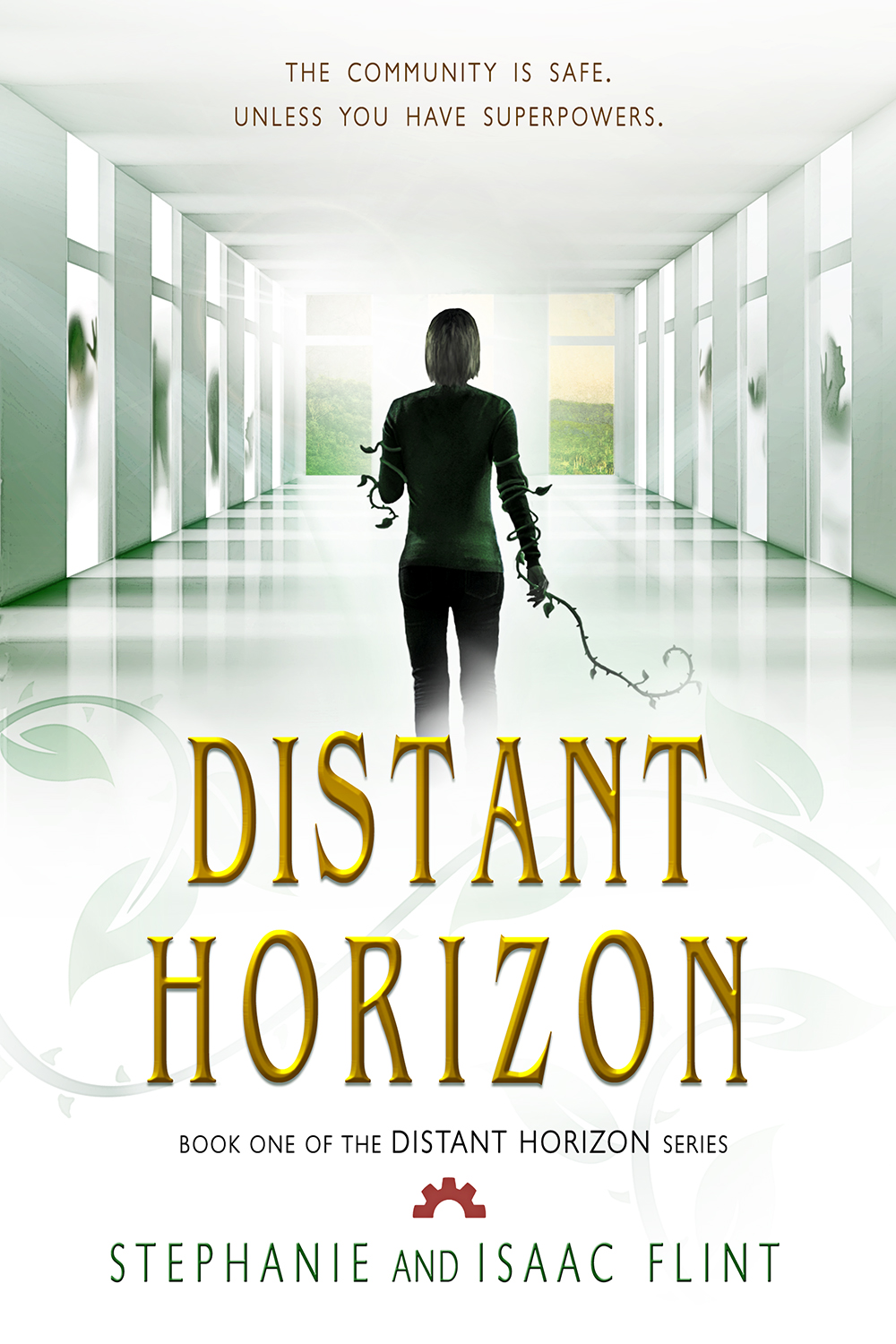
Life-spirit powers play a huge role in the Distant Horizon and Glitch series.
And if you don’t mind diving right into the action, Whispers in the Code is free at most online ebook retailers!


* * *
Happy reading and writing!




 Stephanie Flint - Author and Artist