Tag Archives: point of view

Memory Seeds

A couple weeks ago I posted “When Two Books Share the Same Scene,” and I referenced the concept of “memory seeds.”

Let’s go deeper!

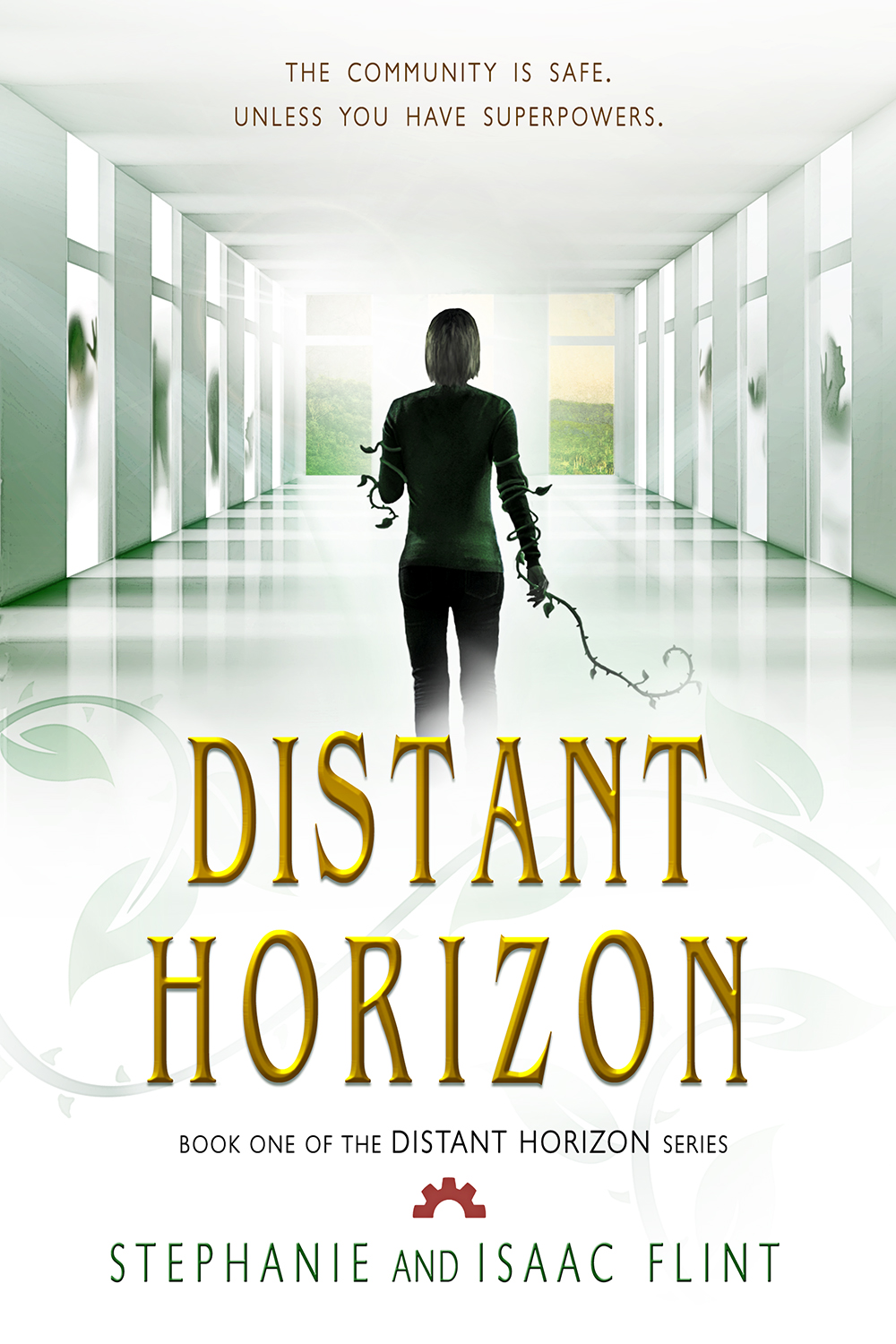
In the world of Distant Horizon, telepathy is one of the strongest and most dangerous powers a person can have. While it’s generally used to read minds and emotions, telepathy can also be used to implant ideas in a person’s thoughts and, at its most powerful, possess them.

(Tim is very much not a fan of this when he starts dealing with the second Legion Spore in Spirits of a Glitch, and he first gets an idea of how the implanted memories work in Ghost of a Memory).

Lots of fun for me as the author, not so much fun for my characters.

However, a few telepaths, including Lady Winters (the insidious “Brainmaster,” but don’t let her catch you calling her that), know how to plant so-called “memory seeds.” Rather than having to be present when they attack, a telepath leaves a set of (usually) false memories inside their victim’s mind that are set to activate under certain conditions.

In Jenna’s case, Lady Winters inserts memories of Jenna being transformed into a sub-human beast, though she’s never actually been in a beastie tank.

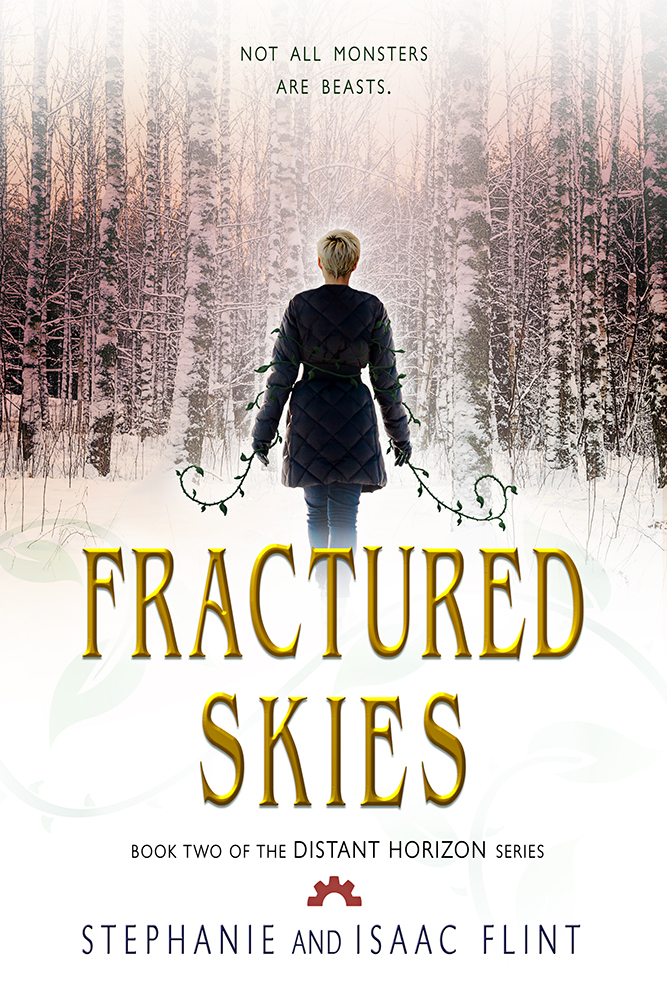
Here’s a look at a scene in Fractured Skies where she’s attempting to confront the seed with Gwen, one of the rebel telepaths:

Are you ready?

I swallowed hard… or imagined I did… and nodded. Let’s get this over with.

She raised her hands to the black ceiling above us. The blackness grew lighter, shifting into green. Gwen faded into the darkness. Green liquid crashed over my head.

I was trapped in the glass tube of a beastie tank.

Thick bubbles shimmered around me as I flailed, screaming. The burning liquid, the deadened sensation of my hands and feet—I shook my head and begged to get out, but my words were lost in the breathing mask strapped over my mouth.

Look around you. This isn’t real. Wasn’t real? What wasn’t real? I pounded my fists against the glass. “Let me out!”

Look beyond the glass. What should you see?

I took a gasping breath. Beyond the glass I couldn’t see anything…

That was the problem. I should have been able to see something. A shadow of movement, the smooth structures of other tubes. Those images slowly formed in front of me… but not because my eyes had adjusted.

Recognizing that your surroundings aren’t what they are supposed to be allows you to take the first step in controlling your situation.

That voice… Gwen!

Over time the memories get worse, with the idea that the next time Jenna confronts her, Lady Winters could easily use the memory seeds to disable her in a fight.

This happens and, in a later confrontation, Lady Winters adds the memory of the Legion Spore’s transformation. With the latter seed, simply hearing the Legion Spore’s telepathic voices can trigger the memory, but crowded spaces (claustrophobia from being inside the transforming Legion Spore) can also cause the seeds to strike.

Ideally, another telepath would be able to remove them, which is what Gwen tries to do at first. But when you’re dealing with someone as strong as Lady Winters, removing the seeds can be a challenge, especially when traps have been laid to keep them from being removed.

Memory seeds aren’t the only trick telepaths can use to manipulate others, and once we get to Fractured Skies, Jenna learns that the seeds in her head may be a bit more complex than the average seed.

And once we get to Starless Night, well, the enemy she’s fighting might be herself…

* * *

Who can Jenna trust when she can’t trust her own mind and memories?

* * *

Happy reading and writing!

1 Comment

Filed under Writing

When Two Books Share the Same Scene

Hi there! Today I’m going to be talking about tackling two points of view of the same scene in different books. But there are going to be some spoilers regarding the Distant Horizon Universe. They’ll be minor, but if you’re trying to avoid spoilers, go read the books first, then come back after!

Still here?

Cool.

There are several scenes in Fractured Skies (Distant Horizon #2) that reference events in the Glitch Saga.

While the Glitch Saga (Glitch #1-3) follows Tim’s point of view within the Camaraderie, the Distant Horizon series follows Jenna’s point of view with the Coalition rebels.

At times, these scenes directly overlap.

For example, in Ghost of a Memory (Glitch #2), there’s a scene where Tim first takes the Legion Spore to attack the OA training base in Japan:

Master Zaytsev, we are required to alert you to a small, unidentified vessel leaving the area.

“Insignificant,” I murmur. We need to fix this glitch, not apprehend ships.

Master Zaytsev… The voices are curious. She has our memories.

I frown and bring the revolving set of images onto the main screen. Mechs. Helicopters… There’s a small firefight in the distant region, but most of the people on the ground now are Special Forces.

We are legion, it calls mentally, and I almost swear it’s happy. Then I see the fast fleeing vessel.

“Zoom in.” Nothing happens. I bite my cheek. “Legion Spore?”

No response.

I type the command, and one of the Legion Spore’s eyes shift and focus until they reveal a small, black car flying into the distance. My chest tightens as I manually scan the ground for signs of the rebels. I don’t see anyone, so maybe they escaped. “What were the memories?”

Not her own. Disappointment. Stolen memories, used to cause pain. Are we a device for pain, Master Zaytsev?

Long story short, there’s some behind-the-scenes information that Tim doesn’t have in regards to those memories the Legion Spore saw. During an earlier mission, Jenna fell victim to a telepathic attack that left “memory seeds” in her head, seeds which attempt to weaken the victim’s mind.

Jenna is all too familiar with the problem these seeds can cause, and the memories—painful images of being transformed into a beast and the Legion Spore—tend to attack at the worst times. Such as right in the middle of a mission.

In Fractured Skies, she’s at the same base when Tim brings the Legion Spore there to attack, and her view of what’s happening is a little bit different:

We are legion. Telepathic voices, overlapping but discordant, boomed in my head, overshadowing every other thought. I clapped my hands over my ears, trying to plug out the sound, but that didn’t stop the wave of pain rolling through my skull. So many voices, so much pain…

I gasped, my eyes watering. Pain. I knew exactly what this was. The numerous voices and the sense of being one unit… “The Legion Spore,” I whispered. Chills ran down my spine. My body shook, all of my muscles feeling loose and scattered, as if there was nothing else around me but so many creatures, beastie and human, their bones knitting with metal. Their skin stretching to form a hull. A loss of sight, our vision was black, and all there could be was a terrible, hot, burning pain. We gritted our teeth, strained against our binds. The noise… that beating, beating pulse of hearts merging with clicking gears and digital clocks. Winding, binding, whimpering, crying…

“Jenna!”

 We struggled against the metal grid. It held us tight. The bindings, the wires were part of our bone, part of our new skeleton, and radiation… terrible radiation unified us, our new sight—our powers, together, a legion of souls—

“Jenna! Listen to me!”

Listening. Commands… commands… Her senses, same as us. Her memories are ours… She is part of us. Meant to be part of us. She could complete us. Join us; we are legion…

“Jenna! Damn it, I need her to see me!” A firm hand gripped my chin and forced me to look into brown eyes—

Brown eyes… Lance’s eyes were green. Whose were these?

 “She’s responding,” the face said. Slowly it came into focus, and I finally saw Quin, not the horrible visions. Cold sweat covered my aching body.

“Can we go invisible yet? I think we’re out of range, but still—” A fuzzy-looking Inese turned in the driver’s seat, looking back.

“Not yet. Let’s be sure we have her.” Quin held my chin tight so I couldn’t look away. “Can you hear me?”

I swallowed hard. My throat burned as if it was raw. “Yeah,” I whispered.

“Do you remember anything?”

“Yes.” I stared at his face. I should have been able to escape the memories. But how could I use Gwen’s teachings if I didn’t know it was a memory? It felt real, like only part of it was a memory, but part of it was new.

“What happened?” Quin released my chin and I looked around me. The base was out of sight and, thank the Community, so was the horrible vessel.

“A memory seed,” I said. “The creation of the Legion Spore. One of Lady Winters’ attacks.”

Quin frowned, his eyebrows quirked with worry. “You were saying ‘We are legion.’ ”


So there you have it!

A look at what was going on in Jenna’s mind when the Legion Spore spots the fleeing rebels.

This scene was fairly easy to match up, because we really don’t see a whole lot of overlap.

I think this might be the easiest way to work with multiple perspectives, because, while the larger event is the same, there’s not a whole lot of interaction.

In one of my other projects, I’m working on an alternate perspective for The Wind Mage and the Wolf, and there’s an entire scene of dialogue and action that overlap.

That one has been proving trickier, since I need to make sure that everything still happens the same, in the same order, and makes logical sense without contradicting the other.

For that one, I wrote the majority of the story, and left the overlapping scene for last. My current method for trying to bring them together is to strip out the fluff from the original scene, making note of what the POV character in the new story would see, and then rewriting the rest of the details from his point of view.

It’s tricky, but neat to play with different perspectives.

* * *

Two sides of the same war…

* * *

Happy reading and writing!

2 Comments

Filed under Writing

Thoughts on Writing – The Omniscient POV

For most of the stories I’ve written, I prefer a deep point of view. I like being right next to the character, getting their thoughts and feelings as they see it. Most of the time I choose either first person (Distant Horizon and Glitch), or close third (Magic’s Stealing and The Little One). While I might swap point of view characters between scenes, those scenes stay distinctly in one person’s head.

And then I started working on The Multiverse Chronicles.

The Multiverse Chronicles is pseudo-steampunk fantasy that consists of a series of short episodes (each around 1,000 to 2,000 words long) that will posted weekly on a blog dedicated to the series. My husband, Isaac, writes the rough draft, which I edit.

At first, editing an omniscient point of view drove me nuts. I wanted one person to follow, and I wanted to stay with that person. (This despite toying with the omniscient POV in The Little One, where one of the characters is a fourthwalling telepath). All of those rules about not head-hopping? They kept poking me while I tried to edit. But once I finished editing the first episode, I tentatively took it to the writing group we attend. To my surprise, they didn’t have a problem with the point of view.

Okay, cool. So I just need to keep up whatever we did with the first episode, right?

I started work on the next episode. I initially wrote with the expectation that I was writing from the bodyguard’s point of view, but then I realized she wouldn’t see the scene in the way we’d written it. In this particular episode, the bodyguard is grudgingly attending a ball in which the man she loves is about to be formally engaged to a snobby princess who looks down at her.

But what I’d embellished focused on the splendor of the ball… not the dark side of the festivities.

Let’s take a look at the current (rough) intro for this episode:

The grand hall of Britannia’s castle was adorned with ornate, stained-glass lanterns. Their yellow arc lights depicted the glorious reign of the Dragon Dynasty across the cream-colored wallpaper. Flickering images of gold and crimson dragons danced among pink-tinted clouds at sunrise. Further down the grand hall, these lanterns revealed the proud history of Britannia. The first Dragon Queen sent her dragons to battle an unkempt hoard of miscreants, and later, she stood with her proud chin high as she morphed into the form of a glistening dragon, uniting her subjects into an unshakable empire for the past two-and-a-half centuries.


Beneath the lanterns, diplomats from across the continent mingled, tipping crystal goblets at each other with brilliant smiles as they eagerly awaited the announcement from the current Dragon Queen, Queen Catherine V.

Not exactly the reaction I’d expect from a scorned bodyguard.

However, it did match the mood of the queen, who is pleased with the arrangement of her daughter to the prince.

Suddenly, it made sense. I needed to write part of this scene from the perspective of the queen. Because we’re writing this in omniscient, I could bring in her point of view, even in the same scene, allowing us to see the contrast between the two characters and sense the rising tension.

For example, compare the queen’s thoughts about the bodyguard with the bodyguard’s thoughts about the royalty:

The queen had to admit that the prince was bit relaxed, slacking on the formalities she’d worked so hard to instill into her daughter. But he would come around, just as her Ramón had.


Her telepaths had assured her that the prince was faithful, even if his doting bodyguard was something of a slob. She rapped her fingers on the armrest’s dragon head, exhaled in time with the methodical orchestra, and returned her attention to the guests.

Now, for the bodyguard:

“Indeed, this has been a marvelous party, fit for the First Queen, and now, for my daughter.” The queen cast a loving gaze to Princess Cassandra, who beamed with pride.


As if she was ever anything but prideful.


Alia kept her face blank, but her cheeks burned at the thought of that snooty, high-horsed princess being anywhere near Alfons.


Not that there was anything she could do about it.


“Over these past months,” the queen continued, “I have been thrilled with the courtliness of Prince Alfons, crown prince of the house of Egilhard, who has treated my daughter with the utmost respect that can be expected from a man of his station.”


Because anyone who isn’t raised like some prude isn’t expected to be respectful, right? Alia clenched and unclenched her fists, but Alfons was too busy fawning over his princess to notice the queen’s slight.

Neither queen nor bodyguard like each other. Since we’re in an omniscient point of view, we get to see inside the heads of both characters.

The question I pondered, then, was how to make sure the transition was smooth. The danger of omniscience is head-hopping, a disorienting feeling of being thrown from one person’s point of view to another.

In order to avoid that problem, I decided to make sure that whenever a transition occurs, that transition must be clear. Our focus subtly shifts to the new character with a few cues, such as naming the character and quickly getting into their thoughts with a thought that is clearly not the thought of the former character.

As I considered the topic, I realized we could model this concept after movies and TV shows. Different camera shots let us see what different characters are up to, even in the same scene. (Off the top of my head, I’m thinking of Agents of SHIELD and Once Upon A Time). Without leaving the scene, the camera subtly pans to a character with an ulterior motive. We see their reaction, whether it be a malicious smile or a sad lowering of the eyes. We don’t hop heads, but we do switch point of view.

Let’s take a look at the current draft of The Multiverse Chronicles, in which the point of view switches from the queen to the bodyguard.

The queen’s telepaths had assured her that the prince was faithful, even if his doting bodyguard was something of a slob. She rapped her fingers on the armrest’s dragon head, exhaled in time with the methodical orchestra, and returned her attention to the guests.


Amongst the rigid guards and the pristine diplomats, amongst the proper dukes and the swirling, bejeweled duchesses who danced at their side, stood a lone, blue-uniformed soldier.


Alia Behringer, the prince’s favorite bodyguard. She was tall, especially among this crowd, with wheat blond hair and a lean, muscled body.


Alia cast a furtive glance toward the Dragon Queen, caught her glower, and looked away. She remained stoic as the redcoats, but unlike her counterparts, her blue-eyed gaze returned to the prince.


He was her charge, and she would defend him with her life.


She avoided the queen’s heavy gaze and gave her attention to the prince. Months ago he would have been joking at her side, not perched on miss high-and-mighty’s ‘graceful, endearing, and oh-so-lovely’ arm.

This scene could still use some tightening in terms of point of view, but we can see the switch from the queen to the bodyguard. The queen focuses on the bodyguard, we get a bit of information about her, and then we start seeing her thoughts, things she would know but the queen wouldn’t. Calling the guards redcoats, for example, or noting that she would defend the prince with her life, or how she calls the princess ‘high-and-mighty.’

The queen would not think in these terms.

The Multiverse Chronicles is still very much a work in progress. But the beginnings of the omniscient point of view is there, slowly unraveling itself and making itself useful.

I’ve tried taking cues from other books that feature an omniscient point of view (Ray Bradbury’s Something Wicked This Way Comes, for example) but I’ll admit, I haven’t read many stories with an omniscient POV that I remember, though I know I’ve read them.

I hope you enjoyed this post. Have you had much experience in reading or writing omniscient points of view? 🙂

Further reading I found on the subject:

http://io9.com/5924661/how-to-write-an-omniscient-narrator-if-youre-not-actually-omniscient-yourself (A really nice explanation of omniscient narration, and how to make it work)

http://www.scribophile.com/academy/using-third-person-omniscient-pov (Explains the difference between subjective and objective narrators, and potential pitfalls with an omniscient point of view)

4 Comments

Filed under Writing

Do your characters pass judgement?

Today I have another writing-related post. Do your characters pass judgement?

It’s something I’ve seen blogged about in regards to point-of-view, and it also has quite a bit to do with showing. Your characters, as you write them (especially whichever character is leading the scene), pass judgment on everything they see or hear. This may be good, or it may be bad. It’s how they view the world, and it shows their attitude and voice. For example, take the small bit of scene from the manuscript I’m currently working on (Glitch).

Val pushes a plate of ham and eggs in front of me. She polished hers off a good while ago, as if she has already forgotten yesterday’s concerns. “When’s the last time you ate?”
I’m not sure. Maybe that’s why my head feels fuzzy. I push the plate aside and go for a bowl of applesauce. Though the chunky apples are practical, they taste far more extravagant than anything the Community… or the Coalition… would serve. I check the recipe in the database: cinnamon, chili powder, nutmeg.
I’d be happy with sugar.

If I’ve done my work right, the scene should give you a few clues into the main character’s personality: a bit more down-to-earth (going for practicality), curiosity (he checks the database for something as simple as a recipe), and to some degree, simplicity (being happy with just sugar, and not the other spices). When you look at the scene on the whole, he’s passing judgment on the applesauce… even though it might not be something we’d normally thinking of passing judgement on. It’s not meant that he’s being negative, only that we see it from his point of view.

Now, for a bit more obvious of a scene passing judgement:

The door opens to a bright, tall room. I breathe sharply. The Legion Spore is ugly. There’s something awkward about the mess of tentacles dangling beneath the Legion Spore’s fleshy, bulbous body, though I’m drawn to the thin membrane of its air sac. Pink fins softly ripple, glowing under the blue light.

Short, since the rest would be confusing out of context, but the main character is being introduced to the vessel he’s going to be piloting, which is a monster in its own right. While it’s supposed to be ugly, like he says, it’s also supposed to be impressive. Now, both these scenes are still in draft-phase, so I may end up changing them or omitting sections altogether, but the idea is there. The main character passes judgement. ‘Awkward’ and ‘mess’ are both negative descriptors, while the softly rippling fins are meant to be positive.

These may just be my own meanderings I’ve been considering, but feel free to share your thoughts. Have you noticed your characters passing judgment? Are the scenes in which they do more prone to being “showing” rather than “telling?” What are your thoughts?

Leave a comment

Filed under Personal Work, Writing