Tag Archives: writing tips

Thoughts on Writing- Developing a Fictional Language

A while back, I wrote a post about creating a fantasy language. Today, as I’m continuing to plot for The Wishing Blade series, I want to expand on that idea. What things should we consider when developing a fictional language?

I’d say part of that depends on the purpose of the language. If you’re only going to have it show in one or two scenes, a word here or there, you might only need to create those few words and consider how it sounds regarding the culture of the people who use it.

If, on the other hand, you plan to write whole paragraphs in it, have miscommunication issues (or spells that backfire–as with the Cantingen word magic in The Wishing Blade series), or use it explain part of the culture or mythology, you might want to go a little more in detail in regards to how the language functions, even if your reader never sees most of it.

I’ve been skimming through articles, trying to get an idea of things to keep an eye out for, and this article in particular has some great suggestions as to what sort of things to keep in mind when creating a language. Things such as the range of sounds your language has, how words are stressed, and how to change words from present to past tense.

I already know that I’m not going to have a perfect fictional language and there are going to be imperfections. But, having a set of rules that are relatively easy to follow, as well as a dictionary of sorts, should help to alleviate that problem.

Starting out, I took all the phrases I’d already written for the first book and broke them apart, figuring out what each word was and entering that into an Excel file. (As a side note, I just discovered that it will sometimes enter suffixes for you if you have the same word ending row after row in the same column–conjugation got faster!) Then I considered common words that I might run into: colors, directions, verbs, nouns, elements…

Once I had a general list, I started double checking to make sure none of them had the exact same sound (since word magic is based on pronunciation), and that words that have the same sounds have the same spelling, so I could picture it correctly.

For example, I wrote out the cardinal direction and created versions for both Cantingen and Cirenan words:

English || {Cantingen} || Cirenan
North || {Chudé} || Chud
East || {Nuré} || Nur
South || {Sidé} || Sid
West || {Dre} || Dreh
Dimension || {Dribé} ||
Southwest || {Sidé si dre} || Sid-Dreh

(Note: ‘si’ is the equivalent of ‘and’)

Since word magic has a concept of there being different realms and dimensions, I also included that word in the Cantingen language regarding directions (though I’m still working out the details), but did not include it in Cirenan. You can see how the two languages are related, obviously having branched off from one or the other.

I’m still working on grammatical rules, but I’ve figured out thus far that verbs will primarily be regular conjugations (thus making it easier to read because the endings for a verb will always be the same.

Subject {-suffix} || Conjugated Verb (dacin – to destroy)

I {-a} ||  dacina (I destroy)

You (Person) {-at} || dacinat (You destroy)

You (Imperative//Magic) {-an} ||dacinan (Magic destroys) (Note: This is the form often used when a word mage is commanding magic to do something)

He {-on} || dacinon (He destroys)

She {-ol} || dacinol (She destroys)

They {-eht} || dacineht (They destroy)

It {-tra} || dacintra (It destroys)

(Note: Word mages probably wouldn’t use this particular verb in their spells because it’s too vague.)

I’ve been debating adding additional suffixes for goddess and god, essentially a “formal” version of he/she and they. Haven’t yet decided on that, though.

Originally, when I started creating the Cantingen language, I planned on them having a very specific set of words, and no more than those words. The idea was that they would sometimes have to create convoluted phrases to mean something very simple.

Problem is… that’s really convoluted. (And something I may be fixing in the current draft of The Shadow War.

For example, let’s look at this phrase as it currently stands:

Be la niitan musieh shodo li dohlé’jute trorlat si fora lel sarana si tasse lel urell duhan so mitora en eh chi rov’wida so nocho Pellmer chono la be.

Simply put, it’s a portal spell to the grassy plains of Pellmer.

The spell itself isn’t that simple.

Here’s a part of the English translation, with asterisks denoting breaks between words:

(Open)*Create*all and any*transfer-passage*as window-door*12 feet high and six feet wide* direct-front*of my seeing*to*any-safe*grass-field*of*Pellmer*(Close)

That’s… not easy to read at all.

Okay, let’s break that down even further.

The open (Be la) and close (la be) statements signify the start and end of a spell. Required for word magic to work properly.

niit is the word for “to create,” with niitan being the imperative telling magic to create something.

musieh – all and any (mu si eh) – English equivalent to “everything”

shodo – passage

li – in the form of (as a)

dohlé’jute –  dohlé (window),  the apostrophe symbolizes “of” or possession, jute (door) –

trorlat si fora  – ten and two (12)

lel sarana– (lel) measurement akin to feet, sarana (referring to height)

si – and

tasse – six

lel urell – (lel) measurement akin to feet, urell (referring to width)

…And so forth. I think I may want to break it down just a bit more and make it easier to work with. I mean, those poor word mages have it bad enough just trying to pronounce it right.

Eventually, I’d like to go through the language sometime with IPA (International Phonetic Alphabet) and mark all the sounds to keep it consistent, plus design a script that the Cantingen word mages use based on the common sounds.

For now, I’ve got various conjugations created, and I’m trying to work from there. To fully flesh out the language, I’m considering trying to translate English phrases so that I can create words I might not otherwise consider.

For example, I spent about an hour or so taking a passage from The Shadow War, translating that intro a structure the Cantingen language would use, and then translating that into the Cantingen language (after double-checking my glossary and coming up with new words.

This is what I came up with:

Original Passage (English):

Siklana kept reading. “Listhant gave Diandae permission to open a portal into ‘the Old Realm,’ where Ruetravahn retrieved his words of power.” She paused. “This could mean that word magic isn’t really a split from Old Cirenan, but something altogether different.”

Passage rewritten to match style of Cantingen language (Still in English):

Siklana continued to read. “Listhant permitted Diandae to create a portal to the Old Realm. In the Old Realm, Ruetravahn retrieved the Words-of-Power.” Siklana stopped reading. “This scroll I am reading uncertainly explains that the Words-of-Power are something inherently different from the Old Cirenan language.

Passage in Cantingen language:

Siklana ahaolsho shi. “Listhant mocon Diandae niitol Dribékre. Da Dribékre, Ruetravahn glaton Shadi.” Siklana shiylagsho. Keh mishia uuhtrafo Shadilakosha clisé Quisrena’Casikre.

Now, the fun part of this was trying to read the passage aloud, based on the rules of pronunciation I’ve come up with. Each vowel is pronounced separately, with the exception of two vowels which are the same. For example, ‘aa’ is held longer than ‘a’ by itself or next to another vowel (or maybe it’s inflected more… I need to do more studying of phrases regarding language construction). Many of the consonants sound “harder.”

Needless to say, my reading didn’t go smoothly. Could be because I haven’t practiced it, or could be due to my current pronunciation rules. I’m considering adding in more letters and vowels that are smoother when I add additional words, as I originally pictured it being a much more flowing language, which would have made it easier for word mages to perform spells. Right now, there are a lot more stops and starts and broken sounds.

Once I work out a bit more of the language, I’ll probably go back through the second book and make sure that the phrases there still make sense. I’ve already been going back and correcting a few of the mistakes I’ve seen.

I hope you enjoyed this post. 🙂 Have you ever tried creating your own language for a story you wrote?


Related Reading :

http://www.councilofelrond.com/subject/how-to-create-your-own-language/ – An article with a lot of useful things to consider when creating a language

https://www.facebook.com/groups/Linguistics.and.conlangs/ – Facebook group that discusses conlangs

http://www.wired.com/2015/09/conlang-book/ – Article talking about the creation of Game of Throne’s “Dothraki” language

http://www.stormthecastle.com/mainpages/for_writers/using-invented-language-in-your-novel.htm – Ideas to make it easier on your readers if you use a conlang

1 Comment

Filed under Writing

Thoughts on Writing – Salvaging Plot Points from a Trunked Story

Every once in a while, I like working out potential plot points in blog posts. This is one of those posts. Be warned, there may be spoilers for the world of The Wishing Blade series ahead. I’m trying to keep it to a minimum, but…

I’ll have a big SPOILERS warning before I get to the plot-heavy part.

Now, onto the post.

With beta-readers looking at the manuscript for The Shadow War (Book Two of The Wishing Blades series) and Camp NaNoWriMo coming up, I’ve been plotting for the third book (currently unnamed). I’ve got the general plotline figured out, and I know where this particular story is going. However, there’s a few particulars I’m still trying to figure out, since those may affect the fourth book, as well as later books set in that world.

One particular I’m working on has to do with Litkanston, the country south of Cirena. In Magic’s Stealing, Litkanston is briefly referenced in a conversation between Aifa (a goddess) and Toranih (the main character).

“You’ve heard of Litkanston?” [Aifa asked.]

Toranih scowled. “Kind of hard to miss the neighboring kingdom.”

“But you’ve heard the tales…” Aifa stepped forward, her doe-eyes wild, fearful, and a tad over-dramatic for Toranih’s liking.

“Vaguely. No one can leave Litkanston if they go past the Division.”

“The Divide,” Aifa corrected.

Nothing else is mentioned about it in the first book. In the second book, though, Litkanston is mentioned again. Without delving too deep into spoiler territory, I can say that something the main characters need to stop the shadows is found near the Divide… and there’s a good chance they’ll be spending time in that region in the third book, trying not to get themselves trapped.

But here’s the thing.

The so-called “Divide” that traps anyone who enters Litkanston happened fairly recently in the history of the world, leading a couple characters to suspect that Shevanlagiy (antagonist of the first book) had a hand in its creation.

Does she?

WARNING: THIS IS WHERE THE POTENTIALLY BIGGER SPOILERS ARE! (I say potentially since this might not be the direction I take the story).

That’s what I’m currently trying to decide. On one hand, she very well could be responsible for the Divide, for all the reason that the characters believe (after all, they know she has a major role in the creation of shadows, and a tendency to destroy worlds). On the other hand, I’m tempted to push it into the hands of a character that no one would suspect–Listhant-Nsasrar, the high-god of Cirena.

The reason is two-fold. One, because I don’t necessarily want Shevanlagiy to be responsible for all the world’s big magical problems, and two, because of a story-arc I wrote a decade ago when I wrote the rough drafts of the original Cirena stories, a plot referencing a lost romance between Nsasrar and a princess of the Cantingen Islands.

With the updated story, it would be fairly easy to explain the Divide based on that plot. Let’s take a closer look.

From what I remember of the original plot, Nsasrar falls in love with the princess of the Cantingen Islands. But fate binds him through magic’s lure, and the princess is killed by a specific sword that isn’t supposed to be able to kill her (thanks to the equivalent of word magic). At least, it appears she is killed. In reality, it seems she has been thrown back in time, and into Litkanston, where a younger version of the god and the princess develop their romance. Alas, she is mortal and he is not, and I assume she eventually dies (because this was a story draft I didn’t complete), and presumably, the god returns to the Immortal Realm to wander. (After writing the draft for this post I skimmed through the original manuscript to see if there’s any tasty story fodder… and now I want to work more on the actual mythology of the world).

Theoretically, the high god could attempt to slow time down in the region with his love interest, thus creating the barrier later known as the Divide.

There’s another story element from the original stories that could play a part, as well.

Originally, the time span of the stories was much, much longer. The main characters in The Wishing Blade series became immortal, and the Shadow War took place over a period of two hundred years (Now I suspect it’s going to be less than a year). In both versions, the shodo’charl eliminated shadows in a brilliant flash of light. But in the original, it took those shadows and sent them some two- to four-hundred years into the future, removing the shadow essence from them in the process (and leading to some very confused former shadows).

I haven’t yet decided what happens to the shadows who are hit by the light of the shodo’charl in the updated series. One possibility is that they’re thrown into the future (but not several hundred years). Another possibility is that the shodo’charl sends the shadows to Litkanston.

If that’s the case, then that gives me story fodder for later, as characters seek to bring their loved ones back to Cirena. (Remember, once they pass into Litkanston, they can’t return–at least not until the curse on the place is lifted and the Divide is broken).

My thought is that perhaps Nsasrar falls in love the princess, and knowing the shodo’charl has time-bending properties, he attempts to set up the divide to slow time to the outside world of Cirena–thus giving him more time to spend with his beloved. (I should probably note that while he is the (Cirenan) god of creation, Madiya is the (Cantingen) goddess of death, and he can’t necessarily stop a person from dying. I mean, he could make them immortal, but I’m not sure how well that would sit with a Cantingen princess. The Cantingen religion sees death as part of an important equilibrium. Then again… immortals can still be killed. That there is a potential plot hole I’d need to examine closer before choosing to go this route.)

However, in his attempt to create the barrier, something goes wrong, and the Divide is stronger than he expects, causing the whole country to be cast under a blanket where regular magic doesn’t work (or if it does, it doesn’t work properly) and strange creatures escape from the Immortal Realm to terrorize the land. And the days are extremely short. And the night brings a fog and werewolf-like creatures that use a form of magic’s lure (which seems to be one of the few powers that still works) to control and army and take power…

Ahem. That particular story could use some tidying.

A lot of tidying.

Still, the original plot could also play into the fact that the realm as whole is getting weaker, a plot point I’m currently tinkering with in the second book.

Now, the fun part is that most of this plotting wouldn’t even be touched on in The Wishing Blade series. It’s all backstory for me to know and use to examine character motivations (and possibly have Shevanlagiy protesting that particular magical mishap was not her fault). That, and political implications. Nsasrar isn’t necessarily going to want to mention to Madiya that he’s the one who got the country of Litkanston separated from their realm. But it does show why he might be sympathetic to Shevanlagiy’s cause. Both have lost someone they loved, someone who they took desperate measures to try to get back.

END OF POTENTIAL SPOILERS

The point of this (other than letting me clear my thoughts by writing out the idea and reasoning through it) is that even when you have an outlandish rough draft that you may have trunked a long time ago, you might still find snippets of useful information that can breathe life into your story or make a plot work… without taking a really long roundabout way to fix it. (I am prone to daydreaming the roundabout ways to see if there’s anything useful in them).

And this is why I don’t delete anything. I just save it in a new document and move on. I never know when I might want to examine it again. Plus, if you’re writing a fantasy story, it’s kind of like finding a legend that gives you hints about what might have happened…

Okay, just looked at the original manuscript that has that story line. 134,000 words. Oiy. I always did tend to write on the long side.

I hope you enjoyed this post. 🙂 Have you ever salvaged anything for a story from an older story you wrote?

2 Comments

Filed under Writing

Thoughts on Writing – Breaking the Writer’s Block

A couple days ago I was looking through my Stephanie Flint Goodreads author dashboard (I also have an account under my maiden name, where I post my reviews), and I decided to answer another one of the author questions (you can see my answers here). One of the questions was on writer’s block, and that got me thinking about the concept. I wanted to elaborate on my original answer to “How do you deal with writer’s block?” and this post is the result.

(Parts of this post are taken from from my original answer on my Goodreads page. The rest is new).

I have a ton of story ideas I like to work on, so I rarely feel like I have true writer’s block. It’s more like having a zig-zagging line of a ping pong ball that doesn’t get anywhere fast because it’s trying to go too many places at once. That being said, there are times when I’m not really in the mood to write, or I don’t know how to approach a scene.

If I’m not in the mood to write, I’ll often switch to a different writing project (since I write in slightly varying genres, the projects themselves have different moods). An example of this is when I want something more lighthearted, I might work more on The Wishing Blade series (Middle-Grade/YA Fantasy). Ultimately, I expect that series to have a happy end (though I could surprise myself). If I want to work on something darker, I’ll switch to The Multiverse Chronicles (Adult Steampunk Fantasy war). Both feature war and fighting. but the approach, depending on the scene, is different.

Another example of this is the difference between Distant Horizon and Glitch. Both take place in the same universe, but the themes are different. Distant Horizon is a dystopia at heart, but it’s science-fiction and action, with a few horror elements thrown into the mix. The horror elements add to the tone, but they don’t dominate. In Glitch, the story takes on a more science-fantasy tone, with very heavy horror elements. There’s a sense of dread throughout the book, with a tragic ending rather than a feeling of determination.

If I’m having trouble working on a story in particular, maybe my heart just isn’t into tormenting the main character. I’ll switch projects for a little while. Of course, if I want to drive a character insane, it’s just as easy to switch projects to that story arc and work on the scene I really want to write.

Alternatively, if you prefer to write linearly, but you’re stumped, you might try writing a detailed summary of the scene, or even just a few sentences describing what should happen so that you can keep moving forward and not get stuck. After all, you now have the idea written, even if it’s not fully fleshed out. I did this quite a bit for Little One.

Other times I’ll work on editing and revision instead of writing something completely new. The process of cleaning up the manuscript is usually different than putting a whole new sequence on paper (er… the computer). For me, having multiple projects lets me keep moving along even when one stalls (such as if you have to send it out to beta-readers or an editor or need to set it aside for a month so you can come back to it fresh).

In the event that I don’t know how to approach a particular scene, a lot of times I’ll find music that fits the mood, and listen to that while daydreaming the scene from multiple angles. I’ve got eclectic music tastes. I might go from listening to Epica and Xandria to Gordon Lightfoot and Dan Fogelberg in the same day, all while working on different scenes.

Finding music that matches the mood can be really helpful.

Another music option to consider is that if you’ve listened to a particular song or set of songs while plotting, listening to that music again can help rekindle the desire to work on the story. (Youtube playlists are nice for this, at least until the a video in the playlist is removed or made private, and can’t remember what songs you had listed).

When I started back on working with Magic’s Stealing, I was listening to Gordon Lightfoot’s “The House You Live In,” “Race Among the Ruins,” and “Shadows.” Also found a rendition of “Rainbow Connection” that I liked. Those were some of the original songs I plotted to. Since then, I’ve added other songs to those, but those were my starting point for re-imagining the series.

A different example is for Distant Horizon. “Subdivisions” by Rush and “Brave New World” by Styx immediately come to mind, and listening to those songs will quickly have me daydreaming for the book. Alternatively, “Pushing the Speed of Light” by Julia Ecklar and Anne Prather, and “The Phoenix” by Julia Ecklar will have me wanting to work on Glitch.

Funny thing, though, is that just because you might have a certain mood associated with a song, not everyone is going to picture the same thing. Take a look at fan music videos. Some you’ll think work really well to fit the story. Others… well, you might feel they’re grasping at straws. But the key for your plotting purposes is to find music that helps you. Unless you’re trying to come up with a playlist that absolutely matches the story for readers to enjoy, at which point that might be a bit different.

Finally, I’ve noticed a tendency in the weather and time of year having an effect on the stories I want to write. Come November, I’ll want to work on Magic’s Stealing. Right now, as it’s the beginning of summer, I want to work on Distant Horizon. At the same time, the start of the school year season will have the same result. A lot has to  do with when I started plotting a story, and the setting of the story itself.

But that’s just me. Do you ever have to deal with not wanting to write, and if so, how do you work around it?

I hope you found this post helpful. 🙂

Leave a comment

Filed under Writing

Thoughts on Writing – Active Vs Passive Protagonists

Sometimes, when writing or reading a story, we run into protagonists who fall flat. Protagonists who seem boring or uninteresting, and we just can’t figure out why.

One possibility is that they aren’t playing an active role in the story.

It’s tough to avoid. As a writer, you may very well have a plot you want to convey. You want your character to follow the plot so you can show your readers all the cool stuff in your world.

Sometimes, you choose the wrong protagonist.

I’m a big fan of Janice Hardy’s book, Planning Your Novel. One of the things she talks about is choosing a character who has stakes in the story. Who has the most to lose? Who is going to be the most involved? Who has the point of view most interesting for you to tell?

Another thing to look for? Which character can be actively involved for convincing reasons.

One way to find an active character is to examine which of your characters are willing to act to get what they want.

Maybe they want to protect their sister from certain death (Hunger Games), so they volunteer themselves for a near-suicidal death game. Or maybe they want to choose how they die and not leave it to chance, so they attempt to jettison themselves from an airlock (Better World by Autumn Kalquist).

They’ve got to have desires which are being blocked from them. And regardless, they have to try to get around those blocks.

It doesn’t have to be life-and-death situations. Maybe a character wants to find true love, and so they sneak into a masquerade they would normally avoid. Or maybe they want to solve a crime because they’re reminded of how a family member was killed years ago, and they think it’s the same killer. They want to prevent it from happening again, so they sneak into the scene of the crime at the end of the night.

Point is, an active character has something they want. A goal to be achieved.

An active character will take action on that goal. They don’t just let things happen.

(Note: If your character achieves their goal without making it happen because of what they did, the reader is going to feel cheated at the end of the story.)

It can be easy to let the setting and plot drag them along. Really easy. For example: Oh, hey! I’ve been kidnapped and taken to a rebel camp. And they need fighters, so I’m going to join them in battle even though I have no reason to trust them! And guess what, it just so happens that someone I trusted is really an evil evil bad guy, and they think I’m important for some unknown reason… Yeah…an early draft of one of our stories might have sounded a bit like that before we edited it… Acting on personal motives are important. Even when a character is being tossed around by external forces, they shouldn’t just react. They should actively take a role in the events being played.

The nice thing is that a character’s internal conflicts can push them to act against external forces they might usually ignore.

Let’s take a look at the earlier example of a character who wants to find true love. Maybe internally he’s afraid of being alone, and he feels that if he never finds love, he’ll be alone forever. The catalyst could be that a close friend finds a “perfect” love, and leaves the protagonist behind.

Driven by loneliness, this protagonist determines to sneak into a masquerade where he might meet the true love of his life. (He actively makes this choice and then proceeds to try to go to the masquerade).

He doesn’t have to successfully make it into the masquerade. In fact, it might be more interesting if he doesn’t. (Conflict!)

So our protagonist tries to go in the normal route, but he’s not invited. (Why not? Is he of the wrong societal class? Wasn’t invited because he accidentally showed up the host of the house with a super cool invention? These reasons could play an important role in the coming conflict.)

This protagonist has the option to turn back and go home, giving up on his dreams (Leading into a tragedy, perhaps?). Or he could scale the back wall of the manor and sneak into someone’s chambers, planning to slip into the masquerade unnoticed.

Maybe the room is dark, and he thinks it’s empty. He sneaks into the hall and proceeds to the masquerade, moving along with his goals. He is going to that masquerade, and he is going to dance with anyone who will give him the chance.

And maybe, just maybe, his true love will be there.

He’s actively pursuing his goals.

But what if he instead stumbles in on a secret meeting to overthrow the lord of the house… and they threaten to kill him if he doesn’t participate. And hey, since he snuck inside, no one will believe him if he’s caught poisoning the lord and blames the conspirators.

Now that he’s been dragged into a larger conflict that he has no interest in, it’s easy to let a character be buffeted around without acting on their own behalf, which can quickly get boring. Even if he’s forced to be involved, we should still see him act on his internal conflicts and goals.

Back to the story. Our protagonist now has an additional goal: get through the night alive (which might supersede his goal of finding true love–at least for the moment. However, this internal goal is still going to influence his actions).

Maybe his goal now is to poison the lord as the secret group instructed. Perhaps he agrees that the current lord of the house is a scumbag, and the world would be better off without him. (And maybe he discovered someone he has a crush on is working in the group who just recruited him… so double the motivation for impressing them).

Alternatively, maybe he doesn’t want to poison the lord. Maybe he secretly likes the man, and the whole reason he was sneaking incognito into the masquerade was because he wanted a chance to meet the lord without societal rules getting between them.

And that means he now has an additional conflict. He needs to get close enough to the lord to warn him of the plot… without getting caught by the people who recruited him.

Or maybe he just ditches the whole plan altogether and does what he can to get out of the manor and run for the hills. (Downside… this feels unexciting. How does this fit with his internal goal of finding true love?)

Whatever this protagonist does, he needs to make the choice. There are times he may have to react to a situation, but even then, even when he’s forced into a corner, he should still explore options to get him back on track with his internal goals.

It helps if the antagonist of your story is in direct opposition to your protagonist’s goals. A character without conflict isn’t going to be so clearly taking actions to resolve a conflict if there is no conflict to resolve.

Your protagonist needs to want.

What would this example have looked like if our protagonist wasn’t actively taking a role?

Let’s go with the idea that our protagonist still wants to find true love. But instead of choosing to sneak into the masquerade himself, he mopes around until a friend drags him along. While there, he gripes a bit that no one there will interest him, and mostly stands in a corner until a dancer invites him to dance. He takes the invitation without really being interested, only to learn that the dancer really wants him to slip a pill into the lord’s drink.

Here, he has choices. Refuse (and have the assassins after him later), agree to poison the drink (and actually try to poison the lord), or agree (and then try to warn the lord instead).

This is a catalyst point. He’s been dragged into a conflict bigger than himself. But he still has his own internal goals.

The question is, does he stand up for himself? For his goals?

Or does he allow himself to be thrown around between plot points? Does he react to those points? Or does he push the plot points in his own direction?

Does he actively influence the plot?

If he doesn’t, and he doesn’t have a reason to act, then it’s going to be harder to keep him active. Say our protagonist isn’t looking for true love, and he’s just there because the friend dragged him there. Then when the conspirator tells him to put a pill in the lord’s drink, he does so, because otherwise they plan to kill him. But he’s just meandering along, following what everyone else is telling him to do without making any choices of his own.

At this point, the protagonist really needs to be the one to try to poison the lord or warn him. If he steps back and lets his friend do all the work, or if it just happens that the lord overhears him say something about the conspiracy and that saves the day, then it’s not going to be satisfying. Sure, he had the information, but he wasn’t actively choosing to do something with the information he had.

(That’s not to say it can never work. You might have a comedy in which the hero is bumbling along and causes all sorts of elaborate stuff to happen. But would it be nearly as funny if we didn’t know he was actually trying to do something entirely different and mundane?)

The actions a the protagonist takes should influence the events of a story, Some things may be out of their control, and they will react, but at the same time, they should also act per their own motivations.

Protagonists and antagonists work against each other to create a dynamic story with active characters. Side characters with strong motivations can help create plot twists and keep the story from feeling flat. Internal motives are important to driving stories, and helps to create interesting conflict.

I hope you found this post helpful. 🙂

Have you read any stories or run into any problems trying to write a character who just wasn’t being active in the plot?

Leave a comment

Filed under Writing

Thoughts on Writing – Naming Your Character

In my previous post, I talked about choosing the right attire for the characters in your world. Today, I want to talk a bit about naming.

We’ve all heard suggestions for basic naming conventions. These are a few off the top of my head:

  1. Make sure each name sounds/looks different (Varying syllabic emphasis can help here–pay attention to where you emphasize the name. “Anna” has a different emphasis than “Blayloc,” for instance).
  2. Don’t have the same first letter of their names for multiple characters in the same story (For example: Jenna, Jim, Jack, Janice… oh dear. Isaac and I may need to revisit Distant Horizon and change a few names…)
  3. If writing fantasy/science fiction, don’t have long, convoluted names. Or if you do, shorten them. (I’m looking at you Shevanlagiy… Bit of trivia, when I wrote the first draft of The Wishing Blade a decade ago, I copy-pasted her name each time I needed to type it. Probably should’ve taken that as a hint.)
  4. Don’t have two characters with the same name (Unless this is part of the plot, at which point you still want the readers to be able to easily tell them apart.)
  5. If your name has too nice of a ring to it, Google-search the name to make sure it’s not already taken. (I once created an original character whose name I later realized was very similar to a DeviantArt stock artist that I often used stock from).

When I originally created my main character for the Exiles role-play campaign that Isaac ran (a story set in the Distant Horizon universe, which we plan to write later), I named her Emily Johnson.

Worked for the campaign, but looking back, I’ve been debating changing her name. There are two reasons.

One, she is supposed to be of Asian heritage, and so I have considered giving her an Asian surname (I haven’t decided which particular culture–Korean, Japanese, Chinese, etc…). However, given that she lives in a dystopian world where English names are encouraged, and there’s a good chance that somewhere along the line, her father/grandfather/great grandfather might not have been Asian, I’m not too worried about this one. Name makes sense for the world of the story. Now, in areas which aren’t under the Community’s control, the names you see are going to be a bit different.

However, there is another Emily in the story: Lady Emily Black. While most characters wouldn’t know her as Emily, if Isaac and I ever delve into that character’s youth, we’ll end up with two Emilys in the same universe. If they were stand-alone stories in different universes, I’m not sure it would be a problem. Same universe?

Could be confusing.

My initial response was to change the main character’s name. (After all, there’s a story purpose for “Emily” regarding the other character: her mother’s name was Emma, and she was named for her mother).

But let’s take a quick look at the culture of the world, in which Lady Emily Black is a well-known, highly respected diplomat (at least within the Community). Thus, it makes sense that a family might name their child after her, hoping that kid would pick up some of her better-known attributes (and indeed, both characters play the part of a peacekeeper between the people they work with).

Not only that, Lady Emily Black is typically known as Lady Black, with Emily being relatively unused (unless we ever go into writing her backstory).

Based on those factors, I’m considering keeping Emily’s name as it is. I might still to choose to change it, giving her a different surname or changing her first name to keep the characters a bit more separate, but right now, I think I’ve got another set of names to worry about.

Jenna, Jim, Jack, Janice…

But… I like their names! I’ve grown fond of them! They all fit the character!

*Sigh.* Something Isaac and I will have to discuss and decide if we need to change before we do our final round of edits.

It’s not like we’ve got Camaraderie/Coalition/Community in the same book–

Or Crush and Chill (both “C” names, both based on their superpowers)—

Um… I’ll get back to you on that.

I hope you enjoyed this post. 🙂

Have you ever had to change the names of your characters for clarity? Would you change Emily’s name, or swap out the multiple “J” names a bit?

Looking for more naming tips? Try these articles:

http://thewritelife.com/6-creative-ways-to-name-your-fictional-characters/

http://www.writersdigest.com/online-editor/the-7-rules-of-picking-names-for-fictional-characters

http://www.writersdigest.com/writing-articles/by-writing-goal/improve-my-writing/how-to-give-your-character-the-perfect-name

http://thewritepractice.com/8-tips-for-naming-characters/

Leave a comment

Filed under Writing

Thoughts on Writing – Considering Attire in World Building

Last weekend Isaac and I went to Planet Comicon as volunteers, and we had a lot of fun! During our off time, we got to see some cool panels, spent money in the vendor room (Always have a budget… it helps), and saw a neat cosplay.

However, the side-effect of going to Planet Comicon and NakaKon is the resulting desire to write and draw comics. (Originally we had planned on writing The Multiverse Chronicles in comic book form, but that didn’t happen. We kept the idea of doing illustrations, though).

Long story short, Isaac and I were trying to get Photoshop CS6 installed on his new laptop (and the program wasn’t quite cooperating), so I had some downtime while chatting with the Adobe representatives. Since my mind was side-tracked with the idea of how to convert one of our later planned series, Exiles, into a comic book format, I decided to try sketching one of the main characters.

This was the result:

Exiles Character Concept Art

When I looked at her armor, I realized it really didn’t quite… work (I’ve never been particularly good at drawing armor). It didn’t fit what I had pictured. So I started looking up modern day outfits. The real-life Special Forces uniforms didn’t match the in-universe uniforms, so I looked a bit more to SWAT teams for inspiration. Had Isaac help with the visors… (my first attempt at their helmets looked like something from Hunger Games), and then we looked over both uniforms.

This was the result of the uniform sketches:

Exiles Special Forces Uniform Concept Art

Ultimately, our conversation concluded with us discussing that their outfits should match the reason they need that outfit.

For example, the reason our in-universe Special Forces look like a SWAT team is because when they came about, they were dealing with people who had super powers. People who could throw fireballs or used super strength. People who might use swords just because they had a super skill that made them extraordinary with a blade.

These guys needed to be equipped to deal with powers.

For that reason, Isaac and I considered that the original outfit I drew might not be that far-fetched, at least for certain teams. Having a form of armor around their arms and shoulders would be seriously helpful if they got into melee combat… and might protect against burns. They probably wouldn’t want to have a bunch of pouches on the outside of their uniform (do you really want your equipment easily accessible to someone who is telekinetic)? In fact, their outfits might be modular. If they expected to go up against a certain kind of adversary in a certain situation, they could adjust accordingly.

Look at historical “knights in shining armor” and consider that chainmail was more effective at blocking certain types of weapons and strikes than others. Plate armor also came with certain advantages and disadvantages. If you didn’t take this sort of thing into account (or couldn’t), you were at a major disadvantage. There’s an interesting discussion about the effectiveness of chainmail here.

However, those considerations meant that our newer sketches still worked. In areas where super powers are unheard of (the Community), our Special Forces would be more likely to wear the bulkier outfits with all the pockets and gear that would be effective against ordinary assailants. But if they were going up against a group of rebels, they might be more cautious of what they wore.

When you are developing your world, keep the clothing of your characters in mind. What would they wear for practicality? What, if removed from the equation, might create a problem for them?

For example, in our Exiles story, none of the outfits our main characters have fit them properly. They snatch the clothes from a shipment of cargo, wear what they can, and have to make do with what else they can find, at least for a little while. It’s a problem they have to solve.

You can use the attire of a character to enrich the world, and the culture of that world. Why are they wearing what they’re wearing? Is it because they can afford to? Can’t afford not to? What is available to them?

Have you considered the attire your characters well as part of your world building? Can you think of any examples of outfits that fit really well (or not at all) in their story’s world?

Also, if you want to watch an interesting review of real-life body armor versus armor from science fiction (Halo), The Game Theorists did an in-depth video on Youtube. Found that interesting a while back, and Isaac remembered it today when we were reviewing our concept art.

I hope you enjoyed this post. 🙂

Leave a comment

Filed under Writing

Thoughts on Writing – Referencing Other Books For Writing Style

One of the things I’ve found helpful when writing specific scenes, especially if I’m aiming for a certain tone or voice, is to read a book with a similar style. For example, in the latest scene I’m editing for The Multiverse Chronicles, I’m working on part two of an episode that has a certain pterosaur’s point of view. In the previous episode (Episode 13: The Test – Part One), the curious pterosaur has been captured by “mangy humans.”

This is the first paragraph from one of the earlier drafts of the intro to Part Two:


For days, the mangy men dragged the young pterosaur around the island with their floating hut. If she could keep up, she was rewarded with fresh fish. If she failed to keep up, the pain of the chain around her neck motivated her to try harder. Eventually she got fast, and then the men started taking her to a small village on the main land.


Curious about what the antagonists were actually doing, I asked Isaac what he was picturing the antagonists doing (partially because I wanted to know more about the boat). He gave me a bit more detail, and I ended up taking a 700 word scene and turning it into a 1,600 word scene. (Remember what I said before about my tendency to go into detail? This is especially true when I ask him questions about a small scene, then run rampant.)

When I first tried figuring out how we might flesh this out, the imagery that came to mind was an old book. If I have my classics right, that book is Black Beauty, which I vaguely remember as a story about a horse’s life as he’s passed from owner to owner. Though I could be mixing up horse stories, I seem to remember a scene with a cruel or uncaring master, which is similar to what I wanted for this scene.

While I didn’t have a copy of Black Beauty on hand, the Goodreads page for this book had a nice-sized preview which gave me a feel for the writing style, voice, and things I might look for. In fact, reading about the horse’s “breaking” reminded me of handicapped horse races, which involved using weights to slow horses down (I was a fan of horse-racing computer games).

Thus, I wondered if the antagonists might be able to use lead weights to burden our pterosaur protagonist, intending to build her strength so she would fly faster. (Originally, they started up their steamboat and dragged her around the island, making her keep up. But when the pterosaur is mentioned later in the story as being able to fly up to 80 miles per hour without a rider, and a quick Google search revealed that an average steamboat speed was 30 miles per hour… our antagonists had to improvise.)


Anyhow, the first paragraph turned into something like this (still needs polishing):


After the young pterosaur’s capture, the mangy humans kept her chained to their floating hut. At first, she fought the chains. She snapped at the chain and flapped her wings, but the chain held fast and the boat was anchored, and she found herself pulled from the shore and into the water. Though the humans at the hatchery had kept her enclosed in their dome, they never bound her with a dirty, ragged chain, which tore at her skin and mangled her scales.


She was not a happy pterosaur.


Later that evening, the weathered man with straw-colored hair approached her with a pile of hemp rope in his hands. She shrieked at him and flared her wings, but he just smiled, revealing a set of broken teeth and grit in his wrinkled skin. The pterosaur snapped at him—let him see that her teeth were not broken! He only laughed. He dumped the rope on the sand and returned to his hut.


Shortly thereafter, the two men cornered her. The jeered as she tried to thwap them with her wings, and too soon they had cast a net of rope over her head. Her beak caught and her claws caught and her crest caught, too. She struggled, but the only result was to become further tangled. No escape.


Now that she was tethered, the weathered man knelt beside her and bound her beak so she could not bite, tied her claws so she could not scratch, and finally, strapped a leaden pad to her back.


They removed the net.


Furious, she tried to launch herself at them, only to stumble and collapse in the sand. How heavy were these weights, which prevented her from standing. She shrugged her shoulders, trying to at least sit upright. No such luck, for the weights held her down.


A fierce whistle pierced the air and a gust of steam rose from a metal pipe above the floating hut. What a terrible noise!


Then suddenly her chains lurched and she was torn into the ocean. Salty water splashed into her eyes and nostrils.


The floating hut moved, and the weights dragged her deeper. Her mind screamed that she could not fly, nor swim, so long as the chain held her fast. She sank, still flapping her wings, splashing.


This goes on for a bit before we see the end of the original paragraph with the pterosaur in the village, but hey… we get a lot more personality from the characters, more of the world, and more emotion. However, there might be some trimming in the near future. We’ll see what our beta-reader says.

The scene might not feel exactly like Black Beauty, but it isn’t meant to. I was looking for inspiration. Reading sections of a book with a style you want to mimic helps improve similar scenes as those books can give insights into the style of writing, voice, and terminology you might need.

I’ve used this technique several times. Reading Ray Bradbury’s Fahrenheit 451 and Something Wicked This Way Comes for the rough draft of Little One, various horror stories for Glitch, and Steelheart for final touches on Distant Horizon.

You don’t want to match the voice exactly, but seeing what other books do or don’t do well can teach you tricks to use in your own writing.

I hope you enjoyed the sneak peek of the next episode of The Multiverse Chronicles. 🙂

Have you found any books to be helpful in developing the stories you’re writing?

Leave a comment

Filed under Writing

Thoughts on Writing – A Blurb for Distant Horizon: Part Two

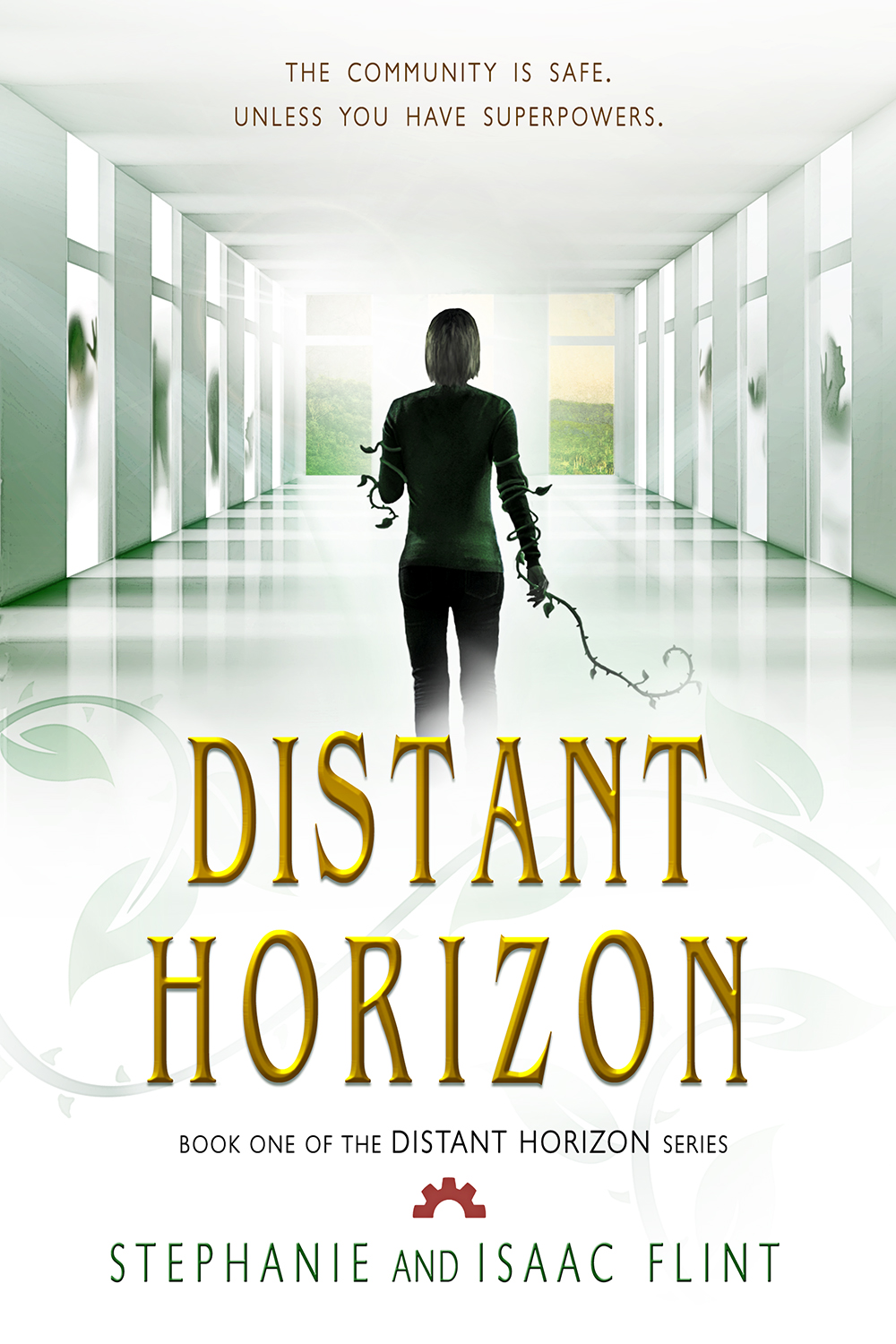
Last week I did a post about writing a blurb for Distant Horizon, the YA/NA Dystopian novel that my husband and I will soon publish.

After writing the previous post, then editing the blurb, I came up with three versions that Isaac and I took to the writer’s meeting we attend. The first version was a short blurb in present tense that focused on the world of the novel, but didn’t mention the protagonist. The second was the blurb-ified query letter. The third was a cross between the two.

At the writer’s meeting, we struck out the first one. The second and third versions tied for favorite in regards to which each person preferred.

I’ve made the suggested edits, and I’ve come up with two versions as possible options.

Which one would entice you to read the book?

Version 1

The Community is safe.

At least, that’s what we are supposed to believe.


Eighteen-year-old Jenna Nickleson resides in an efficient, secure society that’s recovering from a hallucinogenic plague. So when agents of the Community’s Special Forces arrive at her university prior to a mandatory Health Scan, Jenna’s paranoia—and recent string of hallucinations—prompt her to find out what happens to the students who fail. Rumor has it that they’re sent away for treatment, but when she uncovers a ruthless government conspiracy, her ideal world is shattered.

Terrified, Jenna flees her home under the protection of a ragtag band of freedom fighters. The rebels offer her refuge on their rusty airship and claim her hallucinations are elemental plant powers. She’s not so sure she trusts them, but when she comes face-to-face with a cruel telepath in charge of the government’s darkest secrets, Jenna realizes she’ll need more than special powers to escape with her mind and body intact.


Version 2

The Community is safe.

At least, that’s what we are supposed to believe.


Sixty years ago, a hallucinogenic plague annihilated half the world’s population, leading to the formation of the Community—an international government that promises its citizens safety, security, and efficiency. Every day, Community citizens swallow a mandatory pill to ensure their immunity to the plague. A year after graduating high school, they take the Health Scan.

Most pass, and continue with their lives.

Others disappear.

Eighteen-year-old Jenna Nickleson hasn’t taken the pill since her senior year in high school. She feels more alive without it, and she hasn’t shown any signs of infection—at least, not until two days after a surprise Health Scan is announced and Special Forces arrive at her university campus.

Spurred by the recent string of hallucinations, Jenna searches for any inkling of what happens to those who fail the scan. Rumor has it that they’re sent away for treatment, and once cured, receive a menial job. But when she uncovers the cruel truth behind the plague, her ideal world is shattered.

Underneath the illusion of safety, Special Forces agents harbor a dark secret.

The plague is a lie.

Version one is based on the final query letter we wrote before deciding to create our own company. The blurb reveals a lot more information, but (as some of the writers at the meeting pointed out) narrows the options that the protagonist might choose. With this blurb, we know that the government’s secrets involve super powers, a telepath, and that the protagonist goes with the rebels (at least to start with).

This blurb seems to ask the question, “How will Jenna escape the telepath?” “What other secrets does this government have?”

For the moment, I’ve chosen the same tagline for both versions and changed them completely to present tense. The goal is to draw readers into the story by giving them the sense that all this is happening immediately.

Version two sets up the world before the protagonist. We don’t know what she ultimately chooses to do, though we know that she’s uncovered some kind of secret, Special Forcess agents are enforcing that secret, and that the plague is a lie.

“Why is the government lying about the plague?” “What’s really going on?” “What’s going to happen to Jenna?”

We don’t know, but the blurb promises the reader that if they read the book, they’ll find out.

What do you think? Which blurb catches your attention, and why?

I hope you’ve enjoyed this post. 🙂

6 Comments

Filed under Business Ventures, Writing

Thoughts on Blogging – A Question For My Blog Readers

As we approach summer, (which means I should have more time to write blog posts), I’ve come up with a question for those of you who read my blog:

What do you like reading on my blog, and what do you want to see more of?

Is there anything you would prefer to see less of?

About a year ago I went from only posting “behind the scenes” content about book covers I had designed, to writing articles on my writing processes and the steps my husband and I were taking in creating our publishing company.

Then I started creating the video blogs with the readings, and then finally reblogging our pseudo-steampunk series, The Multiverse Chronicles.

From what I can tell, most of the people who follow this blog are writers. Do you want to see more posts on writing and the writing craft? Publishing? Self-publishing techniques?

Do you like seeing the Behind the Scenes posts about how I make book covers?

Do you watch the video blog posts I do, and/or listen to the readings of Magic’s Stealing?

Do you read the Multiverse serial episodes?

Is there anything you want to see that I haven’t tried yet?

Feel free to respond via the form below, or to send me an email privately (my contact page).

I look forward to hearing from you. 🙂

* * *

Just a quick reminder, I’m running a giveaway for two ebook copies of Magic’s Stealing! There’s only four days left, so enter while you can. 🙂

8 Comments

Filed under Writing