
When it comes to fantasy and sci-fi, I love reading about, seeing, and writing about meddling gods, goddesses, and deities. Which is why, when I’m pitching my books at live events, I tend to say that if you like stories with meddling gods, you might like my Wishing Blade series (and several of the Legends of Cirena stories).
But… that doesn’t mean there aren’t any meddling, deity-like beings in the Distant Horizon books. They’re just not gods, and they don’t play such an obvious, prominent role.
Let’s have a look at how this all got started when it comes what’s been an influence on my writing.
Obviously, meddling deities show up pretty heavily in mythology, including Greek and Roman mythology, which was the mainstay of myth discussion when I was in school. The two which, ironically, has a hard time holding my interest. Too much family drama and gods being too powerful, maybe? I mean, if the gods are going to be jerks, I want to see the mortals kicking them off their throne eventually.
When I have been on myth-research kicks, it’s been Egyptian mythology (probably inspired by being a fan of Stargate SG-1), and Norse mythology (I’m not actually sure what inspired that research kick… possibly a children’s play we did in high school?). That, and I went on a whole kick reading about different kinds of unicorns (which definitely influenced the chesnathéme in the Wishing Blade universe.
Anyway, in reading fantasy, the first one I recall reading and seeing involvement from the gods and goddesses was probably from Tamora Pierce’s series, such as The Immortals and the Trickster Duology. (The latter of which heavily influenced how I developed the Cirenan pantheon world in the Wishing Blade Universe).
Meanwhile, in sci-fi, I’ve always been a fan of Q in Star Trek: The Next Generation. The trickster-aspect, the way the non-powerful people respond to his games… and then in other series, those moments when even Q gets baffled…
All fascinating.
Is it any wonder that meddling deities would work their way into my stories?
In the Wishing Blade series, the gods are extremely involved. From Aifa, goddess of relationships, granting her magic to Toranih and Daernan when mortal magic gets stolen, to the Trickster, with his army of shadows made from mortals who got caught in the wrong place at the wrong time… The gods get involved, they try to account for prophetic danger, and they can guess incorrectly.
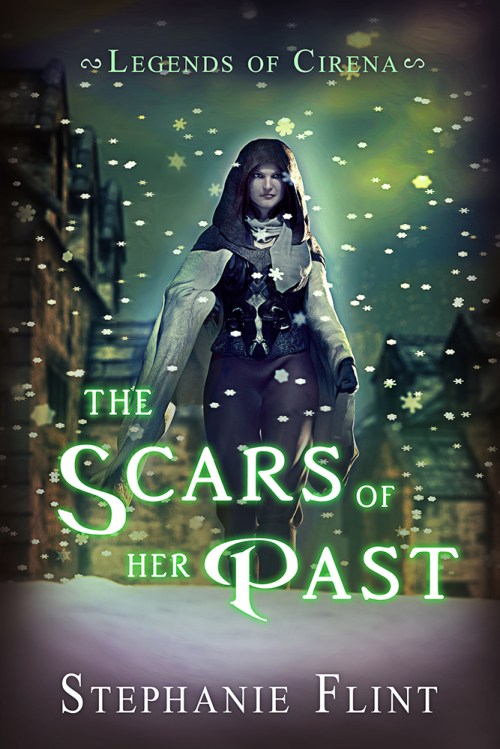
They can also try to lend their indirect help, pointing mortals in the right direction, as we see in The Scars of Her Past, when the Oracle shows up in shapeshifted disguise to pass along a warning to Alia, whose past puts her in a position to offer help no one else can.
On the writing side, it can be tricky to make sure that the gods can’t simply solve the problems themselves, but their flaws and limits make them fun to write.
In the case of The Scars of Her Past (Legends of Cirena #5), the threat Alia must confront involves magebane, which reacts explosively to magic. If the goddess gets too close to magebane with her magic, it would react like a bomb, not only destroying the city she’s trying to protect, but possibly unraveling their reality in the area that got hit.
Which means she needs a mortal without magic to investigate.
We also see the Oracle in the Stone and String series (there she goes by the name of Meshon), offering cryptic help and nudging Edyli along, all while trying to stay out of the sight of the goddess of the dead, whose rigid desire for control of mortal fate could get the world destroyed—again—if the gods aren’t careful.
In the case of The Cursed Halls of Kalecen (Legends of Cirena #4), the god of justice was once a chesnathé (more-or-less a very judgemental unicorn) whose horn has been broken. And since chesnathéme use their horns to cast judgement, well… let’s just say his skewed sense of justice is a problem for everyone involved.
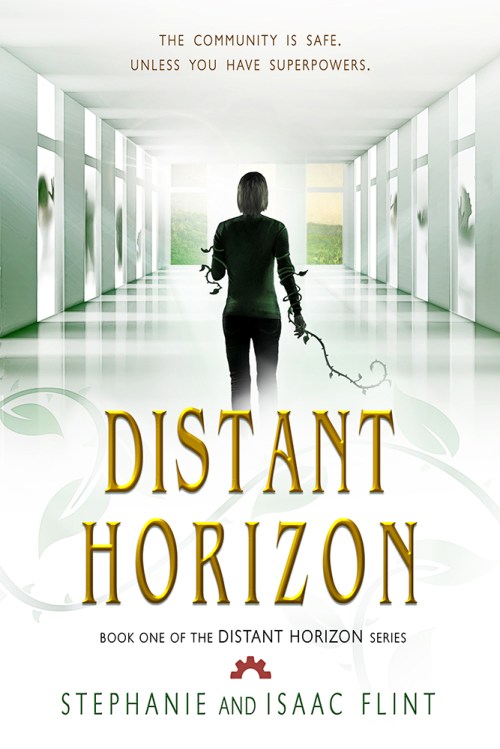
Once we get to the Distant Horizon series, the science fantasy world, we get characters like Spectator and Krissa Wolf, both not-quite omnipotent beings who interfere with the lives of our characters.
Spectator is absolutely a meddler (arguably, he set the events of Distant Horizon into motion behind the scenes, though that’s not revealed until Ghost of a Memory… and even then, it’s vaguely stated).
And Krissa Wolf is a character who can make even the most powerful members of the Camaraderie of Evil nervous, because they can’t shield her (they can’t block her powers). I know why that’s the case, but some reveals won’t come until later stories. 😉
In both cases, they’re reality benders, capable of changing the world around them. Each have their own motives, but because they’re fourthwallers (an in-universe religion that believes their world is all one big game or story), Spectator and Wolf want to keep that game entertaining… which means not using their powers to solve a problem unless it’s going to be fun for the ones watching the game unfold.
And there you have it, a glimpse at meddling deities in the Wishing Blade and Distant Horizon universes!
* * *
Want to see the gods get involved?

* * *
Happy reading and writing!




Pingback: Infinitas Publishing – Status Report | Stephanie Flint - Author and Artist