Category Archives: Business Ventures

Thoughts on Writing – What does a Serial Episode need?

While waiting for the final round of beta comments on Magic’s Stealing (there are a lot of waiting phases… which is why it is really helpful to have another project on hand), I’ve been working on editing The Multiverse Chronicles.

As I’ve said before, The Multiverse Chronicles is a set of short stories written by my husband, which I then revise and edit. Our current goal is to have twenty-four episodes in the first season, which will be released weekly over a period of six months.

There are a few specific challenges associated with this project. While all the episodes must fit together as a whole (and I’m not sure I’d recommend reading them out of order), they each need to stand alone on some level.

The reason is this: Not everyone who might stumble upon the Multiverse blog will read them from the very beginning, and readers who do start from the beginning may miss a week. While each episode stands alone, Isaac and I must decide how much information to remind a reader of in each episode (since we don’t want to remind them that Alia is the bodyguard of Prince Alfons every episode–that would get monotonous very quickly if they’re reading the full season all at once).

So what do I want us to achieve in our upcoming serial blog series?

Each episode needs to be compelling. There needs to be:

  • A strong sense of character, and relationships between characters.
  • Both humor and serious notes… usually involving some bit of quirkiness.
  • A strong sense of world-building.
  • Conflict and/or tension.
  • A reasonable beginning, middle, and end.
  • Something that propels this episode into the next.

With these core elements, I believe each episode has the potential to draw a reader back the next week, or, if they aren’t interested in serial fiction, maybe get them intrigued by the complete volume of season one (which needs to be complete in itself while opening up questions of interest for season two).

Isaac and I intend to have the entire first season written  (at least a rough draft), as well as the first four episodes polished, before releasing the first episode. This way we have a month’s worth of episodes ready to release without worrying about what happens if we run into a snag while polishing a later episode. Of course, I’m hoping we will have the majority of the season polished beforehand, but we’ll see. I’ve also got to continue writing the rough draft of the second book in The Wishing Blade series.

Will this work? Can we successfully imbue each episode with these elements? Will readers enjoy The Multiverse Chronicles?

Hard to say until we start releasing episodes, but if I think that if we keep the above ideas in mind, I’ll have a decent guide to work from as I edit each episode.

I hope you enjoyed this post. Do you have any serial stories that you’ve enjoyed? Are there certain traits of serial fiction that you like or dislike?


Further Reading About Writing Serial Fiction:

http://tuesdayserial.com/?p=2032

http://riptidepublishing.com/faq/all-about-serial-fiction

http://thewritepractice.com/serial-novels/

http://blog.karenwoodward.org/2013/04/how-to-write-episodic-serialized-fiction.html

http://ezinearticles.com/?How-To-Write-Serial-Fiction—The-Four-Keys&id=6243275

http://www.justinmclachlan.com/1948/5-tips-writing-serial-fiction/

http://writerunboxed.com/2014/02/24/serial-fiction/

http://blog.janicehardy.com/2013/04/what-downton-abbey-can-teach-us-about.html

5 Comments

Filed under Business Ventures, Writing

Thoughts on Gaming – The Importance of Clear Instructions

Isaac and I recently went to St. Louis to visit friends, and while there, we had them test out our new Battle Decks: Multiverse 1953 game (Thanks, guys!). The goal was to see how easy the rules were to follow without our intervention, as well as to make sure the game played as we intended based on those rules. Think of it kind of like beta-reading… you want to make sure your readers are getting the information and the meaning you intend. Where there is confusion, there is trouble.

It quickly became apparent that our rules could use some tweaking for clarity, namely in the form of pictures and diagrams explaining how to read the cards. The back of the box has a diagram showing the set-up of the game, but that was it. When we offered the diagram found in the trial version of the game, which allows players to play the game with a couple print-outs and two decks of poker cards, we found that the rules were a bit easier to follow. Especially if the player has played similar games, such as Magic: the Gathering or Pokemon. I haven’t played the latter to be able to say how close those rules play, but that was the comparison one of our friends made.

Battle Decks Basic Card Game Setup

The first version of the picture instructions for the trial version of Battle Decks.

As you can see in the picture, it tells what each card is, but not how to read them. Also, from using this picture, we found that it was confusing to have notes on both the opponent’s playing field and your playing field. We’re considering limiting the text to the player’s side of the field, that way players don’t have to feel like they’re reading the cards upside down (especially problematic if the player hasn’t had much sleep).

Isaac and I are also considering creating a diagram of the basic card types to explain how to read each card. For example, we’ll point out the HP, DEF, ATK, and DMG information and what those numbers pertain to, along with where the point cost of a hero card is and where abilities can be found. We’ll add pictures of counter tokens and explain how to use them (something we neglected entirely in the text-based rules).

Beta-testers are important!

We learned from our testing experience that being able to verbally explain the rules made the learning process go much smoother. Players understood the game much faster when we showed them how to play through a round. And once they figured out the rules, we got to see them effectively using abilities (the bodyguard ability in this case) in a way that we rarely used in our own game play. We also found where a certain young dragon character card had a potentially game-breaking trait, which we intend to remove before publishing the final version of Battle Decks.

Though we had entertained the idea before, we now know that a video explaining the rules and showing a round of the game is crucial. With a video, potential players can see how the game is played without having to wade through a lot of text rules… and we can include supplemental videos which explain the different cards’ abilities. Our goal is to make the game easy to understand and play. Otherwise, someone who chooses to give it a try might decide the game is too difficult and set it aside.

For example, when I first tried picking up the Star Wars: Miniatures game with my dad, it took a while to figure out since we didn’t know anyone else who played. We started out with simpler cards and ignored rules that didn’t make sense to us, and eventually, we figured it out. Later, I began playing the game with Isaac and we moved on to more difficult characters with bigger abilities.

We kept this in mind when creating Battle Decks. We included characters who only have a few abilities, along with characters who have several. That way players can ease their way into the game. We’re also considering creating “campaigns” with set characters for each player, or a limited S&R deck to vary game play.

Overall, I’d say this first round of beta-testing was successful, and we have quite a few ideas of how to improve the rules and improve a player’s experience.

I hope you enjoyed this post. 🙂 Have you ever found a game to have really difficult rules to understand? What did you do about it?

Leave a comment

Filed under Business Ventures, Gaming

Thoughts on Publishing – The Unboxing of Battle Decks: Multiverse 1953

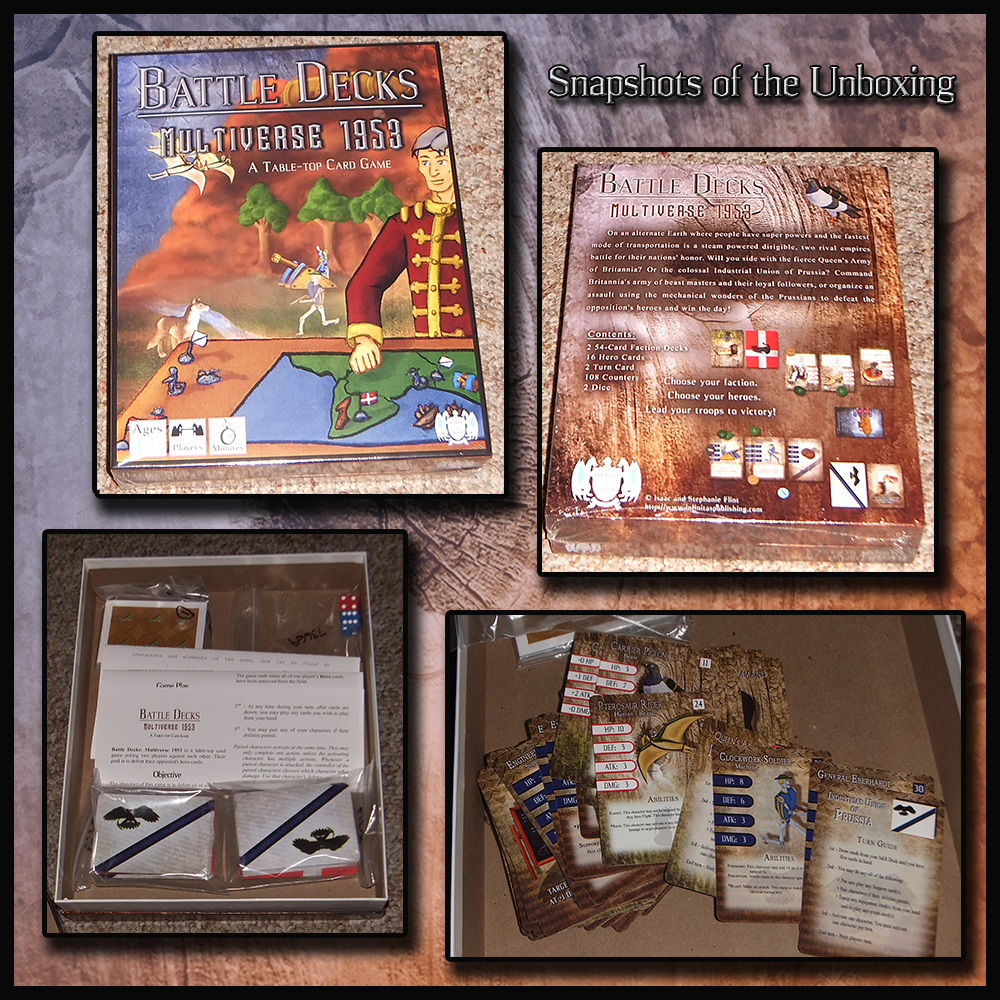
Guess what my husband and I got in the mail today… the full version of our Battle Decks: Multiverse 1953 card game! Woot! 😀

We unboxed the game almost immediately, and now you can get another sneak peek into Battle Decks (including the cover). We printed the game at The Game Crafter, a site which is little pricey but not bad for print-on-demand games. I was a bit nervous as to how well it would print, but I’m happy with the results, and I’m looking forward to playing our first game with the actual cards.

Battle Decks: Multiverse 1953 - The Unboxing

A heads up, if the game looks interesting to you, we will be releasing a free, PDF trial edition which shows you how to play a basic game. A try-before-you-buy sort of thing.

Battle Decks: Multiverse 1953 is a card game Isaac and I will be publishing under our new business, Infinitas Publishing. Isaac created the rules of the game and figured out how the points worked and what the stats should be. I did about half of the card art, minus sketching anything mechanical. Isaac did those sketches. We’re also working on an upcoming blog series called The Multiverse Chronicles, which mentions several of the characters included in the game.

I hope you enjoyed this post. 🙂

Leave a comment

Filed under Book Covers, Business Ventures, Gaming, Photo Illustration

Thoughts about Publishing – Fireworks and Photoshoots

IP---Fireworks

A photograph from our fireworks photo shoot for the book trailer. The ‘scrying bowl’ from Magic’s Stealing.

Over the weekend, my husband and I visited my family for the Fourth of July. Among the things we did… per usual tradition… was to purchase fireworks. In previous years, we’ve typically picked up an assortment of fountains, smoke balls, and sparklers, then headed across town (or recently) up the hill in the evening to watch the fireworks from the city display. Over the years, the people around town have been picking up the big fireworks, so this year we watched them from the front yard. (And I made chocolate chip cookies during the lull… yum!) Anyway, we didn’t find any smoke balls for sale, but we did pick up a couple smoke canisters. The goal? To use the one day we had available to shoot off fireworks in a city area to get potential footage for the book trailer.

IP---Fireworks1

The setup for the 3D camera, ‘scrying bowl,’ and smoke canister.

While we don’t know for certain we’ll use the footage, the shoot was a lot of fun… and very smoky. Me, Isaac, and my dad headed up the hill, scoped out a decent spot for us to lay the bowl and the canister (we brought a couple bottles of water in case the canister didn’t fire properly), along with the 3D camera (it has video capabilities) and the DSLR. I set up the tripod for the 3D camera and kept it low to the ground, then once that was set up, Isaac lit the canister. I shot several still images with the DSLR for potential book cover usage, while Dad kept an eye on what the wind was doing with the smoke. Afterwards, we watered the area around the canisters and set them aside to cool. Dad went back the next day to throw them away.

IP---Fireworks

A still shot from the book trailer video shoot for Magic’s Stealing.

IP---Fireworks

Me having fun with Isaac’s Ultrasaber.

Later that night, I remembered a few photoshoots I’ve done previously using smoke balls and an FX lightsaber (I’m a Star Wars fan). I suggested that we should get a couple more smoke canisters (like Isaac suggested in the first place) and use Isaac’s new Ultrasaber to make long exposure shots. We each got one canister, and we took turns running around in the smoke, trying not to breathe it, to get the various effects. We also shot off a fountain, continued watching the surrounding fireworks show from the neighbors, and played with the sparklers and long exposures to see if we could get any ribbon-like effects for the Magic’s Stealing book cover. We had a lot of fun, and my parents joined in on playing with the sparklers. (We usually take turns lighting the sparklers and twirling them around). And I got poppers. So much fun…you throw them on the ground and they make light and noise… *Happy sigh.* Like my grandma said, “we had a party!”

IP - Fireworks

Isaac got creative with his sparklers and made various video game characters…

The next day we taped a bunch of streamers left over from party streamers ‘fireworks’ to a fan, then took both video and long exposure shots. We got a lot of abstract images, which are great for creating magical effects for the book cover.

IP---Fireworks

Long exposure of streamers for book cover art.


All in all, Isaac and I enjoyed combining our work with play. I hope you enjoyed this post, and I hope you had an enjoyable weekend, regardless of whether or not you celebrate the Fourth. 🙂


Leave a comment

Filed under Book Covers, Business Ventures, Photo Illustration, Writing

Thoughts on Publishing – A Blurb for Magic’s Stealing

As I get closer to publishing Magic’s Stealing, I’ve been compiling the various elements meant to catch a reader’s attention. While a lot of emphasis is placed on the book cover (and I’ve realized the current version I’m considering may be better suited to the third book, so I’m debating what I might use instead for the first), after the cover, a reader inevitably sees the blurb. The blurb should show what the book is about and entice a reader to either buy the book, or at least take a look inside.

However, as a writer, we’re so close to our stories that it’s hard to see what will draw the reader’s attention. I’ve posted my current idea for a blurb on Absolute Write (which is a very useful source of information for authors), and I’ve come up with two slightly different versions. The question is… which works better? Short and snappy? Or more details about the world?

In order to get a little more insight on the subject, I read through a few articles that discussed what makes a good blurb (see the links below if you’re interested), and came up with a list of elements to consider:

  • A sense of the main character(s). Who and what kind of character are they? (For Magic’s Stealing: Toranih is a young noblewoman who would rather have a sword in her hand than use magic to heal or throw fireballs.)
  • Just enough detail to show the type of story and what makes this book different. (For Magic’s Stealing: there’s a kingdom, magical ribbons, mages, shadows who are impervious to mortal weapons… and this is where I start to wonder if I need to hone in on the description)
  • What the main conflict/plot will be. (For Magic’s Stealing: Almost all magic is stolen from the kingdom, leaving two young mages–one of whom doesn’t like magic–to protect their home.)
  • A question that entices the reader, or leaves them wanting more. (For Magic’s Stealing: Will Toranih successfully adopt the responsibilities of a mage so she can fight the shadows? Or will she fail and cause her home to perish?)
  • Offer a taste of the writing style. (Maybe I can include a tiny clip at the beginning of the description. You know, those story bites usually seen in italics?)

These are the current versions of the blurbs that I’m considering for Magic’s Stealing.

Short Version:

Toranih would rather have a sword in her hand than use her powers to heal or throw fireballs, and as a result, her magic skills are lacking. But when the kingdom’s magic is stolen, she’s one of the few whose powers remain. With former mages dying from magic withdrawal, and the looming threat of an army of shadows who are impervious to mortal weapons, she must either adopt her neglected responsibilities as a mage or watch her home perish.

Long Version:

For centuries, ribbons of magic have provided the kingdom of Cirena with light, healing, and protection. Then, in a span of minutes, those ribbons fly from their masters, stolen, save for the ribbons of two young mages. One of these mages is Toranih, a noblewoman who never liked magic to begin with. The other mage is her best friend, Daernan, a gifted shapechanger who uses his magical sight to track the vanishing ribbons. Toranih would rather have a sword in her hand than use her powers to heal or throw fireballs, and as a result, her skills are lacking. But with former mages dying from magic withdrawal, and the looming threat of an army of shadows who are impervious to mortal weapons, she must either adopt the responsibilities of a mage or watch their home perish.

So my question to you is this: Which blurb, if either, holds your attention, and do they entice you to ‘look inside?’ Why? Or if you neither holds your attention, why not?

I’m concerned that the shorter one may read too fast, but that the longer one may loose readers with unnecessary information. One solution I’m considering is that Smashwords offers both a short and long description for retailers, and as such, I could use both descriptions in their respective sections. Anyone who wanted more information could click to read the longer description. In the meantime, if whichever description I choose for Amazon doesn’t seem to be working, I can try switching it out for the other and see which one works better.

I hope you enjoyed the post. Are there any blurbs that worked well for you? Anything you’ve found that didn’t?

A few articles I found particularly helpful while researching the subject:

http://romanceuniversity.org/2011/11/23/5-top-tips-for-writing-a-compelling-book-blurb-by-amy-wilkins/

http://kristenpham.com/2014/01/14/how-to-write-a-great-ya-fantasy-or-sci-fi-book-blurb/

http://www.thecreativepenn.com/2010/11/16/how-to-write-back-blurb-for-your-book/

http://www.lightmessages.com/lm/index.php/blog/writing/229-how-to-write-a-book-cover-blurb

6 Comments

Filed under Business Ventures, Personal Work, Writing

Thoughts on Publishing – Book Trailers

Isaac and I have been considering ways to promote our books once they’re ready. I’ve got a cover in mind for Magic’s Stealing, along with a couple possible blurbs, but we both agree that having a few other promotional materials meant to pique the interest of readers would be handy. One promo piece we’re considering is that of a book trailer.

Love ’em or hate ’em, a good book trailer catches the eye of a potential reader and either gets them to investigate what the book is about, or get them to make that final step toward picking up a book they’ve been on the fence about.

In order to get a feel for what makes a good book trailer, we perused Youtube and watched various (mostly young adult) book trailers. The below is our subjective conclusions.

Elements of a Good Trailer:

  • Music that fits the tone of the book. Compare the kind of music found in movies to your genre. A suspense might have suspenseful music. Horror might have music that is jarring or creepy. Action might be fast paced. Use music (make sure you have the right licence) to help convey genre to the reader.
  • Use cliches to catch interest… sparingly. If your book turns a cliche on its head, such as having a gladiator woman instead of a man… you might want to focus on that. Or you can hint at similarities in your book to other stories. For example, I showed my husband the book trailer for Throne of Glass (Note: I haven’t read the book, so I don’t know how well the trailer matches it), which starts off with a silhouetted version of the character on the cover. Isaac’s first reaction was ‘is this Assassin’s Creed?’ Since the book is about an assassin, then it makes sense that people who enjoyed Assassin’s Creed might enjoy a book about an assassin. Using similarities to other books, games, or movies allows the reader to consider that, if they enjoyed the other story, they might enjoy this one, too.
  • Set the theme. Convey the mood and tone of the book, and offer a sense of setting. This was often done using the imagery and/or animation shown. But also show what makes this book different from other books with similar themes… why readers should pick up this particular book.
  • If you already have a fan base from an existing prequel, touch on what excited them about the first book, but don’t leave new readers without a sense of what’s going on.
  • Include the name of the book and the author, along with when and where it will be available. Include buy links once available, and make it easy for a potential reader to buy your book. Don’t forget to include the cover of the book somewhere in your trailer, so readers can link the trailer to the book when it comes time to buy it.
  • Give readers something to remember. Granted, be careful not to use a cheesy gimmick unless the story calls for it, but if the reader remembers (and likes) the trailer, they may be more likely to pick up the book later, if they choose not to buy it immediately. If the reader doesn’t remember the trailer, they may not be as likely to pick up the book if they come across it later.
  • If writing non-fiction, give a sense of what the book will be about, introduce the author… maybe include a bit of humor, if you’re the kind of author who uses humor in your book.
  • Simplicity is your friend. You may not need a voice-over or a bunch of flashy images. Sometimes a simple ‘what if’ hook will catch a reader’s attention, as can using more ‘booky’ graphics. Words on the screen, skillfully placed, can be effective.
  • When comparing book trailers to movie trailers, Isaac and I noticed that the movie trailer showed the type of characters involved (such as a strong female protagonist and the rough-but-romantic guy). Movie trailers were typically faster paced, and those trailers focused on higher-budget graphics (something books often don’t have… the graphics or the budget). Movies that disappoint in theatres often show clips in the trailer that don’t deliver a consistent feel once you watch the movie.

Elements of a Bad Trailer:

  • Audio: Some trailers were obnoxiously loud or really quiet and hard to hear. Or the dialogue wasn’t clear. Be sure your potential reader can understand what is being said.
  • Too much telling, and/or a trailer that goes on too long. If you go on and on… and on… you may loose the reader. Worse, they may assume your book will drag, too.
  • Don’t quote your blurb verbatim. Readers will read that when they look at the book. Give the reader something new or expand on something that might interest them. You want a hook.
  • Cheesy lines. This can be hard to judge, because certain tropes are common, but make sure your dramatic pauses are actually dramatic… and don’t have you rolling on the floor in a fit of giggles.
    • Unless that’s the kind of story you’re trying to tell. If so, then by all means do so. I bought one book because the campy humor of the trailer was too entertaining to pass up.
  • Too distracting. If the trailer uses flashy elements and distracting colors, or elements that seem out of place, readers may be too distracted by those elements to remember what the actual book is about.
  • Don’t have ads on your book trailer. Seriously… the trailer is an ad. Readers don’t need to see unrelated Youtube ads popping up on the screen while we’re trying to watch it. Having other ads (when you can control them) impedes the message you’re trying to send out.

One thought I had during this whole process was to create a ‘teaser’ for the book rather than a ‘trailer.’ The idea would be to convey a small, interesting part of your story (For Magic’s Stealing, an example might be to voice over a section of the story where the antagonist, Shevanlagiy, is speaking to a rival. The teaser could therefore show what the protagonist is going up against. For example, there’s a line in the current draft of Magic’s Stealing where she say: “I’ll destroy everything,” she whispered, “if it gives me the power I need.” Granted, a little more context might be helpful.) For a trailer, you want to give a sense of the story as a whole. But for a teaser… one trailer we saw used a small bit of dialogue, a small scene that might have been directly from the book to show what the protagonist is dealing with. But it didn’t necessarily say a lot about the larger story.


I hope you enjoyed this post, and in the meantime, Isaac and I will be considering the above when we go to make a trailer for Magic’s Stealing. But what are your thoughts? Have you found any book trailers to be particularly effective (or ineffective)? 🙂


If you want to read more about book trailers:

http://therumpus.net/2013/06/fantastic-book-trailers-and-the-reasons-theyre-so-good/

https://www.goodreads.com/topic/show/1348243-what-makes-a-good-book-trailer

http://www.thecreativepenn.com/2011/01/07/how-to-create-a-book-trailer/


Example trailers, you be the judge of good or bad:

(Note, I haven’t read all of these. I just watched the trailer.)

Throne of Glass: https://www.youtube.com/watch?v=j_t1kXaDtRQ

An Ember in the Ashes: https://www.youtube.com/watch?v=sbvyCrkVT7M

Matched: https://www.youtube.com/watch?v=xaeNWL8rlBI

Steelheart: https://www.youtube.com/watch?v=6sC9NtpXLH4

The One: https://www.youtube.com/watch?v=qVDfV7gCCFE

Fire: https://www.youtube.com/watch?v=IEiijD-tV5M

The Monstrumologist: https://www.youtube.com/watch?v=B4V-biapntE

How to Catch a Russian Spy: https://www.youtube.com/watch?v=W2frzMX4IWM

The Glass Arrow: https://www.youtube.com/watch?v=G20Qz172G4s

Divergent: https://www.youtube.com/watch?v=tu5Erw-posg vs. https://www.youtube.com/watch?v=sutgWjz10sM

Virals: https://www.youtube.com/watch?v=MeBCqpUmPSU

Half Bad: https://www.youtube.com/watch?v=UIcpalOypmo

Three: https://www.youtube.com/watch?v=Zs46WskvpGU

Replica: https://www.youtube.com/watch?v=G62U728THG0

Existence: https://www.youtube.com/watch?v=_pUWjgCTTVg

The Raven Boys: http://maggiestiefvater.com/blog/the-animated-book-trailer-for-the-raven-boys/

The Young Elites: https://www.youtube.com/watch?v=F9VTgbB0dWg

Minder: https://www.youtube.com/watch?v=8lv6eC3E-9k

The Friday Society: https://www.youtube.com/watch?v=xs5rXZrglf4

Miriam Black: https://www.youtube.com/watch?v=gcR1B-48lK4

Leviathan: https://www.youtube.com/watch?v=PYiw5vkQFPw

The Flame Alphabet: https://www.youtube.com/watch?v=YMhEAIDclbI

Reboot: https://www.youtube.com/watch?v=adUV6qZgZdQ&index=8&list=PLogL8GFmSgvnNjVhWtvSFjawIn0HlzTRN

Leave a comment

Filed under Business Ventures, Photo Illustration, Writing

Sneak Peek – Battle Decks

If you’ve been reading my blog lately, you may know that my husband, Isaac, and I are starting a publishing company for our stories and games. Well, I’ve talked a lot about the stories, but today I’m going to give you a peek into one of our games-in-progress: Battle Decks.

I’m not going to give a whole lot of detail on the game just yet, but I will say this: it’s a fantasy pseudo-steampunk table-top card game, where there are two battling factions and your goal is to take out the opponent’s hero cards. We’re considering the catch-phrase of “Dragons, dinosaurs, and dirigibles, oh my!”SBibb - Battle Decks Sneek Peek

Anyway, at this point in time, we have the basic mechanics of the game, stand-in cards, and we’ve played it on and off between ourselves over the past couple years. Currently, we’re in the process of creating the art for the actual cards. For the typical card, Isaac creates the base image with pencil on sketchbook paper. Then I go in and add the details, smoothing out the line art in the process. We then scan the page onto the computer. I retouch the pencil art in Photoshop CS6. Isaac does the basic coloring. Then I do the final touch-ups to the coloring and shade the image. That completes the basic art, up to the point we add them to their actual cards.

We’ve already ordered one proof of the first few cards, and there are tweaks to be made for readability. But it’s coming along, slowly but surely. There might be a set of stories planned around this game, too…

Your sneak peek is one character from each faction. 🙂

SBibb - Battle Decks Sneek Peek

Leave a comment

Filed under Business Ventures, Photo Illustration

The Infinitas Publishing Site is now Live!

I’m happy to announce that Isaac and I now have our Infinitas Publishing site live. 😀

http://infinitaspublishing.com

Took most of yesterday (including a couple photoshoots) and a few hours here and there to get it up and running, but after finally figuring out how to get the domain properly mapped, it’s now up. You can read about the behind the scenes process on our first blog (written by Isaac): http://infinitaspublishing.com/blogs/post/Behind-the-Website/

A few parts of the site aren’t quite working yet (the upper banner doesn’t want to resize for mobile devices), but I’ve sent an email to the web host to see if they can help.

Also, we have a new twitter account where we’ll be making announcements in regards to the books and games we’re publishing: https://twitter.com/InfinitasPub

Not much up at the moment, but it’s a start. We hope you enjoy it, and we have more plans for it as we continue to move forward. 🙂

Leave a comment

Filed under Business Ventures, Personal Work

Thoughts on Publishing – Pricing the Novella

Today, let’s talk business: What are you willing to pay for a novella?

When I went to ConQuest, I knew full well that I planned to fork over twenty bucks for a hardback copy of a book that contained two of Brandon Sanderson’s novellas. Sure, they’re available for purchase in ebook format for considerably cheaper, but having the hardback is nice, and I’m a fan of his work. (A note here: I’m the kind of person who likes having a hard copy, be it paperback or hardback. I’ll happily read non-fiction pertaining to publishing on my Kindle, but I have a difficult time reading fiction.) Anyway, I got the book signed at the convention, and I’ve read one of the stories (Perfect State) thus far. Even though I haven’t read the second one yet, spending that twenty dollars was worth every penny.

But not everyone is going to feel that way, and not for every book.

From the business perspective, I’ve got to figure out what readers are willing to pay for each book. Do I want to come up with a single, standard price range, or price them individually, according to length, genre, and various other factors? I don’t have the advantage of hiring a super-awesome illustrator for the cover art, or a top-of-the-line editor to make sure there aren’t typos. Not to start with, anyway (though I’ll sure do my best to find as many typos and errors as I can before I hit ‘publish’). Can I  make sure that the stories are the best they can be? Can I make sure that they are worth a reader’s hard-earned money?

I’ve determined that The Wishing Blade will be a series of (probably three) novellas. I’ve got the first one written, and it’s going through the process of being beta-read. Now the question I’m pondering is this: What should I price this novella, once I’ve completed edits and created the cover art?

On one hand, it’s a novella, so it’s not as long as a novel. I’m not sure how much money readers will be willing to spend, especially for an unknown author. While I do have several free pieces of flash fiction available on Smashwords, the style of writing varies, so it is unclear how many readers who download the freebies will be interested in the paid stories. I can’t price the stories as high as someone who already has a fan base. On the other hand, I’m trying to start a business. Which means that I actually need to be making money. The joy of self-publishing is that I get to wear two hats. I’m the creator, the author, and I’m also the business woman. So… provided that the stories are of a decent quality: engaging, not many typos, decent formatting, and good cover art, what should a novella be priced at?

I’m mostly going to look at Kindle’s (non-Select) pricing strategy, but I intend to sell on Smashwords as well:

99 cents: Not necessarily a bad spot for a short story, and many authors offer their novels at 99 cents as a way to promote their other works. However, the 99 cent price range only offers 35% royalties (I think it’s closer to 50-60% royalties on Smashwords, given that my “Ashes” short story, priced 99 cents, earned 56 cents after a Smashwords 10 cent cut and 33 cents transaction fee). The downside of this range is that people may pick up a 99 cent book on a whim, then forget about it because of the “it’s only a dollar” mentality.

$1.99: Long considered “the dead zone” in ebook pricing. I read a Smashwords report showing a trend of $2.99 vastly outperforming $1.99, and 99 cents doing just a bit better than the $1.99 range. Also keep in mind that Kindle only offers 35% royalties here. Not a lot of incentive to try this range, though I’ve seen trade publishers discount higher priced books to $1.99 on Book Bub. However, without actually testing this price range, it’s hard to say how well it performs for a specific story.

$2.99: Seems a bit high for a novella, with so many novels selling for $2.99, but is it? (See below list of example novella prices). At 2.99, Kindle authors get 70% royalties.  That’s around $2.00, versus 70 cents from pricing at $1.99, or 35 cents from pricing at 99 cents. And technically, if you hope to sell your novel at $4.99 or $6.99, that’s not too bad.

Now, one catch here is that I’m currently looking at the US dollar pricing. I haven’t even started to look at the UK or other territories. I’ll have to decide whether to try the retailer’s automatic price comparisons, or take a look at what’s selling in those stores and price it directly. This could be a bit difficult, though, given that the Amazon sites for other territories doesn’t show much what price they’re selling at. (Feel free to chime in with your thoughts on pricing, regardless of what currency you buy books with).

Here’s a few examples of novella length ebook prices in USD, from both independent and trade published authors (Note: I haven’t read all of these, I just did some research):

  • Perfect State by Brandon Sanderson sells for $2.99. I think it classifies as a novella. “Mitosis,” a short story from his Reckoners series, sells for $1.99.
  • Fairest by Marissa Meyer sells for $9.99 (46,600 words per Renaissance Learning)
  • The Invasion (an Animorphs book) by K.A. Applegate  sells for $5.99  (33,000 words per Renaissance Learning). Novella length, though meant for a younger audience.
  • Out of the Storm by Jody Hedlung is offered for free on Amazon. (The description suggests this is an introduction to her Beacons of Hope series).
  • Icefall by David Wood sells for $2.99 (approximately 30,000 words per article about the novella, and per Smashwords).
  • Elixer by Jennifer L. Armentrout sells for 99 cents (part of The Covenant Series).
  • Peacemaker by Lindsay Buroker sells for $2.99 (40,000 words, per her blog post).
  • Better World by Autumn Kalquist sells for $2.99. (A prequel novella to a novel series).

By the way, Renaissance Learning is great for finding the word count of books, especially middle grade and young adult. http://www.arbookfind.com/default.aspx

One of the textbooks I was reading recently, which focused on small business management (never mind that it’s from the earlier 90s), talked about the perception of value when marketing a product. There were two factors considered: quality and price.

A note on the chart below: an unknown indie author does not mean low quality, simply untested. Unfortunately, many people still perceive self-published books to be of low quality, whether they are or not.

High quality and high price: Serves clientele with expensive tastes. (Think of a Big 5 publisher selling an ebook for 13.99 from a big-name author).

Low quality and high price: No one buys the product, because the perception of value around it is muddled. (Think of an unknown author selling their ebook at $13.99).

Low quality and low price: “Cheap.” Not highly valued, but considered a decent price. (Think of how 99 cent indie novels are often perceived).

High quality and low price: “A good deal.” (Think of a Big 5 publisher running a $1.99 ad in Book Bub for a regularly $9.99 ebook).

So, at this point, I’m thinking of making Magic’s Stealing available for $2.99. It’s currently sitting at 30,000 words.

I hope you enjoyed this post. 🙂 What are your thoughts and experiences in the matter?

If you’re interested in further reading on the subject, these are a few of the articles I read while doing my research:

Leave a comment

Filed under Business Ventures, Writing

Thoughts on Publishing – A Novel or Three Novellas?

In general, I write novels. Then I trim said novels because their early drafts are excessively long. However, I’ve recently become fascinated with the concept of serial novelization. You release the novel in several parts, with the idea that readers know they aren’t getting a complete work at one time and that the next installment will come in a timely manner. I toyed with the idea of doing this for my current manuscript, The Wishing Blade, with each installment between 10,000 to 15,000 words. But as I started the rewriting stage, I realized that each section didn’t feel complete. The sections left on a cliffhanger, and weren’t really satisfying.

The other serialized option I’d studied was to write a complete short story (or novella), and make sure it had a full beginning, middle, and end, even if it was part of a larger work. At the moment, I’m thinking that might actually work well for The Wishing Blade. Each installment would be around 30,000 words, maybe more, with an expected three installments. I could release the story sooner, while still producing a reasonable quality work. Each story would be complete in itself, so there would hopefully be fewer unhappy readers who aren’t satisfied with the ending. With each installment, the reader should feel the series has made progress. Think about the show Avatar: The Last Airbender. (I think Legend of Korra and Fullmetal Alchemist where this way in their first seasons, too, but it’s been long enough since I’ve watched them that I don’t remember). For the most part, each episode (or set of episodes) felt complete, even though there was a larger story arc in progress. Granted… I’m still in the second season of Avatar, so that might change.


So here’s how it would work.

1. I separate The Wishing Blade into three novellas. They’re tentatively called Magic’s Stealing, The Shadow War, and The Immortal Realm. (What do you think of the names? Good? Bad? Neutral?)

2. I then figure out the story arc for each individual novella. This is crucial, because while reading them in order would be preferable, I also want readers to be able to pick up book three, enjoy it, then go back to book one. I personally have a habit of grabbing whichever book interests me… even if it’s in the middle of the series.

So the novellas would look something like this:

  1. Magic’s Stealing: Focus on the loss of ribbon magic in Cirena. Main character who hates magic is suddenly one of the few who can still use magic, and she’s trying to figure out what happened to the magic and where she fits into the whole scheme.
  2. The Shadow War: Main characters get separated. One works from within the shadows to foil the trickster god’s plot to kill the gods and get magic for himself. The other seeks out glass-stone, a material which has been proven to kill shadows and not be susceptible to shadow magic, then seeks to protect and warn others in the mortal realm. (For those of you who read my post on creating fantasy languages, this is where word magic shows itself).
  3. The Immortal Realm: Character in shadow realm escapes into ‘immortal realm’ and seeks out artifact (from book one) which could wipe out shadows for good. Other character defends Cirena’s capitol city from the shadows’ massive onslaught. They’ll either succeed in their separate goals, which serves to aid the other, or they’ll fail and the shadows will take over the kingdom.

3. Edit book one and make shiny. Send to beta readers for feedback. Work on a different story in the meantime (either finish the rough draft for The Wishing Blade: The Shadow War, or work on long-overdue edits to book two in my husband’s and my Distant Horizon universe). Once beta readers return comments, I’ll review said comments, make edits as necessary, then set book one aside for a while. Work on The Shadow War in the meantime.

4. Polish book one. Do what editing I can, maybe get an additional beta reader to proofread for errors.

5. Begin publishing process. Upload to Kindle and Smashwords, and consider other markets (I’m currently considering Drive Thru Fiction and Draft2Digital, but I haven’t had experience with either). For now, The Wishing Blade will be in ebook format only. I hope that once I have all three books out, I’ll be able to earn enough from them to purchase a block of ISBNs. Then I’ll need to decide if I want to make a collected print edition with all three books, or make a separate edition for each story. (If you’re looking for a length comparison, I’ve been looking at the old Animorphs series. Wrong genre and age group, but the word count is about right.)

6. Continue process with book two. I’m hoping to release each book around two months apart, though I may change my mind on that once I get further into this process.


Granted, there’s a lot more going on in the background (my husband and I setting up a partnership to publish this, and we’re picking up the DBA, EIN, and trying to figure out tax forms, etc…) but this is what I’ve got going on in the front end. Hopefully you found this post to be interesting, and I’d love to hear what your thoughts are regarding this process. 🙂

6 Comments

Filed under Business Ventures, Personal Work, Writing