Tag Archives: The Wishing Blade

Thoughts on Writing – Developing a Fantasy Language (Interrogative)

For my short story, “Stone and String,” and for The Wishing Blade series, I’ve been trying to develop a functional conlang (constructed language) to add flavor to the world and for use as plot points. However, I ran into a problem… how do I ask questions in my Cantingen language?

See, I’ve been developing this over a period of time. Figuring out potential words and jotting them down for future use… figuring out a grammar rule (researched a whole slew of grammar rules from various languages to figure out the previous grammar rule)… and adding them to the dictionary as I go. I already had verb conjugations figured out (at least for an imperative style phrase in present tense), numbers, possessives (sort of) and adjectives. Apparently I already figured out adverbs, too, but hadn’t realized it. (And so I jotted that down, too).

But then it hit me that I hadn’t figured out how to ask a question in the Cantingen language.

I considered not having them use questions at all… then decided that would be just a bit too bossy for them. While word magic based on the language isn’t likely to use questions (though Isaac has challenge me to figure out how they might make it work) since it’s based on commanding magic to do what they want, the casual speaker is going to want to ask questions.

So I did some quick internet research on interrogative language stuff… (it may become quickly apparent that while I am trying to learn what the various mechanics are, I have trouble remembering the names for those mechanics)… and began formatting how to create the questions.

First off, I knew that I couldn’t use tone to imply that something is a question. That’s because word magic is intended to be read and still be clear… without the use of a question mark. I didn’t want to mess with swapping sentence structure around to make a question. And I didn’t want to inflect the verb in order to suggest that it’s a question.

Somehow, the result ended up reminding of an elementary school English lesson:

How does the dog run? The dog runs quickly. The dog runs how? Quickly.

And thus I decided on these rules:

  1. Questions are to be phrased so that the interrogative portion of the question replaces the who/what/etc portion of the question.
    1. (Ex. The dog runs how? vs The dog runs quickly.)
  2. To form a question, the who/what/etc suffix is attached before the word quéth, thus forming the phrase which replaces the part of the sentence in question.
    1. (Ex. nanlli mean “how,”quéth indicates that the sentence is question. Together, they create nanlliquéth.)
  3. Because the question is indicated in the sentence, there is no need for a question mark.
    1. (Ex. In English, it would look like the person says: “The dog runs how.” It should read flatter, without the rise in tone that a question in English would have. )
  4. Yes/No questions simply attach quéth to the verb in question.
    1. (Ex. hasil is “dog” and nivé is “to run.” “The dog runs,” translates to Hasil nivétra. If you say “The dog runs?” in English, you would say Hasil nivétraquéth. in Cantingen.


The questions ended up looking something like this:


Who – ka 

Who is that girl? Edyli is that girl.

Kaquéth dratethol ali doran. Edyli dratethol ali doran.

*
What kas

That sound is of what? That sound is of leaves.

Ali runin dratetha so kasqueth. Ali runin dratethtra so inarame.

*
Whenvésa

We leave when? We leave soon.

Yliav vésaquéth. Yliav jano.

*

Whereuru

The scroll is where? The scroll is in the box.

Kev dratethtra da uruquéth.Kev dratethtra da vari.

*
Whyji

She weaves why? She enjoys to weave.

Walol jiquéth. Kaviol wal.

*
How  – nanlli

She weaves how? She weaves quickly.

Walol nanlliquéth. Walol naf.

*
Yes/No Questions

This is the girl I seek?

Éda dratetholquéth doran somaria.

It’s still rough, and probably needs some polishing, but that’s what I have so far. It came in handy while working on The Shadow War. While there aren’t anyone asking questions directly in the Cantingen language, there are a few times when the main characters are speaking to people who are from the Cantingen Islands. Knowing how their primary language worked, I was able to change the sentence structure to add to the voice of those character.

For example, there’s a scene that takes place at the marketplace outside of Ashan.

The merchant bowed politely to the horses. She spoke softly in a Cantingen dialect, nothing Toranih understood, before finally turning to her customers and smiling. “Something attracts your eye?” she asked. Her Cirenan speech was articulate and careful, common among the Islanders. A rich blue sash wrapped around her hips and across her slender, bronze shoulders. Her dark hair had been pulled into loose curls and silver ribbons.

Daernan gestured to a pastry with a flaky, golden-brown crust, apricot paste, and streaks of yogurt frosting. “I’ll have that.”

Though I use the question mark here to mark correct English grammar, note how the question is phrased… “Something attracts your eye?” rather than “Does something attract your eye?” or “Do you see anything you like?” Theoretically, you could read it as a statement: “Something attracts your eye.” But if the merchant were to be speaking in the Cantingen language, she would use “quéth” to designate the question. “Eliaved nicolquéth naenlli.” (Literally, it translates to “Unknown sweet bread attracts your attention.” but the merchant knows enough Cirenan to phrase the question in a more familiar way).

* * *

I hope you enjoyed this post. 🙂 Have you tried constructing your own language, and if so, what problems have you run into?

If you want to read more about conlangs, I also have a post about Developing a Fictional Language (Cantingen) and Developing a Fictional Language (Maijevan).

2 Comments

Filed under Writing

The Shadow War – Launch Day!

After an extra month of waiting, The Shadow War is finally here! It’s the second book of The Wishing Blade series, so if you’ve been wondering what happens next, that wait is over!

*Squee!*

I’m both excited and nervous with this one. For this one, we get to see Daernan’s point of view for a large part of the story (60%, to be exact), and we get one short scene from Siklana at the end. But don’t worry, Toranih and Shevanlagiy also get their fair share of scenes, too. Not only that, but we get glimpses of both Maijevan and Cantingen cultures, and the bit of rivalry that might be brewing between the various countries and cities. 😉

So, without further ado…

The Wishing Blade - Section Break - Magic Swirl

The Shadow War

Upper MG / Lower YA

The Wishing Blade - Section Break - Magic Swirl

The Shadow War - Book Cover

The Wishing Blade - Section Break - Magic Swirl

Though a shadow is as good as a ghost, with no free will to speak of, they may still be saved…

The kingdom of Cirena is under attack from an army of shadows—beings who can only be hurt by magic or fire. Magic has been stolen, and as the shadows spread, infecting all they touch, the last two ribbon mages race to the nearest port city to warn them of the impending invasion. One of those mages, Toranih, is among the few who can see the Trickster-cursed army, and she’s determined to get magic back—no matter how much she distrusts it. When she is captured by shadows and a dark secret is revealed about her future, her best friend, Daernan, is left to defend the city. But his only methods of stopping the shadows are by fire and the devastating magic of the shodo’charl.

With the knowledge that the shadows are innocent townsfolk forced to do a warlord’s bidding, Daernan must choose between saving the shadows or saving those who have not yet turned.

The Wishing Blade - Section Break - Magic Swirl

Now Available!

Amazon US ~ Amazon UKBN.com ~ iTunes ~ KoboSmashwords

Paperback Edition

Add to Goodreads

The Wishing Blade - Section Break - Magic Swirl

A sneak peek…

The roof afforded a smoky view of the burning courthouse and the surrounding mayhem, and here Daernan understood the madness of the shadows. As their victims faded, turning into shadowy wisps, they, too, turned on the crowd. The more the shadows converted, the faster the crowd disappeared.

No wonder they used the explosions. People in the affected areas fled from their homes and the markets, trying to evacuate because the smoke in the distance meant the whole southern side of the city might be burning. But the ghostly shadows waited for them with impromptu weapons, and the refugees fled right into their hands.

“It’s so easy for them,” Daernan whispered. “Lord Menchtoteale found a simple way to conscript his army.”

Siklana frowned as she dug the shodo’charl free from the bag and passed him the stone. “What are they doing?”

“Using the explosions to force people from their homes.” Daernan reached to take the bundle, then stopped. Siklana’s brown eyes were wide with worry, her lips forming an unhappy frown. He quickly turned away and clasped the oilskin tight in his fingers. There were so many shadows. If he released the stone now, he might be killing countless innocent people. But if he didn’t release the stone’s magic, more would be trapped.

“Should we do this?” he asked softly.

Siklana peered over the ledge. “You’re asking me?”

He whispered a soft prayer to Madiya—primarily because she was responsible for taking the dead through her realm—but he fervently hoped he was wrong. Hoped that somehow, some way, the shodo’charl did not kill them.

He hooked his fingers under the oilskin, trembling, already feeling the cold sweat forming on his neck and soaking his back. To do this . . . if he killed them . . . he wasn’t sure how he was going to sleep. How he was going to account for their deaths? But the longer he waited, the more who would die when he finally released the oilskin.

The Wishing Blade - Section Break - Magic Swirl

Enjoy! Feel free to tell your friends, or anyone you think might enjoy the book. 😀

4 Comments

Filed under Business Ventures, Writing

The Shadow War – Now Available for Pre-Order

If you enjoyed reading Magic’s Stealing, then good news! The pre-order for the next book in the series, The Shadow War, is now avilable for pre-order!

The book is still in progress (The Shadow War has been through three beta readers, and now Isaac is reading it), but I expect to have it completed by February 2017. Actually, I’m hoping to have it done sooner, but being realistic, I’m trying to give myself a bit more time to complete the project. Once it’s finished, The Shadow War will probably be about 47,000 words long, though the final word count may vary.

Since I was running the promotion for “Stone and String” on Kindle (a short story set in the world of The Wishing Blade), I wanted to make sure I had the second book of The Wishing Blade series available to pre-order. The series starts with Magic’s Stealing, and continues in The Shadow War.

Now, for the book cover!

The Wishing Blade - Section Break - Magic Swirl

The Shadow War

Young Adult / Middle Grade Fantasy

The Wishing Blade - Section Break - Magic Swirl

The Shadow War - Book Cover

The Wishing Blade - Section Break - Magic Swirl


The kingdom of Cirena is under attack from an army of shadows—beings who can only be hurt by magic or fire. But magic has been stolen, and as the shadows spread, infecting all they touch, the last two ribbon mages race to the nearest port city to warn them of the impending invasion. One of those mages, Toranih, is among the few who can see the Trickster-cursed army, and she’s determined to get magic back—no matter how much she distrusts it. But when she is captured by shadows and a secret is revealed about her future, her only chance of survival may be to fight the shadows from within.

Available for Pre-Order:

Amazon US ~ Amazon UKBN.com ~ iTunes ~ KoboSmashwords

Add to Goodreads

The Wishing Blade - Section Break - Magic Swirl

Enjoy! 😀

Leave a comment

Filed under Business Ventures, Writing

Stone and String Available for Free for a Limited Time!

When I released “Stone and String” on Kindle, I went ahead and decided to try out Kindle Select, since the short story isn’t part of a series (though it is part of the world of The Wishing Blade). As such, I get five days to have the story available for free.

I started the promotion a couple days ago, and it’s supposed to end on November 27th. So if you want to read it, now’s the time to pick it up. 😉

“Stone and String,” an 8000-word Fantasy Short Story

Download for free on Amazon (US)!

Download for free on Amazon (UK)!

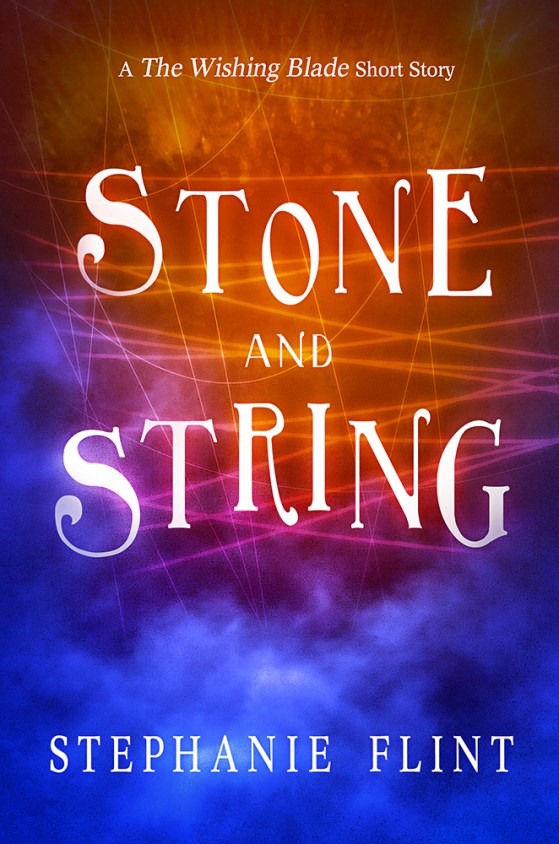
Stone and String - Book Cover

In the world of “The Wishing Blade,” everyone is born with two strings of magic. One strand is life, and the other is death. Very few can manipulate them.

Among the Cantingen Islanders, children are tested for this ability during their first rites of magic, a ceremony which determines what magic they have and their future as a mage. But when Edyli’s little sister, Akymi, dies in an accident before those rites can occur, Edyli does the unthinkable. She uses magic to return Akymi to the living. As a result, she finds herself in a land of weblike strings… the afterlife.

Edyli refuses to give up seeing her sister’s first rites. With the help of a mysterious immortal and sheer determination, she has every intention of seeing her sister once more, even if it means incurring the wrath of Madia, the goddess of the dead.

Stone and String - Teaser Blurb

Download for free on Amazon (US)!

Download for free on Amazon (UK)!

After the promotion I plan to remove “Stone and String” from Kindle Select and release it on Smashwords (which includes BN.com, Kobo, iTunes, etc). This should happen sometime in late December However, the price will return to 99 cents.

Enjoy! 🙂

Leave a comment

Filed under Business Ventures, Writing

Thoughts on Writing – A Blurb for The Shadow War

I’m preparing to create the pre-order page for The Shadow War, the second book of The Wishing Blade series. I’m still in the editing phases, and it’s going to be a little while before it releases (I’m planning to set the release date for February, though I’m hoping to release it sooner). But I want to have the page up before I do the Stone and String freebie days from Kindle Select.

Before I can create the page, however, I want to have a blurb ready (those dreaded, tricky things that entice readers to buy the book). The Shadow War is a YA/Middle Grade fantasy novella (47,000 words), the second of The Wishing Blade series. (You can read the blurb for the first book by clicking here).

So I’ve been thinking about a blurb, and this is what I’ve come up with:

The kingdom of Cirena is under attack from an army of shadows—beings who can only be hurt by magic or fire. But magic has been stolen, and as the shadows spread, infecting all they touch, the last two ribbon mages race to the nearest port city to warn them of the impending invasion. One of those mages, Toranih, is among the few who can even see the Trickster-cursed army, and she’s determined to get magic back—no matter how much she distrusts it. But when she gets captured by the shadows and a secret is revealed about her future, her only chance of survival may be to fight the shadows from within.

While this may be what I use for my initial post of the pre-order page, I want to make sue it works in the long run. So my questions for you are these:

  1. Is the blurb intriguing?
  2. Does it reveal too much? Too little?
  3. Does it show clear goals and motivations?
  4. If you’ve read Magic’s Stealing, does it interest you in reading The Shadow War?
  5. If you haven’t read Magic’s Stealing, does it interest you in learning more or looking inside either of the books?

Thanks for your input! I appreciate it! 😀

I hope you find this post helpful for your own writings. What pitfalls have you run into when writing a blurb?

Leave a comment

Filed under Writing

Thoughts on Publishing – “Stone and String” Unboxing

It’s been a while since I’ve uploaded a video blog post, but I received my print copies of “Stone and String” today (a day early!) and wanted to do the unboxing. So I’ve got a quick announcement about the Infinitas Publishing booth at Burg Fest, the upcoming dates regarding Distant Horizon, and the first look at the print copies of “Stone and String.” Check out the video below, and I hope you enjoy it. 🙂


Click here if you can’t see the video.

Leave a comment

Filed under Business Ventures, Writing

New Release – “Stone and String” is Now Available!

Remember that short story I was working on a couple weeks ago?  Well, “Stone and String” is now available! 😀

The Wishing Blade - Section Break - Magic Swirl

Stone and String Book Cover


Blurb

In the world of The Wishing Blade, everyone is born with two strings of magic. One strand is life, and the other is death. Very few can manipulate them.

Among the Cantingen Islanders, children are tested for this ability during their first rites of magic, a ceremony which determines what magic they have and their future as a mage. But when Edyli’s little sister, Akymi, dies in an accident before those rites can occur, Edyli does the unthinkable. She uses magic to return Akymi to the living. As a result, she finds herself in a land of web-like strings… the afterlife.

Edyli refuses to give up seeing her sister’s first rites. With the help of a mysterious immortal and sheer determination, she has every intention of seeing her sister once more, even if it means incurring the wrath of Madia, the goddess of the dead.


The Wishing Blade - Section Break - Magic Swirl

Buy Now on Amazon (US)

Buy Now on Amazon (UK)

Add "Stone and String" to Goodreads

The Wishing Blade - Section Break - Magic Swirl

“Stone and String” is a short story based in the universe of The Wishing Blade series. Though the stories are related (“Stone and String” takes place at the same time as the events of Magic’s Stealing), “Stone and String” stands alone. While Magic’s Stealing takes place in Cirena, and focuses on ribbon magic, “Stone and String” takes place on the Cantingen Islands and focuses on string magic and word magic, with a healthy dose of the Cantingen language.

I’m currently testing out KDP Select, so the ebook is only available from Amazon. But since it’s enrolled in Kindle Select, that means it can be borrowed if you have Kindle Unlimited.

Enjoy! 😀

Leave a comment

Filed under Business Ventures, Writing

Thoughts on Writing – Developing a Fictional Language (Maijevan)

Lately, I’ve been working a bit on my conlangs (constructed languages). I started out with the Cantingen language (a “word magic” system used throughout my The Wishing Blade series). I’ve been developing it over time, adding words here and there as required and every once in a while going on a spree to flesh it out.

While going through my latest round of edits on The Shadow War (book two of the series), I double-checked that my attempts to create sensical sentences were correct. Most weren’t, and I had to rewrite many of the instances where the language was included. But I had a chance to flesh it out even more in “Stone and String” (tentative title), a short story based on the Cantingen Islands. I’m super excited to be working on that soon, as I’ve just about got all the feedback from the people I’ve asked to beta-read.

However, that short story led me to thinking about other places in the world of The Wishing Blade that I might want to develop further. Namely, Maijev. It’s a large city in the land of Cirena, but unlike the rest of the kingdom, it has a reputation for being anti-mage and isolated. Mages usually avoid the place because there’s something about the area that burns at their skin if they try to use ribbon magic (word magic is unaffected) and generally makes them uncomfortable.

I’ve gone back and forth on whether or not they should have their own language. Would they only speak that? Probably not. But it did seem possible they would have one for when they didn’t want to be listened to by outsiders, so I started considering how it would sound.

I’ve based the appearance of some of the character’s names from Maijev on Russian names, and as such, used that as a starting point. I looked to see what differences there were between Russian and English (such as the lack of vowel sounds and the concepts of perfective and imperfective aspects). Then I took that and ran (in other words, what I’ve developed thus far of the Maijevan language probably doesn’t look a thing like Russian. I haven’t studied the language, so I don’t know much about it).

Anyway, I started out by writing a few notes about Maijev’s general culture, which could affect the language.

  1. They don’t acknowledge the gods, at least not separately, though they understand that they exist. They might categorize the gods the same as immortal monsters (gods/immortals should be same word)
  2. Magic is cursed. Or, if not “cursed” per se, it is considered something akin to “evil”
  3. Whatever it is coming from the ground that burns mages is what keeps them safe
  4. Competition is encouraged/fierce.
  5. High possibility of strong family bonds? (Might explain why the lord of the city adopts a mage for a son… never mind that he sorely distrusts mages)
  6. They acknowledge a feudal-like caste system
  7. They’re fascinated with technology/science/academia. (While the rest of Cirena is fascinated with magic and what magic can do, Maijev has more-or-less started into the age of the industrial revolution).

I decided that their language system would be very rigid and precise. It’s a phonetic language, and for the most part, you can tell exactly how to pronounce a word based on the spelling. Also, the sentence structure is organized in a specific format:

(Subject) (Negative, if negative) (Perfect/Imperfect) (Tense) (Verb)

I also decided on a few additional rules:

  1. No articles.
  2. Adjectives and adverbs use same word. “Quiet” and “quietly” are both digaev) but placement determines which it is.
  3. When there is more than one adjective or adverb, it is separated by “and” (vo).
  4. Adjectives are placed immediately after the noun in question.
  5. Adverbs are placed immediately after the verb in question.
  6. Verbs are not conjugated. A subject of some form should always be given to show who is acting.

Thus, “The small and quiet dog was digging.” becomes Nitilver vreg vo digaev ni miski natch.

  • nitilver – (subject) dog
  • vreg – (adjective) small
  • vo -(conjunction) and
  • digaev – (adjective) quiet
  • ni – (imperfective aspect) – shows the action was not completed
  • miski – (past tense) shows that the verb happened in the past
  • natch – (verb) to dig

Now, I’m considering removing the past tense word miski and simply replacing it with ni (imperfective – incomplete action) or gadi (perfective – completed action), but then, that would remove the ambiguity if someone didn’t use either aspect. But, if they like having a rigid society, perhaps they don’t have an ambiguous form. Haven’t decided yet.

What have I learned thus far about creating a fictional language?

  1. It was helpful to create a list of phonemes and sounds first. That way I could create words without worrying that I might use a sound later that I don’t want to include in the language. Conversely, once I started working with it, I realized I wanted to include a couple extra vowel sounds.
  2. It was also helpful to create the sentence structure and rules system before trying to create sentences. Now I know a bit more about what words the language even uses, and won’t be stuck rewriting sentences later.

However, I’m not a linguist, and I could be doing these things completely wrong (I wasn’t familiar with how imperfective and perfective aspects worked before I started toying with this idea).

And it might not even matter, because, as Isaac (my husband) pointed out, the Maijevan and Cirenan languages should be at least somewhat related. So I need to go create the Cirenan structure before I do much more work with Maijevan. On the bright side, since this time period is far from the “original” use of the language, and Cirena is a much more travel-oriented community, I might have it pull a few stunts from English. That is, itcan borrow words from the other languages, and have a few more “irregular” rules. *Shudder.*

But, given the mythology of their world… well, we’ll see what happens.

I hope you enjoyed this post. Have you tried creating any fantasy languages of your own? 🙂

10 Comments

Filed under Writing

Thoughts on Writing – How A Deleted Scene Turned into A Short Story Idea

Hello, again! I realize I’ve been silent for awhile, and I thought I’d give a quick update. See, I’m sort of between projects. Distant Horizon is being read by a proofreader, and I’ve gotten notes back for The Shadow War… and I apparently have a few plot holes that need to be addressed before  I can make much progress. That, and I finally finished the beta-reading project I’ve been long overdue on!

But that left me in writing-limbo. It’s not like I don’t have a bunch of projects to work on. (Trust me, I’ve got plenty of rough drafts begging to be polished). But I didn’t want to start anything big until my two main projects were finished.

And, well, I’ve been reading a lot about short stories and the concept of short stories and then I kind of decided… why not write a short story while I’m waiting?

It started with edits to The Shadow War. One concern had to do with the numerous point of view shifts. There are two characters in particular who had scenes, but, upon second look, I realized might not add much to the story itself (Never mind that I thoroughly enjoyed them).

My first thought was to take one of those scenes (since I rarely delete anything, I copied them into a separate document before removing them from the book) and flesh it into a short story from the point of view of one of the antagonists or semi-antagonists.

Problem with that was two-fold. First… spoilers. All the spoilers. There would be no way around it with the scenes I wanted to write. Second… background details that I wasn’t ready to explore. There’s a highly-detailed world behind The Wishing Blade, and not all the details have been worked out. The ones pertaining to the main plot are mostly in place, but some of the ‘how did this character get here‘ have not.

So I pushed those ideas out for now (Someday I want to write a novel or novella that looks at the antagonists of the series. I could have so much fun with their stories).

Instead, I started looking at areas in the world which interest me, but have nothing to do with the main story. Or, well… are only vaguely related. In this case, the Cantingen Islands. Remember that word magic conlang I’ve been working on? It features heavily in the rough draft of the third book, but from an outsider’s perspective. But I’ve wanted to do more with it, and actually take a look at their mythology and culture.

Enter the short story idea for Stone and String (tentative title). My goal was to write a short story between 5,000 to 10,000 words, with a cohesive beginning, middle, and end. And that goal has been achieved, completing the story at 8,000 words!

The story takes place in the Cantingen Islands, around the time of Magic’s Stealing but not tied to any of the main characters. It explores word magic to a degree, but focuses heavily on their afterlife, as the main character is a young girl who trades her death magic for a chance to see her little sister after an accident kills her.

The story is off to beta-readers now, but I’m hoping that edits go smoothly and I can publish it here in the next couple months. Hopefully it will tide readers over until I can finish The Shadow War.

If people enjoy it, I may write more short stories following the particular character. If not… well, it’s a stand-alone, so it won’t leave anyone on a cliffhanger.

Now, the caveat is that I plan on releasing the short story through Kindle Select so that it can be placed in Kindle Unlimited. Which means, at least for a few months, it won’t be available outside of Amazon. I’m curious to see if it might bring new readers to the series.

But the main books will continue to be available through multiple channels, as I prefer not to have all my eggs in one basket.

Anyway, I hope you enjoyed this post! Have you tried using Kindle Select, or had luck writing stand-alone short stories? 🙂

Leave a comment

Filed under Business Ventures, Writing

Thoughts on Writing- Developing a Fictional Language

A while back, I wrote a post about creating a fantasy language. Today, as I’m continuing to plot for The Wishing Blade series, I want to expand on that idea. What things should we consider when developing a fictional language?

I’d say part of that depends on the purpose of the language. If you’re only going to have it show in one or two scenes, a word here or there, you might only need to create those few words and consider how it sounds regarding the culture of the people who use it.

If, on the other hand, you plan to write whole paragraphs in it, have miscommunication issues (or spells that backfire–as with the Cantingen word magic in The Wishing Blade series), or use it explain part of the culture or mythology, you might want to go a little more in detail in regards to how the language functions, even if your reader never sees most of it.

I’ve been skimming through articles, trying to get an idea of things to keep an eye out for, and this article in particular has some great suggestions as to what sort of things to keep in mind when creating a language. Things such as the range of sounds your language has, how words are stressed, and how to change words from present to past tense.

I already know that I’m not going to have a perfect fictional language and there are going to be imperfections. But, having a set of rules that are relatively easy to follow, as well as a dictionary of sorts, should help to alleviate that problem.

Starting out, I took all the phrases I’d already written for the first book and broke them apart, figuring out what each word was and entering that into an Excel file. (As a side note, I just discovered that it will sometimes enter suffixes for you if you have the same word ending row after row in the same column–conjugation got faster!) Then I considered common words that I might run into: colors, directions, verbs, nouns, elements…

Once I had a general list, I started double checking to make sure none of them had the exact same sound (since word magic is based on pronunciation), and that words that have the same sounds have the same spelling, so I could picture it correctly.

For example, I wrote out the cardinal direction and created versions for both Cantingen and Cirenan words:

English || {Cantingen} || Cirenan
North || {Chudé} || Chud
East || {Nuré} || Nur
South || {Sidé} || Sid
West || {Dre} || Dreh
Dimension || {Dribé} ||
Southwest || {Sidé si dre} || Sid-Dreh

(Note: ‘si’ is the equivalent of ‘and’)

Since word magic has a concept of there being different realms and dimensions, I also included that word in the Cantingen language regarding directions (though I’m still working out the details), but did not include it in Cirenan. You can see how the two languages are related, obviously having branched off from one or the other.

I’m still working on grammatical rules, but I’ve figured out thus far that verbs will primarily be regular conjugations (thus making it easier to read because the endings for a verb will always be the same.

Subject {-suffix} || Conjugated Verb (dacin – to destroy)

I {-a} ||  dacina (I destroy)

You (Person) {-at} || dacinat (You destroy)

You (Imperative//Magic) {-an} ||dacinan (Magic destroys) (Note: This is the form often used when a word mage is commanding magic to do something)

He {-on} || dacinon (He destroys)

She {-ol} || dacinol (She destroys)

They {-eht} || dacineht (They destroy)

It {-tra} || dacintra (It destroys)

(Note: Word mages probably wouldn’t use this particular verb in their spells because it’s too vague.)

I’ve been debating adding additional suffixes for goddess and god, essentially a “formal” version of he/she and they. Haven’t yet decided on that, though.

Originally, when I started creating the Cantingen language, I planned on them having a very specific set of words, and no more than those words. The idea was that they would sometimes have to create convoluted phrases to mean something very simple.

Problem is… that’s really convoluted. (And something I may be fixing in the current draft of The Shadow War.

For example, let’s look at this phrase as it currently stands:

Be la niitan musieh shodo li dohlé’jute trorlat si fora lel sarana si tasse lel urell duhan so mitora en eh chi rov’wida so nocho Pellmer chono la be.

Simply put, it’s a portal spell to the grassy plains of Pellmer.

The spell itself isn’t that simple.

Here’s a part of the English translation, with asterisks denoting breaks between words:

(Open)*Create*all and any*transfer-passage*as window-door*12 feet high and six feet wide* direct-front*of my seeing*to*any-safe*grass-field*of*Pellmer*(Close)

That’s… not easy to read at all.

Okay, let’s break that down even further.

The open (Be la) and close (la be) statements signify the start and end of a spell. Required for word magic to work properly.

niit is the word for “to create,” with niitan being the imperative telling magic to create something.

musieh – all and any (mu si eh) – English equivalent to “everything”

shodo – passage

li – in the form of (as a)

dohlé’jute –  dohlé (window),  the apostrophe symbolizes “of” or possession, jute (door) –

trorlat si fora  – ten and two (12)

lel sarana– (lel) measurement akin to feet, sarana (referring to height)

si – and

tasse – six

lel urell – (lel) measurement akin to feet, urell (referring to width)

…And so forth. I think I may want to break it down just a bit more and make it easier to work with. I mean, those poor word mages have it bad enough just trying to pronounce it right.

Eventually, I’d like to go through the language sometime with IPA (International Phonetic Alphabet) and mark all the sounds to keep it consistent, plus design a script that the Cantingen word mages use based on the common sounds.

For now, I’ve got various conjugations created, and I’m trying to work from there. To fully flesh out the language, I’m considering trying to translate English phrases so that I can create words I might not otherwise consider.

For example, I spent about an hour or so taking a passage from The Shadow War, translating that intro a structure the Cantingen language would use, and then translating that into the Cantingen language (after double-checking my glossary and coming up with new words.

This is what I came up with:

Original Passage (English):

Siklana kept reading. “Listhant gave Diandae permission to open a portal into ‘the Old Realm,’ where Ruetravahn retrieved his words of power.” She paused. “This could mean that word magic isn’t really a split from Old Cirenan, but something altogether different.”

Passage rewritten to match style of Cantingen language (Still in English):

Siklana continued to read. “Listhant permitted Diandae to create a portal to the Old Realm. In the Old Realm, Ruetravahn retrieved the Words-of-Power.” Siklana stopped reading. “This scroll I am reading uncertainly explains that the Words-of-Power are something inherently different from the Old Cirenan language.

Passage in Cantingen language:

Siklana ahaolsho shi. “Listhant mocon Diandae niitol Dribékre. Da Dribékre, Ruetravahn glaton Shadi.” Siklana shiylagsho. Keh mishia uuhtrafo Shadilakosha clisé Quisrena’Casikre.

Now, the fun part of this was trying to read the passage aloud, based on the rules of pronunciation I’ve come up with. Each vowel is pronounced separately, with the exception of two vowels which are the same. For example, ‘aa’ is held longer than ‘a’ by itself or next to another vowel (or maybe it’s inflected more… I need to do more studying of phrases regarding language construction). Many of the consonants sound “harder.”

Needless to say, my reading didn’t go smoothly. Could be because I haven’t practiced it, or could be due to my current pronunciation rules. I’m considering adding in more letters and vowels that are smoother when I add additional words, as I originally pictured it being a much more flowing language, which would have made it easier for word mages to perform spells. Right now, there are a lot more stops and starts and broken sounds.

Once I work out a bit more of the language, I’ll probably go back through the second book and make sure that the phrases there still make sense. I’ve already been going back and correcting a few of the mistakes I’ve seen.

I hope you enjoyed this post. 🙂 Have you ever tried creating your own language for a story you wrote?


Related Reading :

http://www.councilofelrond.com/subject/how-to-create-your-own-language/ – An article with a lot of useful things to consider when creating a language

https://www.facebook.com/groups/Linguistics.and.conlangs/ – Facebook group that discusses conlangs

http://www.wired.com/2015/09/conlang-book/ – Article talking about the creation of Game of Throne’s “Dothraki” language

http://www.stormthecastle.com/mainpages/for_writers/using-invented-language-in-your-novel.htm – Ideas to make it easier on your readers if you use a conlang

1 Comment

Filed under Writing