Tag Archives: writing

Thoughts on Writing – Developing a Mythology

Now that I’ve launched Magic’s Stealing, it’s time to get back on task with other writing projects. In this case, the next project is The Multiverse Chronicles. My husband plots the story and writes the rough draft, while I polish and edit each episode. I’m currently sitting on episode 11 (I’ve got a few ideas on how to fix the problems I’ve been having with it, thanks to the critique group I attend.), and once I edit episode 12, I’ll go back through the first twelve episodes and look for continuity errors. I’ll also be looking at the sections at the end of each episode, which detail what’s going on behind the scenes and hopefully adds suspense, along with fixing a few areas I have highlighted as “Elders.”

For example:

Alia kicked a pebble. It skipped across the bricks and clanged against the iron fence. One of the guards, an older man with more physical prowess than she could ever hope to achieve, gave her a knowing, sad smile before returning his attention to the passing motor carriages.

She sighed and sat on the edge of the fountain at the center of the courtyard. Water trickled behind her, courtesy of the fountain’s elder statue. The elder’s copper limbs were buffed and polished of the green tarnish that constantly tried to creep in.

(MAYBE HAVE HER THINK SOMETHING ABOUT A RELEVANT ELDER HERE).

A round of applause and raucous laughter burst forth from the open palace doors, and Alia squeezed her eyes shut.

The engagement had been announced.

The reason I made note of areas like this is to remind me that there is a reference to world-building here that hasn’t been developed. In this case, the mythology that develops in the story’s world in place of traditional Greek/Roman mythology.

A quick run-down regarding Multiverse… it’s a pseudo-steampunk world (more fantasy now than steampunk) that takes place in a different universe during the year of what is our world’s 1953. Unlike our world, their world developed “magic” and their progress with technology slowed and took a different track. A few pre-historic and mythical creatures remained alive and well (pterosaurs and dragons), and several world religions didn’t take hold.

While Isaac and I went with the idea that they still developed the Greek/Roman culture to a large extent, the pantheon is different. We determined there would be five elders (which would tie into the five pendants of a later story), who were each people who had made themselves “immortal” by tying their spirits to an a jeweled artifact. At some point, one of these five elders (a trickster) gets greedy and attacks the others for their power, successfully defeating them until a “hero” rises to defeat the trickster and, despite being able to become a spirit herself, chooses to live to an old age and die along with the rest of the normal mortals.

That’s the gist of the mythology, but that was all we had. No detailed names or personalities, which makes it really hard to reference in a story.

So, today, I daydreamed of possible details for the mythology for the elders.

First, it had been a while since Isaac and I talked about the concept, so I’d forgotten about the hero existing, and instead placed the first Dragon Queen in the hero’s place.

Second, since this was supposed to be set in Greek/Roman times, I figured I’d draw on what I knew of that mythology to create personalities for the elders. I wasn’t too worried about it being exact, however, since this is a very, very alternate timeline. (Though I did do a bit of quick research once I started writing this post).

Third, the mythology of the elders doesn’t need to be exact since a lot of time has passed in the story, and lore naturally splinters with time.

Fourth, the artifacts each is elder is connected to would be probably be something special to them, and thus the people who worship them might swear upon those objects (by Athena’s sword…)

Fifth, this particular world already has ground rules in regards to what can be done with the various powers (such as only being able to have three powers before the human body begins to breaks down) and certain aspects of later lore (such as the jewels their artifacts would hold, since those are tied to the pendants I mentioned earlier).

So, with those things in mind, this is what I came up with.

For the first elder, I chose Athena as the base personality. I decided she would have shapeshifting (thanks to the story about Arachne… and the song “The Goddess and the Weaver” by Spiral Dance that  I now have stuck in my head), life-spirit (possibly… I may change this later), and super intellect (for being the goddess of wisdom). Her artifact would be based on ruby, for power.

For the second elder, I kept thinking of Ares and Hephaestus (Sad to say, I thought one was Greek and the other Roman, not that they were brothers. *Ahem.* Google searches are helpful). I debated making him a fire elemental and having him be a blacksmith, but that seemed too typical (I already have one of those guy’s in Magic’s Stealing, after all). Instead, I gave him a rare extended power… the ability to manipulate the shape of any metal. (Think ‘metal bending’ from Avatar: The Last Airbender). I’m debating on having him be the brother of the first elder. His artifact would be based on sapphire, for creation.

For the third elder, I decided he would be based somewhat on Demeter (for the harvest… and possibly referencing fertility, though a quick search shows that Aphrodite is better suited to that side of things). I also considered having him based on Artemis (which would put him at odds with the fertility reference), and giving him a relation to “the hunt.” Ultimately, I decided that he would have plant manipulation, beast mastery, and life-spirit for his powers. He is the elder of all things related to growth, and he’s the go-to elder if someone wants to request a bountiful harvest. His artifact would be based on an emerald, for growth.

For the fourth elder, I considered giving him time-bending powers, but then I realized that I was going to end up with six elders, and so he got cast aside and is now the “forgotten” elder. Don’t know if I’ll ever reference him or not.

Anyway, I’m thinking of giving this guy the ‘death’ extended power, which allows him to pretty much kill anyone without a second thought. (A very rare power, and obviously dangerous). If I recall, Isaac and I have that power set as being the combination of life-spirit, radiation, and carbon alchemy. (So he’d be a Hades/Thanatos reference, perhaps?) I’m thinking that he and the first elder were business partners when they were still human, and the first elder used her intellect with his alchemy to figure out how to make themselves spirits (and relatively immortal), and thus rise to power. His artifact would be  based on a diamond, for command over life.

For the fifth elder, I went less the way of a trickster, as originally planned, and instead considered referencing Pandora and/or Prometheus. This elder would have a “jack of all trades” power, which meant that she would be able to do minor dealings with all the elements involved, and she would be of the curious sort. Her artifact would be based on amber, for binding/time.

Based on these personalities, I figure that they successfully ruled their subjects for a long time, until “Pandora” got bored and decided to see how far she could take her powers. She steals a powerful artifact from “Demeter,” and goes about trying to create a strange land of her own, which would later be known as the Deep, a weird forest that, once entered, cannot be escaped. However, her experiments wreak havoc on the surrounding land, and the other elders attempt to attack her. However, due to the various magics in the Deep, and “Hades’ ” attempt to use radiation (known to harm spirits) to subdue her, he accidentally transforms her into a wraith-like monster, and she in turn attacks the elders.

I wasn’t satisfied with this.

Instead of wreaking havoc intentionally, what if “Pandora” stole the secret for becoming an elder from the others, and gave this to the regular humans around her (where we get the Prometheus reference)? Seeing that she’s reduced their power, the other elders attempt to contain her by creating the Deep (a labyrinth of sorts), but when “Hades” attempts to do the final containment with his powers over light, he overdoes his power, which then conflicts with the strange magic in the area and transforms “Pandora” into a wraith-like spirit, who must now feed off other spirits to sustain herself. She goes mad, and the first person she attacks upon breaking free is “Hades.” She then proceeds to torment the land in elemental whirlwinds and firestorms as she searches out the other elders to kill them.

(At one point, I considered that the elders would either go into hiding, according to those who might still worship them, or that “Athena” and “Hephaestus” would survive long enough to seek out a promising young woman who could talk to dragons, thus leading into the Dragon Queen lore, but then Isaac reminded me that the main cultures in the Multiverse story at this point didn’t worship them, and that the Hero, not the First Dragon Queen, slayed the trickster.)

She eventually does kill the elders, and continues wreaking havoc until a lone hero rises up to defeat her (we can thank the anime, The Devil is a Part-Timer, for this little bit of story). Once “Pandora” is defeated, the Hero could choose to become immortal herself, but decides instead to end the reign of the spirits over them, and thus ends the time of the elders.

I still like the idea of her stealing Demeter’s artifact, so maybe she does do that, but nothing is set in stone. A lot of this will probably change.

But this version does work well in connection with the pendants, because now a certain alchemist in one of the later stories has research fodder that can be used to achieve his goals. Everything ties together, and there might even be a bit of a cycle from this story which will be relevant to other stories in this universe.

Maybe. We’ll see.

I talked to Isaac about the latest idea for the history of the elders, and he seemed to like it. We still need to come up with names for them, preferably based on Greek or Roman names, but I suspect it would be better not to name them directly since they’re supposed to be characters in their own right.

But, more importantly for now, I have a loose mythology that I can reference in Multiverse. Now that statue Alia sits by can finally have a name. 🙂

I hope you enjoyed this post. How deep do you like to delve into the mythology of your fictional universes?

Leave a comment

Filed under Writing

Thoughts on Writing – To Swear or Not To Swear

Warning: This post is meant to be an informative article about swearing in fiction. As such, I have not censored the words involved. If you do not wish to read the actual words, you may wish to skip over this particular post.

Before I finished editing Magic’s Stealing, one of the lines I was torn on changing involved whether or not to have a character swear. In all fairness, I tend to lean on the side of, ‘as few swears as possible, but do what feels right for the character and sounds better.’ However, I ran into the problem that this particular swear would be in the very first chapter, and I was worried that readers who generally avoid swearing might avoid the book if they happened to see a curse word so early.

First chapters set up a standard of what the reader should expect. If you see magic early on, you expect magic. If you see dark, creepy landscapes, you expect horror. Clones? Sci-Fi. And if you see swearing in the first few pages, you’re likely to expect swearing later.

However, in Magic’s Stealing, this is the one time throughout the entire book that we see a modern day swear. Everything else is set specifically to the world.

Here’s the passage:

Coming? The pink ribbons carried Daernan’s thoughts to Toranih’s mind, and she fought the urge to swipe them away.

Toranih knelt beside the window so that she was eye-level with the owl. He tilted his head and blinked. She snorted. “I’ve been expressly forbidden from attending the festival,” she said in the most high-and-mighty voice she could muster. “So, no. I’m not coming.”

Not that she minded missing the event. Too much magic and too many people teasing her about when she and Daernan would make their courtship a formal engagement.

She turned from the window, lit her oil lamp, and then mentally killed the crystal’s light.

The ribbons vanished.

Let me guess. Your father wasn’t happy that you challenged Lady Ikara to a duel, then respectfully threatened that she ought to let her fiancé fight for her, lest you knock her off her high horse onto her—he mentally coughed for effect—her lazy ass?

Toranih shrugged. “She insulted you. Good excuse not to go.”

Originally, the line read

Let me guess. Your father wasn’t happy that you challenged Lady Ikara to a duel, then respectfully threatened that she ought to let her fiancé fight for her, lest you knock her off her high horse onto her—he mentally coughed for effect—her lazy bum?

Given the circumstances, showing Daernan quoting Toranih exactly, and having her say a curse word (in this context), helps to clearly show the type of character she is… even if most of her other curses are either world based (“For the love of Shol,” “Cursed Trickster,” “Isahna-cursed…”) or simply said as She cursed under her breath.

In the long run, I decided to use the actual word. For one, it fits her character and the situation, and for another, it’s not that “bad” of a swear. (Keep in mind, this is YA. We can see some really strong cursing depending on the characters and genre involved). In all honesty, I don’t know if I would have thought about it twice if it hadn’t been for the fact that–before edits–the story almost felt like it could be classified as middle grade.

I tend to look at cursing as having a variety of “types.” You have what feels to me more like classic curses (whether they are or aren’t)… such as damn, hell, ass, etc… and then you have what feels more modern (even if they have been around for ages) fuck, crap, heck… and even then, the ‘strength’ of the reaction a person will give to each varies entirely upon the person. Others could care less what curse you use as long as you don’t curse in vain (This is an interesting article on the subject of cursing in vain, if you’re interested in Christian theology. It also shows how deeply ingrained religion is regarding various curses). Consider that you can get creative, too. (“Odin’s beard” for Norse mythology, anyone?… Take a look at this site (renaissance faire-themed) for a few examples of how you can string together world-based curses).

(As a side note, this post as a whole has the most curse words I’ve ever written in one place. Outside of the occasional “frack” I used when role-playing a certain character a while back (you can probably blame the original Battlestar Galactica for that one) you will rarely hear me curse. Rarely. Can’t say it doesn’t happen, because things sometimes take me by surprise, but still. This is rather interesting to write).

Curses also tend to be based on context clues and tone.

Take a look at the word “ass.” When refering to a certain barnyard creature, it’s not a curse. Call the guy sitting next to you an ass, and now you have a swear word. (According to dictionary.com, a swear word is “a word used in swearing or cursing; a profane or obscene word.” That is, something that is offensive.

The great fun of trying to decide whether to swear or not is largely based on whether or not you wish to risk offending someone, or alienating members of your audience who might find certain terminology offensive. On the other hand, you risk offending someone if you don’t include the swear where they feel one should be.

Isn’t writing wonderful?

This is why it pays to know your audience, and know what terminology they accept. If you’re writing for yourself, you can do whatever [the fuck] you want. Note that adding the swear doesn’t fit my normal writing style, and writing it felt really out of place. If we’re looking at this from a character point of view, this doesn’t fit the established rules for my “character.”

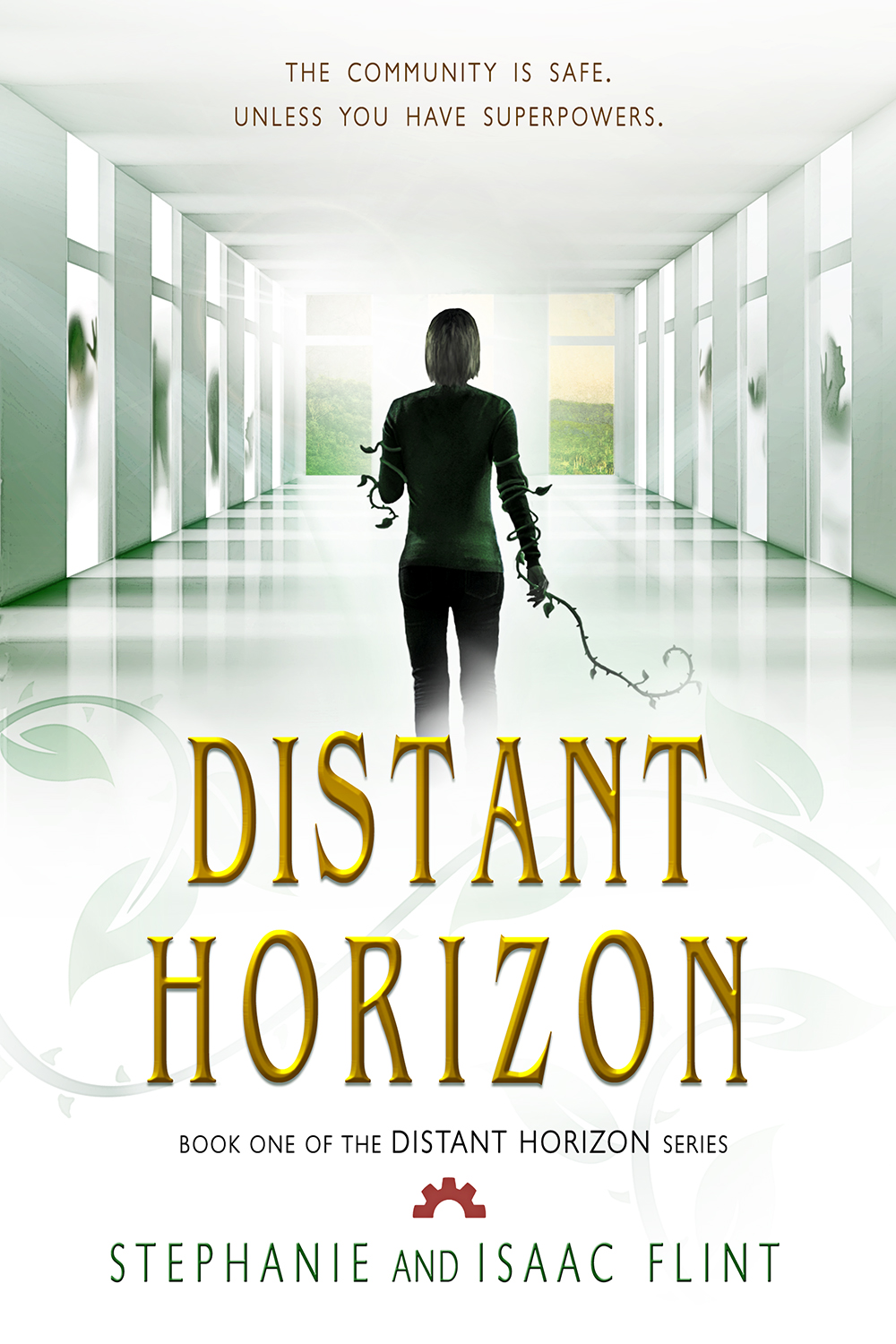
Take a look at this scene from my husband’s and my manuscript of Distant Horizon:

Behind us, Jack snorted. “Superheroes– like comic books. You’ve heard of comic books, right? Video games?”

The three of us exchanged glances. We’d played interactive educational activities on EYEnet, but those weren’t particularly humorous.

“You’ve… you’ve heard of video games, right?” Jack pushed himself from the doorway and gaped at us.

Lance shook his head ‘no.’

Jack grunted. “Pops, I’m telling you– the Community sucks.”

Tim stuffed his hands in his pockets. “The Community is safe, secure, efficient. It’s not… bad.”

Jack is anti-Community, very much a rebel, so he’s going to use curses however he [damn] pleases. Tim, on the other hand, has been raised in the Community, where cursing is seen as inefficient… though they have a few of their own choice phrases (For the love of efficiency, Jenna, hurry up and finish your homework!). When Tim tries to refute Jack, he almost quotes him, but he doesn’t, because saying a curse makes him feel awkward. (Like me and writing half the curses in this post. Though, arguably, it’s questionable whether Tim would have even heard that particular swear). Again, this reveals characterization… not that all characterization is in whether they curse or not. That’s just one tiny aspect of dialogue you can fiddle with.

Now let’s take a look at how we can approach cursing in fiction.

Say the actual word: If you’re writing an adult novel or upper YA, you’re probably safe to use the actual word given your target audience. If you’re writing middle grade, using a substitute might be better. The benefits of saying the actual word come when it isn’t avoidable (the sentence doesn’t work without it, or removing it makes a scene unnecessarily comical), or when it shows a personality trait of the character. You might not use swear words in regular prose, but you might add them to dialogue. Whether you sprinkle them in or apply a heavy dosage depends on the genre you’re writing and your target audience.

Use a substitute: Particularly useful if you’re writing middle grade (where parents tend to be a bit pickier about what their children read), or if you want to add comedy. Also useful if you want to add flavor to the world. Of course, some people prefer to see the actual word, others don’t. Just make sure that the word used fits the situation and feels natural.

However, there are downsides to using a substitute.

If you aren’t careful, you can turn a completely innocent word into a curse for your poor, unsuspecting reader.

When I was a kid, my parents had a filter on the TV. It censured and replaced certain words from the captions (I have a partial hearing loss, so I have captions on whenever possible). I didn’t really care for cursing, so I didn’t mind… with a couple exceptions. One, the filter didn’t always recognize the difference between names and swears… Principal Prickly on the TV show, Recess always had his name filtered, and while watching 8 Simple Rules, the word ‘sex’ would often be translated to ‘hugs.’ (It was a really strict filter).

The problem was that my mind automatically began to translate everything back… even when I wasn’t watching TV.

This is around the same time that a certain “Free Hugs” movement became popular.

*Ahem.* (See what my mind translated that to? Took a while for me to stop wincing every time I saw a sign for free hugs).

Let this be a warning… people will still know the original meaning.

Alternatively, you can also create a negative meaning to an otherwise innocent word. For example, if you tell kids to substitute ‘witch’ for ‘bitch,’ we now apply a derogatory meaning to the word ‘witch.’ Of course, you have the Halloween nasty, evil witch (of which this is probably meant to reference), but keep in mind that there are people who consider themselves witches in practice and don’t act in the way that the term ‘bitch’ usually implies.

That particular factor was brought up when I was reading articles regarding the Clean Reader app (Read the article here about what the Clean Reader app is, and here for the article that mentions the problem of substituting “witch” for “bitch,” if you’re interested).

Also, slight derail, words can take on negative sub-text through similar routes.

For example, take a look at the word ‘gyp’ (as in… I’ve been gypped!) It wasn’t until recently that I became aware that the term derived from the word “gypsy,” referring to a stereotype of gypsies as thieves. Now, in some areas, calling someone a gypsy is a major slur. In others, not at all. Depends on who you’re talking to and how you’re using the term. But it’s something to be aware of.

Like all curses, slurs, and swears… whether or not something is offensive depends entirely on the audience. (In fiction, you can recognize this in how characters react to each other based on what they say or don’t say).

So, you can use a substitute, but make sure it has the meaning you intend.

Reference without specifying: You can sometimes suggest that a person cursed without ever saying what was said. He turned the corridor. Three giant monsters stood in his way. He cursed. This plan was getting worse by the minute.

We’re told that the character curses, but it’s left to our imagination as to what he actually says. I tend to use this one when a world-based curse won’t work. Alternatively, how other characters react to something said in a foreign language we don’t understand can give us the impression that they cursed or said something insulting… even if we don’t know for certain. (Consider how R2-D2 and C3p0 talk in Star Wars. We don’t know what R2-D2 says, but we have a pretty good idea thanks to C3P0’s reactions.)

Eliminate: When in doubt, leave it out… or not. Sometimes a sentence really doesn’t need the cursing to flow properly, and will feel stronger without it. (Remember earlier, where I bracketed the curse words) Sometimes a slight rephrasing of the sentence can eliminate the need for a particular word. Test how the sentence sounds with and without the curse (speaking aloud can be helpful here… though you might want to be alone when you try this) to determine whether the curse adds to the story.

There are some words I tend to avoid when I write, because I personally don’t like them or want to perpetuate a stereotype. For example, I tend to avoid slut because I don’t like vilifying someone just because they sleep with multiple partners, or bastard because I don’t like vilifying people born out of wedlock.

Granted, there may be times when they story calls for these particular slurs, and to use anything else sounds ridiculous. But I typically try a bit harder to avoid those than other curses.

The point is, whether you use cursing in your writing is entirely up to you. If you get your stories published through a publishing press, they may have their own house rules about what stays or goes. But otherwise, you get to decide based on your own needs, and whether or not you think it will work for your target audience.

Like all words in a story, the swear should serve the story. If it doesn’t, cut it. (Your word count will thank you). If it does, keep it.

I hope you found this post useful. How do you handle swearing in your stories?

Further articles of interest:

https://www.goodreads.com/author_blog_posts/2636571-by-odin-s-beard-what-the-frack-is-all-this-sprock

https://dailypost.wordpress.com/2013/10/24/cursing/


Leave a comment

Filed under Writing

Thoughts on Publishing – A To-Do List

I launched the cover reveal and announcement of pre-orders for Magic’s Stealing yesterday, so make sure to check that out if you haven’t already. 🙂

In the meantime, I have ideas for new posts, primarily based on my writing process, though they do include minor spoilers (per usual) for the various stories. Possible topics include “Developing A Magic System – Glass-stone (The Wishing Blade series),” “To Swear or Not to Swear,” “How to Keep Characters Alive Under Dire Circumstances/Using Game-play to Solve a Story Problem (The Multiverse Chronicles),” and “Dealing With Multiple Character Motivations in a Scene (The Wishing Blade series).” Let me know if any of them stand out to you that I should write first.

For now, though, I thought I’d go over my publishing process from the past couple days. If you have any questions, feel free to ask.

Last couple days:

  1. Marked up paper manuscript of Magic’s Stealing. Input changes into ebook file.
  2. Added the table of contents and platform-specific adjustments to each file.
  3. Quickly proofed both files with their table 0f contents on my Kindle.
  4. Uploaded files to Smashwords and Kindle (and discovered that if you have the final file ready, you can set the pre-order for only a couple days away).
  5. Checked that those files uploaded properly the next day.
  6. Added the book to Goodreads.
  7. Changed my accounts to have new author photo.
  8. Updated the main Infinitas Publishing website with the new book cover, blurb and links. Corrected Battle Decks name, and added a blog post.
  9. Tweeted the pre-order announcement from the publisher account (which is specifically meant for announcements).
  10. Prepared a blog post announcing pre-orders and revealed cover. (Thank you to everyone who shared the post! I appreciate it. 😀 )
  11. Responded to tweets.
  12. Sent email to potential reviewer and cover reveal/book launch blogger.
  13. Sent emails to beta readers to offer a thank-you copy of the final ebook.
  14. Wrote up this list to help me keep track of what I’ve done thus far.

Up next:

  1. Complete book cover assignments from separate project (I’m really glad I got through most of those before trying to launch Magic’s Stealing).
  2. Update author photo on Author Central for non-US countries, since they have separate web logins.
  3. Research potential reviewers and make contact.
  4. Continue editing The Multiverse Chronicles episodes. Isaac is getting well ahead of me in getting the rough draft written.
  5. Start writing The Shadow War (I have the first portion written in rough form, but I already know there’s a few big changes I need to make before continuing).
  6. Take a break every now and then. Probably in the form of role-playing one of my favorite characters in the current campaign with Isaac. (Side note: It will be a while before that particular story gets written. It’s highly convoluted… which is what happens when dealing with a super-powerful fourthwaller. *Ahem.*)

That’s the plan. I hope you enjoyed this post. 🙂 Have you had any experiences with preparations for releasing a book?

6 Comments

Filed under Business Ventures, Writing

Thoughts on Writing – Creating a Fantasy Map

I recently received my final beta-reader comments for Magic’s Stealing, and I’ve been making edits (I’ll be doing a cover reveal soon!), but today I’m going to focus on one of the ideas that the beta-reader suggested, which was to include a map of the region.

A lot of fantasy stories include a map of some sort as a way to help readers envision the layout of the land, or the city where the story is taking place. Maps can be used to enhance the feeling of the story (seriously, take a look at the map of Middle Earth) and one article I read suggested that a well-drawn map, which includes elements of the story, can make the world feel more real. It’s sort of like having an artifact from the world itself.

I’ve debated before on including a map, but I originally put the idea aside because I wasn’t sure if I could make it look professional, and also because I didn’t want to lock down the distances before I finished the series.

Then my husband pointed out, having a map would be a good tool for future reference. Not only that, but I wouldn’t have to include it in the first edition of the ebook. I could wait until I release the print edition, then update the ebook at that time.

Anyway, let’s take a look at the steps I’m taking to create the map. I have a rough guide. When I wrote the first draft of this story twelve years ago, I also drew a map in Paint. It’s horribly inaccurate

The estate where Toranih lives probably shouldn’t be as large as the capital city of Cirena. The Cantingen Islands probably shouldn’t be quite so tiny. And there are plenty of other problems.

SBibb - Old Cirena Map

Original map… made many years ago

My husband suggested that I start by writing down the places referenced in the story, then taking note of their directions and the amount of time it takes to travel from one place to get to another, as mentioned in the story.

So I went through Magic’s Stealing and searched for key phrases related to traveling. Minute, hour, road, travel, east, west… etc. I didn’t include directions within buildings, such as going downstairs. Just the kingdom and the cities.

This is what I found in Magic’s Stealing through a basic search.

Fifteen minutes later, Toranih reached the place of the healers. (From the seer’s cottage, jogging)


In minutes they had left the square behind and pounded into the lower city. (Riding hard on horseback)


“We’re two hours from Viyna. A guard could stop here, and we’d be reasonably undercover…” (At the mountain forge, riding on horseback, not rushing)


They fled into the heavy rain, mud spattering them on the road to Viyna. (From the Covonilayno estate)


…and then stormed through yet another portal into the temple in the northern district of Ashan. (Directions within a large city)


The girl was cold and shadowy, colder than the northern village of Reveratch. (Region layout)


“Go to the northern tunnel. Tell Cafrash to send more of his shadows into the city…” (Directions of a tunnel)


“This is it. Sid-Dreh.”//“What’s Sid-Dreh?”//Siklana pushed Toranih out of the way and squinted at the plaque. “South and west, respectively…” (Cardinal directions in Old Cirenan)


…but many of them used the communal oven in the marketplace that had developed in the eastern side of the city. (Layout of Viyna)


The marketplace brimmed with travelers from Ashan, the eastern port. (Region directions)


The ribbons streamed into the sky, a dazzling array of colors, then fled East, away from the city in a glaring river. (Direction the magic is stolen, from Viyna to the mountain forge)


“…If the Trickster branches into the Islands or crosses the sea to the eastern lands, there is no telling how quickly he could rise.” (Region layout)


Ferta was several days out, even by carriage. (Regional layout)


“…When I’m at the academy, I practice in the forest outside of the city walls.” (Reference to Cirena City)

While I may not want to draw out the tunnels on the main map, having a map may make the tunnels be a little more understandable. At this point, though, I’m seeing potential for some interesting back story. How far out do these tunnels actually extend? As you’ll see in a bit, the distances between cities and towns is much greater than the original map suggests. Do the tunnels extend to other cities? Are there towns or dwellings I haven’t mentioned before? Or do they open in the middle of nowhere?

Anyway, instead of trying to mark out the full range of a city or estate, I’m considering following the lead of a few other maps I looked at, which use a basic symbol to designate the location of a city or important landmark. In order to figure out the rough scale, I’ll need to look up the average travel times of riding horseback or walking, and then place my locations based on that scale.

According to this site: http://www.lrgaf.org/guide/writers-guide.htm horses can walk 3-5 miles per hour, trot 8-10 miles per hour, canter at 15 miles per hour, or gallop at 25-30 miles per hour. Now, keeping in mind that weather, type of horse, and condition of horse will effect speed, let’s go with the idea that we’re talking about a horse with decent stamina and who hasn’t been tired from a lot of riding. And let’s go with the idea that the roads in Cirena are of decent quality, and the map is counting on non-rainy days. A general internet search suggests that a fit person can walk 4 miles in an hour (or 1 mile every fifteen minutes), on relatively flat terrain.

So… now that we’ve got some numbers, let’s look back at the descriptions pulled from the story.

Fifteen minutes later, Toranih reached the place of the healers.

In this scene, Toranih is jogging/quickly walking to the temple. She is in reasonably good physical condition, as she’s trying to train to be a guardsman. I had a hard time finding a single average for jogging, so let’s just say that she’s walking. In this case, she walked a mile to reach the temple from the seer’s cottage. If the temple is supposed to be relatively central in the city, then Viyna may be a couple miles wide.

In minutes they had left the square behind and pounded into the lower city.

The characters are riding hard in this scene, but they are likely cantering instead of galloping due to street layout and rain. At the quoted 15 miles per hour, a quarter of a mile per minute, and let’s say 4 minutes, then they have traveled 1 mile from the courthouse to the lower city.

“We’re two hours from Viyna. A guard could stop here, and we’d be reasonably undercover…”

Here, the characters reached the mountain forge by riding on horseback. They took it easy, probably walking or trotting, which puts us at 3-10 miles per hour. Let’s say they traveled at an average of 5 miles per hour. The mountain forge would be roughly 10 miles from Viyna, or if they had cars and a 60 mph speed limit, ten minutes to drive. Picture someplace that takes you ten minutes to drive to on the highway, and now you have the rough distance. (And the kingdom suddenly feels much smaller).

It was going to be a long week (of traveling through the wood).//Scene break//After a full day of assuring her sister that not only were bandits rare in this forest, but she was protected by two mages and– ahem– a well-aimed knife thrower, Toranih finally led Starlight to the forest edge. The dusty road from Viyna to Ashan wound its way in the distance around the edge of the forest. Though the road was smoother, the route jogged several miles north and was usually filled with travelers, adding almost a week to the trip when a couple days of hard riding through the forest would do.

They’re in a hurry to get through the woods, but it’s been raining and they’re somewhat tired. Let’s say their pace averages a fast walk, at five miles per hour, for seven hours of the day. That’s 35 miles a day, or 175 miles after five days of traveling. According to the narration, the road between Viyna and Ashan that avoids the forest adds a day to the trip, whereas hard riding (when possible), gets them quickly through the forest. Say ‘hard riding’ is 7 hours a day (based on 7.5 hours I read somewhere on the internet…which I don’t remember where now and may not be all that accurate) at 10 miles per hour due to rough terrain, so that would be 70 miles per day, or 140 miles in two days.

If they took the road directly from Viyna to Ashan, instead, then they would be walking 7 hours a day, 4 miles per hour, and let’s go with a full seven days, approximately 196 miles. Granted, if they stop to rest one or two of those days, and that’s been taken into account, then the distance isn’t quite as great.

But I went ahead and plugged 196 miles into Google Maps to get a comparative distance with a road I’m used to traveling, and eeps.

Ranging from 140 to 200 miles wide, that forest is much larger than what I was picturing.

This is why having a scaled map is a useful tool for world building. Even if you don’t give the readers the actual scale, you can figure out relative distances without having them wobbling all over the place.

So, for my test run, let’s say that this forest is 140 miles. I picture the edge of the forest not being too far from Viyna, maybe a quarter mile, and maybe a couple miles from Ashan. For the Cantingen Islands (which are mentioned in the second book as being ‘near’ to Ashan but without a more concrete detail), I went to look at the distances from other islands to a mainland. Miami, Florida, to Bailey Town, Bahamas, is about 55 miles out, according to Google Maps and a trusty ruler.

Let’s say the Cantingen Islands are 60 miles from Ashan.

Now, let’s look at another city…

Ferta was several days out, even by carriage.

Horses trot at 8-10 miles per hour, and I read that a pair of horses pulling a carriage would move faster than the average horse alone, so let’s go with 10 miles per hour. Then 8 hours of riding for 4-5 days, we’re looking at around 320 to 400 miles away.

It doesn’t even fit on my initial map attempt.

SBibb - Cirena Map Test Run

Then my husband reminded me that people rarely travel in straight lines. There’s hills, glades, rivers, lakes, avoiding certain unfriendly estates, resting the horses… a number of things that could increase the time, but not the distance.

So I took my current references, redrew a map that actually includes geography, replaced the cities with the scale as a general guide, not rule, and now I plan to check the narration to revise for the updated travel times (or have them be a little more accurate, anyway). I don’t plan for this to be the final version (since it’s missing a few cities and roads), and I probably won’t put this in the ebook.

But it should make a lot more sense than the original version–other than the fact that this map has the mountain forge at 90 miles away from Viyna, which doesn’t exactly work for the story.

Oh, well. It’s a starting point.

SBibb - Cirena Map Updated

I hope you enjoyed this post. 🙂

Have you ever tried making a fantasy map? What difficulties have you run into?

4 Comments

Filed under Photo Illustration, Writing

Thoughts On Writing – Using Subplots To Tie Everything Together

Last time I blogged, I talked about figuring out what happens next in a scene. That process helped me out considerably with the scene I was working on, along with a few scenes before that. However, I’ve been running into a new problem–figuring out how to get the ending to fit together.

The story I’m currently working on is supposed to be a romance with science fiction elements. One of the scenes I visualized for the ending was… well… not romantic. The characters stay together, but there’s this looming shadow of oppression hanging over them both.

Not exactly a happy ending.

I tried day-dreaming alternative ways the scene could play out. I originally had Special Forces tapping Cole’s phone, and so they overhear when Amy says that Mr. Rivera is a member of Challenge, a supposed terrorist organization. But then my husband pointed out that, as Cole’s supervisor, Mr. Rivera would be the one to hear the message first.

No Special Forces agents descending on the group, leading to a major fight scene that doesn’t end well for anybody. Not unless Tamara called the police earlier, but that didn’t make sense with her motives.

So I started plotting what might be said if Tamara and Cole sat down confront Mr. Rivera directly. One of the things I pictured Mr. Rivera saying was that not all members of Challenge were the bad guys. Then I realized that I already had the elements in place to include an actual bad guy who was working for Challenge.

All in the form of a separate subplot that I’d largely forgotten.

This is a scene from earlier in the story, one which made me realize I had an undeveloped subplot waiting to be used.

“What took you so long?” Amy looked up from her phone and raised an eyebrow. She was probably playing an EYEnet game, or something like that. “Get lost in the cafeteria? Or did you meet somebody cute downstairs?” She eyed my empty laundry basket suspiciously.


“Unless you count the police officer, not really.” I dropped onto the bed and yawned.


Admittedly, the guy had been cute. Light brown hair, closely cropped to his head. Square jaw, and a smattering of super-light freckles across his cheeks. Didn’t look badly built, either. But I’d been too worried about the ‘painting’ to dwell on his looks.


“Police officer?” She frowned and lowered her phone to her lap. “What happened?”


“Someone drew a picture on the wall.” I sighed, already removing my phone from my pocket to show her.


“A policeman came for a picture?”


“Not just any picture.” I passed her the phone. Her green eyes widened as she stared at the picture I’d taken. “You okay?”


I wrestled the phone back from her fingers. Her knuckles had gone white from how tight she was gripping that thing.


“Yeah,” she whispered. “Wish I’d thought of that.”


I blinked. “What?”


She laughed dismissively. “Using laundry detergent to paint a picture. It’s imaginative. Even if it is… well… you know.” Her voice dropped off, and her lips twisted into a frown. She was still eyeing my phone.


“Should I delete the picture?” I asked.


“What?”


“You know… so it doesn’t look like I’m supporting them?”


She scoffed. “You? Supporting them? Please. You’re like… the community ideal. Or you will be, if the whole EYEnet Match thing works out. You already reported this to the police, didn’t you? That’s how they found it?”


I nodded.


“Then you’re fine. Long as you weren’t the one who painted it.” She swiveled around to her computer.


“I’m fine? Someone around here is painting terrorist symbols on campus. In our dorm.”


Amy shrugged. Her blond ponytail bobbed inconspicuously. “I’m not worried. It’s probably just a student wanting to cause a ruckus. And even if it is someone from Challenge, I still wouldn’t worry too much. Didn’t you read those articles I gave you? Most those people probably aren’t going to do an outright attack. They need allies, not enemies, and attacking innocent people isn’t going to win them brownie points.”

Originally, I had planned for Amy to be the one doing the painting, since she has ties to Challenge. But as I wrote this scene, I got the distinct impression that Amy wasn’t the culprit. While I want readers to wonder if she is the culprit, this scene is also foreshadowing. If I weave in other incidents similar to this one, I can hint that there’s someone else on campus who is leaving behind these symbols.

Someone being reckless.

When I get to the scene where Tamara and Cole must choose between reporting to the police that Mr. Rivera is part of Challenge, or working with him, it helps if they have someone to rally against. In this case, a rogue member of Challenge who might actually be a threat.

The stakes are high for both sides. If this rogue is discovered, they draw attention to the ‘good’ Challenge members–Mr. Rivera and Amy. In addition, if this rogue makes an attack, innocent people are at risk. Since Tamara is interested in finding out the truth behind Challenge, she’s likely to get involved. Cole may get involved to protect Tamara and learn more about his supervisor’s (Mr. Rivera’s) secrets, while Amy would get involved because she wants to dispel the notion that all members of Challenge are terrorists.

Thus, by following a subplot that got planted earlier in the story, I may have a way to bring both sides together, raise the stakes, and still have the potential for a happy-ever-after.

But that’s still to be determined.

Now that I know someone other than Amy is leaving the symbol in public places, I’ve got to decide who they are, what they want, and how far they’ll go to get that.

Lesson learned? Subplots can be a helpful tool to move your story along and flesh out the world.

I hope you enjoyed this post. 🙂

Have you ever found a piece of foreshadowing or minor subplot to be useful later when writing a story?

7 Comments

Filed under Writing

Thoughts on Writing – Consistency of Style

With Magic’s Stealing out to beta readers, I’m trying to avoid working on that story line until I get the collected thoughts of the readers. That way I can evaluate all the comments and figure out how best to apply them. In the meantime, I’ve switched gears. I’m working on Isaac’s and my Distant Horizon story line. The first book is written and mostly polished, so I’m working on plot consistency in the second book. To do that, I’m rereading the first book to refresh my memory on what changes were made. (Seriously… my notes suggest I’ve read the first book twenty times. Granted, some of those rounds only involved skimming for minor edits, but some of those included major overhauls, and needless to say, I’m starting to get a little tired of rereading it.)

During my read-through, I realized that there’s a shift in the writing style from the first few chapters to the later chapters. There’s less description, more every-day action, and the slow set-up of things starting to go wrong for the protagonist. Events are happening, but I’m worried that they aren’t as enticing as they could be. Now, one possibility is that I’ve read through these first few chapters so many times that it’s all kind of a gray blur. I know the plot too well, but the story may be fine as-is. The other possibility is that there’s a definite shift in writing style that needs to be corrected, or risk turning away readers who might otherwise be interested in the story.

When the story first starts, its sounds very much dystopian:

The first time I flushed adominogen, the oblong capsule tumbled from my hand and bounced off the bathroom sink, once, twice, then fell into the toilet with a finalizing plop.

Gone.

I waited all day for someone to ask why I didn’t report accidently losing my pill. But no one did, and I didn’t have any of the hallucinations that I might have had for not taking adominogen. Instead, the world around me felt so much more alive. My attention improved, not that it was bad to begin with, and I could think clearer. Be more efficient.

After that, I stopped taking the pill. I graduated high school and moved into my first year of college, no sign of theophrenia. But when our hall advisor announced that the annual Health Scan would take place in two days, I panicked.

I needed three things to graduate: excellent grades, as many efficiency points as possible, and to pass the scan. It wasn’t often that someone failed, but it did happen. One of my friends in high school had a sister who failed. Galina. She took the scan at the clinic downtown, and Special Forces escorted her away, all while assuring her everything would be fine.

I didn’t want to end up like her, so right after the announcement yesterday, I took the pill. It was like throwing a clear, plastic tarp over my world. I couldn’t concentrate, but I couldn’t go to the doctor for the symptoms.

Not taking the pill was an international offense.

And a little bit later, still in the same style:

After the incident with Lady Black, I had this constant, nagging feeling that someone stood right behind me, watching me. Stalking me. If this was the plague, then I could only guess this was the onset of paranoia, the delusion that I was somehow important enough to warrant special attention.

Or I maybe I was just paranoid; the Health Scan was less than twenty-four hours away.

My bedroom door rattled and I looked up from my biology book. Faint, golden light traced my desk, highlighting the leaves of my plant and trailing along the edge of my bookcase.

The doorknob rattled again, followed by a new, chinking sound of metal.

I scooted from my chair, then sidled against the wall before checking the door’s peephole.

No one was out there.

Maybe the air pressure was playing with the hinges.

I opened the door and stuck my head into the hall. A couple students passed by, but they’d been too far back to affect the door.

But, as the story progresses (leaving act one into act two), the style shifts, bringing on more description:

Pops led us into a dark, narrow hall, a far cry from the neatly glowing dorm corridors. What might’ve gleamed with bronze reflections was now a dull, dented bit of metal. Yellow lights ran the length of the ceiling in small round inlets, casting a weird, brownish glow over the area. One of the lights was burnt out, and another was completely missing, the socket bare.

We headed up the second flight of stairs. The elevator we passed had a piece of yellowed paper with a DO NOT USE warning taped across it.

“We’ve been running on minimal repairs,” Pops explained. “We have decent funding, but we haven’t had a chance to resupply, and Crush only has so much time to work. He usually monitors the computers for signs of enemy activity.” Pops stopped at a plain, bronze door at the top flight of steps. “This is Jim’s office. My room is across the hall.”

Inside, a dusty world globe sat on the corner of an ornate, wood desk, obscured by various file folders and papers. Books were piled high, their spines haphazardly stacked like a puzzle game. An ancient, faded rug lay beneath the desk, so worn that its vibrant, geometric shapes and numbers were barely distinguishable. Bookshelves surrounded us from floor to ceiling, organized and decorated with models of antique stealth planes and trinkets. A giant, arched window graced the far wall, overlooking the night sky, and two red, plush chairs sat opposite the desk, where a reading lamp blanketed the room in a warm glow.

Later, part of an action sequence:

I followed Lance, since he was closest, and we huddled in the leaves, taking shelter from the fight. A local rushed the monster, and the beasts grabbed him by the throat and yanked him from the ground. Bones snapped and his screams fell short.

“We’ve got to help,” Lance said.

I wasn’t sure if it was his heart or mine pounding double-time in my ears.

No wonder Inese gave me her gun.

Behind us, there was no sign of Jack or Matoska, and I couldn’t hear anything more than a mingled mass of screams and shouts. Ahead, more beasties darted through the field, half-loping, half-running. One was lanky and pale, what little clothing it wore hooked over its bony waist. Crusted blood and clods of dirt plastered its skin. A feline eye stared my direction, while the other was swollen shut.

Other beasts were bulky and heavily muscled, swinging swords or metal clubs, bashing in the locals’ skulls if they got too close. A large glob of water hovered around a beast that stood straighter, more human than the others. The creature lunged at a man and water splashed onto the electric spear. Static traversed the metal shaft. Both man and beast crashed to the ground as electricity coursed over the beastie’s water-slick skin.

In the long run, I see a potential benefit of keeping the story the way it is because, as the style shifts, it suggests that the main character, Jenna, opens her eyes and really starts to see the world as it is, not how it’s portrayed by the sheltered Community. The story goes from being light on description to heavy on description, and the writing style includes thicker paragraphs. In addition, at least in the examples I’ve posted, the character goes from reflecting on the world around her (distant), to becoming heavily involved, a participant. Which might not be a bad thing. I won’t know until I have it available for readers to read.

I hope you enjoyed this post (and the sneak peek at Distant Horizon), and I’d love to hear your thoughts. Have you experienced any issues with keeping the style and tone of a story consistent? Have you read any books where the style shifted subtly, or even dramatically?

Leave a comment

Filed under Personal Work, Writing

Thoughts on Publishing – A Novel or Three Novellas?

In general, I write novels. Then I trim said novels because their early drafts are excessively long. However, I’ve recently become fascinated with the concept of serial novelization. You release the novel in several parts, with the idea that readers know they aren’t getting a complete work at one time and that the next installment will come in a timely manner. I toyed with the idea of doing this for my current manuscript, The Wishing Blade, with each installment between 10,000 to 15,000 words. But as I started the rewriting stage, I realized that each section didn’t feel complete. The sections left on a cliffhanger, and weren’t really satisfying.

The other serialized option I’d studied was to write a complete short story (or novella), and make sure it had a full beginning, middle, and end, even if it was part of a larger work. At the moment, I’m thinking that might actually work well for The Wishing Blade. Each installment would be around 30,000 words, maybe more, with an expected three installments. I could release the story sooner, while still producing a reasonable quality work. Each story would be complete in itself, so there would hopefully be fewer unhappy readers who aren’t satisfied with the ending. With each installment, the reader should feel the series has made progress. Think about the show Avatar: The Last Airbender. (I think Legend of Korra and Fullmetal Alchemist where this way in their first seasons, too, but it’s been long enough since I’ve watched them that I don’t remember). For the most part, each episode (or set of episodes) felt complete, even though there was a larger story arc in progress. Granted… I’m still in the second season of Avatar, so that might change.


So here’s how it would work.

1. I separate The Wishing Blade into three novellas. They’re tentatively called Magic’s Stealing, The Shadow War, and The Immortal Realm. (What do you think of the names? Good? Bad? Neutral?)

2. I then figure out the story arc for each individual novella. This is crucial, because while reading them in order would be preferable, I also want readers to be able to pick up book three, enjoy it, then go back to book one. I personally have a habit of grabbing whichever book interests me… even if it’s in the middle of the series.

So the novellas would look something like this:

  1. Magic’s Stealing: Focus on the loss of ribbon magic in Cirena. Main character who hates magic is suddenly one of the few who can still use magic, and she’s trying to figure out what happened to the magic and where she fits into the whole scheme.
  2. The Shadow War: Main characters get separated. One works from within the shadows to foil the trickster god’s plot to kill the gods and get magic for himself. The other seeks out glass-stone, a material which has been proven to kill shadows and not be susceptible to shadow magic, then seeks to protect and warn others in the mortal realm. (For those of you who read my post on creating fantasy languages, this is where word magic shows itself).
  3. The Immortal Realm: Character in shadow realm escapes into ‘immortal realm’ and seeks out artifact (from book one) which could wipe out shadows for good. Other character defends Cirena’s capitol city from the shadows’ massive onslaught. They’ll either succeed in their separate goals, which serves to aid the other, or they’ll fail and the shadows will take over the kingdom.

3. Edit book one and make shiny. Send to beta readers for feedback. Work on a different story in the meantime (either finish the rough draft for The Wishing Blade: The Shadow War, or work on long-overdue edits to book two in my husband’s and my Distant Horizon universe). Once beta readers return comments, I’ll review said comments, make edits as necessary, then set book one aside for a while. Work on The Shadow War in the meantime.

4. Polish book one. Do what editing I can, maybe get an additional beta reader to proofread for errors.

5. Begin publishing process. Upload to Kindle and Smashwords, and consider other markets (I’m currently considering Drive Thru Fiction and Draft2Digital, but I haven’t had experience with either). For now, The Wishing Blade will be in ebook format only. I hope that once I have all three books out, I’ll be able to earn enough from them to purchase a block of ISBNs. Then I’ll need to decide if I want to make a collected print edition with all three books, or make a separate edition for each story. (If you’re looking for a length comparison, I’ve been looking at the old Animorphs series. Wrong genre and age group, but the word count is about right.)

6. Continue process with book two. I’m hoping to release each book around two months apart, though I may change my mind on that once I get further into this process.


Granted, there’s a lot more going on in the background (my husband and I setting up a partnership to publish this, and we’re picking up the DBA, EIN, and trying to figure out tax forms, etc…) but this is what I’ve got going on in the front end. Hopefully you found this post to be interesting, and I’d love to hear what your thoughts are regarding this process. 🙂

6 Comments

Filed under Business Ventures, Personal Work, Writing

Thoughts on Writing – To Time Travel or not to Time Travel

In my current manuscript, The Wishing Blade, I’ve been streamlining the original story while striving to maintain the overall tone. I started the original draft in 2003, and I set it aside for several years before pulling it out again this year to revise it into a workable manuscript. While some plot points have been easy to keep or discard, there’s one point I’ve been going back and forth on… whether or not to keep the time travel incident in the novel or whether to remove it all together.

Now you get to have a first hand look at my thinking process regarding revisions… all while I try to work this out for myself.

First, let’s look at reasons to remove this incident:

1. Potential Confusion: I have a tendency to confuse people once I start talking about time and dimensional travel in my stories, and I’ve seen agents list ‘no time travel’ in what queries they accept. (However, the last point is negated since I intend to self-publish this particular story. And technically, while some agents might not want time travel, others might. So this bullet revolves entirely on whether or not the incident is confusing to readers and pulls them out of the story.)

2. Potential Loss of Tension: One of the main characters must ‘die’ if the time travel incident remains. The other character goes back in time with the aid of the gods, and they prevent the death of the other character. There are complications that arise once the character returns to the present, but those complications are minimal. Worse, by showing readers that there’s an object that does allow time travel in this particular universe, any future sequences threatening the main characters’ lives is moot, because readers may then wonder why the characters don’t just go back in time and fix it?

3. Unnecessary Plot Point: At this point, the time travel device only allows time travel once in the story. It does do other things, but I could pretty easily remove the time travel incident and chalk up its bizarre powers to other magic.

Possible solutions:

1. Streamline the sequence: Make sure what happens is clear to readers (or is as clear to the readers as it is to the main characters…).

2. Consequences: To avoid loss of tension, I could make sure there are consequences to going back in time. (In this case, I need to make sure those consequences are clear to both character and reader). Also, I could make the complications that arise from time travel a little more immediate. This was actually the case in the original draft, but was removed when I didn’t find a reasonable place to reinsert the point. (And this is a good example of where having fresh eyes to look at a manuscript can be useful, because you might remove an important tidbit without noticing the resulting effects).

3. Increase Relevance: Similar to the point about consequences, if I can better tie in the time travel incident to the main plot, along with making the incident crucial with what’s to follow (along with the irony of the incident regarding the antagonist), the incident shouldn’t feel out of place. Linking the antagonist further into this scene could also improve the overall story.

Besides the reasons I might remove the incident, I’m also considering reasons to keep the incident:

1. Character Development and Increased Tension: We get to see the antagonist step forward to protect one of the main characters– and get a hint as to why, and what she’s willing to do if that character dies (and remains dead). The goal? Tension rises as the character she’s trying to protect risks their life time and time again, because if the antagonist loses said character, all bets are off in regards to what she’s willing to do to achieve her larger goal, and what she isn’t.

2. Magical World Building: We have an explanation of why the ‘time travel device’ reacts a certain way to the bad guys later. Cause and effect comes into play, and the world gets a little more exploration. And we get to see more of the various character relationships.

3. Time Travel Is Cool: I like time travel and dimensional world travel. I know, that’s not a good excuse. But really… we’ll get to see the effects of time travel first-hand in the story. We don’t just hear about it from a side character.

4. Paradoxes! Or so the characters think…: The incident sets up tension between the antagonist and protagonist, because the protagonist knows who the antagonist is but doesn’t know how they got there…

This is a case where beta readers will come in handy. They’ll help decide if the time travel plot point should be removed altogether (requiring a light restructuring of the plot), or whether the plot point works. For now, (thanks in part to having a friend enthralled by the backstory of the antagonist), I’m going to keep the incident.

So… onward to editing, and I hope you enjoyed this post. Let me know what you think, and please let me know if there’s any topics you’d like me to cover. 🙂

2 Comments

Filed under Personal Work, Writing

Thoughts on Writing – Creating Fantasy Languages

One of the topics I’ve been thinking about recently is creating fantasy languages. Reason being, I’m creating a language for use in my YA fantasy manuscript, The Wishing Blade. Now, in the original draft (and even across several drafts for different books in that world), I only had a handful of made-up words sprinkled into the story to give it flavor. This time, however, the use of the language system suddenly had a reason to shine– I actually intended to show ‘word magic,’ one of the magic systems in my Cirena stories coming from the Cantingen Islands. Suffice it to say, creating a language has been fun, if not a bit difficult.

When I attended ConQuest, one of the panels I attended was about creating alien languages. Some of the topics in the panel included: deciding how in-depth you wanted the language to be– do you want to have a word here and there, or will there be full sentences in this language? How does it look? How does it sound to the ear? Might it have odd sounds (like clicks) that you might not normally read? Do you base your new language off of a current language, and if so, how do you change the language to fit the needs of your story? For example, does a word or phrase mean something now that it doesn’t mean in the future where your story takes place?

All of this is food for thought and can be applied to a fantasy language of your creation. For example, I like the idea that language changes over time. We can portray this in our stories. An example of this in The Wishing Blade is the name of a town, Shuhritan Fritarando. Which no one says because it’s ridiculously long. Most characters, unless they happen to be upper class or a particular linguist (I’m debating on my word mage correcting my main characters about the city’s name), are simply going to call the town Shu Frit. It gets even more fun, because the full name isn’t entirely exact. Shuhritan is an ancient Cantingen word for ‘male royalty’ or ‘king.’ Fritarando translates to ‘small male kin.’ Which could mean nephew, cousin, son, etc., but in this instance refers to ‘son.’ Shu Frit becomes ‘Little King’ in the terms of cultural history, even though neither word actually means that. It’s a colloquialism, informal and a pain to translate, but a natural part of how languages evolve.

Of course, this whole explanation may never show up in the story itself (and probably shouldn’t), but it shows how you can play with language to create cultural history in your novel. It’s a way to add flavor.

However, not everyone in my story is going to use such colloquialisms. In the example I gave, the characters are referring to a language that’s outdated. Outside of naming conventions, the language is only used by word mages. Due to the nature of word magic, these mages need to make sure that what they say is exact– or risk the consequences of having a fireball light them on fire instead of their opponent. Pronounciation is key. Which is why, when I went to place all the words and phrases I had thus far into an Excel spreadsheet, I realized that I needed to change one of my words. I had qui meaning ‘as,’ quis meaning ‘good health,’ and ki being an emphasized word that connects an unusual modifying word to what it is modifying. And they were all pronounced like the English ‘key.’

That could get dangerous for a word mage who is trying to say something about ‘good health’ and instead has his word translated to ‘as.’ (As what? Something deadly?)

So I changed qui to li and did a word search in my manuscript to make the changes. Small details, but hopefully fun for anyone who pays attention to the language in the novel. Eventually I want to make symbols that represent each phonetic pronunciation. (Oh, IPA (international phonetic alphabet)… so fun in high school theater).

If you decide to create a language for your story, I highly recommend writing down the words in a spreadsheet and keeping track of your rules. I recently updated my word document of notes into an Excel Spreadsheet. When I did, I saw several potential problems that I went ahead and fixed. Primarily verb conjugations. (Spanish… French… these classes are starting to be rather helpful, even if I never did become a proficient reader of either language). The Cantingen language is supposed to be precise. Repetitive, even. And I really didn’t want to mess with irregular verbs. So I adjusted each verb that I ran across. As long as you know the ending for “I did something” versus “you did something” or “he did something,” you’ll be able to tell who or what the verb refers to. None of this irregular verb mess we commonly deal with in English. In addition, a single add-on to the word will signify if something is past or future.

Is this a simplification?

Oh yeah. Definitely. But I’m not trying to be Tolkien (though I did try to learn Sindarin Elvish several years ago. Didn’t get far, but I got a few words of Enya’s “May It Be” translated into Sindarin beyond what was already translated). My goal is to add flavor to the story, and keep the language consistent.

And maybe try writing a song in pure ancient Cantingen. That would be fun, though that’ll be after I get more words and verbs ironed out. There’s plenty more that can be said about creating languages, but I’ll leave that for a later post. Let me know what you think, and I hope you enjoyed my ramblings. 🙂

21 Comments

Filed under Personal Work, Writing

Thoughts on Writing – Writer’s Block

Writer’s block… that pesky concept that makes writing difficult and that everyone loves talking about. How to break writer’s block, how to deny writer’s block…

When it comes to writer’s block, I find that trying to write something, anything, is better than writing nothing at all, because it pushes me to another point in the story. But how to work through ‘writer’s block’ is different for everyone. For plotters, this is where having that outline is handy. You write what’s next on the outline, even if you’re cringing as you write. It might not be as terrible as you think once you go back and take a second look. For pantsers, this is where deviating from what you thought you had planned and saying ‘Forget what’s supposed to happen next. I’m going to write whatever comes to mind.’ comes in handy. It might end up leading you to the break-through you need.

One of the things mentioned at ConQuest was that you can’t always force a novel to do what you want. Having trouble writing a scene can be a sign that what you’re trying to write doesn’t fit the novel you’re writing. On the other hand, one of the most important things I took from my creative writing minor in college was that the difficult scenes we tend to avoid writing can also be the best ones to read. With a little polish (or a lot), these scenes can be fantastic. Or… you might read back through the scene and wonder what you were thinking. This has happened to me, especially in my Distant Horizon manuscript. *Cough.* So you learn from trial and error which scenes are causing difficulty because they’re taking you out of your comfort zone, and which scenes are causing difficulty because they simply don’t fit.

For example, I’ve run into a set of scenes in my current manuscript, The Wishing Blade, which are completely new to the story line. These scenes aren’t in my original manuscript, but with the edits I’ve written, they are necessary to keep the story moving forward. Ultimate goal: The good guys want to stop the bad guys from gaining enough power to attack the gods and successfully plunge the country into shadow. Literal shadow… the bad guys’ magic consumes the mortal realm and thrusts it into a dreary half-dimension where the bad guy have complete control over everyone in it. There are two main characters, Toranih and Daernan, and a goddess has granted them some of her magic in an effort to fight the bad guys. Thing is, Toranih absolutely hates magic and would rather be a swordsman. But she gets caught by the bad guys, turned into a shadow, and she has to deal with resisting the bad guy’s magical commands. Daernan isn’t particularly gifted with weapons, but he’s got a decent skill when it comes to wielding magic, and he’s working with a group of people in an attempt to help refugees escape from a city under siege by the bad guys, all while trying to figure out how to get Toranih out from the shadow realm.

Problem is, in the original version of this story, Daernan thinks Toranih is dead, and there is no one else to help him with magic, so he ran along to the king to warn the country about the attacks and put up a defense at the castle. Now he has different motivations, which I’m trying to sort out before I write the next few scenes. I need to know how much he’s going to do to help save the innocent townspeople, which will help for a time, and at what point will he abandon them to go retrieve a weapon that will defend against the shadows in the long run. As for Toranih, she’s trying to slow the spread of the shadows, but I’ve been having a terrible time trying to get through the scene where she acts against their leader. (Because she’s overconfident and actually thinks she might be able to assassinate him. Yeah– that’s going to work so well).

But every time I sat down to write the scene, I wasn’t sure where to go next. My plotting sort of… stopped.

Then my husband, Isaac, gave me the solution that I needed all along. Toranih doesn’t like magic, but she likes swordplay– which is something the bad guy is good at. In the original version of the story, she’s caught in the shadow realm and forms an uneasy friendship with the bad guy, learning from him as she tries to foil him. In this version I have her trying to assassinate him, but I wanted to have her fail miserably. Unfortunately, I wasn’t sure where to go once her attempt failed and he got her back in line. But when Isaac suggested that she attempts to attack the bad guy, who then casually tosses her one of his swords and more or less starts training with her (much to her confusion), this opened up a whole new possibility. Because now she’s not the moping and following the bad guy around because she’s being magically commanded to. Now she’s having to deal with inner conflict. She can learn quite a bit from the bad guy if she sticks around, and it puts her in a position to be close enough that she might be able to strike him later. However, she still doesn’t like being a shadow, and as long as she’s nearby, he might order her to do something she doesn’t want to do.

Which keeps the story rolling and keeps me interested in writing what happens next.

The whole point of this example is that when you’re stumped, you may want to explore new options, or step back and consider character motivations. Or maybe step in and examine character motivations. For my story, there’s a lot of other stuff happening off-screen that affects the main characters. But if I put too much attention there, the task of writing becomes overwhelming and I forget to focus on the characters who are actually important. So try approaching the scene from a different angle. Stop worrying about what the rest of the story world is doing and write what matters to your main characters. Once you’ve got the rough draft written, then revisit the rest of the world.

That being said… it is entirely possible to be stumped on a scene and to use your procrastination as a tool to get chores done. I think this is how I actually remember to do laundry.

Anyhow, I hope this post was helpful, and please let me know what you think. 🙂

Leave a comment

June 1, 2015 · 8:00 pm