In the world of The Wishing Blade universe, everyone has two strings of magic. One strand is life. The other strand is death.
Actually, their entire world is made of strings, which is why string mages are particularly powerful, but those two strings are extra important for magic.
Why?
Life magic is the key to a person’s free will and awareness. Without it, they go into “zombie mode” and act solely on instinct. They’re quieter, and don’t tend to resist magical commands well.
This is also the string used to created “inhabited” or cursed objects (and if that object is glass-stone, it changes from clear to a smoky, glossy black, reminiscent of obsidian. This is a huge point in my upcoming Legends of Cirena novel, The Dark Forest of Aneth. People, and especially priests and priestesses, typically try to avoid inhabited objects.)
But why tie life magic into an object?
Well, it allows the wielder, or a specific user, to power enchantments without expending their own willpower. (The catch here is that if you tie someone’s life magic to an item and that person has a strong will, you might be fighting their will instead of simply powering an enchantment).
Life magic is the string provided to mortals by Listhant-Nsasrar (Lishivant), Cirena’s high god.
On the other hand, death magic is the key to a person being able to die, to sleep, and to dream.
Without their string of death magic, they will eventually go mad unless they have a way to magically induce sleep or go into a meditative trance. (And getting mortally wounded without death magic unpleasant, to say the least. But very effective at keeping them technically alive).
This is the string provided by Madiya (Madia), the goddess of the dead.
If you’ve read “Stone and String,” you know that Edyli lost her death magic after infuriating Madia.
But she’s not the only one who has made Madiya furious.
Ralendacin (Shevanlagiy in The Wishing Blade series) lost access to her death magic, but due to a magic-meets-magebane accident that she might have overpowered with some artifacts she shouldn’t have used, when she “dies” she instead wakes up in another world. (Is this at all tied to something to do with her life magic? Read the Wishing Blade series to make some theories of your own on that…)
Unfortunately for those worlds, Shevanlagiy has a tendency to destroy any world that fails to give her what she’s after, and thus she gained the nickname, “The Destroyer of Worlds.”
Her method of destroying worlds tends to unravel the strings that hold them together, or outright obliterate the strings, giving the gods in the Wishing Blade series a very strong incentive to keep her from destroying this one, too.
* * *
A spell to infuriate the goddess of the dead (Stone and String)…or an opponent who has already made that goddess furious (Magic’s Stealing)…
So far, Isaac and I have done all the photography for The Wishing Blade series covers. And when it came to the cover of Magebane, we’d been planning that cover for a while… even bought the candle holder specifically with the intention of shooting this image.
(It wasn’t entirely an excuse to buy more Depression era glass. Not at all… *Cough.*)
And though it’s been a while since we released Magebane, today I want to talk more about the glass on the cover.
True story… when first proofing the cover, I asked for feedback and someone said it seemed a little too radioactive green. Funny thing about that… That green was intentional, and they weren’t actually wrong.
That glow is the result of UV light shining on the glass and fluorescing with the uranium salts coloring the glass. I actually had to lower the amount of light coming from the candleholder while working on it in Photoshop.
Don’t believe me?
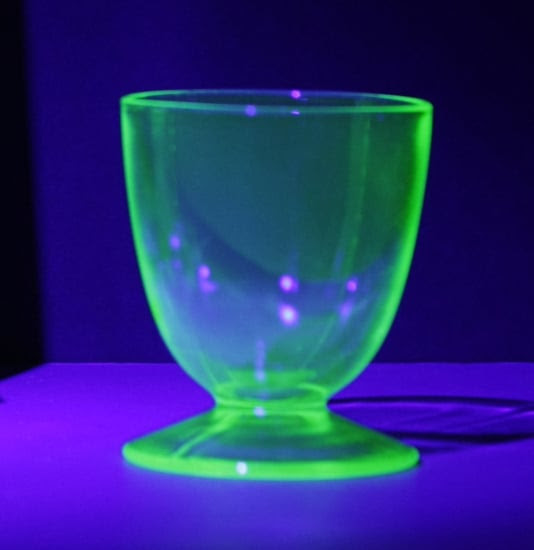
Here’s a look at an unedited photo from the photoshoot:
There’s a model lamp at the top providing a general light, but that purple light you see is from the UV light. The glass is Depression Era glass.
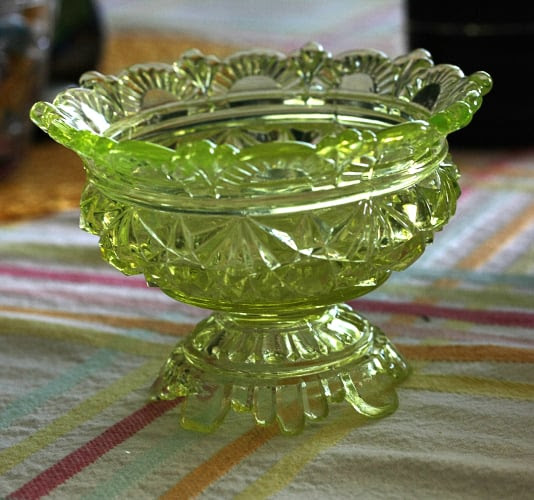
Here’s a look at the same glass but without the UV light.
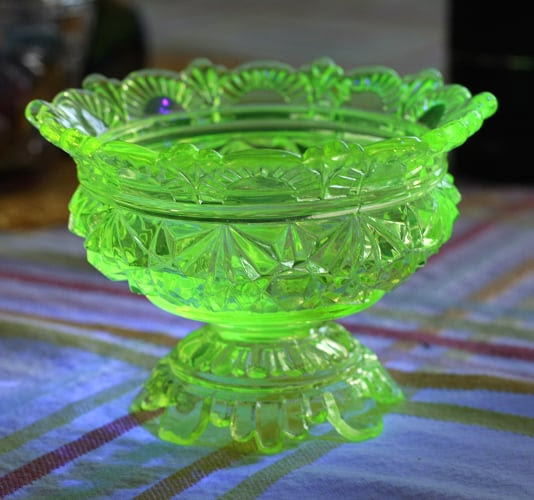
We also shot a set of daisy button glass dishes we considered using (which I believe are actually Victorian era, rather than Depression era, based on their color and pattern), but decided to stick with the candle holder as the main image.
This one just has UV light on it, and no modeling lamp.
It glows hot. Which has been my experience with most yellow uranium glass that I’ve come across.
This, by the way, was with the cheapy UV light we bought at Walmart. Later, we acquired a more powerful UV light (different wavelength, better visible light filter), and these pieces were even brighter.
Now, let’s go into more detail about the real life inspiration for the story’s “magebane” / “charlago.”
The good news is that this glass is not as destructive as it is in the story.
However that “radioactive green” look might be a little more accurate than you first expect. Often known as “Depression Era glass,” these pieces are usually a kind of odd, Vaseline green or “canary yellow” color. You’ve probably seen them hiding in China cabinets or antique stores.
(Pictured Above: Green Depression Era Glass)
Usually, it doesn’t stand out. Some pieces are a little more flowery in their designs, but what makes them so special?
They glow under ultraviolet light (blacklight).
(Well… some do. The frustrating part of hunting for glowing Depression Era glass is that not all green or yellow glass glows. UV flashlights are useful for checking to see which pieces do and don’t. And just because it glows, doesn’t necessarily mean that’s it glowing for the reason I’ll explain in a moment. But when you find the piece that does… there’s the magical “ah-hah!” moment of success.)
See, here’s the thing. For a long time, glassmakers have been using uranium oxide to give glass a rich green or yellow color.
Yes, uranium.
The glass is technically radioactive.
However, according to most internet sources (take these with a grain of salt) and the mineralogist I asked, these glass pieces aren’t so radioactive as to be harmful, at least if you’re not constantly handling them, ingesting pieces of glass (you shouldn’t do that anyway), or messing around with them aside from using them as pretty decoration.
(I would like to add here that I am not an expert in radiation, and I have not actually tested these pieces with a Geiger counter. Please don’t go out and do something that’s going to give you radiation poisoning. There are some antiques that actually do have harmful amounts of radioactive material in them. Stuff with radium, for example. And certain orange or red Fiestaware ceramics from before a certain year. Both are details I play with in Magebane.)
So, that “radioactive green” glow?
Well, it does contain radioactive material.
At the same time, the term is a little misleading because the UV light causes the uranium within the glass to fluoresce, not because it gives off its own creepy light due to nuclear radiation.
You can find a lot of Depression Era glass in antique stores because it was popular during the Depression due to being inexpensive. Though a ban was plaed on putting uranium in the glass during World War II, the process was allowed again later (using depleted uranium), which means that not all uranium glass is Depression glass. Some pieces are replicas and are much more recent.
(In some cases, you can tell when it was made based on the specific markings added by the manufacturer).
However, some pieces are even older than the Depression:
(Pictured above: Canary Yellow Daisy Button Sauce Dish, circa 1880s.Though this is uranium glass, this isn’t actually Depression glass.)
Uranium glass was also made in the late 1800s, meaning that you could find it in the Victorian era. (I was rather thrilled to have ended up finding a piece that, based on its pattern, Isaac and I are pretty sure is from that time frame).
As for the story…
This means that Maijev — that mage-hating place that’s supposed to be pulling from Industrial Revolution and Victorian era tendencies (yes, I know, I’m blending time periods) — could have uranium glass.
And, in the world of The Wishing Blade, ribbon magic and nuclear radiation (even trace amounts) don’t mix well. (Unless you like world-unraveling explosions).
Hence… magebane!
Now that you’ve read about real-life uranium glass, here’s an excerpt from Magebane, a scene in which Siklana gets her first look at charlago glass. 🙂
Unlike real life, though, “Depression era” glass isn’t inexpensive in Cirena… it’s coveted, largely because of its tendencies to ward away mages.
Ruderk examined Siklana soundlessly, then moved to the stove where a tea kettle warmed. “Tea?” He held up the kettle and a green glass cup, paused, and then extracted a different cup. “I’d offer you the finer glassware, but you said you were a mage, didn’t you? I’m not sure how much residual magic might stick around, and I don’t want you getting sick.”
She blinked. “You have charlago glassware? May I see it?”
He shrugged. “Long as you don’t go throwing ribbons at it. One wound a day is plenty enough for me.” He passed over the green cup.
She flinched at the hint of a sting when it touched her skin, and she kept her navy ribbons deep inside herself, where they could not reach the glass. While Ruderk poured them each a cup of tea, she turned the piece in her hands. It was smooth and plain, with a pair of seam lines on either side from the mold, and a simple round base to keep it upright. She sorely wished she had her light crystal with her. Though she could not let the ribbons come into direct contact with the glassware, the light the crystal produced was not magical, and Camir had said kosa light would cause certain forms of charlago to glow.
“It’s beautiful.” She handed back the glassware, and Ruderk exchanged her offering with a steaming, white ceramic cup.
“You should see some of the more meticulous pieces,” he said. “Far more than I can afford, but they have a pretty selection of flowers and patterns to choose from.” He sat himself across the table from her, then reached behind him, snagged a tin, and dropped it onto the table with a clatter. “Biscuits. Help yourself. I made them this morning, so they shouldn’t be too stale.”
I enjoy creating the language of word magic and the Cantingen Islands in my Wishing Blade Universe. So much so that I have a handy Excel sheet with a handful of pages and a semi-clear structure that I’ve realized I really need to get organized (because it’s rather… fun… trying to remember sentence structure when I’m in the middle of revising my current project, The Dark Forest of Aneth, and need to construct a sentence in Cantingen and don’t remember if I’ve decided how that particular grammar is supposed to look.)
One exercise I’ve especially enjoyed, however, is the creation of poetry and songs using the conlang (constructed language). Whether or not I’m actually good at poetry is an entirely different matter, but it’s still fun.
Wind and Words, the second book in the Stone and String series, features two different poems/songs (well, one is intended to be a chant), and one of those songs is called “Dornoram” (“Lonely Child”) and features Madia when she was still a young goddess, before she created mortal-kind.
Though I don’t include the entire song in the story itself (I did include both the Cantingen version and the rough English translation in the back of the book), here’s a look at part of the song:
Dornoram, dornoram Lonely child, lonely child
illselvimorin sut wuget so vinllada’ralencos. wandering in the fog of her father’s new world.
Dornoram, dornoram Lonely child, lonely child
fallamin kidame nevésil vego cochome si kecirme. She has no toys to play with but feathers and strings.
*
Viskar vrethin si walin So she sits and she weaves
drogos osain vieram jévidasil. while she yearns for a playmate that she understands.
Vego éda ralencos dratethia shadi si fashuvasia. But this new world is magic and does not comprehend.
*
Dor so shadi si niitéra Child of magic and creation,
morladiin vieram. she dreams of a playmate,
Morladiin vieram néollased. dreams of a playmate to keep company.
Viskar novanin vincede loch lalli esil, esildo. So she weaves her hair into the form of a doll, little doll.
Morladiin kryl vinvieram llullamia. Dreams of the story her playmate might have.
Vego esil dratethia goréso, But the doll is a puppet,
fallamia kareme, has no thoughts of its own,
si luuh vinmorladsme ketondruv nékryl. and only her dreams give it life.
Essentially, the Cantingen Islanders believe they are Madia’s esilme, her dolls, who return to her from the mortal realm after they die. The rest of the song continues that story, and the idea plays an important role in the Stone and String series.
Do you enjoy seeing fictional languages in stories?
If so, what’s your favorite one? (I’m personally a fan of Tolkien’s Sindarin Elvish, though I never learned more than a few words).
When I set out to write The Wishing Blade series, I originally planned on it being a set of novellas. (Especially because the very first draft I wrote for the entire story arc of the series was 64,000 words).
Magic’ Stealing, the first book I published in the Wishing Blade series, was around 34,000 words, and I figured that future books would be similar.
What I didn’t count on was adding so many more words once I started exploring additional points of view.
Daernan got a chance to shine in The Shadow War, and the main plot really centers around him. Siklana has a major role and character arc in Magebane… and we still get the original views of Toranih and Shevanlagiy.
Not only were viewpoints added, I ended up further developing, and adding, magic systems (who knew word magic and charlago/magebane would play such a critical role in future stories?), and I added words as I reworked scenes to make more sense. Because Isaac–my writing partner and developmental editor–has a point: why try scaling a guarded wall when you could just… I dunno… take the sewers and discover even more fun stuff that affects the plot?
The result was that The Shadow War ended up clocking in around 55,000 words – a short novel, and Magebane clocked in at a whopping 109,000 words – a full-length novel.
(Fun fact… the first version of this post, sent to my newsletter years ago, had Magebane still in progress at 89,000 words.)
The Stone and String stories have also found themselves with longer stories than I originally planned. “Stone and String” was a short story of 8,000 words (surprisingly, it stayed within its expected count). It was meant to be a standalone story. But, of course, I wondered what happened next…
And so Wind and Words came along. While it took a couple starts to actually get it going the direction I wanted, I realized quickly it wasn’t going to be a short story. It ended up being a novella at 23,000 words.
Now the real question is, how long are the next books going to be? (Especially considering that Stone and String 3 should have direct ties to Wishing Blade 4).
While I cringe to look at the release dates of those books and realize I haven’t yet released the next in the series, I’ve found a similar pattern occurring within The Legends of Cirena series as it progresses.
The Wind Mage of Maijev – 15,000 words
The Gryphon and the Mountain Bear – 12,000 words
The Restless Sands of Neel – 25,000 words
The Cursed Halls of Kalecen – 18,000 words
The Scars of Her Past – 21,000 words
The Dragons of the Mist – 21,000 words
The Wind Mage and the Wolf (Cross-over) – 47,000 words
The Trial of Bells and Blood (Cross-over) – 32,000 words
The Dark Forest of Aneth (Cross-over) – WORK-IN-PROGRESS Currently 68,000 words.
In its defense, it not only has the cross-over points of view, it got a third viewpoint and is delving into preplanned lore that wraps up the arc from the first 9 books while setting up the next arc. 🫣
I think a lot of this has to do with adding characters, getting deeper into the lore… stuff like that.
There’s a couple drafts already written for stories that will eventually come after The Dark Forest of Aneth, which you might have seen if you’re signed up for the Wishing Blade Universe newsletter. And then there’s the ongoing story which definitely is building into pre-planned lore and I don’t know if it’s going to be a novella or novel, but the next chapter is eight of sixteen, and it’s already 17,000 words long.
Anyhow, do you have a preferred book length you prefer to read or write?
A kid with untamed beast magic whose fear of raiders frightens said horses?
One overturned cart, countless bruises, and a bill of property damage later…
Ro’nor really wishes he’d inherited wings from his ancestors.
You can now grab the next Legends of Cirena story as an ebook! 😀
The Restless Sands of Neel is the third story in the series (currently all stand-alones, though there will be crossovers later) and was written as part of my collaborative adventure Facebook group. This one is a novella.
Like “The Wind Mage of Maijev” and “The Gryphon and the Mountain Bear,” this one takes place approximately 200 years before the events of The Wishing Blade series and the Stone and String series.
In this one, a not-so-powerful descendant of dragons finds his calling in helping a young kid rescue their family from slavers… but will his scrying magic be enough?
A kid with untamed beast magic whose fear of raiders frightens said horses?
One overturned cart, countless bruises, and a bill of property damage later…
Ro’nor might have descended from dragons, but he wasn’t born with wings or special powers, and he can’t shift into their form. No bards will sing of his heroic deeds.
His only magic is a gift for scrying.
But his uneventful plans to foretell weather patterns in a distant desert are thrown from a far-too-literal cart when raiders spook his horses and he finds himself the de facto warden for a terrified kid only his guide can understand.
According to her, the kid’s family has been kidnapped by slavers.
But with Ro’nor’s scrying skills and a careful redirection of the kid’s beast magic, he might be able to track the slavers and rescue the kid’s family.
Can he evade the dangers of the desert, mount a perilous rescue, and earn a tale that rivals the songs of his ancestors?
Adventure through the scorching deserts of Cirena in this exciting novella…
P.S. These short stories and novellas will be coming out every other month, starting with The Restless Sands of Neel. If you’ve already grabbed this one, look for The Cursed Halls of Kalecen coming in March! 😀
Deceived by the government. Exposed by her powers.
Will she drown in the Community’s deception?
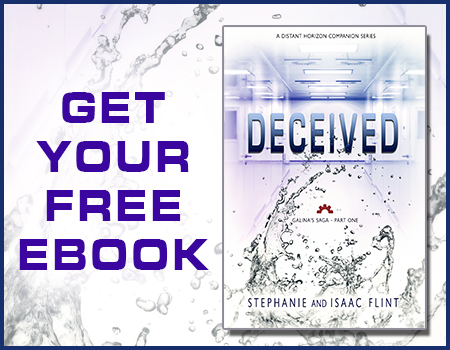
This prequel novella to the Distant Horizon series is now available as an ebook! 😀
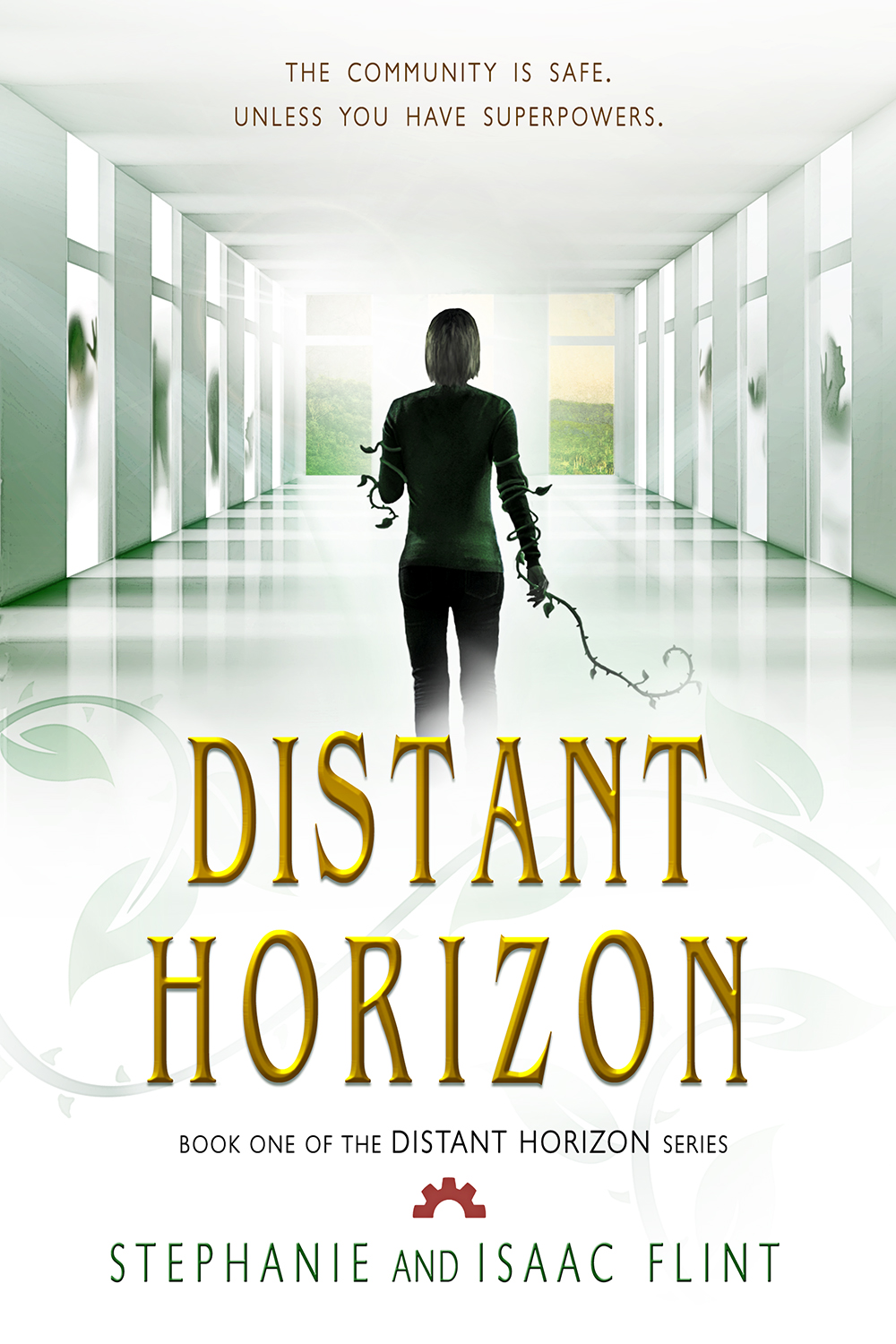
Deceived takes place about two years before the main events of Distant Horizon, and follows Galina, a character who was mentioned early in the Distant Horizon as having never returned after taking the Health Scan.
It’s the first book in a series of novellas, and takes a closer look at what happens to the students who fail.
Long story short?
When Galina turns herself over to the health clinic after believing she’s infected by a hallucinogenic plague, she discovers the truth might not be what it seems. Will she drown in the deceptions?
Note:Deceived serves as a good introduction to the Distant Horizon universe if you want to test the waters and get a feel for how the world works before diving into full-length books like Distant Horizon, or jumping head-first into the commotion with the Glitch saga. ;-D
Deceived is only 99 cents until October 1st, after which it will go to full price.
Grab it on sale while you can! 😀
Alternatively, sign up to the Distant Horizon Universe newsletter to receive Deceived for free as a thank you bonus, along with twice-monthly sneak peeks, behind the scenes updates, and special promotions. 🙂
Today I’m talking about how a character’s backstory influences their actions.
In the first draft of Magic’s Stealing, I never really explained why the main character, Toranih, didn’t like magic. She simply didn’t. But stories generally read better if the author knows why a character behaves a certain way, even if they never explain this directly to the reader. So, in order to add credibility to Toranih’s character, I began to explore her motives.
From Dictionary.com (a really useful resource when double-checking that a word means what you think it means), motives are “somethingthatcausesapersontoactinacertainway,doacertain thing,etc.”
To see why Toranih acts so paranoid/distrustful of magic, while being so interested in learning how to effectively wield a sword, let’s take a look at her world. Toranih is the youngest daughter of the Lord of the Armory, so she has plenty of access to swords and the people who can teach her. In regards to magic, the kingdom has a high number of ribbon mages, so magic is common. However, the ability to see magic is not. Neither Toranih, nor her older sister, Siklana, can see ribbon magic, though her best friend can.
In the original draft of Magic’s Stealing, Toranih did not like magic because she felt like it was all tricks and illusions. (A side note: the trouble with using the term ‘illusion’ with magic is that if you actually have magic doing something, the illusion of something happening is no longer an illusion. I’ve been slowly weeding this word from the story). So my first idea for why Toranih didn’t like magic was that maybe a bad event scared her in the past. She gets her first glimpse of magic at a parade when she was little, and it overwhelms her. Thus, she’s been wary ever since.
However, my husband pointed out that a parade with a lot of colorful, fluttering ribbons is likely to be awe-inspiring to a four-year-old, not terrifying. While I still feel that everyone has different reactions, so what some kids like, others are terrified of (for example… clowns), I started looking elsewhere for answers. Toranih doesn’t like magic, and to the extent that she is paranoid in earlier drafts, there seems like there might be a bit more to her paranoia. So I cut the bit about the parade (keeping the event, but not having it terrify her), and considered Toranih’s distrust of their mythology. There are already several references in the current draft which lends itself to this theory.
For example, after an event involving Toranih being magically called to do a task she wouldn’t otherwise do:
Old fables flitted to the edge of her mind, haunting melodies of immortals and creatures whose very power was that of magic’s lure, the power to call and demand, to whisper in a person’s ear and convince them, without fail, to do their bidding.
In something of a flashback, Toranih’s sister tells her about life and death magic:
Once, long ago, when Siklana showed Toranih how to use her crystal, she’d convinced a couple of the servants to come stand in front of them. One had magic, the other did not. And she’d pointed to the one with magic and all the ribbons, and explained what ribbon magic was and how it worked.
Then Siklana pointed to the other servant, and said that even though he wasn’t a mage, he still had magic. Everyone had magic, but it was difficult to see because it was closer related to string magic, but couldn’t Toranih see it? There were two thin strings running through his body, each entwined and almost impossible to spot.
Siklana had adjusted the crystal to make them more visible. “That’s the only string magic visible to a ribbon mages,” she’d said. “One strand is life, and the other is death. Everyone has them. If you don’t, then you’re dead. That’s how the gods made us,” Siklana had continued, much to Toranih’s dismay. “But only the really powerful gods can manipulate those strings, so there’s nothing to be scared of.”
That memory had stuck with Toranih ever since.
In a conversation with Aifa, the Matchmaker goddess:
Aifa rolled her eyes. “Such a harsh tongue, tut-tut. Dear, I’m the goddess of relationships, not all-powerful. But if you don’t mind your manners, you’ll find yourself mute.”
Toranih swallowed hard. She had heard tales of citizens who’d crossed the gods in older times. Citizens who found their love lives broken or their ability to communicate… impossible.
Toranih has plenty of reason to be uneasy about magic and the gods’ use of magic. However, we can take this a step further. We know that Toranih is very interested in swordsmanship, and wants to be a guardsman except that her father doesn’t think that position befits her station. This is especially problematic when her sister, Siklana, reveals intentions to marry into a different estate, thus leaving Toranih as the sole heir.
Her father handed one of the servants his empty plate and rested back in his chair. “Understanding self-defense is important, but you’re taking these studies a bit far. There are more important subjects for a young lady to—”
“Siklana is much more adept at those studies,” Toranih interrupted. Her scone crumbled and she swept the crumbs into a napkin before he could get onto her about that, too. “Let’s be honest. When inheritance time comes around, she’ll inherit the estate. She’ll master magic at the academy, and she’ll be the one to win the hearts of the city and lead them in her wise, older age.”
Siklana ducked her head behind her bangs. Her dark brown eyes shown through. She was smaller in stature than her younger sister, especially since she lacked the muscle that came from Toranih’s years of swordplay. “What if I marry into a different house?”
Toranih turned sharply. Her sister… marry? Of course she would, she had always been interested in the attention of suitors, but Toranih hadn’t thought she would try to climb the social ladder through marriage.
If she married into a higher class, she would leave behind the Covonilayno estate. “I’d be the heir,” Toranih whispered, stunned.
Her father nodded. “The rights would fall to you. As is custom.”
Toranih glared at her sister. “How long have you been planning this?”
“I’ve been thinking about it for a year,” she admitted coyly. “I’ve already passed the academy’s first year exams, and I’m well into my second year. Our inheritance is decent, but there are a few worthy suitors who could help me further my education once I finish in Cirena City. With a decent suitor’s allowance, I could travel to the Islands. I’ll make sure that’s part of the contract. I might even learn word magic.”
Toranih swallowed hard. While having at least some degree of ribbon magic was common, word magic was practiced by very few. Anyone could learn it, so long as they knew how to pronounce the spell.
But say just one syllable wrong, and any number of horrors awaited the practitioner. Setting ones’ self on fire, opening a portal in the middle of a crowded city and killing anyone in its path, trying to heal someone and killing them instead… and a particularly powerful spell could bind a target to do the mage’s will.
Toranih shivered. Unlike ribbon magic, word magic was invisible. No crystal could reveal words the way it could reveal ribbons.
My husband pointed out that maybe Toranih doesn’t like magic because, unlike her sister (and most every other mage in the kingdom), she never really became adept with magic.
As a young child, Toranih saw her sister and Daernan surpass her with flying colors while she struggled to control ribbons for even basic tasks. At the same time, young noblewomen were taught basic self-defense, which is where she excelled. She threw herself into the study of swords and knives, hoping to become a weapons master. In the meantime, she became more and more resentful of magic. She eventually understood the basics (which we see her using in Magic’s Stealing), but she never quite comes to terms with the fact that she’s been left behind by the mages.
The result?
She can’t easily control magic, so she doesn’t trust it, and (as the current blurb says) she would rather have a sword in her hand than use her powers to heal and throw fireballs.
And now we have the reason that Toranih doesn’t like magic. We can see why she might, at times, lash out or vehemently deny anything to do with being a mage.
But she lives in a world so saturated with magic that she can’t ignore it, and so she still uses the magical light crystal her sister gave her. She still changes into an owl when Daernan convinces her to go to the parade. She still tries to save people who are dying when their magic is stolen. But she has a flaw, and because of that flaw she doesn’t always use her powers when she should, and her unwillingness to try could cost her the people she loves.
Now I’ve just got to make sure that is apparent within the story, even if I never come outright and say this is why she acts the way she does.
I hope you enjoyed this post. 🙂
Have you found any books where character motivations were well-done, or where they were lacking?












 Stephanie Flint - Author and Artist