Tag Archives: Stephanie Flint

Thoughts on Publishing – Pricing an Indie Card Game

Isaac and I have been working on our upcoming card game, Battle Decks: Trials of Blood and Steel, and we had a gaming-experienced friend come by a few days ago to test the game. He gave us a lot of great advice that we’re now looking into implementing. Our date of release may have been pushed to a later date now, but we should have a better game for it.

In the meantime, Isaac and I have been thinking about how to price Battle Decks, as well as how to make it available to the largest number of people (and still make at least a small profit).

Currently, we’re printing Battle Decks through The Game Crafter, a print-on-demand company for tabletop games.

The downside with any version of print-on-demand is the cost. For books, this has become increasingly better over the past several years, and it is now reasonably possible to be competitive with traditionally published books). For tabletop games… they could use a bit more work.

But here’s the problem. Since a customer typically only buys one game at a time, the cost per game is relatively high (at least compared to what you would find in stores). This can be offset by purchasing a large number of games in bulk, but for a small business, this quickly adds up.

Take, for instance, our current version of Battle Decks with all its bells and whistles (four glossy rules pages, a pair of dice, 108 tokens, 126 cards, and the box). The base cost for buying just one game is $28.00, not including shipping. Once you add the cheapest shipping–short of will call (sorry, we’re not traveling to Wisconsin to pick up a box)–we’re looking at $36.00 per game. That goes down to $26.50 per game if we buy ten games at once, but when we add shipping, the price comes to $303.00, or roughly $30.00 a box.

(Note: Shipping costs may vary by location.)

Say we chose to purchase ten boxes at $30.00 a box. We still want to make a profit. If we sell them ourselves, we could offer them for $40.00 a piece and make $10.00 per game, minus sales tax if we factor tax into that cost. However If we take it to a store and ask them to sell it, they’re going to want a wholesale discount. I expect stores want at least a 35% discount off the retail price, and the one store I’ve spoken to thus far preferred a 50% discount off the retail price. Which means that, if we sold our game at $40.00, we’d be selling the game to 35% stores at 26.00 (we lose $4.00 per box), or at $20.00 to 50% stores (we lose $10.00 per box), which basically means that price isn’t feasible.

So, if we push the price of the game up to $50.00, the 35% store wants the game for  $32.50 (we make $2.50 per box), and the 50% store wants the game for $25.00 (we lose $5.00 per box).

However, now we risk pricing the game too high for potential players to take the risk on a new game.

Now, keep in mind that I haven’t done nearly as much research on what stores want in regards to purchasing indie games as I have with books,  so it may be that they want a lower discount. But given that many stores offer discounts to their customers (such as a 10% student or military discount), and they also want to make money (make sense, since they need money to stay in business), and indie games don’t usually have the name recognition that traditionally published games do to help keep those games selling, rather than sitting on the shelves, untouched, I expect that stores will want a decent-sized discount. (Note: See the comments below for input regarding wholesale discount ranges from an experienced seller. According to him, 50% is much less likely to be the norm than a 35% or smaller discount).

I’ll be doing more research in the form of talking directly to stores in the future, once we have more funding available to do a bulk purchase.

In the meantime, yikes.

Our best bet of keeping the game somewhat affordable and still making a small profit is to sell online. However, we’re still looking at a roughly $35.00 to $40.00 game, plus the cost of shipping.

So how do we make the game more accessible?

There’s a few possible options that I’ve found thus far.

Print-And-Play

While browsing The Game Crafter website, Isaac and I noticed that a few games (card games, in particular), had print-and-play editions. With a little more research, and I discovered that Cards Against Humanity has a free print-and-play edition as well as their regular edition.

Basically, a customer pays a small fee (.99 cents to a few dollars) to purchase a PDF file with all the cards ready to print. They print the cards, cut them out, and read any rules that come with the game. They can start playing almost instantly. No shipping time, and low cost.

The downside is the lack of quality control. If a player’s printer renders cards dark or blurry, it may turn other players away from the game. Or maybe the cards aren’t printed on card stock, and shuffling is therefore terrible. (Cards Against Humanity gets around this by putting a set of instructions at the front of their PDF with suggestions on how to print quality cards).

The other downside is that if your game has a lot of cards, and the player uses their own printer, they may end up using a lot of ink.

So… Isaac and I are thinking this isn’t the best alternative option for Battle Decks.

Card-Only Variety

Another option we’re considering is offering a stripped-down, card-only version of the game. No dice, no tokens, a smaller box, and online PDFs you can download and print at your leisure.

This brings the cost of each box down to roughly $17.00 (plus shipping), and if we wanted to make a $5.00 profit, we could offer the game online for $22.00. Shipping would be anywhere from $3-$9, (not sure, since I couldn’t put an unproofed game in my cart). But it’s considerably more affordable, and suitable for players who have plenty of dice, don’t typically use tokens, and don’t mind printing the rules themselves.

We’re thinking of offering the full edition of Battle Decks, with all the additional pieces, along with the card-only version, which gives players more options in regards to how much they want to spend on the game, and how they want to play the game.

Character Cards Only, and Players Use Free Trial Print Version with Proxy Decks

The final option we have considered is offering a small pack of just character cards. (18 cards in a poker card wrap). Base cost $5.00, plus shipping (probably around $3.00, given the piece of one of our other purchases with a slightly larger tuck box).

The idea behind offering only the characters is so that people who play the trial edition (which is a PDF we plan to release that shows players how to proxy the game using poker decks, and includes a single team for each faction) can enhance their game-play while still using the proxy decks, thus making the game more accessible by offering an even lower cost.

However, this only works if you don’t mind using proxy decks. At the moment, I’m leaning toward offering a card-only variety of the core game, in addition to the full version.

Note: These prices may change over time depending on what is being offered at The Game Crafter. Also, further research is needed to determine what indie games of this particular type would reasonably sell at.

Anyway, those are our current thoughts and theories. We haven’t actually tested selling the game with any of these methods.

I hope you enjoyed this post. 🙂 If you were to buy a new, indie card game, how do you prefer to buy it? What prices do you feel are fair?

Further Reading:

http://gamedev.stackexchange.com/questions/27490/how-do-you-decide-upon-the-price-for-a-game – (2011 article, so information may be out of date) One of the people on this webpage make a great point about pricing (indie computer) games based on what platform you’re selling them from.

http://positech.co.uk/cliffsblog/2011/05/08/indie-game-pricing-pressures/ – (2011 article) This article talks about indie (computer) game pricing pressures. It’s a bit off in regards to how books are produced, but the comments do show concern at an expectation for low prices. Those comments also show example of higher-priced (and high-quality) games selling well).

http://danielsolisblog.blogspot.com/2011/09/q-on-card-game-design-costs-and-prices.html (2011 article) – This post details a card game with components, and what pricing various people consider fair for that game

http://gotgeniusgames.com/kickstarter-topic-4-manufacturing-a-card-game/ – Details on card deck pricing from various printers. (I haven’t read through this yet, but it looks like it has potentially useful information)

https://boardgamegeek.com/thread/926760/card-games-what-price-too-high – Discusses profit difference between core games and expansions.
11 Comments

Filed under Business Ventures, Gaming

Thoughts on Publishing – A Video Blog Post and a Reading – The Magician

Today I’m doing something a little different. In an effort to save time (which didn’t work this time around, but hey, now I know what I’m doing, so next time may go faster), I decided to try making a video for a blog post. This is also the unveiling of the Infinitas Publishing Youtube channel. 😀

This was an experiment, to say the least.

I knew bits and pieces of what I was doing, but I had never used Youtube’s video editor before (it allows you to splice videos, add multiple video clips, add music, etc), nor have I tried using Windows Movie Maker for a really long time (and trust me, the older version I used was much more user-friendly).

Anyhow, I managed to get a video tied together, which includes a reading of “The Magician” one of my 1000 Words short stories. It’s also the first time I’ve made an audio edition of any of my stories together, so we’ll see how it goes.

Now, I’m not using a professional mic by any means, so the sound has a lot of hissing at times (and you can hear a car’s speakers in the background at one point).

Since I only rehearsed the story once before I read it, I did stumble a few times. If I try to do a true audio book with any of Isaac’s and my stories later, I’ll want something with a bit clearer sound, and I’ll probably practice each chapter a bit more before I do the recording.

I also keep noticing little tiny phrases that I would reword for accuracy in the video portion, but I guess that’s downside of doing an unscripted video.

But other than that, here it is!

(And  a Youtube link in case you can’t see it).

I hope you enjoyed this video/blog post. If you liked the video and/or the reading, please let me know. I may do more of these. If not, oh well. Worth a shot. 🙂


Leave a comment

Filed under Business Ventures, Writing

Thoughts on Writing – Trademarks and Evolving Languages

Yesterday at the writing group my husband and I usually attend, one of the writers made a comment about how English is a growing language. They pointed out that it constantly shifts and adds new words, whereas other languages are stagnant and are ruled by a constant number of words. This caught my interest, so I thought I’d do a little bit of research on the topic.

Though my research didn’t go quite the way I anticipated, I focused on new influencers to a language.

The National Science Foundation website mentions in their article on language and linguistics that there are a few things that can influence a change in language. For example, the invention of new technologies can bring with it new words (or specifically, the new use of words). The article says, “Plastic, cell phones and the Internet didn’t exist in Shakespeare’s time.” Which, if you think about it, means that time period wouldn’t have had a need for those words.

But what happens when those new technologies develop? The new words have to come from somewhere.

In an article from The Atlantic, they explain the origin of the term ‘cell phone,’ or more accurately, cellular phones. At the time, the word cellular referred to biological cells (still does). What does that have to do with phones?

The network for sending signals to each phone was conceived as being of a cellular nature (check out the article for a diagram). As such, a cellular phone would use a cellular network, and the term was later shortened to ‘cell’ phone.

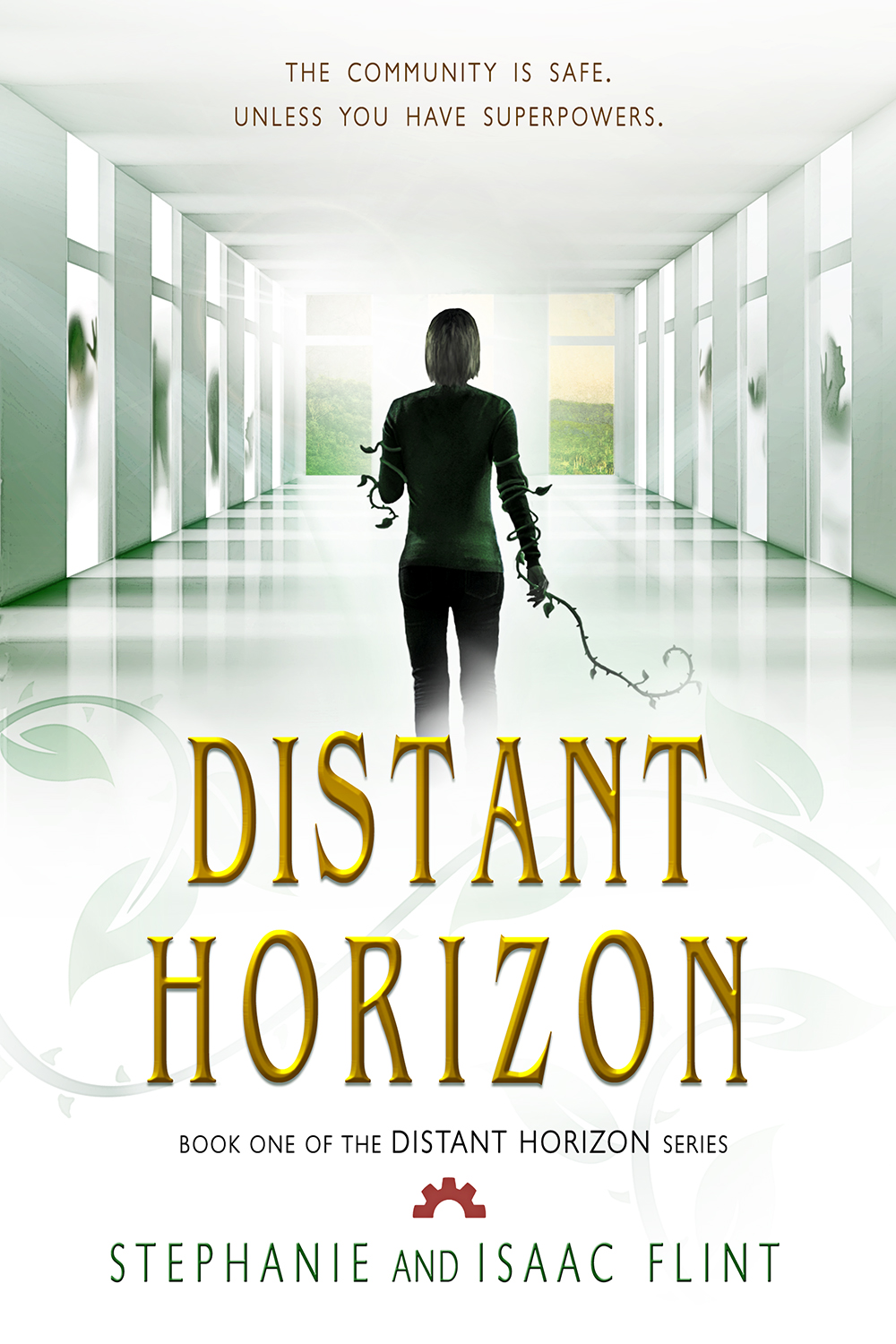
(As a side note, if you are developing a magic system and your story spans over many years, you might consider what developments might influence that magic. For example, in Isaac’s and my Distant Horizon universe, one of the characters has techno sight… the ability to manipulate (digital) technology with their mind. If you go backward to the Multiverse timeline, there aren’t any computers (at least, not that don’t use artificial spirits), so those characters don’t have the techno sight power. Or they might, but it would basically be an unknown power that doesn’t get used, even if it’s in their bloodline for future generations)).

New technology can impact how a language evolves, especially as new terms are needed.

However, when new technology gets involved, so do trademarks. And that’s where things get interesting. For example, look at the the Xerox photo-copying machine. How many people might say “I’m going to xerox that…” turning Xerox, a trademarked brand name, into something generic… (despite attempts to keep in it in their grasp).

If you look at the name, Xerox is the brand, whereas their product is a photo-copying machine. Note that photo-copy is a combination of two words to describe what the product does. But as people became familiar with the product, they turned Xerox into the verb, and thus a new word (or at least a new meaning to the word) was born. HighNames has an article regarding the origins of Xerox, and it turns out that Xerox pulled their name from a combination of Greek words… xeros (dry) and graphia (writing). If xerox, from xeros, now means ‘to photocopy,’ we can see how influences from other languages, plus the change over time, shaped a new word. (Read more about generic trademarks here).

Even now, companies fight to keep their trademarks intact. Google (to use a search engine, originally pulled from ‘googol,’ the number ‘one’ followed by a hundred zeroes). Kleenex, technically a brand name, but now often used to mean a tissue. (“Go grab me a kleenex.”) This is yet another example of a company having to work to keep its trademark intact (This article from The Atlantic has some great examples of companies trying to protect their trademarks). Yet another example of how a trademarked brand has become (or is on it’s way to becoming) a common word is Coke, in which a Concurring Opinions article mentions people asking for a coke (referring to soda in general) and restaurants must distinguish between a Coke or a Pepsi due to trademark legalese.

If you are interested in more information about the evolution of language over time, TED has series of videos about of “How Language Changes Over Time.” I haven’t watched these, but having watched a few TED Talk videos before, I imagine they could have good information.

So how does all this apply to fiction?

Well, if you include conlangs (constructed languages) in your stories, especially over a period of time, you could have fun with changing the language across the generations. Perhaps it’s a company trying to protect their trademark, if you want to stay with the trademarks theme. Perhaps there is a misunderstanding in general. Perhaps there is confusion, if someone from the future tries to explain something to someone from the past. Or perhaps its the opposite. Someone from the past, using an older variety of an evolving language, has a hard time being understood by someone whose updated language no longer sounds the same. (Refer back to the National Science Foundation article for a good example of having a hard time trying to understand an older language).

There’s all sorts of things you can play with, both with fictional languages, and with real languages and real history.

Alternatively, maybe you have a language that is stagnant. One that has only a specific list of words, and that’s that. How do your characters and your society deal with the changes of time? Do they smash words together? Do they struggle to explain technologies? Do they refuse new technology altogether?

Given the way I’ve currently addressed Cantingen word magic in the rough draft of The Shadow War, I suspect their language will be fairly stagnant, with some interesting combinations when trying to explain an object that doesn’t have a specific name or translation.

I hope you’ve enjoyed this post. 🙂 Have you thought much about how languages evolve, and how you can use that evolution in your fiction?

Further Reading:

http://www.scientificamerican.com/article/use-it-or-lose-it-why-lan/ – Talks about the frequency of a word compared to how fast it evolves

http://www.telegraph.co.uk/technology/mobile-phones/11274292/Do-you-understand-text-speak.html – Text speech (In this case, also slang, not specific to text) and trying to translate text speech

http://www.telegraph.co.uk/education/educationopinion/9966117/Text-speak-language-evolution-or-just-laziness.html – Debates whether text speech is language evolution or a lack of proper teaching (leans toward the latter, but does bring up points regarding text speech and ease of communication that would have been interesting had they been developed further

http://knowledgenuts.com/2015/10/10/text-message-slang-goes-back-to-telegraph-operators/ – More or less a counter-argument to the above complaints about text speech, which points out that it got its start with telegraph operators

http://dictionary.reference.com/browse/verbing?s=t – A Definition of ‘verbing’

2 Comments

Filed under Writing

Thoughts on Publishing – Serial Publishing Methods

I recently got back notes from our beta reader for The Multiverse Chronicles, and one of the questions we asked her was whether or not she would read it in serial format (in this case, one episode a week). We want to make sure that when we release the episodes that the method of release will work well for readers.

Though she said that she enjoyed the episodes that she read, she also said that she personally wouldn’t read it in the serial format. She explained the reason was because the first two episodes (two weeks of content) had a lot of characters to keep track of, and given that the episodes alternate between two groups, that was a long time to wait to find out what happened to the main character from the first scene.

As an alternative, she suggested releasing several chapters at once, but at longer intervals, so that readers would have a chance to get grounded in the story before having to wait for the next installment.

In a sense, this is what I’m doing with The Wishing Blade series, but with a several-month interval. Technically, each book will fit together as one larger, complete book, though each one is meant to have a semi-complete story on its own.

Our beta reader suggested looking at Stephen King’s The Green Mile as an example of releasing several chapters at once, a serialized novel that was released monthly in 1996. From what I gathered during my (Wikipedia) research, The Green Mile was released in six parts, once per consecutive month, each paperback book around 100 pages until the last book, at 144 pages). Later the publisher released a compiled edition.

Now, I haven’t read the book, so I’m not sure how complete each part was, (though I did try to skim through a few reviews to get a feel for it, and I’m still not sure), so I don’t know how much of a cliffhanger each episode may or may not have been. Click here for more information about the original release of The Green Mile books.

But this research did lead me to thinking about the various options involved in releasing a serialized novel.

Originally, Isaac and I had intended the Multiverse episodes to be stand-alone short stories that fit a larger story arc, but the story arc took over. and now we have a serialized novel on our hands.

The options (with variation, depending on the author) are generally to release episodes or chapters every few days, once a week, every few weeks, or monthly/bi-monthly.

Due to time constraints, Isaac and I decided not to release episodes more than once a week. Otherwise there would be a long span of time between the beginning and end of each “season.”

However, if you have a complete novel, or if you want to write daily and release the new parts as their written, a faster release schedule may be the way to go.

Releasing weekly or every few days could work great if you have cliffhangers and an audience who is excited for the anticipation of waiting for the next episode. Here, having a story that hooks the reader and doesn’t let go, but demands a faster release schedule, may work well.

Though I haven’t read it personally, I found one example to be Worm, a completed web serial by Wildblow. In their case, they released chapters twice a week (sometimes three times, if donations met a specific goal). Also, The Legion of Nothingwhich (according to the info at the top left corner of its home page) updates twice a week.

Interesting side-note: According to Merriam-Webster.com, bi-weekly can either mean “twice a week” or “every two weeks.” Gotta love the consistency there.

Releasing every few weeks might work better for stories with larger episodes, where the author wants time to make edits before the release, or for writers who are writing the story as they go, but want time for feedback to develop, and time to implement that feedback.

Releasing monthly or even bi-monthly seems like it would work better for longer episodes or short books that have a reasonably complete story arc, however, my current research suggests that stories with strong cliffhangers can work well at this extended rate, too.

One romance series I’ve heard has done well, Renee George’s The Lion Kings, (according to its description/reviews, since I have not read this series, either) has each book as a fairly short installment that involved cliffhangers, where the author released the books on Kindle at around a month or so apart. Of course, audiences preferences may vary between genres.

Then there’s The Martian by Andy Weir. According to Smithsonian.com, The Martian was released on his blog at the rate of one chapter every six to eight weeks, though it does sound like he made adjustments per reader feedback. I’m not sure how long each chapter was, though, and since I haven’t read it, I’m not sure what specific part of the book may have drawn in the large audience that it did. (The Business Insider suggests that the author’s enthusiasm for science attracted a lot of other readers who were also interested in science, which helped propel its popularity forward. The eventually release of a Kindle edition continued to boost its popularity until it was picked up by a traditional publisher).

I haven’t tested out these methods myself, but I wondered if Isaac and I could mix a couple of these ideas together.

In this case, we’re thinking of releasing six episodes (chapters) to start with, which should give readers time to get familiar with the characters and the world, but also leaves off at a major turning point for the story. Then, a week later, we’ll start releasing one episode a week until the story is complete.

We already know that we’ll have at least 28 episodes, and since we originally planned on a six month schedule of weekly releases, offering the first six episodes to start with would help keep this plan on track. Not only that, but it would give readers more reassurance that this will be completed, since they can begin to see how the story will progress. As a bonus, leaving off the first week after the sixth episode would give readers a bit more idea of the conflict that our Battle Decks: Trials of Blood and Steel game (which influenced the story) is about.

So now I just need to see if I can get all six episodes edited before the release date. If so, then we may give this method a shot.

If that doesn’t work well, we can always switch it up later.

The main thing is that we’re trying to go for consistency, that way potential readers know what to expect.

I hope you’ve enjoyed this post. 🙂

Have you found any serialized novels or blog serials that worked well in terms of how they released each segment?

Related Posts:

Thoughts on Writing – What Does A Serial Episode Need? (The Multiverse Chronicles)

Thoughts on Publishing – A Novel or Three Novellas? (The Wishing Blade series)

Leave a comment

Filed under Writing

Thoughts on Writing – Proofreading as a Reader

If you read my previous post, you know that I recently got in my paperback proof copy of Magic’s Stealing in the mail. My main goal was to make sure the formatting was correct, so I debated whether or not to correct typos, and then order a new proof (the answer is now ‘yes’), or to leave it be and not risk messing up the formatting.

But my concern was that trying to save money by not ordering a second proof would cost sales in the long run. (Read this BookBaby blog post for more about saving now costing more in the long run… though my main take from this was not to order a bunch of books before you’ve had someone else look at it).

Having found a couple of particularly stubborn errors in the paperback copy, I’ve decided that fixing those typos now, and then ordering a new copy, would be my best bet. That way I can put my best work forward (I’ll update the ebook versions once this is finalized) before purchasing a large number of books to hand-sell or giveaway. By ordering a new proof once I make the changes, I can also make sure I didn’t mess up the formatting.

The question is, what types of changes should I make?

There are two sorts of “errors” I’ve caught thus far: typos (for example, ones’ self instead of oneself, or “That’s the only string magic visible to a ribbon mages…” plural vs singular issue), and style choices (for example, whether or not to combine two paragraphs instead of leaving them separate).

For the most part, style issues will remain the same. Grammatically, they are correct, and that’s just me being picky. (Read this Fiction University blog post for ideas about when to stop revising).

However, typos will be corrected (the ones I find, anyway).

But why is it that, when we read our work with a fine-tooth proofer’s eye, we still miss things?

Why is it that even traditionally published books, with a lot of backing to their names, still have typos, when they have the funding to hire professional editors?

Part of the problem is that we know our work, so we know what it should say.

Even when reading aloud, or printing off a manuscript and scrutinizing it sentence-by-sentence, we’re going to miss some of these typos. We automatically correct them. Even proofers and editors will occasionally lapse and miss something, especially if they’ve been looking at the manuscript for a while (one editor I know said they limit the number of words they’ll read in a manuscript per day in order to avoid this problem).

Inevitably, however, we get our books printed, read through them later, and there it is… a giant, glaring typo.

Why do we see them now?

Well, one factor is time. With more distance from our work, we’re more likely to forget what we intended, so it’s “new” again. (This is why you see all those suggestions about waiting a few weeks or months between major edits).

Another factor is that you may have made an edit in the previous version of the book to correct a different typo, but in doing so, you accidentally hit a backspace key or inserted an extra letter, or you didn’t read the sentence fully after making adjustments. Whatever the problem, the previous edit created a new typo, which then was not proofed.

The final factor that I’ve been considering is perspective.

I went in trying to read the paperback proof of Magic’s Stealing as a reader–that is, I had no intentions of making edits. I wanted to try to enjoy the book as a reader, only noting typos if I saw them. I mean, that’s part of the reason we want to write, isn’t it? So that we can one day enjoy the fruits of our labor and read the book like a reader would? (Or maybe that’s just me).

Point is, when you read your manuscript in a format that is  the final format, and you read it as a reader, with no intention to edit, you’re likely to catch new typos. Your eye lingers just a bit longer on that odd word, because something threw you out of the story, which you were enjoying for story’s sake.

But that’s just a theory. A I’ve-been-watching-too-much-Game Theorists-theory (If you want to see video and computer game plots picked apart, this is a pretty good Youtube series. So is Film Theorists, but for movies and TV shows.)

Now, I’ve got to get back to editing The Multiverse Chronicles and proofreading Magic’s Stealing for typos.

I hope you’ve enjoyed this post. 🙂 Have you found any tricks for catching typos before you release your stories or send them to an agent?

Leave a comment

Filed under Writing

Thoughts on Publishing – Magic’s Stealing – The Paperback Proof Is In!

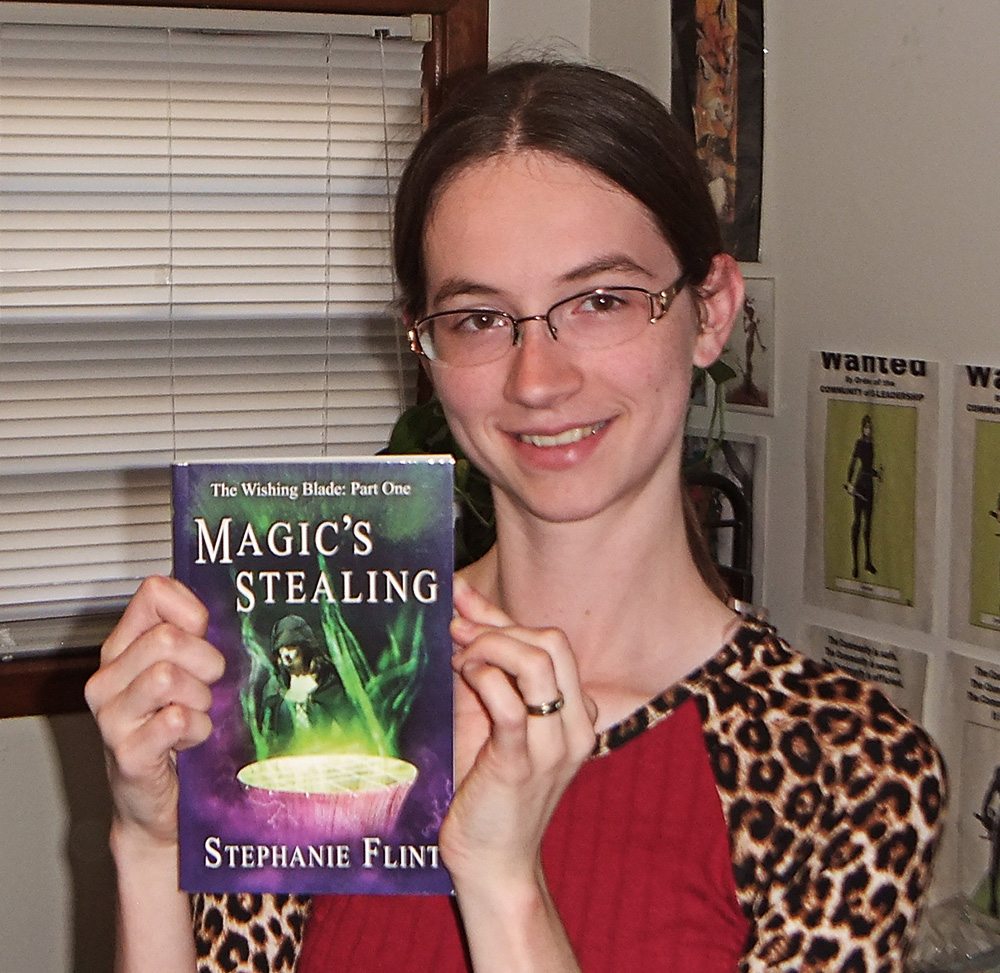
Today I’m going to interrupt my usual post with an announcement: I have received my paperback proof of Magic’s Stealing!

It came in a small, cardboard wrap (not quite a box, but not a bag, either), and was delivered to my front door. Upon opening the package, I took a few pictures. 😀

SBibb - MS Proof(( Please ignore the various HeroMachine pictures and cool artwork in the background… those aren’t our personal works (Though if you want a good way to organize the general look of your characters, HeroMachine is quite fun. There’s a whole row of pictures off the frame that we based on one of our campaigns). ))

SBibb---MSproof2

Fancy Title Page

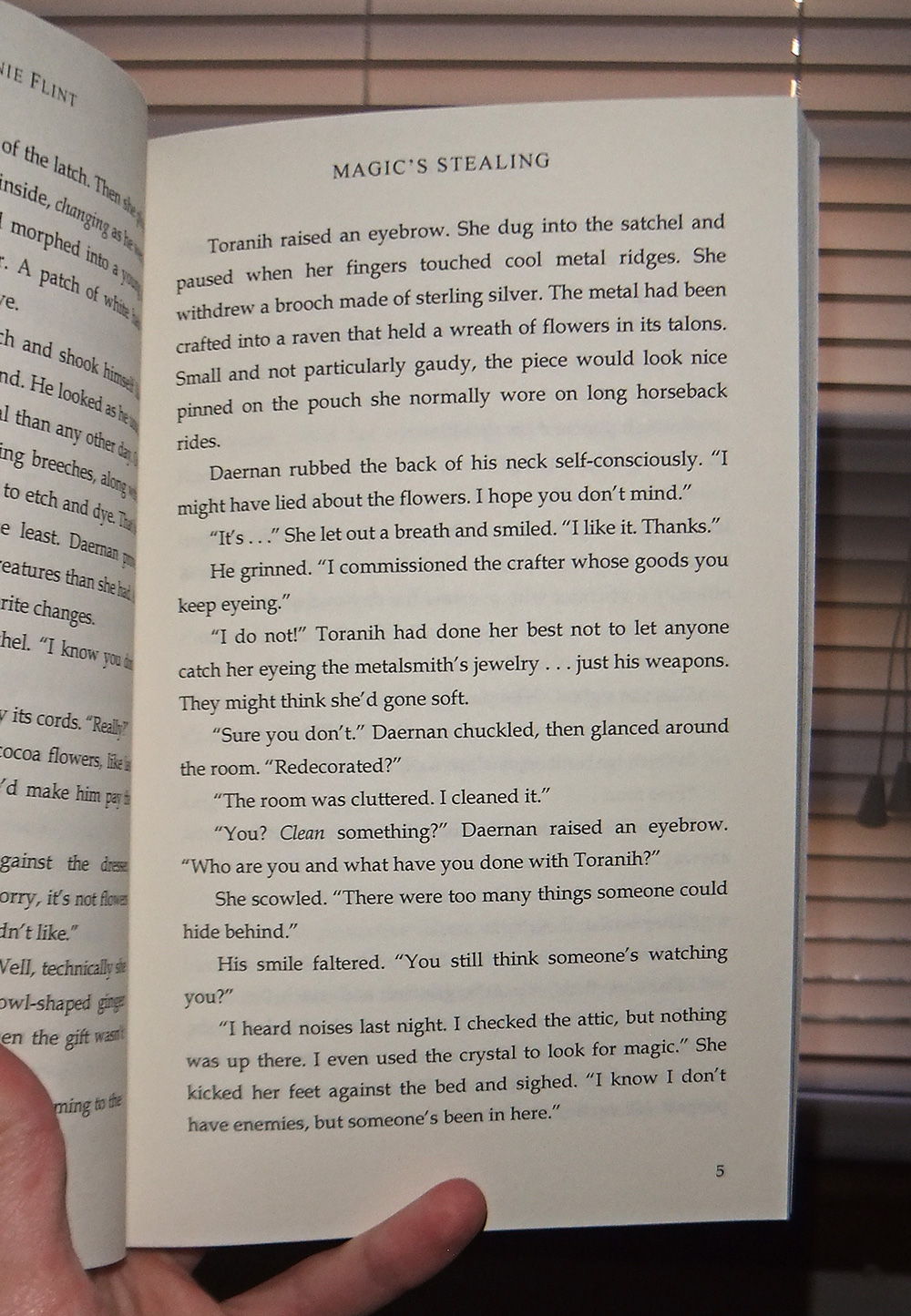
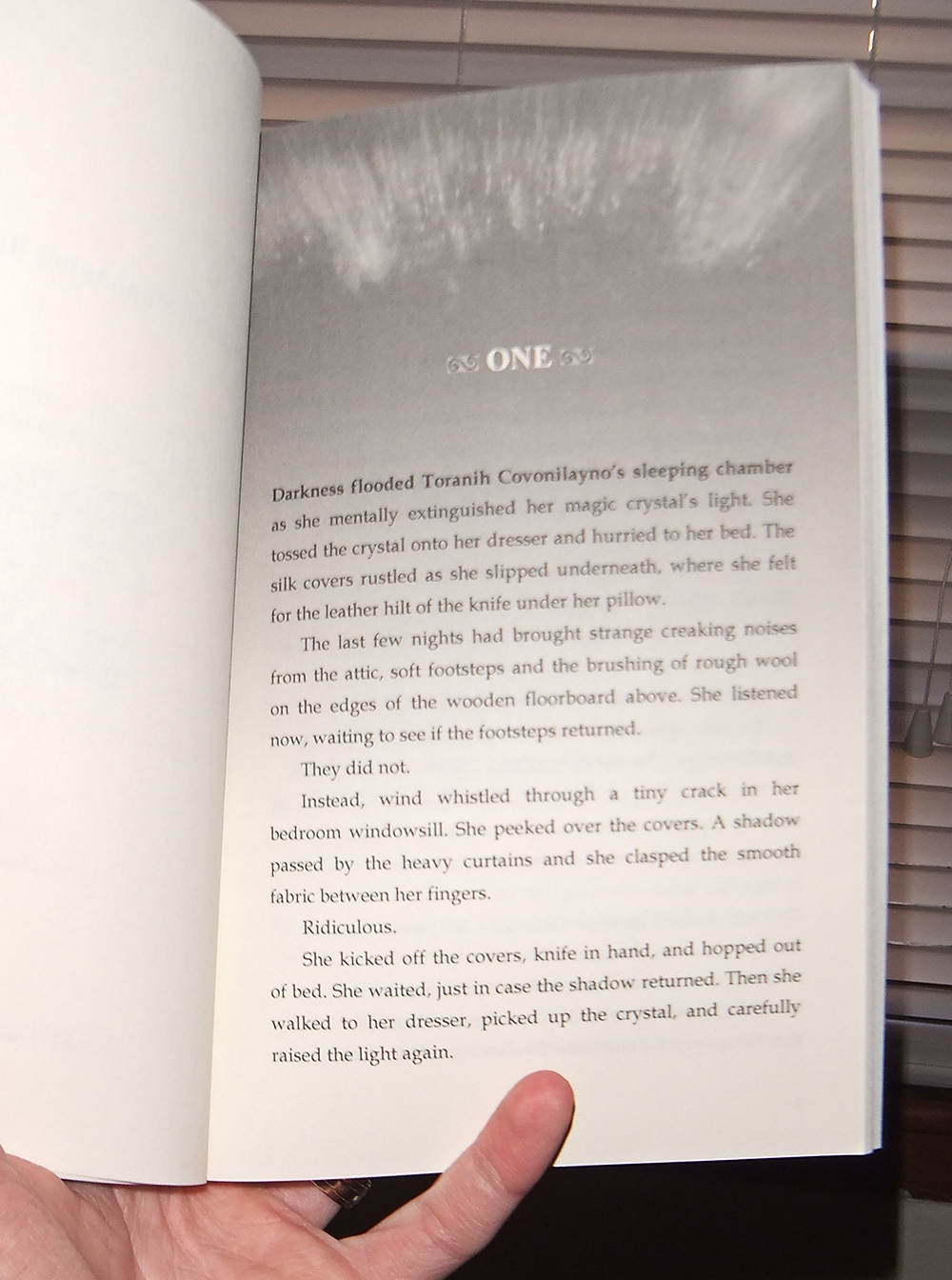
Anyway, this book has 158 pages of content, plus additional pages for the front and back matter, and it clocks in at 170 pages long. Here you can see the the title page (there’s a few pages before it), and further down this post are samples of a chapter page and a regular, full-text page. You can click the images to see them at a larger size.

I did all the formatting in Microsoft Word 2007, and I hope to do a post later on some of the fun tools you can use to add a professional touch to your books. Once I tested a few pages out on my printer for various fonts and sizes and line spacing, I saved this as a PDF, and checked it in the digital proofer on Createspace. Once that looked good, I ordered the print edition.

This particular book is 5.25 x 8 inches (based on a few of my favorite books with easy-to-read formatting), which uses the same dimensions as a 6 x 9, so the cover converted easily. Glossy cover and black-and-white, cream pages. I chose the “bleed” option so that I could use the full page image treatment (pulled from the background of the cover) for the chapter intros and title page.

SBibb---MSproof3

Page Full of Text

I did notice that the words got a tad bit close to the gutter, so that’s something I’ll have to keep in mind for future series, but it’s still readable. Of course, I also justified the text.

This is the end result, and I’m now reading through the book to make sure the formatting is correct before I release the print edition (Amazon only, for now).

I’ve found a couple typos, which I’ve made note of, but if those are all I find, I will most likely let those slide for now so that I don’t potentially mess up the formatting right before ordering a large number of books. If I find a large number of typos, I may go ahead and do the initial revision now.

Though that one I’ve found may keep pestering me…

I don’t know. Maybe I’ll order a second proof, that way I can be sure the formatting looks right and that there are as few errors in the print book as possible.

Anyway, regardless of what I choose to do, I plan to go back and revisit both the print and ebook editions at some point for typos, but I’m considering doing that all at once, when more typos have inevitably been found.

In the meantime, look forward to the paperback edition, coming soon! 😀

SBibb---MSproof4

Sorry, this photo got a little blurry…

I hope you’ve found this post helpful. 🙂

Have you had any experiences with proofing a print edition of your book? How do you decide when to update for typo corrections?


 SBibb --- MS Proof  SBibb---MSproof5 

6 Comments

Filed under Book Covers, Business Ventures, Writing

Thoughts on Writing – Using Foreign Languages In Your Stories

Recently, I’ve been making edits to The Multiverse Chronicles. It’s a pseudo-steampunk fantasy story, and it’s very much not historically accurate. We’ve got dragons, dinosaurs (all right, all right, I know pterosaurs technically aren’t dinosaurs, but still), dirigibles, magic powers, a dragon queen who rules over Britannia, an Industrial Union of Prussia that makes automatons… The list goes on.

Still, we want to have occasional nods to reality, and it’s nice to know which parts of history we’re butchering before we actually butcher it. Since the world is supposed to (vaguely) resemble our own world, we’ve been trying to add flavor through various means, and our latest method has been to insert little snippets of other languages where appropriate.

For example, one of the end scenes of the Multiverse episodes involves a group of airship pirates. The name of their dirigible is mentioned, and the name is supposed to be in German.

Of course, neither Isaac nor I know much of anything about the German language, which is a recipe for potential issues.

In this particular scene, Isaac wants the name of the ship to roughly translate to, “The Spirit of the Iron Vulture.” The first step to renaming this in German was to use Google Translate.

However, from our experiences with Spanish classes in college, we know that online translators aren’t necessarily that reliable. So, whenever I try to name something or use a word that isn’t English, I may use an online translator to start with, but I will usually run it through multiple translators, and then take that translation back from the target language to English to make sure it translates correctly both ways. (I’ve had a few interesting translations when I tried that particular method, as the translator might have had the right word, but not the right meaning). I also try to look up whether words should go before or after one another, if there might be any changes to how the word looks based on what it’s modifying, and anything else that might be different in that language.

For Spanish, this isn’t quite so difficult because I’ve had a few classes, which helps me know what to look for. Even then, I’ve had a beta reader correct my Spanish grammar, and that was helpful to getting the sentence right (I had the wrong verb form).

For German… well… I don’t know German.

I’ve picked up a couple words here and there from Hogan’s Heroes. (Not exactly conducive to knowing how a language works).

I really wasn’t sure what we were looking for in naming conventions, especially since the name we wanted had the “of the” portion. Then I remembered that a friend from college had studied German, so I figured he might be a someone to ask. I sent him a Facebook message, and he was able to offer quite a bit of help.

When in doubt, ask someone with more experience than you.

When Isaac first chose the name, he ended up with “Der Geist Eisengeier.” (Note: If your ship’s name has “the” in the beginning of it, don’t forget to translate that as well). With a bit more checking, I ended up with “Der Geist des Eisernen Geier,” but it seemed a bit of a tongue twister (which I probably pronounce wrong, anyway, since I don’t know German pronunciation rules). Anyway, we asked if it would be feasible to shorten the latter to the former, but our friend pointed out that without “des” (of the), we would end up with a really long, run-on noun. He suggested “Der Geist Des Eisengeier” as a compromise, though he pointed out that German ships would often have longer names.

Isaac and I chose the compromise (Der Geist Des Eisengeier), though knowing about the longer names factor definitely makes using the full name a more feasible option.

As a writer, half of the process of story research is knowing what to look for. In this case, I suspected the language rules might be different from English, but I didn’t have enough knowledge on the subject to know where to begin. At this point, asking someone who does know (or at least has more knowledge than you) is a good way to find a decent starting point. This can be used for language, culture, special procedures, technology… anything. Of course, the more you read, the more you know when you should conduct research, and the more likely you’ll catch where you might have problems before a reader does.

I hope you’ve found this post helpful. 🙂 Have you ever had issues with adding words from another language into your manuscript?

(Another good example of doing writerly research can be found at Thrill Writing, a blog where the author interviews various experts about specific topics which are helpful to fiction writers.)


8 Comments

Filed under Writing

Thoughts on Writing – Sweating the Small Stuff

At the latest writer’s club meeting that my husband and I attended, I read a scene from The Multiverse Chronicles to see if I had cleared up a few problem spots we’d found when I read the scene at the previous meeting.

Overall, the description seemed to be taken care of, which opened up the ability to notice other little details that were out of place.

For example, in this particular scene, the main character, Trish is meeting with various members of the Britannian army. The story doesn’t revolve to heavily around the military operations, but there are some present… and Isaac and I aren’t exactly familiar with military procedures (About the closest reference I have is from Stargate SG-1… which doesn’t exactly count, and I really didn’t pay attention to the military side of things. I was much more fascinated with Daniel Jackson and his archeological endeavors. There’s also M.A.S.H., but it’s been a while since either of us have watched that show. Of course, these are TV shows, so those might not be the most helpful references).

Anyway, one of the other writers questioned whether or not Trish (a private) would salute the corporal.

This is the section:

Trish had arrived at Corporal Smith’s tent, stepped over the sabertooth cub who slept at the foot of the door, then stood at attention in front of the quartermaster’s desk.


Of all the offices in camp, this was by far the tidiest. Every paper was neatly tucked in its proper manila folder, and each folder was labeled and placed in a metal divider with further library codes etched into their spines. Several bookshelves lined the walls of the canvas tent with books tucked alphabetically by author and several notable gaps between the books, most likely where Cornwell hadn’t returned them.


This time the lower shelves were empty. A few books were stacked haphazardly on the top shelf. The tell-tale teeth marks on their spines suggested that the sabertooth had thought them a chew toy, and Smith had disagreed.


“Can I help you?” he asked, eyeing her cautiously.


Trish saluted the corporal. “Yes, sir. Colonel Pearson wanted me to read The Honour of Tactical Flying, fifth edition.”


“Author?”


“Sir James Cuvier, sir.”


The quartermaster selected a stack of papers from its proper folder, skimmed through the names on his list, then winced. “Sorry, Private. I’m afraid Sergeant Cornwell has that book.” He gave her a pitying look.


Trish sighed. At this rate, she’d never get everything done. “Thank you, sir.”

After the meeting, one of the writers asked someone who had been part of the (US) army, and they said that a private would not salute anyone who is not an officer, and since a corporal is not an officer, Trish would not salute Corporal Smith, nor would she refer to him as “sir.”

Now, I’m not sure how this compares to the British army (especially of the given time period), so Isaac and I may need to do some quick research to compare the two, but this does give us a good reference point to start from.

On the bright side, The Multiverse Chronicles are supposed to be more on the fantasy side than the alternate history side, so we’ve got a  little bit of leeway than if we were trying to write military fiction with a lot of historically accurate details.

Either way, I’ll be making a few adjustments.

A different example of small stuff to consider is period anachronisms.

Another writer at the meeting had their story set in 1995, but the policeman in the story was pulling a cellphone out from his pocket and there were computers being used to check where a patient was being held in a hospital.

I wasn’t sure that this fit the time period (mostly because I was thinking that’s the problem horror films have nowadays… they have to explain what happened to their protagonist’s cellphone), so I questioned that.

As such, another member said that they thought the police might have had cellphones at the time, but they would have been worn on the hip (not small enough to fit into a pocket), and that the hospital probably wouldn’t have been using computers at the front desk.

By having someone other than ourselves take a look at our manuscripts, we authors can catch anachronisms or potential problems that we would have missed before they get too ingrained into our plots.

In some cases, these problems aren’t too big of a deal. They’re “the small stuff.”

On the other hand, these problems have the potential to throw a reader out of their reading, and so it can be good to remove as many problems as possible… or make sure there’s an explanation in place (or you could just lampshade it… though make sure you have a good reason to do so).

There’s a lot more I could cover here, so I may make another post about a similar topic later.

I hope you’ve found this post helpful. 🙂 Have you had beta readers point out things like this in your manuscripts?

2 Comments

Filed under Writing

Liebster Award

Liebster AwardI was recently nominated for the Liebster Award by writer Eve Messenger. Basically, the Liebster Award is a blogging meme that allows bloggers to recognize other blogs they enjoy, similar to the Blogger Recognition Award.

Now, I’m terrible at blog-tagging. Part of this is because I feel really awkward “tagging” people chain-letter style, and the other part is that a lot of the blogs I follow don’t actively participate in blog tagging.

However, when I made my post about the Blogger Recognition Award, I realized a large part of the award was letting other people know you appreciate what they do. So I posted a few of my favorite blogs/resources, but I didn’t tag them directly. Instead, I emailed them privately with a link to the blog post and an explanation of why I had nominated them. Four of the seven people I contacted responded enthusiastically, and while they didn’t tag anyone themselves, they seemed happy to know they were appreciated.


So, on to the Liebster Award!


According to the Liebster Award rules, I must now:

  • Answer a list of questions
  • Nominate other bloggers. (I’m going to amend this slightly…)
  • Pose eleven  questions of my own.


The Questions Asked of Me

1. How important do you think it is to network with other writers?

Depends on your goals. If you want to improve your writing, networking can be a great way to find resources and get advice. If you want to learn marketing, networking with other writers can help you learn what worked for them and what didn’t. If you want to socialize with people who are familiar with the trials you’re going through, then networking can be helpful.

Just don’t forget to spend time writing, too.

2. Do you ever read books more than once? Which ones?

Sometimes. His Dark Materials by Philip Pullman is one trilogy I specifically remember re-reading, along with Harry Potter: The Prisoner of Azkaban by JK Rowling, and Shatterglass by Tamora Pierce.

3. What’s the scariest or most challenging thing for you about writing?

Not being sure if other people are going to like what I write, and thus whether the dream of being able to make a living off this is possible.

4. What is the most amazing thing about writing?

Seeing your worlds come to life. And those moments when you’re re-reading your work and get lost in it without realizing you’re reading your writing. That’s awesome.

5. Where is your favorite place to write?

Wherever I can successfully get into the scene without being distracted. That being said, there’s a coffee shop downtown that I did a lot of writing at for a while, and that was enjoyable. I love the smell of coffee… I just don’t like the taste.

6. When’s your best time of day to write? Why?

Whenever I can. (Though I seem to get on a writing streak in the evening or early morning, depending on the day). But really, that depends on whether my day job is in season or not. If it’s in season, then I’m going to be trying to find writing time when I’m at home (and not working on book covers), or during the weekends.

7. What are three of your favorite words?

Um… I’m not actually sure. I can’t think of anything off the top of my head. Though when I read the word “semaphore” in Ray Bradbury’s Something Wicked This Way Comes, I looked it up on Dictionary.com, then really wanted to use that word in something. I’m proud to say that “semaphore” made it into the final draft of Magic’s Stealing.

8. What’s one thing that would tell you you’ve “made it” as a writer?

When I’m able to make a living off my writing (or off the combined books and games sold through Infinitas Publishing with my husband), then I’ll know I’ve “made it.” That, and seeing people enjoy the stories we’ve worked on.

9. In terms of writing or reading, what’s the best thing anyone could say to you right now?

That they really enjoyed a specific scene in a story I’ve worked on… (I love talking about my story plotting, so getting to talk about the specifics is exciting). On the other hand, simply being told that they believe I’ll be able to reach my writing goals is also helpful.

10. Do you have any rituals, superstitions, or preferences related to writing or editing?

I sometimes listen to particular songs or types of songs to get a specific scene in mind.

11. In the face of all the rejection that comes with being a writer, what advice would you give to someone to help them stay on a path toward achieving their dreams?

Keep working to improve your craft (writing or otherwise) and look into all the options. Don’t restrict yourself to one path. Figure out specifically what you want, and learn what it takes to make that work. Don’t try going into your dreams blindly, because there are a lot of pitfalls that can sneak up on you if you aren’t careful.


My Nominations

I nominate you.

That’s right. I’m going to shake things up a bit.

Since the point of the Liebster Award is to discover new bloggers, and since I’ve recently done a similar exercise via the Blogger Recognition Award, I’m going to open up my side of the blog-tag to anyone who wants to make a post in the next week. I’m going to pose 11 questions, and if you want to participate, answer these questions on your blog, then post a link to your post in the comments below. Next week, time permitting, I’ll collect any shared links, then list them on a new blog post.

You are welcome to continue the trend if you wish, but you don’t have to. 🙂


The Questions I’m Asking You

  1. What do you like to write, and what are you working on now?
  2. What does writing mean for you?
  3. If you could visit any place in a story you’ve written, what place would you visit? (Juicy details, please!)
  4. If you had the chance to meet your characters, would you? Who would you want to meet?
  5. What is your favorite book?
  6. If you had to recommend a specific resource (blog, book, website, etc) to another author that you found really helpful, what would you recommend?
  7. Do you have any preferred forms of social media you like to use? Why?
  8. Why do you blog?
  9. What is your favorite quote?
  10. What’s your favorite game?
  11. If you could have a special power, what would it be?


I look forward to seeing what you have to say. 🙂

2 Comments

Filed under Writing

Thoughts on Writing – Multiple Character Motivations in One Scene

Though I’ve primarily been focusing on getting the paperback edition ready for Magic’s Stealing (I ordered the proof copy today!) and making edits to The Multiverse Chronicles, I’ve still been thinking about the plot for The Shadow War. My goal is to iron out as many inconsistencies as possible before I get into the heavy writing/editing phase.

Today I’m going to look to look at a scene from The Shadow War and focus on how knowing the multiple character motivations in that scene can help improve the logic of what’s going on.

Warning: There are spoilers in this post regarding events in Magic’s Stealing, along with certain character motivations and the first major event of The Shadow War.

In other words, if you don’t want spoilers, you might want to pick up a copy of Magic’s Stealing before reading this post, then come back to read this post. If you don’t mind spoilers, then by all means, please continue reading. 🙂

Toward the beginning of The Shadow War (the second book) there is a scene in which it is very important that the main character, Toranih, is captured by the shadows. In the current draft of this scene, a city guard requests her presence for legitimate reasons, but once she’s separated from her friends, a pair of shadows ambush her and the guard, then drag her through a portal to where Shevanlagiy (the antagonist from the previous book) is waiting to kill her. Shevanlagiy makes the attempt, but Toranih takes her by surprise and knocks her aside, leaving Lord Menchtoteale (the leader of the Shadows) to try. He attempts to strike her once, but since Toranih knows that shadows can’t be killed by mortal weapons, she grabs the nearest shadow’s knife and strikes her own hand. She falls into the shadow realm, and Menchtoteale again attempts to kill her, this time making what should be a devastating blow with the Wishing Blade, but Isahna (the trickster god behind the shadows, the god Menchoteale answers to) heals Toranih, orders Shevanlagiy to leave Toranih alone, and orders Menchtoteale to train her.

At this point in time, though, I’m a bit concerned that all of that is going to seem rather… confusing.

Why does Isahna prevent Menchtoteale from killing Toranih, and more importantly, why can’t these big bad guys successfully kill an almost defenseless teenager?

(Though I do have to say that Toranih has been working on her magic, and she is good at physical combat. But still… shouldn’t a well-trained sword fighter with a magic sword, or a super-powerful sorceress, manage one partially-trained kid?)

Since I want these scenes to make logical sense, I did my usual day-dreaming to work out the problems with this scene. As a result, I considered the character motivation for each character involved.

Toranih: She wants to get out of this alive. Being caught by shadows? Not exactly conducive to her plans of warning the port city of the upcoming attack. Now, she’s been in the shadow realm before (in a slightly alternate timeline that got erased because of her actions–read Magic’s Stealing if you want to know how that went), so she has a bit of an idea of how shadow magic works. She also knows that–at least according to her memory–she’s resistant to Menchtoteale’s attempts at magic’s lure (basically, a mind control power).

Shevanlagiy: Thanks to events in Magic’s Stealing, Toranih has part of Shevanlagiy’s magic… specifically her resistance to magic’s lure. Before that event, Shevanlagiy could ignore Isahna’s commands (so long as ignoring his commands don’t alert him to her own secret plans). Now that Shevanlagiy has lost part of her magic, she’s not sure how much it will take for Isahna to give her orders that she must follow, which isn’t good when she plans on stealing the Wishing Blade from him later. At this point, she needs to kill Toranih as soon as possible. However, it’s important that she be the one to kill Toranih, otherwise she won’t get her magic back.

Menchtoteale: He’s in charge of wielding the Wishing Blade, and his job is to collect as much power into the sword as possible. He needs an army of shadows (to overrun the Immortal Realm so that he can kill the gods and force their powers into Wishing Blade). Toranih was one of the few mages who didn’t lose her powers when he wished the magic of Cirena into the Wishing Blade, largely because she had the support of a lower-tier goddess behind her. For Menchtoteale, killing Toranih with the sword means finishing that part of the job. Alternatively, striking her with a shadow blade means he should be able to command her. But he knows that someone who looked like Toranih was particularly resistant to his ability to command the shadows. As such, killing her is the more practical option, even though having a shadow mage on his side could be good for the army.

Isahna: His intent is to have Menchtoteale get as much power in the Wishing Blade as possible so that he can eventually take that sword, confront the high gods, then take their place. (It’s a bit of a vendetta after he lost the bid for power to a different god). He’s gotten surprisingly useful information from Shevanlagiy, but he’s certain that she’s playing him for a fool. Unfortunately, he’s not all-knowing, so he’s not sure what her end-game is. He does have an idea that her resistance to his powers may have dropped recently, and has something to do with Toranih. Thus, keeping Toranih around might give him a few insights into what Shevanlagiy has planned… especially since the kid has strong powers (if she can be coaxed into using them) and an interest in military operations (unlike Menchtoteale, who Isahna chose as his general mainly because the guy could forge the Wishing Blade).

There are other motivations behind these guys, as well, but I’m trying not to give away all the twists of this scene. 😉

Anyway, looking at those motivations, let’s take a look at the scene again and at what could happen instead.

First, Toranih must be captured early on in the story (or at least, she needs to be in a position where she becomes a shadow). This is critical to the plot, as she needs to be working against the shadow army from the inside. The problem with this is that, in theory, Shevanlagiy really should just sneak up on Toranih and stab her in the back.

Problem solved (And we have one very happy Shevanlagiy).

But we know from Magic’s Stealing that Shevanlagiy is hesitant to do that so long as Toranih’s other two friends are around. They have an artifact which can effectively wipe out shadows (and is a large detriment to her own powers). Not only that, but one of those people is Toranih’s sister–who has proven to have particularly good aim with a throwing knife and nearly killed Shevanlagiy once before (Shevanlagiy doesn’t die, per se, but she can get thrown into another realm and thus lose all her progress in this realm). The other person is Daernan–someone Shevanlagiy has been working very hard at making sure he stays alive. Putting him in danger isn’t a good idea for her–not yet.

Even if Shevanlagiy simply stabbed Toranih with a shadow knife and commanded her to hold still while she delivered the finishing blow, the possibility that Toranih might get destroyed by the artifact her friends have–thus permanently losing her “stolen” magic–is not a good risk.

So that’s an area I’m still running into issues with. Shevanlagiy needs Toranih dead, so the question is how does she make that attempt?

For now, let’s say that Shevanlagiy still orders a pair of shadows to kidnap Toranih and bring the girl to her. Now she’s putting the shadows–but not herself–at risk. Shevanlagiy’s first goal is still to kill Toranih… just on her own terms. She’s ready to strike when Toranih arrives, and makes an immediate attempt on Toranih’s life.

Since we don’t want Toranih dead yet, this is where we can see Toranih’s growth with magic from the previous story. She successfully thwarts Shevanlagiy with telekinesis… even though her chances are looking bleak if she can’t find a way to quickly escape.

Now enter Menchtoteale. He’s in the same location (which makes me consider… why would Shevanlagiy bring her captive to the same place as someone who might kill Toranih before her? Perhaps he comes back to their base unexpectedly early? Or perhaps Isahna gets wind that Shevanlagiy is up to something, so he sends his puppet along to check things out). Either way, Menchtoteale arrives unexpectedly, realizes Toranih is the same person he saw earlier, and he knows he won’t be able to control her easily. Forget making her a shadow, then. While Shevanlagiy is still dazed from her earlier attack, he attempts to kill Toranih and be done with it… except that Toranih, in her desperation, snags the knife from one of the nearby shadows and prevents her death by turning herself into a shadow. The catch here is that if he uses the Wishing Blade, that would kill her (but she might not be thinking about that)… unless he stops mid-strike because he’s bewildered that anyone would willingly make themselves a shadow.

He’s not the only one. Toranih isn’t sure what to make of her decision, either.

In the meantime, Shevanlagiy has had enough time to get back into the game. Now it’s more important than ever that she kill Toranih. She prepares to make the kill, but is stopped when Isahna shows up and orders them to stop. She can technically disobey his orders at the moment, but deliberately breaking his rules now would make it clear that she has her own agenda, which would jeopardize her later plans. She holds back, though she’s still trying to figure out how to take out her enemy.

Now, this next section needs some work, but this is what I have in mind so far:

Isahna orders them not to harm Toranih. Both Menchtoteale and Shevanlagiy protest, and Isahna makes the case that Toranih might be useful to have around. He orders Menchtoteale to train her, and orders Shevanlagiy not to kill her. When Shevanlagiy expresses her displeasure with the idea, he begins to question her why. Shevanlagiy tries making excuses, to which Isahna starts giving her minor orders with magic’s lure, ones which he knows she will deny if his suspicions about her are correct. Each time she refuses, her ability to resist magic’s lure dwindles, until he finally gives the order not to kill Toranih. This time, he successfully uses his power against her. Not only can he now keep Shevanlagiy away from his new military interest, but he has also discovered exactly where her resistance to his powers ends.

This is important for multiple reasons.

1st – This sets up a rule of magic that we will see throughout the rest of the series, one which Menchtoteale tells Toranih (paraphrased): “Better to accept the little things that Isahna orders of you, and thus be able to resist the commands that matter to you, rather than resist the insignificant things and be forced to do something terrible.”

2nd – We now see exactly why Shevanlagiy is afraid of Isahna… and why she is more desperate than before to push her plans along and find some way to strike Toranih and get her powers back… especially now that she physically can’t unless she takes care of Isahna first. Not only that, but this puts her in a position to ignore Toranih for the time being and focus her attention on Daernan, which gets into the sub-plot regarding glass-stone and protecting the kingdom from the shadows. Shevanlagiy is playing both sides, which makes her, to some extent, unpredictable.

3rd  – Toranih has now seen firsthand how magic’s lure works from Isahna, which affects her decisions through the rest of the series. This is especially important when Isahna offers her a legitimately useful deal later (Though it comes with it’s costs,of course. I rather enjoy stories with villains who can offer a hard-to-resist deal. Probably one of the reasons that I enjoyed Rumpelstiltskin’s character in Once Upon A Time). Along the same token, we’ll also see Isahna offering Menchtoteale a deal regarding Menchtoteale’s own freedom if he can get Toranih interested in trading places with him… and that gets into a whole nother set of character motivations. Needless to say, Isahna is going to try covering all the angles.

In the long run, taking a close look at what motivates each primary character to act, especially early on in your manuscript, can really help to work out the kinks not only in a specific scene, but also in the full length of the plot. Not only that, but you’ll also have more believable antagonists and stronger protagonists, because we can understand what they’re up against.

Now I just have to figure out how much to actually show in the story. On the bright side I’ve already shown multiple points of view in the first book, so it won’t be as odd if we see the occasional point of view from the antagonists.

I hope this post has been helpful. 🙂 Have you ever explored a character’s motivations to solve problematic scenes?

Leave a comment

Filed under Writing