Tag Archives: proofreading

Oh, the joys of proofreading

It seems like dishes… and just about anything else… gets done when it’s time for the proofreading stage.

Oh, there’s a chore that needs done? Dishes been piling up? The counters are clean now!

Laundry need washed? Everything’s now been washed and hung in the closet! (Or neatly stacked in a chair because the closet is cold and I’d rather put on warm clothes in the morning thank-you-very-much).

Plants need a little bit of pruning? Even those pesky scale bugs are about to face the gardener’s otherwise defeated wrath.

Or, for a little more fun… new stories need written? Old stories need revised? Let’s do this!

(Inner voice just scowls. “No new stories for you right now. Jot down a few notes and get back to proofreading! Finish what you’ve started!”)

*Sigh.*

There’s all these other new stories calling you to write them, but you’re stuck giving that manuscript you’ve looked over nearly a dozen times one more read to look for typos, and then after you’ve given it that maybe-final/maybe-not-final read you’ve got to actually input those notes into the manuscript.

*Cue second sigh.*

Proofreading might be my least favorite part of the process.

Still, proofreading is important, and helps me to correct little typos I don’t want you guys to suffer through. Missing “a”s and “the”s. The occasional word that just doesn’t make sense. Minor plot points I thought I removed during the read-aloud but accidentally remained in place. That sort of thing.

It’s all about polishing… even if, for me, it is the least interesting part of the process.

Funny thing is that in the 2018 newsletter email I’m adapting this post from, I was lamenting the proofreading process for Fractured Skies.

Now I’m lamenting the proofreading/editing process for The Dark Forest of Aneth. The reading part’s been done. I just need to add my editing notes to the manuscript. But… uh… there’s been an outline and draft written for Huntress 3 and a whole new 5,000-word short story drafted, polished, and sent to beta-readers since I finished that reading a few months ago. *Cough.*

So… yeah.

Do I need to write that draft I’ve been meaning to write for five years?

Looks like I just need to get myself some proofreading or editing notes!

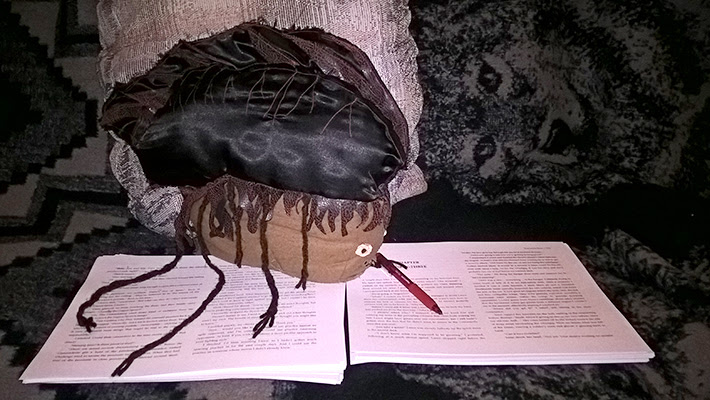
In the meantime… here’s a throwback to when my Legion Spore plushie got to help out with the proofreading:

A plushie Legion Spore sits atop a printed manuscript with a red pen

Isn’t it adorable? (Well, as adorable as living airships made from shapeshifters go). Isaac made it for me for Christmas a few years back.

Actually, I also made him a Legion Spore plushie (we both had the same idea), but let’s just say that the one he made better matched the first Legion Spore, and the one I made closer resembled the Manticore. We had a productive discussion after that regarding the differences between how we saw the living airship of The Glitch Saga.

Needless to say, the Legion Spores you see in the books have been refined a bit.

Or a lot.

And that’s another reason that proofreading… and read-alouds… and beta-reading… is important!

* * *

Read a few polished books that I at some point had to proofread or edit…

* * *

Happy reading and writing!
Leave a comment

Filed under Writing

Thoughts on Writing – Proofreading as a Reader

If you read my previous post, you know that I recently got in my paperback proof copy of Magic’s Stealing in the mail. My main goal was to make sure the formatting was correct, so I debated whether or not to correct typos, and then order a new proof (the answer is now ‘yes’), or to leave it be and not risk messing up the formatting.

But my concern was that trying to save money by not ordering a second proof would cost sales in the long run. (Read this BookBaby blog post for more about saving now costing more in the long run… though my main take from this was not to order a bunch of books before you’ve had someone else look at it).

Having found a couple of particularly stubborn errors in the paperback copy, I’ve decided that fixing those typos now, and then ordering a new copy, would be my best bet. That way I can put my best work forward (I’ll update the ebook versions once this is finalized) before purchasing a large number of books to hand-sell or giveaway. By ordering a new proof once I make the changes, I can also make sure I didn’t mess up the formatting.

The question is, what types of changes should I make?

There are two sorts of “errors” I’ve caught thus far: typos (for example, ones’ self instead of oneself, or “That’s the only string magic visible to a ribbon mages…” plural vs singular issue), and style choices (for example, whether or not to combine two paragraphs instead of leaving them separate).

For the most part, style issues will remain the same. Grammatically, they are correct, and that’s just me being picky. (Read this Fiction University blog post for ideas about when to stop revising).

However, typos will be corrected (the ones I find, anyway).

But why is it that, when we read our work with a fine-tooth proofer’s eye, we still miss things?

Why is it that even traditionally published books, with a lot of backing to their names, still have typos, when they have the funding to hire professional editors?

Part of the problem is that we know our work, so we know what it should say.

Even when reading aloud, or printing off a manuscript and scrutinizing it sentence-by-sentence, we’re going to miss some of these typos. We automatically correct them. Even proofers and editors will occasionally lapse and miss something, especially if they’ve been looking at the manuscript for a while (one editor I know said they limit the number of words they’ll read in a manuscript per day in order to avoid this problem).

Inevitably, however, we get our books printed, read through them later, and there it is… a giant, glaring typo.

Why do we see them now?

Well, one factor is time. With more distance from our work, we’re more likely to forget what we intended, so it’s “new” again. (This is why you see all those suggestions about waiting a few weeks or months between major edits).

Another factor is that you may have made an edit in the previous version of the book to correct a different typo, but in doing so, you accidentally hit a backspace key or inserted an extra letter, or you didn’t read the sentence fully after making adjustments. Whatever the problem, the previous edit created a new typo, which then was not proofed.

The final factor that I’ve been considering is perspective.

I went in trying to read the paperback proof of Magic’s Stealing as a reader–that is, I had no intentions of making edits. I wanted to try to enjoy the book as a reader, only noting typos if I saw them. I mean, that’s part of the reason we want to write, isn’t it? So that we can one day enjoy the fruits of our labor and read the book like a reader would? (Or maybe that’s just me).

Point is, when you read your manuscript in a format that is  the final format, and you read it as a reader, with no intention to edit, you’re likely to catch new typos. Your eye lingers just a bit longer on that odd word, because something threw you out of the story, which you were enjoying for story’s sake.

But that’s just a theory. A I’ve-been-watching-too-much-Game Theorists-theory (If you want to see video and computer game plots picked apart, this is a pretty good Youtube series. So is Film Theorists, but for movies and TV shows.)

Now, I’ve got to get back to editing The Multiverse Chronicles and proofreading Magic’s Stealing for typos.

I hope you’ve enjoyed this post. 🙂 Have you found any tricks for catching typos before you release your stories or send them to an agent?

Leave a comment

Filed under Writing