Well, in previous years, there was National Novel Writing Month, or NaNoWriMo. Many a book was drafted in the span of a month, the goal being 50,000 words by the end of the month, or a short novel.
This comes to writing, on average, 1,667 words a day.
Some writers would front load their word count (I know one very fast typist who hit 25,000 words in a day… though this is not the norm). Others would make a last minute rush during Thanksgiving break to complete their book before midnight on the 30th. (I think my highest count was 12,000 words in one day because of this).
But, for 1,667 words a day, you can complete the rough draft of a short novel in one month.
Or make some really, really good progress on a longer novel.
Unfortunately, NaNoWriMo is no more (for a variety of issues I won’t go into here), but the desire for a community of writers encouraging each other to meet their word counts, competing with each other if that’s what makes them write best, and simply proving to themselves that they can finish a book, or that they can make progress on a book, even if they don’t reach the 50,000 word count… that remains.
And I’m thrilled that ProWritingAid (an editing app) has put together something akin to what NaNoWriMo used to be. (I believe AutoCrit has something similar, but I haven’t had a chance to explore it yet).
This new edition is not as fancy or as glorious as NaNoWriMo was in its hey-day, but it promises a lovely word count tracker and a few forums for community.
Let it be known that I’m finally going to finish Huntress #3.
(Seriously… after two drafts I wasn’t happy with, I am stoked to announce I have a full-blown outline/skeletal rough draft all ready to go that I’m super excited for.)
Let’s do this!
Are you doing Novel November this year, or something similar?
Let me know!
* * *
I wrote Huntress in two weeks, and I’m fairly certain I wrote Changeling as part of a NaNoWriMo challenge (whether Camp NaNo or November… I don’t remember).
Today, I want to talk about a power that doesn’t get a whole lot of visibility in the Distant Horizon series (yet), but has been seen in The Glitch Saga:
Laser eyes.
Laser eyes is what it sounds like… the ability to shoot lasers from your eyes. That being said… what kind of lasers is still in question.
At this point in the currently-published stories, they are mostly highly focused, high-powered beams of damaging light. There are still plenty of related possibilities which have yet to be explored.
And, while it’s the name of a pre-Camaraderie group (the LEU, or Laser Elementals United), this has yet to referenced in any of the currently published stories. They were a band of misfits who were open to all power users… though they didn’t tend to get along well with the Super Bureau (the superheroes of the superheroes vs villains era).
Once I eventually get a chance to revise Little One, we’ll see more about the LEU.
As for the dangers of laser eyes, Tim is all too familiar with them, as evidenced in a scene from Spirits of a Glitch:
The elevator dings and rumbles open to the final floor. I bolt for the hangar. I created a temporary lock on the life support systems in the area, but the heater hums too softly to be running at anything other than minimum capacity.
Another hack, and I skirt through the next two doors.
A red beam of light flashes beside me. My heart jumps to the back of my mouth. Heat scorches the wall. Multiple eyes form along the Manticore’s hull, pulsing with crimson energy. I duck behind the command console near the doors and plug my tablet into the mainframe port.
The Legion Spore (and the Manticore) use laser eyes as their primary weapon against other ships (except when dealing with a glitch). Hence why the Camaraderie is so intent on having power users with laser eyes among those who would make the merge into the monstrous contraption.
Still, little is known about how the power actually works. As mentioned in Distant Horizon:
“We should’ve brought Tim along,” Lance whispered. “He could’ve set them straight.”
I sighed. “I don’t think he knows any more than they do. Besides, we can’t go back in time—it’s not scientifically possible.”
I glowered in his general direction. “Powers do have a logical explanation. At least, some do. Some are weird. Like laser eyes. How can a person shoot lasers from their eyes? Wouldn’t that burn out their retinas?”
“You tell me. You’re the one reading Pops’ dissertation.”
Granted, it has been a couple decades since Pops wrote his dissertation, so more may be known than what the rebels have access to.
Regardless of its oddity (some powers, such as reality bending, laser eyes, and phase-through, do seem to bend the laws of physics), the Camaraderie of Evil likes to make use of the ability.
In fact, when Isaac and I first put together a list of powers for use in this universe, we created four categories: Mental, Reality Shift, Physical, and Elemental. Though we’ve changed the categories somewhat since we started writing this series, we’ve kept several of the powers that fell into the reality shift section.
Among those powers are fourthwalling (later split into reality bending and insight… with “fourthwallers” being related to a specific cult), flying, shapeshifting, phase-through, laser eyes, portal creation, power steal, luck/probability manipulation, alchemy, and invisibility.
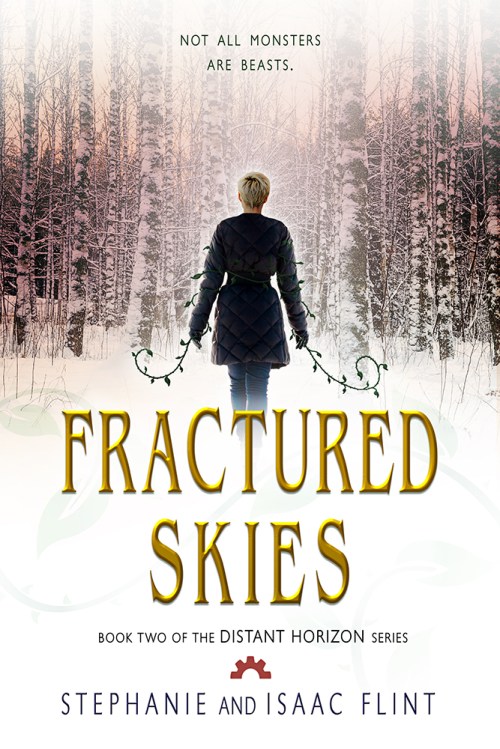
Fractured Skies delves a bit deeper into the insight power, alchemy, and briefly touches on probability manipulation. And Initiated goes full scale into reality bending. But, given time, you’ll eventually see all of them. We hope you stick around to see how it all plays out. 🙂
Here’s an example of laser eyes being used in a battle during Fractured Skies.
Lily pointed to a black helicopter coming in low. A vested, shadowy figure raised a rifle to its shoulder while another stood nearby, eyes glowing a faint red. “Heads down!” She and Quin dropped to their knees behind the boxes. Mom shrieked, covering her head with her arms while Dad threw himself over her. Inese ducked, but a blast of red light smacked her in the chest, sending her sprawling.
“Inese!” I crawled after her, but Quin grabbed my foot and yanked me back. A bullet ricocheted off the concrete where I would’ve been.
“Special Forces agents work together,” Quin said simply. “So should we.”
Eventually we’ll see even more cases of laser eyes in use. 👁️
* * *
Neither Jenna, nor Tim, are much a fan of laser eyes…
So far, Isaac and I have done all the photography for The Wishing Blade series covers. And when it came to the cover of Magebane, we’d been planning that cover for a while… even bought the candle holder specifically with the intention of shooting this image.
(It wasn’t entirely an excuse to buy more Depression era glass. Not at all… *Cough.*)
And though it’s been a while since we released Magebane, today I want to talk more about the glass on the cover.
True story… when first proofing the cover, I asked for feedback and someone said it seemed a little too radioactive green. Funny thing about that… That green was intentional, and they weren’t actually wrong.
That glow is the result of UV light shining on the glass and fluorescing with the uranium salts coloring the glass. I actually had to lower the amount of light coming from the candleholder while working on it in Photoshop.
Don’t believe me?
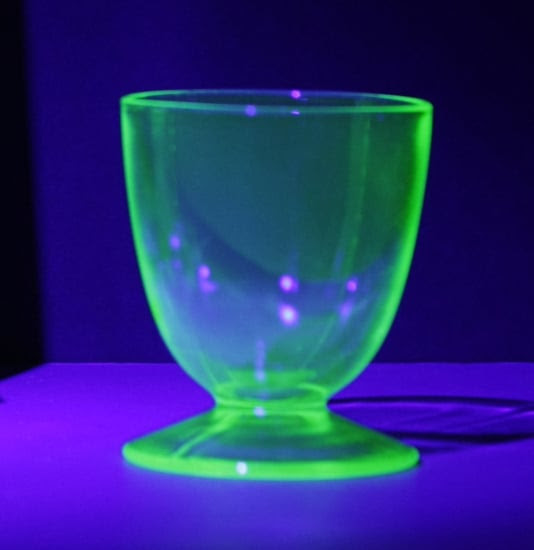
Here’s a look at an unedited photo from the photoshoot:
There’s a model lamp at the top providing a general light, but that purple light you see is from the UV light. The glass is Depression Era glass.
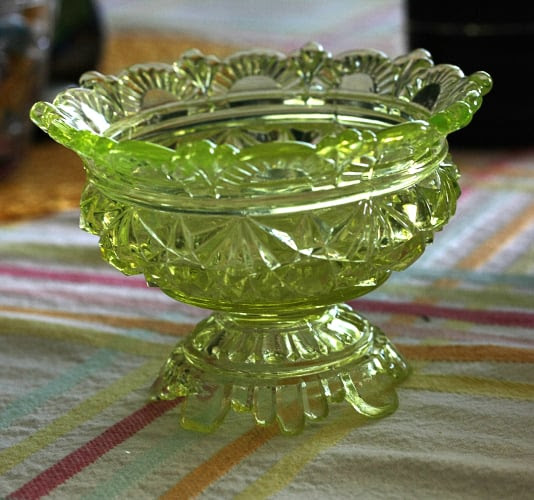
Here’s a look at the same glass but without the UV light.
We also shot a set of daisy button glass dishes we considered using (which I believe are actually Victorian era, rather than Depression era, based on their color and pattern), but decided to stick with the candle holder as the main image.
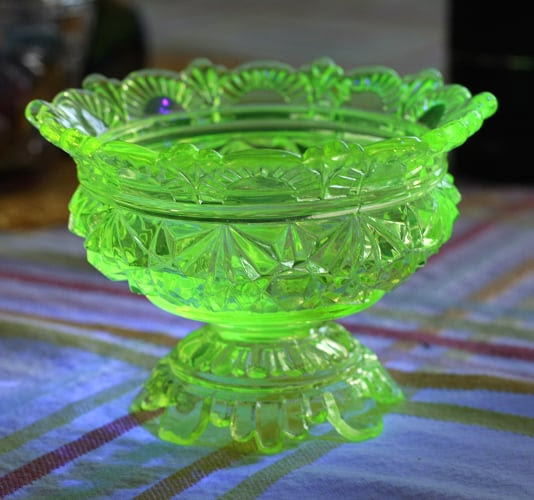
This one just has UV light on it, and no modeling lamp.
It glows hot. Which has been my experience with most yellow uranium glass that I’ve come across.
This, by the way, was with the cheapy UV light we bought at Walmart. Later, we acquired a more powerful UV light (different wavelength, better visible light filter), and these pieces were even brighter.
Now, let’s go into more detail about the real life inspiration for the story’s “magebane” / “charlago.”
The good news is that this glass is not as destructive as it is in the story.
However that “radioactive green” look might be a little more accurate than you first expect. Often known as “Depression Era glass,” these pieces are usually a kind of odd, Vaseline green or “canary yellow” color. You’ve probably seen them hiding in China cabinets or antique stores.
(Pictured Above: Green Depression Era Glass)
Usually, it doesn’t stand out. Some pieces are a little more flowery in their designs, but what makes them so special?
They glow under ultraviolet light (blacklight).
(Well… some do. The frustrating part of hunting for glowing Depression Era glass is that not all green or yellow glass glows. UV flashlights are useful for checking to see which pieces do and don’t. And just because it glows, doesn’t necessarily mean that’s it glowing for the reason I’ll explain in a moment. But when you find the piece that does… there’s the magical “ah-hah!” moment of success.)
See, here’s the thing. For a long time, glassmakers have been using uranium oxide to give glass a rich green or yellow color.
Yes, uranium.
The glass is technically radioactive.
However, according to most internet sources (take these with a grain of salt) and the mineralogist I asked, these glass pieces aren’t so radioactive as to be harmful, at least if you’re not constantly handling them, ingesting pieces of glass (you shouldn’t do that anyway), or messing around with them aside from using them as pretty decoration.
(I would like to add here that I am not an expert in radiation, and I have not actually tested these pieces with a Geiger counter. Please don’t go out and do something that’s going to give you radiation poisoning. There are some antiques that actually do have harmful amounts of radioactive material in them. Stuff with radium, for example. And certain orange or red Fiestaware ceramics from before a certain year. Both are details I play with in Magebane.)
So, that “radioactive green” glow?
Well, it does contain radioactive material.
At the same time, the term is a little misleading because the UV light causes the uranium within the glass to fluoresce, not because it gives off its own creepy light due to nuclear radiation.
You can find a lot of Depression Era glass in antique stores because it was popular during the Depression due to being inexpensive. Though a ban was plaed on putting uranium in the glass during World War II, the process was allowed again later (using depleted uranium), which means that not all uranium glass is Depression glass. Some pieces are replicas and are much more recent.
(In some cases, you can tell when it was made based on the specific markings added by the manufacturer).
However, some pieces are even older than the Depression:
(Pictured above: Canary Yellow Daisy Button Sauce Dish, circa 1880s.Though this is uranium glass, this isn’t actually Depression glass.)
Uranium glass was also made in the late 1800s, meaning that you could find it in the Victorian era. (I was rather thrilled to have ended up finding a piece that, based on its pattern, Isaac and I are pretty sure is from that time frame).
As for the story…
This means that Maijev — that mage-hating place that’s supposed to be pulling from Industrial Revolution and Victorian era tendencies (yes, I know, I’m blending time periods) — could have uranium glass.
And, in the world of The Wishing Blade, ribbon magic and nuclear radiation (even trace amounts) don’t mix well. (Unless you like world-unraveling explosions).
Hence… magebane!
Now that you’ve read about real-life uranium glass, here’s an excerpt from Magebane, a scene in which Siklana gets her first look at charlago glass. 🙂
Unlike real life, though, “Depression era” glass isn’t inexpensive in Cirena… it’s coveted, largely because of its tendencies to ward away mages.
Ruderk examined Siklana soundlessly, then moved to the stove where a tea kettle warmed. “Tea?” He held up the kettle and a green glass cup, paused, and then extracted a different cup. “I’d offer you the finer glassware, but you said you were a mage, didn’t you? I’m not sure how much residual magic might stick around, and I don’t want you getting sick.”
She blinked. “You have charlago glassware? May I see it?”
He shrugged. “Long as you don’t go throwing ribbons at it. One wound a day is plenty enough for me.” He passed over the green cup.
She flinched at the hint of a sting when it touched her skin, and she kept her navy ribbons deep inside herself, where they could not reach the glass. While Ruderk poured them each a cup of tea, she turned the piece in her hands. It was smooth and plain, with a pair of seam lines on either side from the mold, and a simple round base to keep it upright. She sorely wished she had her light crystal with her. Though she could not let the ribbons come into direct contact with the glassware, the light the crystal produced was not magical, and Camir had said kosa light would cause certain forms of charlago to glow.
“It’s beautiful.” She handed back the glassware, and Ruderk exchanged her offering with a steaming, white ceramic cup.
“You should see some of the more meticulous pieces,” he said. “Far more than I can afford, but they have a pretty selection of flowers and patterns to choose from.” He sat himself across the table from her, then reached behind him, snagged a tin, and dropped it onto the table with a clatter. “Biscuits. Help yourself. I made them this morning, so they shouldn’t be too stale.”
There are a bunch of powers in the Distant Horizon universe, from Tim’s techno sight ability to mentally connect with computers to Jenna’s elemental ability to manipulate plant growth and use super speed. Previously, I’ve talked about the life-spirit power and it’s ability to save or suspend lives.
Today, let’s talk about telepathy.
There are several uses for telepathy, including the common ability to read minds and broadcast thoughts for communication, to the more obscure abilities of possession, and even more skilled (albeit nefarious) trick of planting specific memories in a target’s thoughts.
It’s the latter I want to focus on today. Tim got a taste of this in The Glitch Saga.
But Jenna… she deals a lot with the finer troubles of telepathy. While she’s not a telepath herself, a certain notorious Lady Winters leaves a set of memory seeds in Jenna’s head—seeds which, over time, attack her mind with false memories and nightmares meant to leave her more susceptible to future telepathic attacks. The primary seed she has to deal with in Distant Horizon is of beastie transformation, which proves burdensome while she’s trying to search a beastie plant.
Here’s an excerpt from Distant Horizon:
The winding corridor opened to rows upon rows of floor-to-ceiling tanks, each filled with thick, greenish fluid. Bubbles traveled up the tubes, passing over occupants who had been stripped of everything but a breath mask. A helpless, sickening sensation spread through me. I stared at the liquid, petrified.
Lady Winters dragged me into a tube and shoved me inside, the numbing liquid surrounding me, slick against my skin. Burning.
I needed to escape, to breathe, to run—
“Let’s not open these doors, ‘kay?” Jack said, jarring me from my nightmare. I glared at him, but for once, I didn’t mind his sarcasm. Lady Winters had taken joy in giving me that memory. Her identity charm rustled against the fabric of my shirt.
“Isn’t there some way we can help them?” I asked.
“By the time they’re here, it’s too late.” Inese motioned to the tanks around us.
I closed my hands into fists. Lance pushed me forward, and as we passed the tanks, one of the occupants woke. Bubbles erupted around her mask. Her eyes bulged, terrified. She pounded her fists on the glass.
Lance stepped back, despite all his show for strength, but I saw my reflection. It placed me in that tube—in that thick, unknown liquid with its sense of helplessness…
I flinched and turned away. I was betraying the people who were imprisoned here, but every time I looked at them, I was the prisoner.
A memory seed tends to use some sort of outside world trigger (in this case, the beastie tanks), to activate a pre-planted memory. In some cases, the victim will be aware they’re the target of an attack, and in some cases they’ll simply react without knowing why. In other cases, the victim is trapped in the memory, only aware of of what the memory is showing them.
The more skilled the telepath, the harder it is to remove these seeds. Unfortunately for Jenna, Lady Winters is one of the most skilled telepaths within the Camaraderie. And, unfortunately, the memory seeds makes it a tad difficult for her to do research that the rebels need in order to combat the Camaraderie.
Here’s a look at one such scene in Fractured Skies.
I huddled under a mass of vines, Tim’s tablet in my lap. All the lights were on, and I’d made sure the flower charm was nestled firmly against my skin. There was a good chance the charm was the only thing that was going to keep me from having a memory attack. I pressed the icon on the tablet for the Legion Spore folder. A list of files popped up. Some of the documents contained lines of code—gibberish I had no hope of understanding. But some of the documents looked promising, more like a research paper.
Biology—a science I understood.
My heart pulsed in my wrists, warning me this was a bad idea. But if I wanted control of my memories, I had to understand what the Legion Spore was and what it could do.
I opened the first document:
The Legion Spore is an experimental project requiring beasts and power users to be merged with a computer AI to form a single entity of enormous capability and power. To do this, the Legion Spore utilizesa hub system. This system consists of both beasts and power users, each assigned to use their powers for specific tasks while being linked to a single mainframe.
That must have been why I heard multiple voices when the Legion Spore spoke, why it sounded like a discordant chorus. If everyone was trying to think at once, with so many voices crying in pain…
The tablet shook in my fingers.
I could do this. I could read a simple research paper without freaking out because of some stupid thoughts in my head.
For mobility, the Legion Spore flies by utilizing a combination of air and fire elementals who provide the upper membrane with hot gas. In order to conserve space, the air sacs may be deflated while inside a hangar. The hull of the ship, including the membrane, is formed from the bodies of shapeshifters.
I stared at the words. I’d seen all of this before. Not personally, but I’d seen what Lady Winters showed me in the memory attacks. The shapeshifters had been tied to the outer steel frame, a grid of interlinked metal that created the skeleton of the hull. The other beasties and humans were forced to kneel inside a tower of cages. Though the structure was metal, it was mostly empty space and not much bigger than a cargo-hold. Wires ran around their skulls and across their bodies, and into glass tubes between them…
Cold sweat poured down my back.
Dear Community, how could anyone have supported this project?
The vessel is mostly organic, and entirely self-sustaining. Like the Portuguese Man O’ War that it was designed to resemble, the Legion Spore ensnares its prey with long tentacles, targeting organic matter and devouring it through the use of various acidic agents. This may prove doubly useful in battle, as the Legion Spore can feed itself while targeting enemy combatants.
The Legion Spore ate people?
The room wavered in the corners of my vision. My stomach revolted. I closed my eyes and took quick, shallow breaths. I needed a drink of water—
I needed to get through this document first. This was a short one. The more I understood, the better off I’d be against the Legion Spore next time.
Even if the ship did eat its enemies.
Once its prey is devoured, the nutrients go to the Legion Spore’s nutrient tanks. These tanks feed into the hull of the ship, which mimics the flesh and muscle of various warm-blooded creatures—
The fleshy hull stretched out before me, veins pulsing underneath its skin. A sour odor drifted to my nose, but when I tried to wipe it away, a thin tentacle caught my hand.
Thud-thump.
A heart was beating.
Thud-thump. Thud-thump. Thud-thump.
My heart pounded, each thump growing louder as other beating hearts joined in.
A column of thinly covered muscle rose above me as the tentacle dragged me toward a seething, bleeding organ. I couldn’t let it take me! I yanked my hand from the tentacle and fled to a small door at the end of the vessel. A sticky hand grabbed my ankle. I careened to the ground. Airy whispers filled my head, vying for attention. My eyes were dry from the heat of the ship. I was on the top level, next to the air sac. Hot air swirled above me. Their murmurs tickled my ear.
We are legion…
No—I couldn’t let it catch me—couldn’t let it trick me into revealing the location of the Coalition. I pounded on its walls. I had to get out—
Needless to say, Jenna is ready to put a stop to the memory seeds’ attacks, and much of Fractured Skies revolves around her searching for a solution to the problem of those seeds.
Eventually we get to Starless Night, where, without giving too many spoiler, Jenna discovers that the memory seed is a lot more involved than she first thought, and considerably more dangerous. Because, what might happen if a telepath leaves more of themselves in a seed than anyone realizes?
* * *
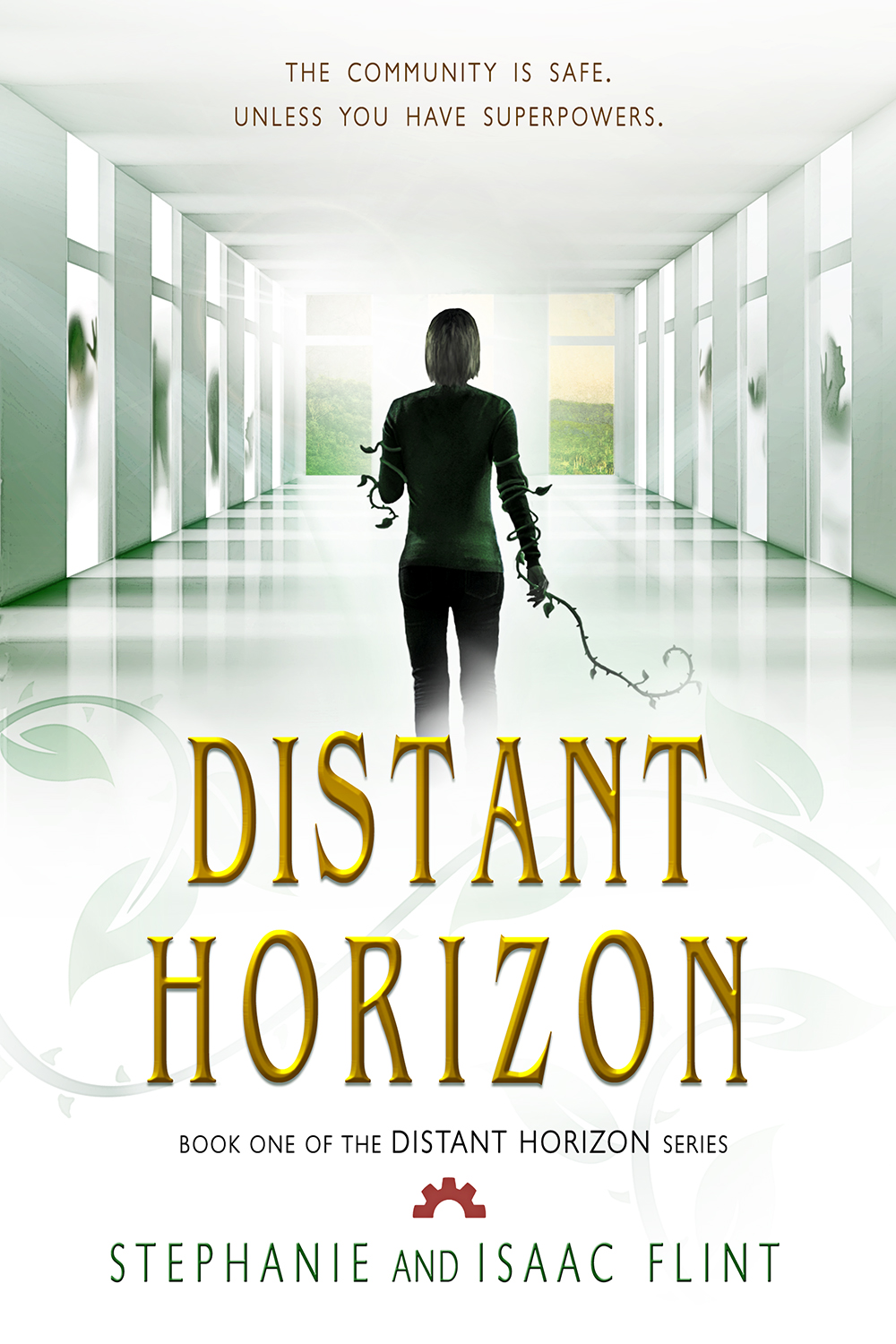
Join Jenna’s fight with memory seeds in the Distant Horizon series!
Enjoy the magic and world-building of the Wishing Blade universe?
You might find some new books to read here!
*
(Note: The giveaways above are hosted through BookFunnel. Authors will usually ask for your email address, and in many cases, the author will collect these addresses for their newsletters.)
So… you read a book you really enjoyed. You tell all your friends (yay!) and if you’re a librarian, eagerly await a patron asking for book recommendations because now you can tell them about this underrated book (have I done this? Yes. Now go read City of Nightmares by Rebecca Schaeffer. It’s a city where you don’t want to go to sleep because if you do, you might turn into your worst nightmare. Art deco vibes. A man-eating pterodactyl. And a main character who’s a coward, but there’s a very important plot reason for that and she’s a fun coward, okay? Go read it.)
But do you want to make an author even happier?
Leave us a quick book review!
Here’s why!
Social proof. Long story short, when other readers see people commenting on a book, they get curious. And those readers might see if those reviews mention anything that catches their interest (or makes them give a big old “NOPE” and bypass the book completely. This is why even negative reviews are important. You might not like that the big twist is that the main character is actually an alien, but I do and now that I know that twist is there, I’m going to snatch up the book because I want to see how well it was foreshadowed. For the record, I thought the author did well. (Click here if you want to know which book I’m referring to. Not naming it directly because yeah… spoilers.)
Stoke the author’s ego and let them know someone connected with their writing. Not even going to hide this one. I love reading reviews because I want to see what you got of the story. It’s awesome when you see something I hoped you would, and also awesome when you make connections that I didn’t realize I’d put in there. Granted, if it’s a negative review, it’s not so awesome… but it means you did take the time to read my book, so that’s cool. And also, see “Social proof” above.
Encourages the author to write more in the series. Or finish it faster. Nothing says “I should prioritize finishing this series” than a lot of book reviews. Especially because book reviews tend to be considerably more rare than sales or downloads. AND if you say what you enjoyed or wanted to see, there’s a chance the author is going to keep that in mind for future books.
Okay, so now you know why authors want you to leave a book review, let’s do a quick how.
There’s no one way to write a review. Some are really long and super detailed. Others are only a couple sentences. Either is great! Don’t sweat it. This isn’t supposed to be a chore.
But, things to keep in mind…
Please don’t list major spoilers without a spoiler warning! Give other readers a chance to be surprised.
Do say what you enjoyed! While this can be an essay (I’m certainly not going to protest), even a couple sentences is super helpful. Who was your favorite character? Why? Did you like the world-building? Was the prose fun to read? Was it a page-turner? Did you want to scream and throw the book across the room because the author ended it on a major cliffhanger and you wanted to know what happens next as of yesterday? Choose at least one, write a sentence or two, and you have the basics of a review!
Feel free to say what you didn’t like. These reviews need to be honest, after all, and as I mentioned earlier, what might not be your cup of tea might be someone else’s, so this is still really helpful. Though… if you want to be nice to the author, maybe sandwich this with something the author did well?
Now… where should you share your review?
Some of the most popular places are going to be directly with the online retailer. Amazon, Kobo, Barnes & Noble, Apple Books, Google Play… those are all really helpful for the author, because you’re going right to where readers are looking to buy more books.
Goodreads is another good one, since it’s meant for book reviews, as are apps like StoryGraph.
But you can also share your review on your own blog or social media.
You don’t have to overthink this. Now, get out there and write a review!
* * *
Want to leave a review on one of my books? Here’s a couple free first-in-series you could start with…
There are a bunch of powers in the Distant Horizon Universe, and at some point I’ll go into detail about all 40-something powers that Isaac and I listed for use in the original role-playing campaign that we played, with each power divided between one of four categories: Mental, Physical, Reality Shift, and Elemental.
Today I want to focus on the “elemental” category, and in specific, the “life-spirit” power.
The life part is easy. A life-spirit elemental typically has healing abilities and can sense the presence of living beings around them.
Here’s an example from Distant Horizon, with a character who uses a combination of healing and telepathy to do her work (slightly edited to avoid spoilers):
I rested my elbow on my knee as Gwen moved to treating Lance. It’ll be okay, I wanted to tell him, but I couldn’t. I didn’t know how much this elderly woman could help us.
Over the next half hour, the bruises cleared from Lance’s face and the deep scratches turned to faint scars. Finally, Gwen leaned against the wall and rubbed her eyes.
Lance rotated his shoulder as if he’d never been wounded. “What’d’ya do?”
“My power is in healing: the ability to save or suspend lives.” She rubbed her forehead gingerly, then looked at me. “It’s your turn. I won’t go deep in your thoughts; I just use telepathy to find the damage.”
I swallowed hard, then felt something else—be there. She was present, searching across my mind, but she wasn’t intrusive. Each memory was tucked away, as if it’d come unbidden, and her presence was friendly. When she did find pain, the memory flashed to the surface and vanished as quickly.
I tried to focus on memories I didn’t mind her seeing, drowsy as she soothed the grazed shoulder and eased the bruises.
However, when it comes to the “spirit” side, that’s when the details get trickier. Life-spirit elementals can “suspend” lives, partially removing a person’s spirit and causing them to go unconscious, or even remove a person’s spirit completely, killing them in the process.
An example from Whispers in the Code:
“Have the Legion Spore remove her spirit,” Commander Rick says, “then dispose of the corpse.”
My throat constricts. I know that it isn’t practical to keep the scout around, but there’s still something unsettling about the idea of having just been in the mind of someone about to die. “Dispose?”
“The Legion Spore needs nutrients and, this way, there will be no evidence for the Oriental Alliance to find,” Commander Rick explains.
What he leaves unspoken sends shivers down my neck. “You want it” —I swallow hard— “to eat her?”
Commander Rick glances at me, and his cocked eyebrows indicates that he understands I’m not ready to give that command. I know he’s right. The process is efficient, but the idea doesn’t settle in my stomach.
Legion Spore, remove her spirit, he sends.
Her head lolls. I detect one less presence of life through the vessel’s scanners.
Legion Spore—consume the remaining body for sustaining nutrients.
Dozens of tiny, translucent tendrils extend from the ivory floor, wrapping around her body. They flatten against her arms and chest and her skin dissolves, revealing the muscle and bone beneath. The body melts away. I force myself to watch, despite the terror creeping through every pore of my skin.
Within a minute, she’s gone.
On the farthest extreme, a life-spirit elemental can bind their spirit (or someone else’s) to an artifact, separate from a body, and thus allow a person to live on as a spirit, rather than die. It’s a tricky process, and not easily achieved.
But a few notorious figures have succeeded. Benjamin (the enthusiastic alchemist we see in the Glitch saga, and who has a cameo in Distant Horizon) is one such spirit.
Another scene from Whispers in the Code (again, slightly edited to avoid spoilers):
Benjamin’s sharp features glow a faint blue. His crisp sleeves are rolled past his elbows, and he wears a work apron over his shirt. His pockets are filled with small tools that may or may not be apparition. He’s odd like that. Sometimes he only manifests the appearance of a craftsman, while at other times, the tools are actually present.
Most noticeable, however, are his wire frame spectacles, green eyes, and his spiky, dark red hair, their colors prominent even with the lack of color across the rest of his translucent body. He’s also got a slightly mad gleam in his eye, though my encounters with the man suggest he’s mostly sane.
Benjamin grins and soundlessly claps his hands. Wonderful! Shall I take amber or emerald? His thoughts echo in my head with the determined curiosity that his voice might have held in life.
The upside of being a spirit is having additional powers. Once a person becomes a spirit, they automatically gain access to telepathy, life-spirit powers (because that’s how they sustain themselves), telekinesis, and to some extent, enhanced insight. However, it still takes them time for them to learn how to use their new powers to interact with the world, and even to manifest, unless they’ve had practice with such powers in their former life.
There are a few downsides to being a spirit, though.
First, they’re attached to an artifact. If their artifact gets destroyed, they die. Also, radiation, life-spirit powers, and electricity become much more damaging. “Shielding,” which temporarily shuts down powers, is especially devastating, since a spirit can’t manifest without access to their powers.
Still, it’s a trade-off some characters are willing to take, and one we see to an extent in Fractured Skies, and definitely becomes more of an issue in the Starless Night.
What do you think? Would you want to be a life-spirit elemental in that universe?
(Bonus: Life-spirit elementals also tend to have a natural bonus against telepaths and those with enhanced charisma!)
* * *
Life-spirit powers play a huge role in the Distant Horizon and Glitch series.
And if you don’t mind diving right into the action, Whispers in the Code is free at most online ebook retailers!
I enjoy creating the language of word magic and the Cantingen Islands in my Wishing Blade Universe. So much so that I have a handy Excel sheet with a handful of pages and a semi-clear structure that I’ve realized I really need to get organized (because it’s rather… fun… trying to remember sentence structure when I’m in the middle of revising my current project, The Dark Forest of Aneth, and need to construct a sentence in Cantingen and don’t remember if I’ve decided how that particular grammar is supposed to look.)
One exercise I’ve especially enjoyed, however, is the creation of poetry and songs using the conlang (constructed language). Whether or not I’m actually good at poetry is an entirely different matter, but it’s still fun.
Wind and Words, the second book in the Stone and String series, features two different poems/songs (well, one is intended to be a chant), and one of those songs is called “Dornoram” (“Lonely Child”) and features Madia when she was still a young goddess, before she created mortal-kind.
Though I don’t include the entire song in the story itself (I did include both the Cantingen version and the rough English translation in the back of the book), here’s a look at part of the song:
Dornoram, dornoram Lonely child, lonely child
illselvimorin sut wuget so vinllada’ralencos. wandering in the fog of her father’s new world.
Dornoram, dornoram Lonely child, lonely child
fallamin kidame nevésil vego cochome si kecirme. She has no toys to play with but feathers and strings.
*
Viskar vrethin si walin So she sits and she weaves
drogos osain vieram jévidasil. while she yearns for a playmate that she understands.
Vego éda ralencos dratethia shadi si fashuvasia. But this new world is magic and does not comprehend.
*
Dor so shadi si niitéra Child of magic and creation,
morladiin vieram. she dreams of a playmate,
Morladiin vieram néollased. dreams of a playmate to keep company.
Viskar novanin vincede loch lalli esil, esildo. So she weaves her hair into the form of a doll, little doll.
Morladiin kryl vinvieram llullamia. Dreams of the story her playmate might have.
Vego esil dratethia goréso, But the doll is a puppet,
fallamia kareme, has no thoughts of its own,
si luuh vinmorladsme ketondruv nékryl. and only her dreams give it life.
Essentially, the Cantingen Islanders believe they are Madia’s esilme, her dolls, who return to her from the mortal realm after they die. The rest of the song continues that story, and the idea plays an important role in the Stone and String series.
Do you enjoy seeing fictional languages in stories?
If so, what’s your favorite one? (I’m personally a fan of Tolkien’s Sindarin Elvish, though I never learned more than a few words).
📚 There are many subscription options available in the reading/publishing world. Here, I’m going to briefly talk about two of them… Kindle Unlimited, and Kobo Plus.
The most well-known one is probably Amazon’s Kindle Unlimited (KU). A huge selection of books for $12.00. If you’re on a budget and don’t have access to a large local library selection (or want niche books that are harder to get through libraries), then Kindle Unlimited can seem like a pretty good deal.
However, for authors, it comes with a catch.
The biggest one is that any ebooks in KU (at least for independent publishers) must be exclusive to KU during the 90 day period that they’re enrolled (or longer, if the author chooses to extend the contract).
That said, very recently, Amazon has moved to allow KU books to be made available for public libraries, which is a huge win for both authors and readers. (Previously, you most likely wanted your books in Kobo’s Overdrive if you wanted library reach).
I’ve used Kindle Unlimited before, both for Glitch and for Huntress, but I ultimately chose to pull our books from KU because I’m really not a fan of exclusivity, or of the issue of “having all my eggs in one basket.”
While I haven’t, as a reader, used it for myself, Isaac did use the monthly Kobo audiobook credit subscription for a while, which was quite nice.
Now, as a writer I like Kobo Plus, because it offers an inexpensive way for readers to access my books ($7.99 a month) without requiring me to be exclusive with Kobo.
Woot!
So, if you read a lot of books and want to try a subscription service, have a look at Kobo Plus. 😁
If you enjoy the worldbuilding and magic/power system of the Distant Horizon universe, you might enjoy these books!
(Note: The giveaways above are hosted through BookFunnel. Authors will usually ask for your email address, and in many cases, the author will collect these addresses for their newsletters.)







 Stephanie Flint - Author and Artist